
What Is Algorithmic Trading for Beginners? The 2026 Guide to Automated Investing
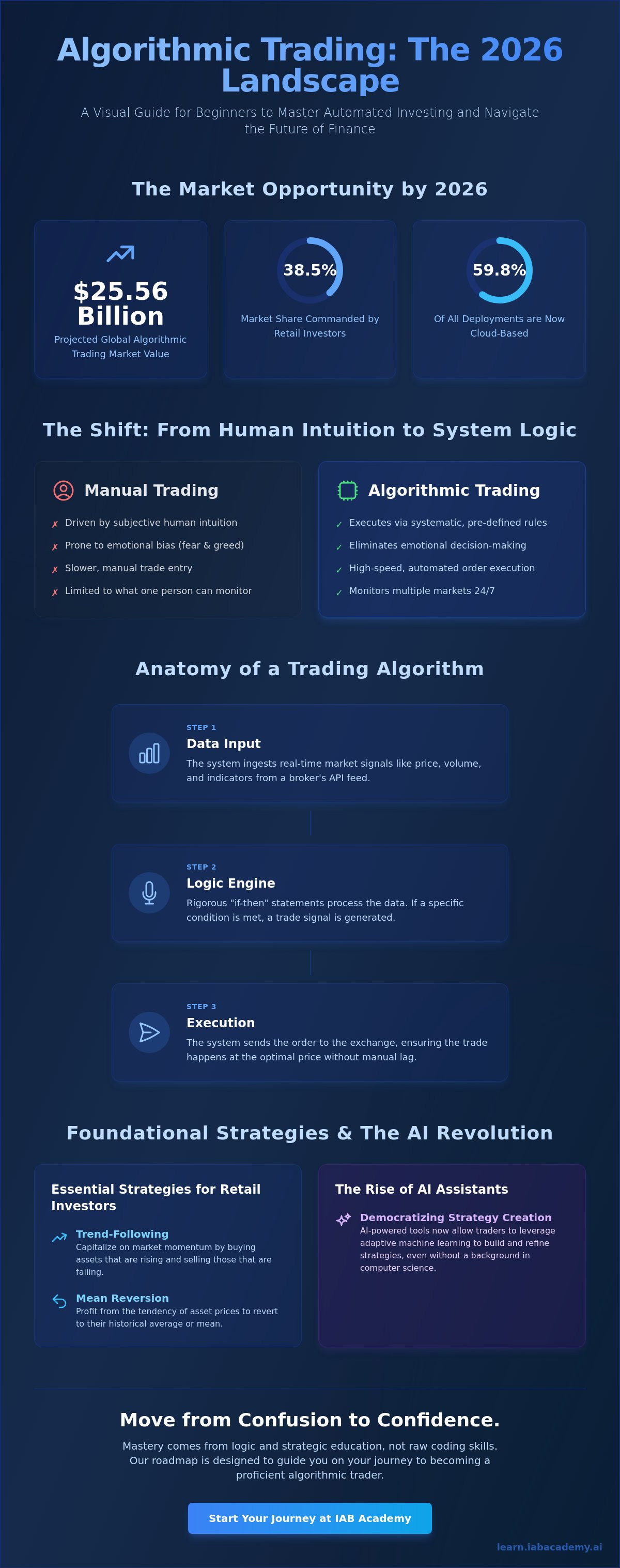
By the end of 2026, retail investors are projected to command 38.5% of a global algorithmic trading market valued at 25.56 billion dollars. This shift signals that understanding what is algorithmic trading for beginners is no longer a niche pursuit for software engineers, but a core competency for any serious professional. You've likely hesitated to start because the technical barriers seem insurmountable or you fear losing capital to a black box error you don't understand. It's a valid concern in an ecosystem where 59.8% of deployment is now cloud-based and increasingly complex.
We'll bridge that gap by showing you that mastery comes from logic and strategic education rather than raw coding skills. You'll learn how to leverage AI-powered assistants and navigate the 2026 regulatory landscape, including the mandatory Algo-ID systems and the EU AI Act. This guide provides the definitive roadmap to move from confusion to confidence. We will break down execution algorithms like VWAP and TWAP so you can future-proof your portfolio with the same discipline used by global institutions.
Key Takeaways
- Understand what is algorithmic trading for beginners by transitioning from subjective human intuition to systematic, rules-based execution within the modern financial ecosystem.
- Demystify the "black box" of automated investing by learning how real-time market data feeds trigger precise trade responses without emotional interference.
- Master foundational strategies such as Trend-Following and Mean Reversion to capitalize on market momentum and historical price averages with professional accuracy.
- Discover how AI-powered trading assistants are democratizing strategy creation, allowing you to leverage adaptive machine learning without a background in computer science.
- Establish a roadmap for educational mastery that prioritizes understanding market logic and risk management before deploying sophisticated automation tools.
Defining Algorithmic Trading in the 2026 Digital Ecosystem
In the 2026 digital ecosystem, Algorithmic Trading is defined as the automated execution of financial orders through pre-defined instructions. It represents a fundamental shift from human intuition to systematic, rules-based precision. For many, understanding what is algorithmic trading for beginners involves moving past the myth of the "magic button" toward a disciplined mastery of market logic. While institutional High-Frequency Trading (HFT) relies on multi-million dollar infrastructure to capture micro-second price gaps, retail algorithmic strategies focus on the consistent execution of proven models. This proficiency has become the new benchmark for modern finance literacy, as the global market is projected to reach 25.56 billion dollars by the end of 2026.
The Core Components: Logic, Data, and Execution
The architecture of an automated system rests on three distinct pillars. First, Data Input involves the ingestion of real-time market signals, such as price action, volume, or sentiment indicators, often delivered via a broker’s API. Second, the Logic Engine processes these signals through rigorous "if-then" statements. For instance, if a specific technical indicator hits a threshold, a buy or sell signal is generated. Finally, Execution occurs when the system sends the order to the exchange. This process ensures the trade happens at the optimal price without the lag associated with manual entry. By 2026, the retail segment is expected to hold 38.5% of the algorithmic market, proving that these technical components are now accessible to non-institutional traders.
Why Beginners are Turning to Automation
Retail investors are increasingly adopting automation to eliminate emotional bias. Fear and greed often lead to poor decision-making; however, an algorithm follows its protocol regardless of market volatility. In a global ecosystem where markets operate 24/7, the necessity of speed is paramount. Humans can't monitor multiple asset classes across different time zones simultaneously, but automation can. Additionally, backtesting allows traders to prove a strategy's viability using historical data before risking actual capital. By simulating performance against past market cycles, you gain statistical confidence in your approach. Understanding what is algorithmic trading for beginners starts with this transition from guesswork to data-backed certainty. It's about building a reliable framework that functions with professional precision, ensuring your strategy remains resilient in an increasingly automated world.
The Anatomy of an Algorithm: How Automated Execution Works
Understanding the internal mechanics of a trading system is the first step in moving beyond the "black box" mentality. While complex algorithms can appear opaque, they are fundamentally composed of transparent, logical sequences that anyone can learn. When exploring what is algorithmic trading for beginners, you must recognize that these systems rely on high-fidelity market data feeds to trigger specific actions. These feeds provide the raw numerical inputs that your logic interprets. To interact with the stock market, your strategy requires a stable, high-speed bridge to an exchange. Latency is the time delay between a market signal and the actual execution of a trade; even millisecond differences can erode profit margins in volatile environments. According to FINRA on algorithmic trading, maintaining rigorous oversight and hard-coded risk management is essential to ensure these systems operate within professional safety parameters.
Technical Requirements for the Modern Trader
Modern execution has moved away from local hardware toward sophisticated cloud-based environments. In 2026, the cloud-based deployment segment accounts for 59.8% of the market because it offers superior uptime and lower latency than traditional home setups. Application Programming Interfaces (APIs) act as the vital messenger between your strategy software and the broker's execution engine. Without a robust API, your logic remains isolated from the liquidity of the exchange. Professional-grade systems also include hard-coded risk management limits. These safeguards act as a "kill switch," automatically halting activity if a specific loss threshold is reached or if market conditions become too volatile. Developing this technical foundation is a core part of mastering your financial education.
The Importance of Backtesting and Simulation
Before deploying capital, you must validate your logic through a process called backtesting. This involves running your algorithm against "In-Sample" data to refine your rules, followed by a verification against "Out-of-Sample" data to see how the strategy performs on previously unseen market conditions. A common pitfall for novices is "Overfitting," where a strategy is so finely tuned to past data that it fails to adapt to real-time market shifts. Effective simulation ensures that your model possesses genuine predictive power rather than just being a historical coincidence. Paper trading, which involves simulated live trading, serves as the final instructional phase. It allows you to observe how your algorithm handles live data feeds and API connectivity without any financial risk, providing the confidence needed for live deployment.
Essential Algorithmic Strategies for Retail Investors
Selecting the right methodology is a critical step for anyone learning what is algorithmic trading for beginners. While the technical anatomy of a system provides the "how," strategies provide the "why." Mean Reversion is a primary strategy used by retail traders; it operates on the "rubber band" theory, which posits that asset prices will eventually return to their historical average after a period of extreme movement. Another essential application is Portfolio Rebalancing. This involves automating the maintenance of your target asset allocation, ensuring your risk profile remains consistent without manual intervention. In the 2026 market, Sentiment Analysis has also gained prominence. This strategy uses AI to scan news and social media for market-moving triggers, allowing algorithms to react to public perception faster than any human could. Gaining a comprehensive Understanding the Basics of Algorithmic Trading is essential before committing capital to these specific models.
Trend-Following: The Professional Standard
Trend-following remains the bedrock of systematic investing. It focuses on capitalizing on sustained momentum by identifying moving average crossovers, such as the 50-day line crossing above the 200-day line. By automating these entry and exit points, you remove the psychological hesitation that often causes traders to miss the start of a major move. These systems often incorporate volatility indicators to adjust position sizes dynamically. This disciplined approach is a cornerstone of how to invest in ai and tech stocks, where price trends can be particularly aggressive. Professional precision in trend-following requires setting hard-coded exit rules to protect gains when the momentum inevitably shifts. It's a reliable way to ensure you're always aligned with the broader market direction.
Arbitrage and Statistical Opportunities
Arbitrage involves exploiting small price differences for the same asset across different exchanges. While institutional HFT firms dominate high-speed arbitrage, retail traders can still find success through Pairs Trading. This statistical strategy involves identifying two highly correlated assets and trading their temporary divergence. For example, if two tech stocks usually move in tandem but suddenly split, the algorithm bets on them returning to their normal correlation. However, the technical barriers to entry for high-speed arbitrage have increased significantly by 2026. Successful execution now requires low-latency cloud infrastructure and sophisticated data feeds to compete. Understanding what is algorithmic trading for beginners in this context means recognizing which strategies are accessible and which require institutional-grade resources. Mastery lies in choosing the battlefield where your logic has the highest probability of success.
The AI Revolution: Transitioning from Rules-Based to Intelligence-Driven Trading
The transition from static, rules-based systems to intelligence-driven trading marks the most significant evolution in the 2026 financial landscape. Traditional algorithms operate on rigid, "if-then" parameters; however, machine learning models adapt to shifting market conditions by identifying complex patterns that escape human observation. This shift means that understanding what is algorithmic trading for beginners now requires a focus on adaptive technologies rather than just basic automation. Predictive analytics play a central role here, forecasting market micro-trends by processing unstructured data from global news cycles and economic reports. Generative AI models streamline the development cycle by translating high-level strategic concepts into functional, debugged code in seconds. This capability ensures that the focus remains on strategic logic rather than the syntax of a programming language.
AI-Powered Strategy Simplification
Contemporary tools allow you to describe a strategy in natural language, which the AI then converts into executable logic. This democratization of technology means a computer science degree is no longer a prerequisite for market entry. Real-time AI tutors provide instant answers to technical queries, guiding you through the nuances of backtesting or API integration. This accessibility is pivotal for initiatives like financial literacy for teens, as it lowers the barrier to entry for the next generation of investors. By leveraging these assistants, you can move from a conceptual idea to a simulated strategy with professional precision. To accelerate your progress, explore our AI-Powered Trading Strategy Tutorials for hands-on guidance in building your first intelligent model.
Ethical Considerations and Market Compliance
As of May 2026, global regulators have increased their focus on the transparency of automated systems. The European Securities and Markets Authority (ESMA) issued a briefing in February 2026 requiring investment firms to clarify how AI impacts their algorithms' decision-making processes. Compliance with Regulation (EU) 2024/1689, known as the AI Act, is now a standard requirement for any system classified as an "AI system." You must ensure your models aren't opaque "black boxes" but rather explainable systems where trade logic remains traceable. This transparency is vital for preventing systemic risks, such as the "Flash Crash" phenomena, which occur when automated orders cascade uncontrollably. Professional-grade trading requires the integration of exchange-mandated circuit breakers and rigorous annual self-assessments. Mastery in the 2026 ecosystem involves balancing the power of AI with the responsibility of regulatory compliance and ethical risk management.
Building Mastery: How to Start Your Algorithmic Trading Journey
Your transition to automated investing must follow a disciplined, modular path to ensure long-term stability. The first step in understanding what is algorithmic trading for beginners isn't learning to code, but rather solidifying your underlying financial knowledge. Before engaging with complex execution engines, you should complete a comprehensive personal finance class. This foundation ensures that you understand the macro-economic forces that drive the data your algorithms will eventually process. Automation is a force multiplier; if your fundamental logic is flawed, the machine will only accelerate your losses.
Once your foundation is secure, the second step involves learning the specific logic of market mechanics. You don't need a computer science degree in 2026. Instead, focus on how price discovery, liquidity, and volatility interact within the digital ecosystem. The third step is selecting an AI-powered educational platform that provides lifetime support. Because the regulatory and technological landscape evolves rapidly, having a mentor that updates its curriculum in real-time is essential for future-proofing your skills. Finally, start small. Begin with paper trading to verify your strategy's performance against live data feeds, then transition to low-capital live tests to observe how your API handles execution under real market pressure.
Choosing the Right Educational Path
While self-taught YouTube tutorials offer fragmented information, professional certification provides a structured curriculum aligned with global industry standards. Structured learning helps you avoid the "beginner's plateau" by providing a logical progression of technical details. Real-time AI tutoring has become a standard in 2026, offering instant feedback when you encounter logic errors or connectivity issues. This high-density instructional model ensures you develop the mastery required to manage sophisticated AI trading assistants with professional precision. Understanding what is algorithmic trading for beginners in this modern context means prioritizing the logic of the global digital ecosystem over the syntax of legacy programming languages.
Enrolling in Professional Excellence
The IAB Academy’s Novice Investor Curriculum is specifically designed to bridge the gap between basic literacy and advanced automation. We provide the tutorials and AI stock analysis tools training necessary to navigate a market where 59.8% of deployment is now cloud-based. By securing lifetime access to our evolving educational resources, you ensure your strategies remain compliant with the latest global standards, such as the EU AI Act or SEBI’s 2026 algorithmic framework. Don't leave your financial future to chance or outdated coding requirements. Embark on your journey toward market mastery today by enrolling in our Algorithmic Trading for Beginners course and secure your place in the future of finance.
Securing Your Competitive Edge in the Automated Era
As the global algorithmic trading market reaches its projected 25.56 billion dollar valuation in 2026, the distinction between novice and professional investors will be defined by systematic discipline. We've shown that understanding what is algorithmic trading for beginners is no longer about mastering legacy code, but about leveraging adaptive AI and cloud-native infrastructure. By prioritizing strategy logic and regulatory compliance, you position yourself to thrive in an ecosystem where retail participants now command a 38.5% market share. Success in this high-stakes environment requires a commitment to continuous, structured learning.
The IAB Academy, a Houston-based global leader in digital standards, is your partner in this professional evolution. Our curriculum features the proprietary Smart Instructor™ available in over 130 languages, providing the real-time guidance necessary for true mastery. You'll receive lifetime access to professional-grade investing education that evolves alongside the shifting financial landscape. It's time to transition from manual uncertainty to automated excellence. Master the Future of Investing with IAB Academy’s AI-Powered Curriculum and claim your place in the modern financial ecosystem. Your journey toward precision starts now.
Frequently Asked Questions
Is algorithmic trading legal for retail investors?
Algorithmic trading is legal for retail investors in most global jurisdictions, including the United States, the European Union, and India. However, you must adhere to specific regional regulations, such as the SEBI framework effective April 1, 2026, which requires algorithms to be registered and tagged with a unique "Algo-ID." Always ensure your automated strategies are deployed through a licensed broker to maintain compliance with market standards.
Can beginners make money with algorithmic trading?
Beginners can generate consistent returns by utilizing systematic, rules-based strategies that eliminate emotional decision-making. Current data for 2026 shows that the retail segment holds a 38.5% share of the algorithmic market, indicating that non-institutional traders are successfully capturing market opportunities. Success requires a deep understanding of what is algorithmic trading for beginners and a commitment to rigorous backtesting before deploying live capital.
Do I need to know how to code to start algo-trading in 2026?
You don't need to be a computer programmer to start automated investing in the current technological landscape. The emergence of sophisticated AI trading assistants and no-code platforms allows you to build complex logic using natural language processing. These tools handle the technical execution and API connectivity, allowing you to focus on strategy development and market analysis rather than writing lines of code.
How much capital do I need to start algorithmic trading?
Most retail brokers allow you to begin automated trading with as little as 500 to 1,000 dollars, depending on the asset class and margin requirements. While institutional strategies require millions, the democratization of broker APIs has made it possible for beginners to run models on fractional shares or small lots. It's essential to start with an amount that allows for proper risk diversification as identified during your simulation phase.
What are the biggest risks of using automated trading systems?
The primary risks include overfitting your strategy to historical data and experiencing "black box" errors where the logic fails during unexpected market volatility. Understanding what is algorithmic trading for beginners involves recognizing that automation requires constant oversight to ensure technical connectivity remains stable. Without hard-coded circuit breakers, an algorithm can execute a high volume of losing trades faster than a human can intervene.
What is the difference between a trading bot and algorithmic trading?
A trading bot is typically a simple, pre-programmed script designed for basic tasks like repetitive buying, whereas algorithmic trading involves a comprehensive ecosystem of data-driven logic. Algorithmic systems often integrate sentiment analysis, machine learning, and advanced execution protocols like VWAP to minimize slippage. While bots are often "set and forget," professional algorithmic trading requires a more sophisticated understanding of market micro-structures.
How do I choose the best algorithmic trading course for beginners?
Focus on programs that offer professional certification and a curriculum that prioritizes market logic over specific programming languages. A high-quality course should provide lifetime access to evolving AI tools and real-time support to help you navigate a market growing at a CAGR of 13.6%. Look for institutional-grade mentors that emphasize risk management and global regulatory compliance as core components of their training.
What happens if my internet goes out while an algorithm is running?
Your trades remain secure if you use a Virtual Private Server (VPS) or cloud-based hosting for your execution engine. Since 59.8% of the market now utilizes cloud-native infrastructure, server-side execution has become the professional standard for retail safety. If your local connection fails, the algorithm continues to run on the remote server, ensuring that your stop-loss orders and exit logic are executed without interruption.
