
How to Invest in AI: A Professional Roadmap to the 2026 Digital Ecosystem
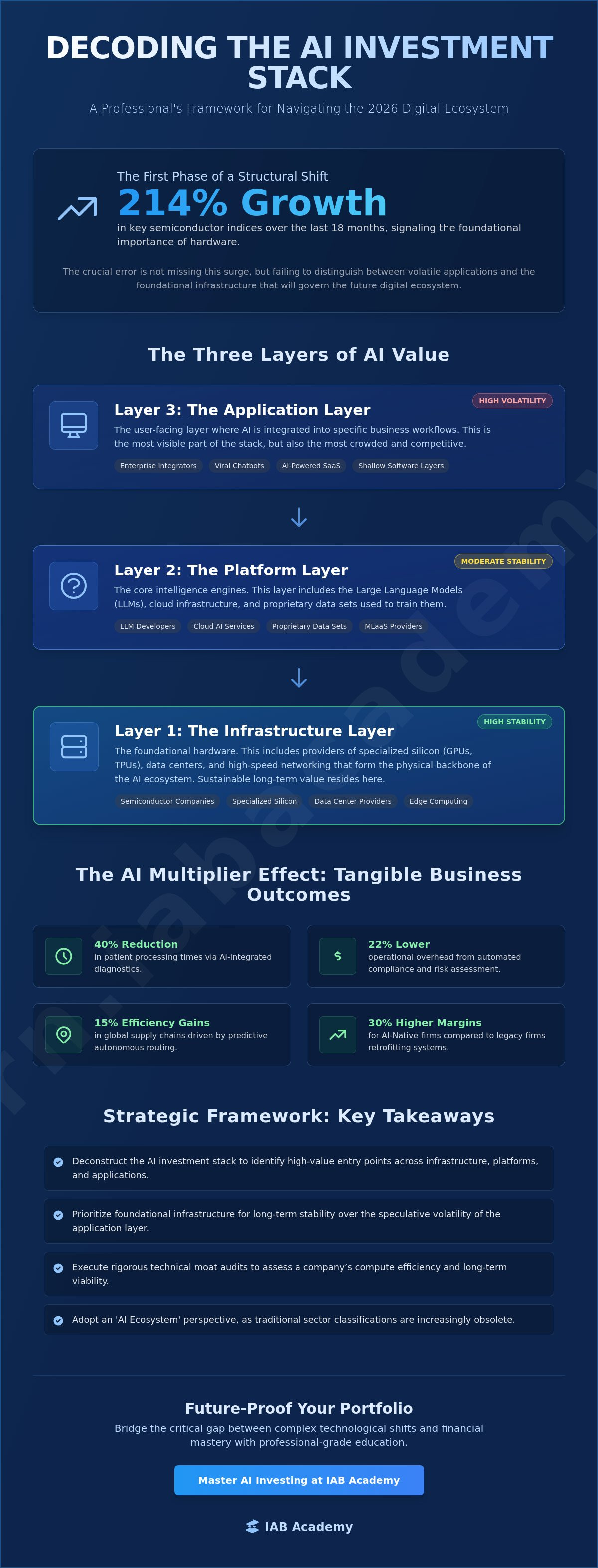
The most significant capital allocation error of the current cycle isn't missing the initial generative surge; it's failing to distinguish between volatile application layers and the foundational infrastructure that will govern the 2026 digital ecosystem. While many retail participants react to daily headlines, institutional professionals recognize that the 214% growth seen in key semiconductor indices over the past 18 months represents only the first phase of a structural shift. You likely feel the weight of information overload as competing narratives cloud your strategy. Understanding how to invest in ai requires moving beyond the noise of the hype cycle to identify where sustainable value actually resides within the technological stack.
This roadmap provides the strategic framework necessary to master the complexities of global artificial intelligence. You'll gain a clear mental model of the industry's architecture, from hardware providers to large language model developers and enterprise integrators. We'll establish actionable criteria for evaluating assets and building a portfolio that prioritizes long-term stability over short-term speculation. We begin by deconstructing the three primary layers of the AI stack to reveal the specific entry points that define professional-grade excellence.
Key Takeaways
- Analyze the evolution of artificial intelligence from an experimental sector into a foundational global infrastructure essential for the 2026 digital ecosystem.
- Deconstruct the AI investment stack to identify high-value entry points across the infrastructure, platform, and application layers.
- Master the strategic framework for how to invest in ai by evaluating the trade-offs between direct equity pure-plays and diversified thematic funds.
- Execute a rigorous technical moat audit to assess a company’s compute efficiency and long-term viability within the intelligence marketplace.
- Adopt the IAB Academy standard for continuous professional education to bridge the critical gap between complex technological shifts and financial mastery.
The 2026 AI Landscape: Why Artificial Intelligence is an Ecosystem, Not a Sector
By 2026, the artificial intelligence market has moved beyond the speculative volatility of 2023. It's no longer a collection of experimental tools but the foundational infrastructure of the global economy. Professional investors now treat AI as a General Purpose Technology (GPT). This classification places it alongside the steam engine, electricity, and the internet as a force that fundamentally rewires societal production functions. Learning how to invest in ai in this mature environment requires a shift from chasing viral chatbots to analyzing structural integration. IDC projections from 2024 suggested that global AI spending would surpass $300 billion by 2026, a milestone that has now been reached as enterprises move from pilot programs to full-scale deployment.
The distinction between the 2023 hype and 2026 growth is rooted in value-driven utility. Early investment cycles focused on large language model (LLM) providers. Today, the focus is on the companies that successfully integrate these models into proprietary workflows. A deep understanding artificial intelligence and its historical development is essential for identifying which firms are building sustainable moats versus those merely renting intelligence from third-party providers. Mastery of these technical nuances is the only way to future-proof a portfolio against the rapid obsolescence of shallow software layers.
Understanding the AI Multiplier Effect
The AI multiplier effect describes how machine intelligence accelerates productivity in non-technological industries. In the healthcare sector, 2026 benchmarks show that AI-integrated diagnostic systems have reduced patient processing times by 40% while increasing accuracy rates. Within the financial services industry, automated compliance and risk assessment protocols have lowered operational overhead by 22% compared to 2024 levels. These gains aren't limited to tech firms; they're revitalizing legacy enterprises that have successfully transitioned their data architectures.
Investors must distinguish between 'AI-Native' companies, which were architected for machine learning from inception, and 'AI-Legacy' firms that are retrofitting existing systems. The performance gap between these two groups has widened significantly. AI-Native firms often show a 30% higher margin due to reduced technical debt and faster iteration cycles. An AI Ecosystem is a network of interdependent hardware and software standards.
Debunking the 'Sector' Myth
Traditional Global Industry Classification Standard (GICS) categories are increasingly obsolete in the 2026 digital economy. Labeling AI as a sub-sector of "Information Technology" ignores its pervasive influence on logistics, retail, and energy. If you limit your scope to software stocks, you'll miss the 15% efficiency gains in global supply chains driven by predictive autonomous routing. A narrow-sector focus creates a significant risk of concentration while ignoring the cross-functional technological shift occurring in heavy industries.
Establishing a 'Global Digital Ecosystem' perspective is mandatory for professional advancement. This approach evaluates how data flows across borders and industries, rather than looking at isolated balance sheets. Successful strategies for how to invest in ai now prioritize companies that control the standards of this ecosystem. This includes providers of specialized silicon, edge computing infrastructure, and the proprietary data sets that train industry-specific models. Professional education in these standards is the only reliable path to achieving excellence in a market that no longer rewards speculative momentum trading.
Decoding the AI Investment Stack: Infrastructure, Platforms, and Applications
Successful capital allocation requires a modular understanding of the digital value chain. By 2026, the market has moved past the initial discovery phase into a structured ecosystem where margins are earned through technical moats and operational integration. Professional strategies for investing in the AI ecosystem emphasize that value capture is not uniform across the stack. Investors must identify which layers offer sustainable competitive advantages versus those facing rapid commoditization. Understanding how to invest in ai involves distinguishing between the physical foundation and the cognitive services built upon it.
Layer 1: The Silicon and Power Foundation
Hardware remains the primary bottleneck for cognitive scaling. While GPUs initially drove the market, the 2026 landscape prioritizes specialized NPUs (Neural Processing Units) designed for high-efficiency inference. This shift is driven by the necessity to lower the cost per query in enterprise environments. Physical infrastructure is the second half of this foundation. The International Energy Agency (IEA) reported in 2024 that data center electricity consumption is on track to double by 2026, potentially reaching over 1,000 TWh globally. This surge places a premium on grid stability, renewable energy integration, and advanced liquid cooling solutions. Investors can find detailed analysis on these physical assets in our guide to Strategic Artificial Intelligence Stocks to Buy.
Layer 2 & 3: From Models to Mastery
The platform layer is undergoing a significant transformation. General-purpose Large Language Models (LLMs) are transitioning into "Compute-as-a-Service" utilities. Price competition among major providers has compressed margins for raw model access. The real value has migrated to Vertical AI. These are specialized applications built on proprietary, industry-specific data that general models cannot access. When determining how to invest in ai at the application level, the focus must be on workflow stickiness. If an AI tool is deeply embedded in a company's programmatic operations or compliance frameworks, the cost of switching becomes prohibitive.
- Proprietary Data Moats: Organizations using unique, non-public datasets to fine-tune models create defensible intellectual property.
- Operational Integration: AI tools that manage core business logic or automated attribution become indispensable to the enterprise.
- SaaS Evolution: Established software providers adding AI layers often capture more value than standalone startups due to their existing distribution networks.
The 2026 growth engine is fueled by end-user productivity tools that demonstrate clear ROI through labor substitution or accelerated output. Margin capture now favors those who control the interface where intelligence meets specific business problems. Professionals seeking to lead these digital transformations should pursue specialized professional certification to validate their strategic expertise in this evolving market.
Strategic Vehicles: Navigating AI Stocks, ETFs, and Thematic Funds
Professional investors must approach the 2026 digital landscape with a bifurcated strategy that balances aggressive growth with institutional stability. Understanding how to invest in ai requires a transition from speculative betting to structured asset allocation. This process begins by choosing the right vehicle: direct equity, exchange-traded funds (ETFs), or thematic mutual funds.
Direct equity offers the highest alpha potential but introduces significant concentration risk. Picking individual "Pure-Plays"—companies where AI is the primary revenue driver—allows investors to capitalize on specific technological breakthroughs. However, these stocks often trade at high valuations, sometimes exceeding 30 times forward earnings. Professionals often balance this volatility by anchoring their portfolios with the "Magnificent 7." These mega-cap leaders provided approximately 75% of the S&P 500's total returns in 2023, offering a foundation of liquidity and massive R&D budgets. To achieve true market outperformance, investors should complement these giants with small-cap innovators that focus on niche applications in healthcare or cybersecurity.
Thematic mutual funds provide a third path, offering professional oversight in volatile sub-sectors. These funds are particularly useful when navigating the 18-month innovation cycles common in machine learning. Active managers can pivot away from companies facing technological obsolescence faster than a passive index, protecting capital during rapid market shifts.
The Case for Diversified AI ETFs
Diversification is the primary tool for reducing idiosyncratic risk. This is the danger that a single company's operational failure or regulatory setback will compromise an entire position. When you're determining how to invest in ai through an ETF, you must evaluate three technical pillars: expense ratios, underlying holdings, and rebalancing frequency. Institutional-grade ETFs typically maintain expense ratios between 0.45% and 0.75%. You should look for funds that rebalance at least semi-annually to ensure the portfolio reflects the latest shifts in the hardware and software layers. For a detailed breakdown of specific fund structures, review our guide on AI Investing for Beginners.
Individual Stock Evaluation Criteria
Successful equity selection requires a move beyond marketing hype to technical reality. Investors should prioritize "AI Revenue Purity," a metric that isolates the percentage of a company's CAGR directly generated by AI-driven products. A high purity score indicates that the firm isn't just rebranding legacy software. Additionally, you must assess the "Data Moat." This refers to the possession of proprietary, non-replicable datasets that provide a competitive advantage in model accuracy. Inference vs. Training costs represent a critical financial indicator, as the former dictates long-term operational margins while the latter reflects initial capital expenditure requirements. Companies that successfully transition from high training costs to efficient, scalable inference are often the most viable long-term holdings.
A Professional Framework for Evaluating AI Investment Opportunities
Understanding how to invest in ai requires a shift from speculative betting to disciplined, data-driven analysis. The 2026 digital ecosystem demands a rigorous five-step evaluation framework to separate sustainable innovators from temporary market beneficiaries. This methodology ensures that capital is allocated to firms with structural advantages rather than those merely riding a wave of industry hype.
- Step 1: Conduct a Technical Moat Audit. Assess the defensibility of the hardware, software, and data layers. A company without proprietary data access or unique algorithmic architectures lacks a sustainable edge in a commoditized market.
- Step 2: Analyze Compute Efficiency. Evaluate the "Compute Efficiency" of the business model. By 2026, the market leaders will be those who can deliver high-performance inference at a fraction of current energy and hardware costs.
- Step 3: Evaluate Regulatory Compliance. Ethical governance is now a core financial metric. Models must align with global standards to avoid catastrophic legal liabilities and operational shutdowns.
- Step 4: Use AI-Powered Screeners. Leverage algorithmic tools to filter for high-growth, high-margin metrics. Target companies maintaining net margins above 20% while sustaining R&D investment at 15% of gross revenue.
- Step 5: Determine the Margin of Safety. Calculate valuations based on 2026 multiples. If the entry price doesn't allow for a 15% margin of safety against conservative earnings projections, the risk profile is likely unacceptable for a professional portfolio.
Leveraging Market Intelligence Tools
Professional investors use programmatic screening to identify emerging leaders before they reach mainstream indices. This data-centric approach is the most effective way to master how to invest in ai while avoiding over-hyped assets. Sentiment analysis tools now scan alternative data, such as developer activity on GitHub and specialized patent filings, to predict breakthroughs before they appear in quarterly reports. You can find specific tool recommendations in our specialized guide on AI Stock Investing.
Risk Management & Compliance
Global regulations directly impact net returns and long-term viability. The EU AI Act, which saw its first major compliance deadlines in 2024, imposes fines of up to 35 million Euros or 7% of global turnover for high-risk violations. Managing concentration risk is equally vital. It's prudent to limit any single AI-centric position to 5% of a total portfolio to protect against sudden supply chain shocks. Future-proofing your strategy involves constant re-evaluation of displacement risks; a software solution that is revolutionary today might become a native operating system feature by the Q3 2026 hardware refresh cycle.
Advance your professional expertise by exploring our full suite of digital ecosystem standards and certifications.
Future-Proofing Your Portfolio: The IAB Academy Standard for AI Mastery
Understanding how to invest in ai requires more than a brokerage account; it demands a commitment to technical literacy. The 2026 digital ecosystem moves at a velocity four times faster than the mobile revolution of 2010. Passive observation is a high-risk strategy in a market where algorithmic shifts occur daily. IAB Academy provides the rigorous structure needed to turn volatility into a controlled professional advantage. We bridge the gap between complex neural networks and financial literacy, ensuring your capital aligns with verified technological benchmarks. Transitioning from an observer to an informed investor means mastering the underlying mechanics of the tools you fund.
The IAB Learning Ecosystem
We've engineered the Novice Investor Curriculum for 2026 to dismantle the barriers between complex machine learning architectures and portfolio management. Our Smart Instructor™ platform utilizes real-time AI tutoring available in 130+ languages, providing instant clarity on topics like programmatic attribution and neural weights. This ensures global standards are accessible regardless of geographic or linguistic boundaries. You're joining a network of certified professionals who prioritize data-driven decision-making over speculative hype. Our community operates on the principle that mastery is a collaborative pursuit, where collective intelligence informs individual excellence.
Your Next Steps Toward Mastery
Success in this decade depends on your ability to set precise 5-10 year objectives. While generative models dominated headlines in 2023, the 2026 landscape focuses on agentic workflows and edge computing integration. You'll need a firm grasp of stock market fundamentals as your bedrock. Technical knowledge isn't enough on its own; you must understand balance sheets and cash flow to identify which firms possess sustainable competitive moats. Identifying how to invest in ai effectively means looking past the interface to the infrastructure beneath. Your roadmap to professional excellence starts with a commitment to these core competencies.
- Establish clear risk-tolerance parameters for high-growth tech sectors.
- Analyze the 2026 digital ecosystem through the lens of compliance and global standards.
- Utilize IAB’s modular learning paths to scale your expertise alongside market shifts.
- Validate your skills through industry-recognized certification.
The window for early-mover advantage is narrowing as institutional adoption reaches 85% across global markets. Securing your financial future requires a proactive, educated approach to asset allocation. Don't leave your professional growth to chance. Enroll in the IAB Academy AI Investing Course to secure your financial future and gain the expertise required to lead in the digital economy.
Mastering the 2026 AI Investment Standard
Navigating the transition toward a fully integrated 2026 digital ecosystem demands a shift from speculative trading to institutional-grade strategy. You've identified that artificial intelligence is no longer a siloed sector; it's a foundational layer impacting every tier of the global economy. By decoding the investment stack from physical infrastructure to end-user applications, you've established a professional framework for long-term capital allocation. Understanding how to invest in ai requires this level of technical precision and a commitment to continuous education as standards evolve.
The IAB Academy, a Houston-based global authority in digital standards, provides the tools necessary to maintain this competitive edge. Our platform offers real-time Smart Instructor™ support in 130+ languages to ensure your mastery remains absolute. You'll gain lifetime access to our 2026 updated curricula, designed to future-proof your portfolio against rapid technological shifts. Don't leave your professional development to chance in this high-stakes market. Secure your lifetime access to IAB Academy’s AI-Powered Investing Education. Your path to industry leadership starts with the right data.
Frequently Asked Questions
Is it too late to invest in AI in 2026?
It's definitely not too late to invest in the AI sector. According to IDC, global AI spending is projected to exceed $300 billion by the end of 2026. This period marks a critical transition from foundational models to industry-specific applications across the globe. Investors are now moving beyond hardware providers like NVIDIA toward software integration and edge computing. This shift creates new entry points for those seeking long-term growth.
What are the biggest risks when investing in artificial intelligence?
Regulatory compliance and high capital expenditures represent the primary risks in this sector. The EU AI Act, which becomes fully enforceable by mid-2026, imposes strict transparency requirements on high-risk systems. Companies failing to meet these standards face fines reaching 7% of global turnover. Additionally, the high cost of H100 or Blackwell GPUs can strain the balance sheets of smaller firms, affecting their long-term viability and market position.
Do I need a technical background to invest in AI stocks successfully?
You don't need a computer science degree, but you must understand the digital ecosystem's architecture. Successful investors focus on key metrics like inference costs and token efficiency rather than raw code. Analyzing how a company utilizes Large Language Models to reduce operational overhead provides a clearer picture of value than technical jargon. Mastery of these fundamentals ensures you identify sustainable growth while navigating a complex and competitive market.
How much of my portfolio should be allocated to AI investments?
Financial advisors often suggest a 5% to 10% allocation for thematic technology sectors, depending on your individual risk tolerance. By 2026, AI is no longer a niche vertical but a horizontal layer across all global industries. Diversifying your approach to how to invest in ai involves balancing high-growth startups with established tech giants. These larger firms use machine learning to optimize their core revenue streams and maintain stability.
What is the difference between an AI 'Pure-Play' and an AI-Integrated company?
An AI pure-play company, such as specialized robotics firms, generates its primary revenue from AI products. In contrast, AI-integrated companies like Adobe or Salesforce incorporate machine learning into existing software suites to enhance user productivity. Pure-plays often offer higher volatility and potential returns for investors. Integrated firms provide more stability through diversified income streams and an established market presence within the digital landscape.
Can AI-powered trading tools help me pick better AI stocks?
AI-driven analytics platforms like BloombergGPT provide sophisticated data processing that manual research cannot match. These tools analyze sentiment across thousands of 2026 earnings calls and SEC filings in seconds. While they offer a competitive edge in identifying patterns, they don't replace professional judgment. Use them to filter opportunities while maintaining a focus on fundamental business health and industry standards to ensure long-term portfolio success.
What happens to AI investments if a recession occurs in 2026?
AI investments often show resilience during downturns because they focus on automation and cost reduction. Gartner reports that 70% of CEOs increased digital investments during previous economic contractions to drive efficiency. While stock prices might fluctuate, companies providing essential AI infrastructure usually maintain demand. Businesses seek to lower labor costs through intelligent automation when budgets are tight, supporting the valuation of high-performing AI firms.
How do I identify a 'bubble' in the AI market?
Identify a bubble by monitoring the gap between market valuations and actual revenue generation. When the price-to-earnings ratios of AI startups exceed historical tech averages by over 50% without net income growth, caution is required. A bubble forms when speculative interest outpaces the practical deployment of technology. Monitor 2026 deployment rates to ensure your roadmap on how to invest in ai remains grounded in fiscal reality.
