
AI Investing for Beginners: The 2026 Comprehensive Masterclass
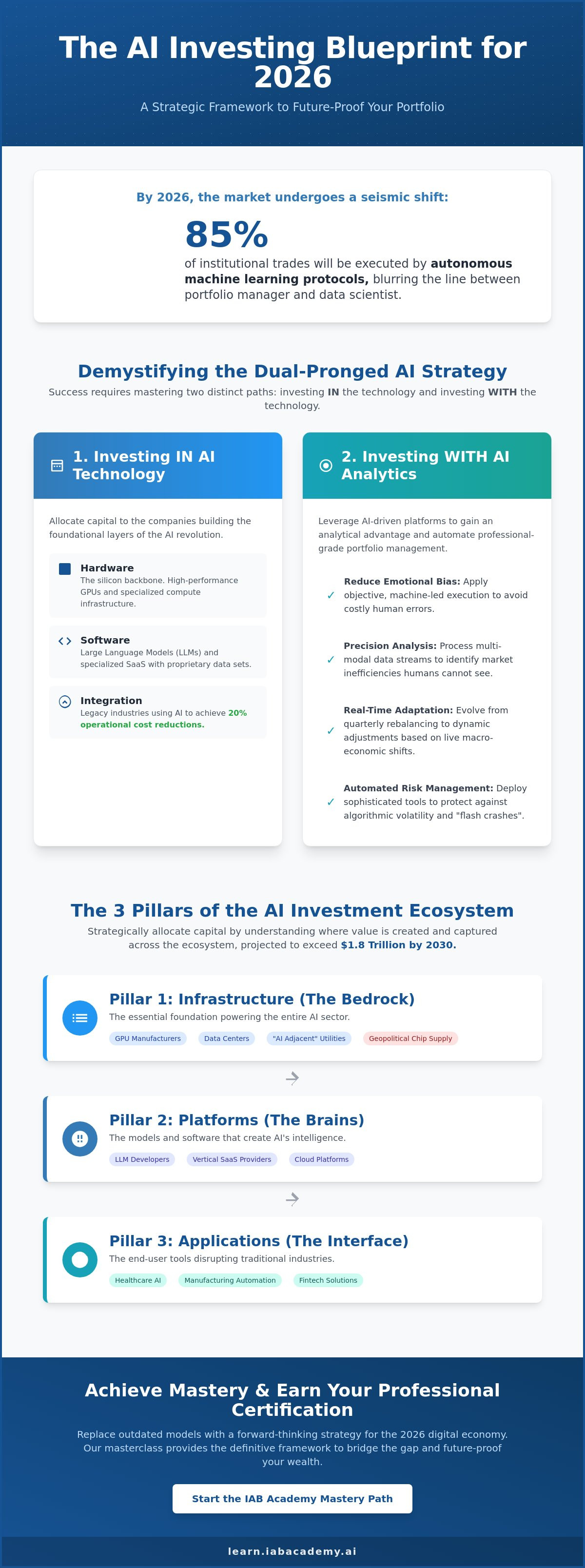
By 2026, the distinction between a traditional portfolio manager and a data scientist will effectively vanish as an estimated 85% of institutional trades rely on autonomous machine learning protocols. You've likely found that the current market environment feels increasingly opaque; it is a chaotic ecosystem where conflicting reports and "black box" algorithms create more confusion than clarity. It's frustrating to feel sidelined by technology that's supposed to be an equalizer. This IAB Academy masterclass provides the definitive framework for AI investing for beginners to bridge this gap and establish professional-grade standards for your financial future.
You'll gain the mastery required to evaluate high-growth technology stocks while simultaneously deploying sophisticated analysis tools to optimize your own holdings with precision. We'll guide you through the specific technicalities of the AI infrastructure, moving from foundational ecosystem analysis to the strategic application of predictive modeling. This disciplined path ensures you achieve a professional certification that validates your ability to future-proof your portfolio against market volatility and technological disruption.
Key Takeaways
- Distinguish between investing in AI infrastructure and utilizing machine learning tools to optimize your portfolio with professional-grade precision.
- Analyze the three critical pillars of the AI ecosystem—infrastructure, platforms, and applications—to strategically allocate capital across tier-1 stocks and niche disruptors.
- Navigate the "Black Box" dilemma and algorithmic volatility to ensure your investment strategy remains resilient against modern market flash crashes.
- Develop a comprehensive framework for AI investing for beginners by selecting AI-compatible platforms that align with your specific risk profile and long-term financial objectives.
- Future-proof your wealth by adopting a mastery-based approach to financial education that replaces outdated models with a forward-thinking strategy for the 2026 digital economy.
Demystifying AI Investing: The Dual-Pronged Strategy for 2026
AI investing represents the strategic intersection of capital allocation and machine learning protocols. It's no longer a niche pursuit reserved for data scientists or hedge fund managers. For those exploring AI investing for beginners, the landscape in 2026 focuses on tangible utility and structural integration rather than the speculative promises of previous years. This shift marks the transition from "hype cycles" to fundamental value creation.
The market has matured significantly since the initial generative AI surge. Gartner reports that by 2026, over 80% of enterprises will have moved generative AI models into full production environments, compared to less than 5% in 2023. This widespread adoption means investors must distinguish between two distinct paths: investing "in" the creators of the technology and investing "with" the technology to manage a portfolio. Success in this environment requires adopting institutional standards, where retail participants utilize the same rigorous metrics and automated frameworks once exclusive to Tier-1 financial firms.
Investing In AI: The Technology Ecosystem
The technology ecosystem is built upon three critical layers. Hardware serves as the silicon backbone; this includes manufacturers of high-performance GPUs and the specialized foundries that produce them. Without this compute power, the entire sector stalls. The software layer follows, comprised of Large Language Models (LLMs) and specialized SaaS providers that offer vertical-specific solutions. Finally, integration represents the largest growth area. Traditional industries, such as manufacturing and healthcare, are being radically disrupted. In 2026, companies that successfully implement AI to reduce operational costs by a projected 20% are becoming the new blue-chip targets for savvy investors.
Investing With AI: The Analytical Advantage
Modern predictive analytics have largely superseded 20th-century technical indicators like simple moving averages. By processing multi-modal data streams, algorithmic trading systems now identify market inefficiencies with a precision that human analysts cannot replicate. This evolution has transformed basic robo-advisors into personalized AI wealth managers. These platforms don't just rebalance quarterly; they adjust to macro-economic shifts in real-time. Mastering AI investing for beginners involves leveraging these tools to achieve professional-grade results. The AI Advantage is the reduction of human emotional bias in trading through the application of objective, machine-led execution.
- Hardware: Focus on the providers of specialized compute and data center infrastructure.
- Software: Evaluate companies based on their proprietary data sets and model efficiency.
- Integration: Identify traditional firms using AI to achieve measurable margin expansion.
- Analysis: Utilize AI-driven platforms to automate risk management and asset selection.
Navigating the AI Investment Ecosystem: Where to Allocate Capital
Successful AI investing for beginners requires a structured approach to a market that analysts project will exceed $1.8 trillion by 2030. Investors must categorize opportunities into three primary pillars: Infrastructure, Platforms, and Applications. This hierarchy helps clarify where value is created and captured. To maximize capital efficiency, use this strategic evaluation framework to vet potential holdings against rigorous industry standards. Logic suggests that while applications catch the public's attention, the underlying layers often provide more stable long-term yields.
Infrastructure and Hardware Leaders
Hardware remains the bedrock of the ecosystem. GPU manufacturers continue to dominate as the 2026 demand for high-performance computing scales across global data centers. However, the investment scope is widening. Utility companies are now essential "AI adjacent" plays because a single AI query consumes up to 10 times the electricity of a standard search. Investors should monitor supply chain vulnerabilities, particularly in the 90% of advanced chips manufactured in specific geopolitical corridors. Balancing Tier-1 semiconductor giants with mid-cap data center providers ensures resilience against market volatility.
Software and Generative AI Platforms
The software layer focuses on proprietary data and model "moats." Companies that own massive, unique datasets possess a competitive advantage that's difficult for newcomers to replicate. Look for firms transitioning from experimental API usage to stable, subscription-based revenue models. These recurring streams provide the predictability needed for long-term growth. For a detailed breakdown of specific market leaders, consult the 2026 Investor’s Guide for AI stocks.
Diversification within the technology sector is mandatory for risk mitigation. Don't concentrate capital solely in large-cap "Magnificent Seven" stocks. While these Tier-1 entities offer stability, emerging niche disruptors in fields like autonomous logistics or specialized biotech often provide higher growth potential. Evaluating these companies requires looking beyond hype and focusing on cash flow and patent strength.
Achieving mastery in AI investing for beginners means understanding how these distinct layers interact to form a cohesive digital economy. It's about recognizing that hardware enables software, which in turn drives consumer applications. If you're ready to professionalize your approach and gain a competitive edge, consider pursuing a strategic certification to validate your market expertise and future-proof your portfolio.
Managing Risk and the Black Box Dilemma
The transition to automated markets introduces the "Black Box" problem, a scenario where the logic behind a specific trade recommendation remains opaque even to the developers. This lack of transparency is a primary concern for those exploring AI investing for beginners. Deep learning models process millions of data points to identify patterns, yet they don't always provide a clear audit trail for their conclusions. In 2024, the Financial Stability Board highlighted that this opacity could hide systemic vulnerabilities, making it difficult for investors to perform traditional due diligence.
Algorithmic volatility represents another critical risk factor. Modern markets are susceptible to "flash crashes" caused by high-frequency trading systems interacting in ways humans didn't intend. The May 6, 2010, Flash Crash, where the Dow Jones Industrial Average dropped nearly 1,000 points in minutes, serves as a historical warning. Today, interconnected AI agents can exacerbate these swings by reacting to the same technical triggers simultaneously. Maintaining stability requires a deep understanding of these automated interactions.
Regulatory bodies are actively establishing frameworks to govern these technologies. On July 26, 2023, the SEC proposed new rules designed to eliminate conflicts of interest in predictive data analytics. These regulations require firms to ensure that their algorithms don't prioritize corporate profits over the best interests of the investor. Ethical wealth management now demands a commitment to these global standards, ensuring that automation doesn't bypass fiduciary responsibilities or market integrity.
Identifying and Mitigating Algorithmic Bias
Data integrity is the foundation of any successful investment signal. If training sets rely on skewed historical data, the AI will likely replicate those errors, leading to poor performance or concentrated risk. Institutional-grade systems utilize human-in-the-loop (HITL) oversight to verify model outputs against real-world economic shifts. It's vital to remember that AI is a tool for augmentation, not a replacement for financial literacy. Professionals must audit their data sources to maintain compliance and ensure that their strategies remain objective and effective.
Portfolio Protection Strategies
Safeguarding capital in a tech-heavy ecosystem requires advanced defensive measures. AI-driven stop-losses and dynamic hedging allow for real-time adjustments that traditional static orders can't match. Relying on a single analytical model is a strategic error; diversification across multiple algorithmic methodologies is essential for resilience. With technology stocks representing roughly 31% of the S&P 500 as of early 2024, maintaining a balanced portfolio requires constant monitoring. Successful AI investing for beginners involves using these tools to manage exposure rather than letting the machine operate without constraints.
Step-by-Step: Building Your AI-Powered Investment Strategy
Developing a robust framework for AI investing for beginners requires a transition from speculative guessing to algorithmic precision. Mastery over this ecosystem begins with a defined five-step protocol designed to align technological capability with long-term financial objectives. Professionals don't just "buy stocks"; they engineer portfolios using data-driven benchmarks.
- Step 1: Establish Your Risk Profile. Define your risk tolerance and 10-year financial targets. Institutional standards often prioritize a Sharpe ratio above 1.5, which measures risk-adjusted return.
- Step 2: Platform Selection. Choose an AI-compatible brokerage that provides robust API integration and low-latency execution. In 2026, the speed of data ingestion is a primary competitive advantage.
- Step 3: Strategic Screening. Deploy AI-driven screeners to filter through 10,000+ global equities. These tools analyze stock market fundamentals alongside alternative data like real-time shipping logs or satellite imagery.
- Step 4: Systematic Backtesting. Use machine learning models to validate your hypothesis against 20 years of historical market cycles to ensure the strategy remains resilient.
- Step 5: Iterative Optimization. Monitor performance metrics weekly. Adjust your model weights based on real-time attribution analysis to maintain professional excellence.
Selecting Your AI Toolset
Retail investors often rely on basic sentiment analysis tools, yet institutional success requires more sophisticated infrastructure. Professional-grade platforms process unstructured data from 50,000 global news sources per minute. When selecting your stack, prioritize real-time data processing and seamless integration with core financial metrics. This ensures your AI investing for beginners journey is built on a foundation of verified technical data rather than volatile social media trends.
The Importance of Backtesting
Backtesting isn't just about reviewing the past; it's about stress-testing your logic against volatility. Modern AI can simulate 5,000 market scenarios, including "black swan" events, in under 30 seconds. You must avoid overfitting, which happens when a strategy is too narrowly tuned to past data and fails in live markets. Professionals transition from paper trading to live capital only after achieving a 95% confidence interval in simulated environments. This disciplined approach minimizes the risk of significant drawdown during initial execution phases.
Ready to advance your technical proficiency? Explore our professional certification programs to master the digital financial ecosystem.
Future-Proofing Your Wealth: The IAB Academy Mastery Path
Traditional financial education frequently fails because it relies on static models that can't keep pace with the 2026 market velocity. Relying on decade-old investment theories creates a strategic deficit when 80% of daily market volume is now driven by algorithmic execution. The IAB Academy addresses this disconnect by replacing outdated textbooks with a dynamic framework designed for AI investing for beginners. Our methodology focuses on standardization and professional excellence, ensuring you don't just participate in the market; you master it.
The IAB Academy philosophy centers on the belief that technical proficiency is the only true hedge against market volatility. We provide a structured environment where complex data sets are transformed into actionable strategies. By aligning your portfolio with the global digital ecosystem, you gain a competitive edge that traditional retail investors lack. This path isn't about chasing trends. It's about establishing a rigorous, professional standard for wealth preservation and growth through validated AI methodologies.
The Smart Instructor™ Advantage
Success in modern markets requires immediate clarity. The Smart Instructor™ functions as your elite, global mentor, providing instant answers to technical trading questions in 130+ languages. This isn't a simple chatbot; it's a sophisticated instructional tool that interprets complex market signals into plain language. Whether you're analyzing programmatic shifts or attribution models, the instructor provides 24/7 support to ensure your learning never stalls. It analyzes your progress in real-time, adjusting the complexity of the modules to match your evolving skill set.
- Multilingual Precision: Access high-density financial information in your native tongue, removing the barrier of technical jargon.
- Adaptive Learning: The system identifies gaps in your knowledge and serves targeted content to bridge them immediately.
- Global Mentorship: Benefit from a persona that reflects the highest standards of international digital advertising and finance.
Enrolling in the Novice Investor Curriculum
Your journey toward professional validation starts with a comprehensive foundation. Before deploying advanced machine learning models, you must establish a baseline in finance literacy. This prerequisite ensures you understand the fundamental mechanics of capital before adding the layer of AI complexity. Our curriculum is built for AI investing for beginners who are serious about career-level mastery and long-term financial stability.
Enrolling provides you with lifetime access to an evolving repository of knowledge. As the AI ecosystem shifts, our course materials are updated to reflect new compliance standards and technological breakthroughs. Upon completion, you earn a certification that validates your expertise, signaling to the industry that you possess the skills required for the future of finance. Don't leave your wealth to chance. Join the next generation of sophisticated investors and secure your place in the digital economy today.
Securing Your Position in the 2026 AI Economy
The shift toward automated capital markets isn't just a trend; it's the new baseline for 2026. You've now grasped the dual-pronged strategy required to navigate this ecosystem, moving from simple capital allocation to managing the complex Black Box dilemma that defines modern risk. Success in AI investing for beginners requires more than just enthusiasm. It demands a disciplined adherence to industry standards and a commitment to technical mastery. By building a strategy rooted in 2026 data and future-proofed frameworks, you transition from a spectator to a sophisticated participant in the global digital economy.
The IAB Academy, based in Houston, Texas, provides the definitive infrastructure for this transition. Our global learning portal offers lifetime access to the Novice Investor Curriculum, ensuring your knowledge remains relevant as the ecosystem evolves. You'll engage with our Smart Instructor™, an AI-powered video tutor capable of delivering technical insights in over 130 languages. This isn't just education; it's professional validation for those ready to lead. Master AI Investing with IAB Academy’s Smart Instructor™. Your journey toward professional excellence starts today.
Frequently Asked Questions
Is AI investing suitable for absolute beginners?
Yes, AI investing for beginners is highly accessible because 80% of retail brokerage platforms now integrate automated analytical tools. You don't need a computer science degree to utilize these systems. Modern interfaces translate complex algorithmic data into actionable insights. This allows novice investors to maintain a diversified portfolio without manual oversight. Mastery of these tools ensures your strategy remains competitive in the 2026 financial ecosystem.
How much capital do I need to start investing in AI stocks?
You can initiate an AI-focused portfolio with as little as $5 through platforms offering fractional shares. While traditional brokerage accounts once required $1,000 minimums, 95% of major apps now support micro-investing. This low barrier to entry allows you to acquire exposure to high-value stocks like NVIDIA or Microsoft. Starting early facilitates long-term capital appreciation through compound interest within the global digital landscape.
Can AI tools guarantee profits in the stock market?
AI tools cannot guarantee profits because market volatility remains an inherent risk in all financial sectors. The SEC explicitly states that past performance doesn't predict future results, even when using advanced algorithms. These tools function as decision-support systems rather than crystal balls. They process data 1,000 times faster than humans but still operate within unpredictable economic cycles. Relying solely on automation without human oversight often leads to unhedged losses.
What is the difference between a robo-advisor and an AI trading assistant?
A robo-advisor automates long-term portfolio management through passive indexing, while an AI trading assistant provides real-time technical analysis for active execution. Robo-advisors currently manage over $2.5 trillion in global assets by rebalancing accounts automatically. In contrast, trading assistants use large language models to scan 10,000 news articles per second for sentiment signals. One builds wealth through stability; the other seeks alpha through immediate market inefficiencies.
Are AI investing tools legal and regulated by the SEC?
AI investing tools are legal and subject to strict SEC oversight under the Investment Advisers Act of 1940. Registered firms must ensure their algorithms don't prioritize corporate interests over client fiduciary duties. In 2023, the SEC proposed new rules to address potential conflicts of interest in predictive data analytics. Compliance remains a cornerstone of our instructional framework to ensure you operate within established industry standards and maintain professional integrity.
How do I choose between an AI ETF and individual AI stocks?
Choose an AI ETF if you seek broad exposure across 30 to 50 different companies to mitigate individual company risk. Individual stocks offer higher potential returns but carry 100% exposure to that specific firm's operational success. Data from 2024 shows that thematic ETFs provide a more stable entry point for those learning AI investing for beginners. Diversification protects your capital from the 20% volatility swings common in the tech sector.
Does IAB Academy offer a certification for completing the AI investing course?
The IAB Academy provides a formal certification of mastery upon the successful completion of the AI investing curriculum. This credential validates your technical proficiency and commitment to professional excellence in the digital advertising and finance ecosystem. It acts as a hallmark of quality that signals your capability to navigate complex technological shifts. Professionals use this validation to distinguish themselves and prove their expertise in a competitive global market.
Will AI replace human financial advisors by 2026?
AI won't replace human financial advisors by 2026, but it'll redefine their roles into a hybrid model. Industry reports suggest that 70% of advisors will utilize AI to handle data-heavy tasks like tax-loss harvesting and reporting. This shift allows humans to focus on complex emotional counseling and estate planning. The future belongs to professionals who achieve synergy between algorithmic speed and human intuition to provide comprehensive financial guidance.
