
Strategic Artificial Intelligence Stocks to Buy: The 2026 Investor’s Guide
While the "Magnificent Seven" captured 75% of the S&P 500's total gains in 2023, the most strategic artificial intelligence stocks to buy for 2026 are increasingly found outside this crowded circle. You've likely watched the rapid ascent of chipmakers with a mix of excitement and legitimate concern that you're entering at a market peak. It's difficult to parse complex technical specifications or diversify when the headlines focus on the same handful of names. You aren't alone in seeking a more disciplined approach to tech-heavy asset allocation.
We've developed this guide to help you master the evolving investment landscape through a rigorous, professional framework. You'll gain the confidence to evaluate infrastructure and software leaders using the same standards applied by global industry mentors. We'll examine a vetted list of AI assets and outline a modular strategy for future-proofing your portfolio against volatility. This transition from broad exposure to surgical precision ensures your capital aligns with the actual drivers of the digital ecosystem.
Key Takeaways
- Map the 2026 AI value chain to transition from speculative enthusiasm toward performance-based investing across hardware, cloud, and software layers.
- Identify the essential artificial intelligence stocks to buy within the infrastructure sector by evaluating hardware-software synergies and manufacturing dominance.
- Evaluate the software frontier to distinguish enterprise application winners leveraging proprietary data exclusivity and strategic open-source models.
- Master a professional-grade analytical framework using the "Rule of 40" and "AI Moat" assessments to move beyond traditional P/E ratios.
- Bridge the gap between retail trading and institutional analysis by integrating industry standards and technical mastery into your investment strategy.
The AI Investment Ecosystem in 2026: Mapping the Value Chain
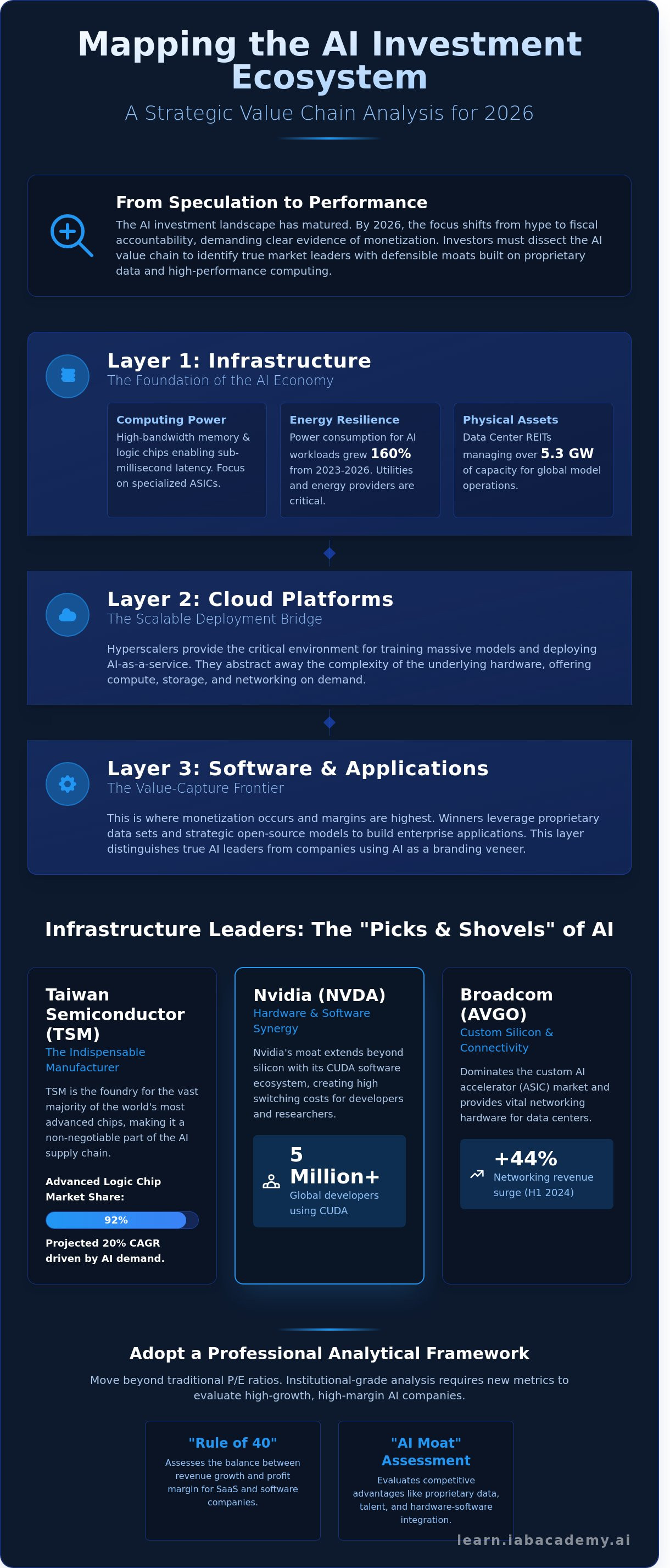
By 2026, the speculative phase of the recent AI boom has transitioned into a disciplined era of fiscal accountability. Investors now prioritize artificial intelligence stocks to buy based on realized earnings rather than conceptual potential. This shift marks the end of "AI experimentation," a period where nearly 80% of enterprise pilot projects failed to reach production in 2024. Today, the market demands clear evidence of AI monetization through expanded margins or entirely new revenue streams. Discerning investors must separate companies building core neural architectures from those using AI as a branding veneer. True market leaders demonstrate a competitive moat built on proprietary data sets and high-performance computing clusters. In this mature landscape, the value chain is divided into three distinct layers: hardware infrastructure, cloud platforms, and software applications. Each layer offers different risk profiles and capital requirements, requiring a modular approach to portfolio construction.Infrastructure: The Foundation of the AI Economy
Semiconductor demand remains the primary barometer for the health of the AI sector. In 2026, the focus has expanded beyond general-purpose GPUs to specialized ASICs designed for specific inference tasks. Data center REITs and energy providers have become critical components of the supply chain, as power consumption for AI workloads grew by 160% between 2023 and 2026. The AI infrastructure layer serves as the physical backbone of the digital ecosystem. Strategic investors should analyze:- Computing Power: Manufacturers of high-bandwidth memory and logic chips that enable sub-millisecond latency.
- Energy Resilience: Utilities and nuclear energy providers securing the grid for hyperscalers.
- Physical Assets: Real estate investment trusts managing the 5.3 gigawatts of capacity required for global model operations.
Software and Services: Where the Margins Live
The software layer represents the frontier of artificial intelligence stocks to buyInfrastructure Leaders: Top Hardware and Chip Artificial Intelligence Stocks to Buy
Physical infrastructure represents the most resilient layer of the AI stack. Unlike application-layer software that often faces rapid churn, hardware providers command high barriers to entry through capital intensity and proprietary intellectual property. This "pick and shovel" strategy remains the least speculative way to identify artificial intelligence stocks to buy because it powers the compute required for every large language model and generative tool. Investors seeking a strategic view on the AI ecosystem prioritize these hardware foundations to capture growth across the entire technological landscape.
- Nvidia (NVDA): Nvidia maintains its lead through the synergy of Blackwell architecture and the CUDA software ecosystem. With over 5 million developers globally using CUDA as of 2024, the software moat is as critical as the silicon itself.
- Taiwan Semiconductor (TSM): As the foundry for 92% of the world's most advanced logic chips, TSM is the indispensable manufacturer. Its 2025 revenue projections reflect a 20% compound annual growth rate driven by relentless AI demand.
- Broadcom (AVGO): Broadcom dominates the custom AI accelerator (ASIC) market. Its networking revenue surged 44% in the first half of 2024, proving that connectivity is as vital as raw processing power.
Semiconductor Giants and Their Market Dominance
The 2026 landscape differentiates between general-purpose GPUs and Application-Specific Integrated Circuits (ASICs). While GPUs offer flexibility, ASICs provide up to 3x better energy efficiency for specific inferencing workloads. Leading chipmakers typically allocate 15% to 20% of their annual revenue to R&D to maintain this competitive edge. Geopolitical shifts, specifically the impact of the 2022 CHIPS Act, have forced a redistribution of supply chains. This makes domestic manufacturing capabilities a key metric for long-term valuation. Understanding these shifts is essential for mastering the AI investment landscape and future-proofing your portfolio.
Networking and Connectivity: The Hidden AI Winners
Processing speed is irrelevant if data cannot move between clusters. High-speed data transfer has become the primary bottleneck for scaling large models in 2026. Arista Networks has emerged as a leader, providing the 800G switching technology required for massive data center fabrics. Industry data suggests that for every dollar spent on AI chips, approximately $0.20 is spent on networking and power infrastructure. This correlation ensures that as data center construction spending hits its projected $250 billion peak, networking stocks will track closely with chip manufacturers. It's a disciplined way to find artificial intelligence stocks to buy that support the backbone of the industry.
The Software Frontier: Identifying Enterprise AI and Application Winners
The transition from hardware infrastructure to software application marks the second phase of the AI investment cycle. Microsoft maintains a primary position through its Azure-OpenAI partnership. This collaboration has integrated GPT-4 capabilities across the Microsoft 365 suite, influencing productivity for over 400 million paid seats. Meta Platforms has adopted a distinct strategy by championing open-source models like Llama 3. This approach lowers the barrier for developers while simultaneously enhancing Meta's proprietary advertising algorithms. In 2024, Meta reported that its AI-driven Advantage+ tools yielded a 32% increase in return on ad spend for retail partners. Palantir remains a critical player for institutional investors looking at artificial intelligence stocks to buy. Its Artificial Intelligence Platform (AIP) saw US commercial customer counts grow by 69% year-over-year in early 2024, proving the demand for specialized, secure data integration in defense and manufacturing. Alphabet continues to defend its ecosystem by embedding Gemini into its core Search product, which still commands over 90% of the global search market as of late 2024.
The Battle for the AI Desktop: MSFT vs. GOOGL
Microsoft and Alphabet are locked in a struggle for dominance over professional workflows. Microsoft's early lead with Copilot has forced a rapid response from Google Workspace. Current data indicates that 60% of Fortune 500 companies are now testing Microsoft’s AI features. Alphabet counters this by utilizing its massive data advantage from YouTube and Android to train Gemini. While analysts initially feared AI search would cannibalize Google’s revenue, the company reported an 11% increase in search advertising revenue in Q1 2024. This suggests that AI integration expands rather than replaces traditional search behaviors. The victor in this space will be the one that achieves the highest enterprise adoption rate through seamless integration into existing daily habits.
Niche Leaders in Vertical AI
Specialized AI applications offer high retention rates due to their "sticky" nature within specific industries. In healthcare, AI tools now automate 30% of administrative documentation, allowing providers to focus on patient care. Financial services use specialized models for real-time compliance and fraud detection. Investors should monitor small-cap firms that focus on these high-barrier entries. These companies often become acquisition targets for larger tech conglomerates. Success in this sector depends on proprietary datasets that competitors can't easily replicate. This makes them resilient artificial intelligence stocks to buy for long-term portfolio stability. Look for companies with a net revenue retention rate exceeding 120% to identify the true winners in vertical software.
- Healthcare: Companies automating diagnostic imaging and clinical notes.
- Finance: Platforms utilizing AI for predictive credit scoring and risk management.
- Legal: Software that reduces contract review time by up to 50%.
A Strategic Framework for Evaluating AI Stocks
Traditional valuation metrics often fail to capture the exponential growth trajectory of the technology sector. When identifying artificial intelligence stocks to buy, investors must prioritize the "Rule of 40." This metric dictates that a company's combined revenue growth rate and profit margin should exceed 40%. In 2024, top-tier AI firms maintained this benchmark even as they scaled infrastructure, proving that growth doesn't have to come at the expense of fiscal discipline.
Monitoring the "Capex to Revenue" ratio is vital for ensuring sustainable scaling. If a company's capital expenditure exceeds 35% of its revenue without a clear path to monetization, the risk of over-extension increases. High-density compute requires massive investment; however, long-term value depends on converting that compute into recurring revenue streams rather than just raw processing power.
An AI Moat is the combination of unique data and integrated user workflows. This structural advantage prevents competitors from easily replicating a company's market position, as it creates high switching costs for enterprise clients.
Key Financial Metrics for AI Investors
Forward earnings guidance provides a window into the next 12 to 18 months of performance. In a sector where hardware cycles move every six months, stale data is a liability. Free cash flow remains the ultimate validator. It funds the continuous R&D required to retain top-tier engineering talent, which saw a 25% salary premium in 2025 according to industry benchmarks. Investors should look for companies that generate enough cash to fuel their own innovation without constant dilutive secondary offerings.
Risk Mitigation and Diversification
Volatility is inherent in high-growth tech. Implementing stop-loss orders at 15% to 20% below entry points protects capital during sudden market corrections. For those seeking broader exposure, ETFs offer a diversified basket of artificial intelligence stocks to buy, reducing the impact of a single company's failure. Success in this volatile environment requires a high level of finance literacy to manage complex market cycles effectively.
Strategic portfolio construction involves balancing high-risk startups with established blue-chips. A disciplined approach often involves allocating 70% of the AI-focused portfolio to "Magnificent Seven" style leaders with proven compute access and data exclusivity. The remaining 30% can be distributed among emerging players specializing in niche applications like edge computing or specialized LLM fine-tuning.
Future-Proofing Your Portfolio with IAB Academy
Identifying the most strategic artificial intelligence stocks to buy is a technical challenge that requires a professional-grade toolkit. While retail sentiment often drives short-term volatility, long-term wealth is built on the foundation of institutional-level data literacy. The IAB Academy serves as the definitive mentor for investors who demand mastery over market mechanics. By 2026, the divide between those who use AI and those who are replaced by it will be absolute. Education is the primary lever to ensure you remain on the right side of that shift.
The Smart Instructor™ technology acts as a real-time pedagogical layer. It doesn't just provide signals; it explains the underlying logic of market movements. This process facilitates a transition from a novice observer to a certified, AI-powered investor capable of high-density strategic thinking. You'll move beyond chasing tickers to understanding the structural shifts in the global digital ecosystem.
The IAB Methodology: AI-Powered Investing Education
Our financial literacy curriculum is engineered for the 2026 market ecosystem. It focuses on several key pillars of professional advancement:
- Algorithmic Validation: Use AI tools to stress-test your investment theses against historical data and projected volatility.
- Programmatic Risk Assessment: Understand the attribution models that drive institutional capital flows.
- Lifetime Strategy Evolution: Gain permanent access to updated modules as artificial intelligence stocks to buy evolve from emerging tech into established infrastructure.
This modular approach ensures that your knowledge base remains current. You aren't just learning a static set of rules; you're adopting a disciplined framework for continuous growth in a volatile sector.
Join a Global Community of Professional Investors
Mastery isn't achieved in isolation. The IAB Academy connects you with a global ecosystem of experts and peers who prioritize objective analysis over market noise. This network provides the mentorship necessary to refine your execution and achieve professional excellence. Certification from the academy serves as a hallmark of financial mastery, signaling that you possess the technical proficiency to manage capital in a sophisticated digital environment. It's time to elevate your strategy from speculation to science.
Mastering the 2026 AI Investment Landscape
The transition toward a fully integrated digital economy by 2026 necessitates a shift from speculative betting to strategic asset allocation. Success in this sector depends on distinguishing between hardware providers fueling the infrastructure boom and software innovators delivering measurable enterprise value. Identifying the most resilient artificial intelligence stocks to buy requires a disciplined framework that balances technical scalability with market compliance. Mastery over these complex financial ecosystems is no longer optional for those seeking long-term excellence.
The IAB Academy provides the professional precision and institutional knowledge required to navigate these shifts. Our comprehensive financial literacy curriculum is specifically engineered for 2026 market dynamics. You'll gain instant support through the Smart Instructor™ AI, which provides answers in over 130 languages. We also provide lifetime access to all future AI investing course updates to ensure your strategy remains future-proof. Enroll in the IAB Academy to master AI-powered investing strategies. Your path to professional validation and market expertise begins today.
Frequently Asked Questions
What are the best artificial intelligence stocks to buy for beginners in 2026?
Beginners should prioritize established hyperscalers like Microsoft and Alphabet. These companies possess the capital to sustain the $100 billion annual infrastructure spends required for model training. By 2026, Microsoft's integration of Copilot across its 400 million Microsoft 365 users provides a stable entry point into artificial intelligence stocks to buy. These firms offer lower volatility compared to pure-play startups while maintaining a 15 percent projected annual growth rate in cloud revenue.
Is it too late to invest in AI stocks like Nvidia?
It isn't too late to invest in Nvidia, provided you understand its role as the industry's foundational layer. As of 2025, Nvidia maintains an 80 percent market share in the data center AI chip market. The rollout of the Blackwell architecture ensures dominance through 2026. While the triple-digit gains of 2023 have stabilized, the company's 50 percent net profit margins remain a benchmark for hardware excellence in the global digital ecosystem.
How do I identify a "fake" AI stock or a company just using the hype?
Identify fraudulent AI claims by analyzing the percentage of revenue directly attributed to machine learning products in quarterly SEC filings. Legitimate contenders typically allocate at least 15 percent of their total revenue to R&D. If a company's 10-K report mentions "AI" 50 times but shows zero capital expenditure on GPU clusters or proprietary datasets, it's likely leveraging hype. Authentic firms demonstrate clear technical integration within their core programmatic workflows.
What is the difference between AI infrastructure and AI application stocks?
AI infrastructure stocks focus on the physical and foundational layer, including semiconductor manufacturers like TSMC and cloud providers like AWS. AI application stocks represent the software layer that utilizes this hardware to solve specific end-user problems, such as Salesforce or Adobe. Infrastructure companies currently capture 60 percent of the value chain. The shift toward application-layer dominance is projected to accelerate by late 2026 as enterprise adoption matures.
Should I buy individual AI stocks or an AI-focused ETF?
Investors seeking broad exposure should prioritize AI-focused ETFs like BOTZ or ROBO to mitigate the risk of individual company failure. These funds hold 30 to 100 different assets, providing a safety net against the high volatility of the tech sector. If you have the expertise to analyze balance sheets, selecting artificial intelligence stocks to buy individually can lead to higher alpha. Most professionals maintain a 70/30 split between ETFs and individual picks.
How much of my portfolio should be dedicated to artificial intelligence?
Financial advisors generally recommend a 5 to 10 percent allocation to thematic technology sectors like artificial intelligence. This concentration allows for significant upside without compromising the 60/40 traditional portfolio structure. For aggressive growth strategies, some institutional models increased this to 15 percent by January 2025. You must balance this against your personal liquidity needs and the 20 percent annual standard deviation typical of the NASDAQ-100 index.
What are the biggest risks when investing in AI technologies?
The primary risks include stringent global regulatory compliance frameworks like the EU AI Act and the massive energy requirements of data centers. By 2026, power consumption for AI is expected to double, potentially creating a bottleneck for growth. Investors must also monitor the cyclical nature of hardware. A sudden drop in GPU demand could lead to a 30 percent valuation correction across the entire semiconductor ecosystem, impacting even the strongest balance sheets.
