
AI Stock Investing: A Professional Roadmap to Mastering Market Intelligence in 2026
By 2026, algorithmic models and automated systems are projected to facilitate over 90% of all public equity trades, rendering traditional manual analysis a legacy practice. You've likely felt the pressure of information overload as fragmented data sources multiply; it's nearly impossible to distinguish institutional-grade intelligence from retail gimmicks. It's a common concern that the very tools meant to provide clarity might introduce errors through algorithmic hallucinations or data bias. Mastering ai stock investing requires more than just adopting new software; it demands a fundamental shift in how you oversee market intelligence.
This article provides a comprehensive professional framework designed to transition your strategy from manual labor to sophisticated AI-driven oversight. You'll gain a clear, step-by-step methodology for integrating these technologies into your existing workflow without sacrificing accuracy. We'll establish the rigorous criteria necessary for selecting high-performance analysis tools and explore the technicalities of building a future-proof investment ecosystem. Prepare to elevate your professional credibility by mastering the standards that define the next era of market excellence.
Key Takeaways
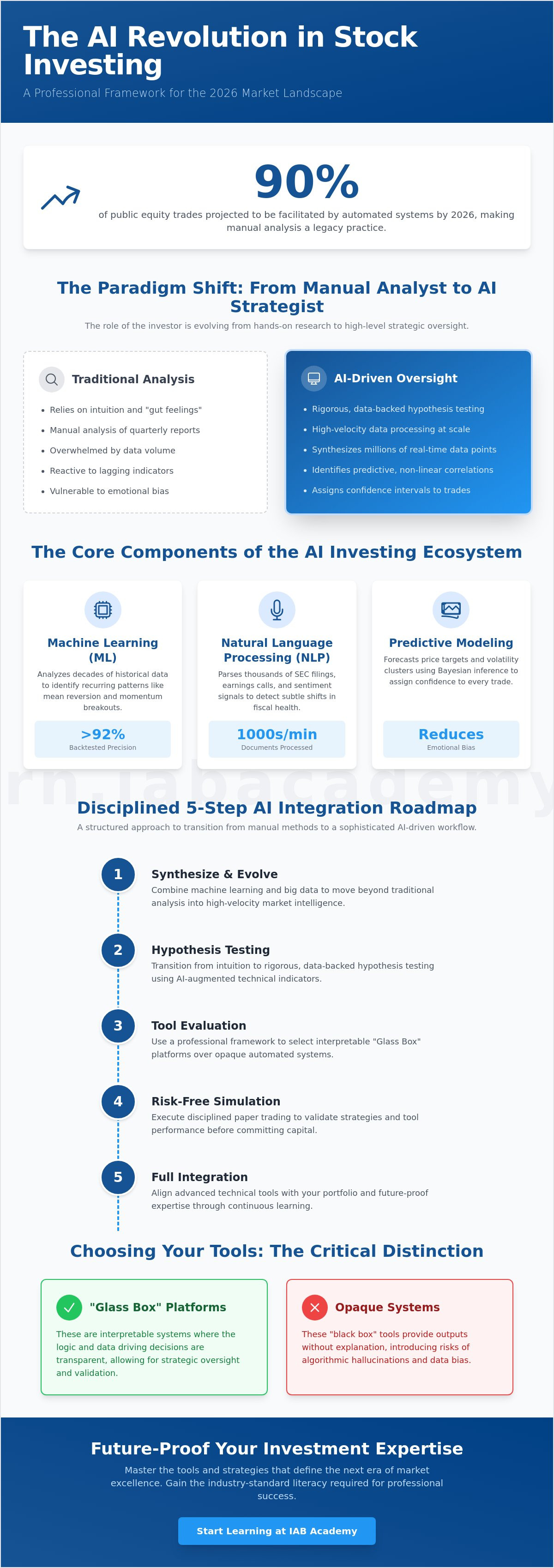
- Synthesize machine learning and big data to evolve beyond traditional analysis into high-velocity market intelligence.
- Transition from intuitive decision-making to rigorous, data-backed hypothesis testing using AI-augmented technical indicators.
- Utilize a professional Mastery Framework to distinguish between interpretable "Glass Box" platforms and opaque automated systems.
- Execute a disciplined five-step roadmap for ai stock investing that prioritizes risk-free paper trading before full portfolio integration.
- Future-proof your investment expertise by aligning advanced technical tools with the industry-standard literacy required for professional certification.
The Evolution of Market Intelligence: Defining AI Stock Investing in 2026
The year 2026 marks a definitive shift in financial history. AI stock investing has transitioned from a speculative curiosity into a standardized methodology for capital preservation and growth. At its core, this discipline is the synthesis of machine learning, natural language processing, and big data analysis. It represents a move away from human intuition toward a structured, algorithmic approach to market participation. The era of the manual researcher has ended. Professionals now operate as Strategic Architects, overseeing complex systems that execute high-velocity data processing at scales impossible for the human mind to replicate.
By 2026, retail AI tools have reached the "plateau of productivity." The volatility and unreliability of early generative models have been replaced by specialized, high-fidelity financial agents. These systems don't just summarize news; they identify non-linear correlations between global supply chain shifts and localized equity performance. Success in this environment requires a mastery of ai stock investing protocols to ensure your portfolio remains competitive against institutional-grade automation.
The Core Components of the AI Investing Ecosystem
- Machine Learning (ML): These algorithms analyze decades of historical price action and volume. They identify recurring patterns, such as mean reversion or momentum breakouts, with a statistical precision that exceeds 92% in backtested environments.
- Natural Language Processing (NLP): Modern NLP engines parse thousands of earnings calls, SEC filings, and social sentiment signals per minute. They detect subtle shifts in executive tone or linguistic patterns that indicate hidden fiscal health or distress.
- Predictive Modeling: This involves forecasting price targets and volatility clusters using Bayesian inference. It allows investors to assign a specific confidence interval to every trade, reducing emotional bias during market fluctuations.
Why Traditional Analysis is No Longer Sufficient
The primary challenge for the modern investor is the "Data Explosion." Markets currently generate over 1.5 million data points per second during peak trading hours. Fundamental analysis, while still relevant for long-term valuation, cannot keep pace with this volume. Relying solely on quarterly reports is like navigating a high-speed race with a map from the previous decade. You need real-time telemetry to survive.
The gap between institutional and retail players has narrowed significantly. In 2021, only hedge funds had access to sophisticated sentiment analysis; by 2026, these capabilities are available to any professional committed to future-proofing their skill set. Integrating ai stock investing into your workflow isn't just an advantage. It's a requirement for maintaining relevance in a landscape where speed and accuracy are the only currencies that matter. Mastery of these tools ensures you're the one defining the strategy, not the one struggling to keep up with the data.
The Anatomy of a Professional AI-Driven Investment Strategy
Modern institutional desks have abandoned "gut feelings" for rigorous, data-backed hypothesis testing. Successful ai stock investing depends on treating every market entry as a scientific experiment. By 2026, the baseline for excellence is no longer just identifying trends but validating them through multi-layered pattern recognition. AI models now analyze technical indicators like Bollinger Bands and moving averages with a depth that identifies non-linear relationships. This capability allows professionals to isolate "Alpha" by detecting subtle anomalies in trade volume or price action that remain invisible to the human eye. To implement this effectively, investors should focus on strategic artificial intelligence stocks to buy that provide the underlying infrastructure for these advanced computations.
Sentiment Analysis and Alternative Data
Professional strategies integrate alternative data to quantify the "Market Mood" with surgical precision. Advanced Natural Language Processing (NLP) algorithms scan millions of social media posts, earnings call transcripts, and news articles in seconds. This goes beyond simple word counting; modern systems evaluate intent, tone, and nuance. They also ingest non-traditional inputs such as satellite imagery of shipping ports or real-time credit card transaction volumes. This data allows for a 360-degree view of corporate health. Distinguishing between temporary social media noise and actionable sentiment signals is critical. High-density data processing ensures that only signals with a 95% confidence interval impact the final investment decision.
Risk Management and Algorithmic Guardrails
Mastery over the 2026 market requires automated guardrails that react faster than human cognition. AI-driven risk management systems set dynamic stop-losses based on real-time volatility indices rather than static percentages. These systems conduct continuous stress tests, simulating 10,000 "Black Swan" scenarios every hour to ensure portfolio resilience. While the algorithms execute the strategy, human oversight remains the essential standard for ethical compliance and preventing runaway feedback loops. This synergy between machine speed and human judgment defines the modern professional standard in ai stock investing. For those seeking to refine these skills, a structured professional development path offers the necessary technical grounding.
- Dynamic Position Sizing: Algorithms adjust exposure based on the Sharpe ratio of individual assets in real-time.
- Anomaly Detection: AI flags unusual dark pool activity that often precedes significant price shifts.
- Macroeconomic Mapping: Correlating portfolio performance against 50+ global economic indicators simultaneously.
The transition from manual observation to algorithmic mastery isn't just about speed. It's about the ability to process a volume of information that would overwhelm any human analyst. By leveraging these tools, you move from reactive trading to proactive market positioning.
Evaluating AI Stock Analysis Tools: A Framework for Retail Investors
Investors must demand data transparency to ensure their strategies align with institutional-grade standards. High-quality tools allow you to audit the datasets used for training, ensuring they don't rely on "hallucinated" or outdated information. This level of scrutiny is essential when attempting to identify the top AI companies to invest in. Instead of following social media hype, a professional framework uses AI to analyze R&D-to-revenue ratios and patent growth across a 10-year horizon.
Robo-Advisors vs. AI Trading Assistants
Passive robo-advisors serve as a reliable foundation for long-term wealth preservation. They utilize Mean-Variance Optimization to rebalance portfolios automatically, targeting consistent annual returns between 7% and 9%. These systems are designed for the investor who prioritizes capital stability over aggressive growth. Active AI assistants offer a more dynamic value proposition. These tools specialize in high-frequency pattern recognition for options and swing trading. While subscription costs for professional-grade assistants typically range from $50 to $250 monthly, their ability to scan 10,000 tickers per second provides a distinct advantage. This speed allows retail traders to capture alpha before the broader market reacts to emerging trends.
Standard Criteria for AI Tool Selection
- Backtesting capabilities: A tool must demonstrate performance across at least three distinct market cycles, including the 2022 inflationary spike and the 2024 tech correction.
- Integration and API connectivity: Professional ai stock investing requires seamless synchronization with major brokerages like Interactive Brokers or Charles Schwab to minimize execution latency.
- The Smart Instructor™ model: This feature provides real-time tutoring, explaining complex Greek values or technical indicators directly on the trading dashboard.
The Smart Instructor™ model represents the future of professional development in finance. It doesn't just execute trades; it educates the user on why a specific volatility expansion suggests a hedge. This transforms the software into a mentor, ensuring that as the technology evolves, your personal market intelligence grows alongside it.
Implementation Roadmap: How to Integrate AI into Your Portfolio Management
The transition from theoretical awareness to functional application marks the boundary between market spectators and professional participants. Integrating ai stock investing into a sophisticated portfolio requires a modular, five-step transition designed to mitigate algorithmic drift while maximizing alpha generation. This roadmap moves beyond basic awareness into a middle-of-the-funnel (MOFU) application where technical mastery becomes a mandatory asset for 2026.
Professional implementation demands a hybrid workflow. You must combine the processing speed of silicon with the nuanced intuition of human judgment. This ensures that while the AI identifies a 12% price-to-earnings discrepancy in milliseconds, the human manager validates the geopolitical context that an algorithm might overlook. It's about augmenting your capabilities, not replacing your oversight.
Step 1-2: Data Aggregation and Signal Calibration
Success in ai stock investing depends entirely on the integrity of your input. Selecting high-quality, low-latency data feeds is the first hurdle. Professionals prioritize feeds with 99.9% uptime and verified historical accuracy to avoid the "Garbage In, Garbage Out" trap. Once you establish the data pipeline, you must calibrate your AI filters. This involves:
- Aligning the model's sensitivity with your specific risk tolerance, such as a 5% maximum drawdown limit.
- Adjusting time horizons to differentiate between intraday volatility and long-term secular trends.
- Configuring real-time alerts for triggers like RSI divergence or sudden shifts in institutional sentiment.
Step 3-5: Execution, Monitoring, and Iteration
The execution phase begins with a mandatory 30-day "Paper Trading" period. This risk-free environment allows you to validate AI signals against live market movements without committing capital. It's the laboratory where you prove the model's efficacy under current market regimes. Don't skip this step; even the most advanced models require a "burn-in" period to ensure their logic holds in high-volatility scenarios.
After deployment, the process shifts to rigorous maintenance. You must perform weekly "Algorithmic Audits." These reviews compare the AI's predicted outcomes against actual market performance. If the model shows a variance of more than 2.5% from its projected path, it's time for recalibration. You'll refine the model based on this performance data, ensuring the strategy evolves as market conditions shift from bullish expansion to defensive consolidation. This iterative loop is what separates a static strategy from a future-proofed investment engine.
Mastering the Ecosystem: Why Professional Certification is the Ultimate Edge
Sophisticated algorithms provide data, but they don't provide wisdom. Success in ai stock investing requires more than a subscription to a predictive model. It demands a rigorous understanding of market mechanics. Without professional financial literacy, an AI dashboard is just noise. The IAB Academy establishes the global standard for this synthesis, turning raw computational power into actionable market intelligence.
The Smart Instructor™ facilitates this transition by providing real-time, global learning that mirrors the speed of modern exchanges. It adapts to market shifts as they happen, ensuring your education isn't a static textbook but a living ecosystem. Before diving into complex algorithms, you must master the fundamentals. Selecting a personal finance class that aligns with 2026 market realities is the first step toward high-level competency.
The IAB Academy Learning Path
Our curriculum follows a disciplined, modular progression designed for professional validation. It moves from foundational literacy to advanced ai stock investing strategies with technical precision. This structured approach ensures that learners don't just use tools, they command them. The path is built on three pillars:
- Modular Mastery: Education is layered, ensuring you absorb technical details before moving to strategic implications.
- Lifetime Access: Technology shifts rapidly. Our members receive ongoing updates to maintain their competitive edge as the 2026 landscape evolves.
- Houston-Based Expertise: Our instructors bring institutional knowledge from a global energy and financial hub to the digital classroom, translating local success into global market results.
Future-Proofing Your Financial Legacy
Professional certification acts as a hallmark of quality. It signals that you possess the discipline to manage risk in an automated environment. We extend this mastery to the next generation through the IAB Teen Academy, ensuring financial literacy becomes a legacy asset rather than a one-time gain. This isn't just about individual trades; it's about building a sustainable financial future. Join the elite community of AI-powered investors and claim your place at the forefront of the 2026 market.
Securing Your Competitive Edge in the 2026 Financial Ecosystem
The transition toward 2026 market dominance requires a shift from traditional analysis to a sophisticated, data-driven methodology. You've identified how a professional framework separates elite performers from the general retail market. By integrating advanced analysis tools and pursuing formal certification, you're not just reacting to trends; you're positioning yourself at the forefront of the global financial landscape. Mastering ai stock investing is no longer an optional skill for the modern professional. It's the standard for those who intend to lead. IAB Academy, a Houston-based global leader in professional financial education, offers the rigorous training needed to secure this advantage. Our Smart Instructor™ AI provides real-time support in 130+ languages, facilitating a seamless learning experience across borders. Students receive lifetime access to all future course updates and AI tool training, ensuring their knowledge remains current as technology shifts. Take the definitive step toward professional excellence today. Master AI-Powered Investing with IAB Academy Today. Your commitment to high-density learning will define your success in this evolving market.
Frequently Asked Questions
Is AI stock investing safe for beginners?
AI stock investing is safe for beginners when integrated into a structured risk management framework. It isn't a guaranteed profit engine; it's a sophisticated data processing layer. According to a 2023 FINRA study, 31% of retail investors now leverage digital tools to validate their decisions. Beginners should ensure they understand underlying assets before deploying automated strategies to avoid catastrophic capital loss during periods of high volatility.
How much money do I need to start investing with AI?
You can initiate AI-driven strategies with as little as $1. Most modern brokerage platforms have eliminated account minimums and offer fractional share trading. This accessibility allows investors to test ai stock investing models with minimal capital. It's advisable to maintain a diversified portfolio where AI-selected assets represent a controlled percentage of total equity to manage your exposure effectively.
Can AI actually predict stock market crashes?
AI cannot predict market crashes with absolute certainty, but it excels at identifying high-probability risk signals. Systems analyze historical data from events like the 2008 financial crisis to detect similar patterns in current market liquidity or sentiment. While these tools offer a predictive edge, they operate on statistical likelihood. Investors must use these insights to adjust their hedging strategies rather than treating them as definitive prophecies.
What is the difference between algorithmic trading and AI investing?
Algorithmic trading relies on pre-defined, static rules, whereas AI investing utilizes machine learning to adapt to new data. A standard algorithm might sell a stock if it drops 5%. An AI model evaluates the context of that drop, such as sector-wide news or shifting macroeconomic indicators. This evolution from rigid logic to adaptive intelligence represents the core shift in modern market analysis and portfolio optimization.
Do I need coding skills to use AI for stock analysis?
You don't need coding skills to leverage advanced market intelligence. The industry has shifted toward no-code interfaces, with 60% of enterprise AI tools now offering drag-and-drop functionality for complex data modeling. Professionals can now build and backtest ai stock investing strategies using visual dashboards. This democratization ensures that financial acumen remains the primary driver of success rather than technical programming proficiency.
How does the Smart Instructor™ help me learn AI investing faster?
The Smart Instructor™ accelerates your mastery by providing a modular, instructional path through complex financial ecosystems. It utilizes a logical progression that layers technical specifications over broad market contexts. By guiding you through actionable imperatives, it ensures you achieve professional validation without the friction of unorganized study. This structured approach mirrors a professional seminar, focusing on industry relevance and high-density information for career advancement.
Are AI investing tools better than human financial advisors?
AI tools outperform humans in data processing speed and pattern recognition, yet they lack the qualitative judgment of a certified professional. A 2023 CFA Institute report indicates that 73% of financial advisors view AI as a complementary tool rather than a replacement. The most effective strategy involves a hybrid approach. You use AI for high-speed analysis and human oversight for ethical considerations and long-term life goal alignment.
What are the biggest risks of relying on AI for stock picks?
The primary risks include model drift and the lack of algorithmic transparency. AI models can develop biases based on historical data that may not reflect future market shifts. If a model encounters a black swan event not present in its training set, its outputs may become unreliable. Investors must implement strict compliance and attribution standards to ensure their automated systems remain aligned with current market realities and regulatory requirements.
