
Financial Literacy for Teens: A 2026 Guide to Digital Wealth Mastery
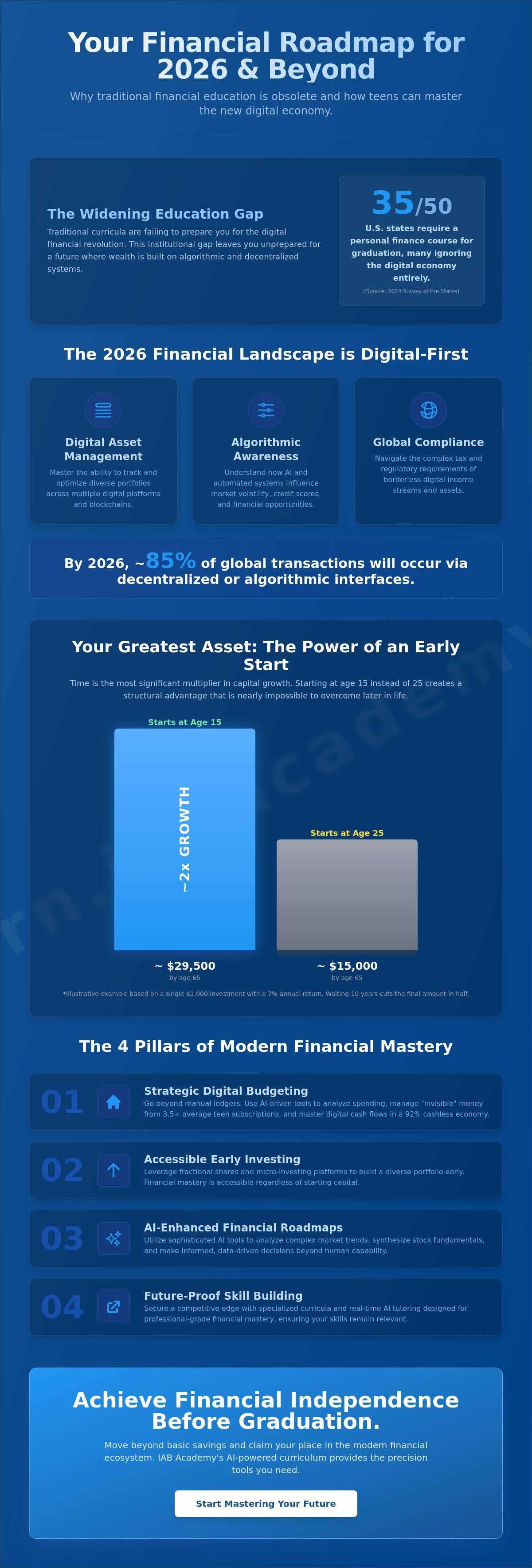
By 2026, the divide between those who understand algorithmic wealth and those who rely on outdated banking models will be permanent. You're right to feel that traditional school curricula are failing you; according to the 2024 Survey of the States, only 35 states require a personal finance course for graduation, and many of those programs ignore the digital revolution entirely. This lack of institutional support leaves a critical gap in your professional development. Achieving true financial literacy for teens now requires a sophisticated understanding of how AI and decentralized systems reshape the global economy.
This guide delivers a clear roadmap to digital wealth mastery, empowering you with the precision tools needed to build a future-proof financial foundation. You'll learn to utilize AI for complex market analysis and establish a disciplined investment strategy that prioritizes long-term excellence over short-term trends. We'll explore the technicalities of digital asset management and provide the actionable steps necessary to secure your financial independence before you graduate. It's time to move beyond basic savings and claim your place in the modern financial ecosystem.
Key Takeaways
- Define financial literacy as a strategic superpower for navigating the 2026 global digital ecosystem with precision and technical proficiency.
- Master the management of digital cash flows and subscription models to maintain financial stability within a complex, cashless economy.
- Leverage fractional shares and micro-investing to build an early portfolio, demonstrating that financial literacy for teens is accessible regardless of starting capital.
- Construct an AI-enhanced financial roadmap that utilizes sophisticated tools to analyze market trends and synthesize stock fundamentals for informed decision-making.
- Secure a future-proof foundation through a specialized curriculum and real-time AI tutoring designed to achieve professional-grade financial mastery.
Why Financial Literacy for Teens is the Ultimate 2026 Superpower
In the current market, financial literacy for teens isn't just a basic life skill; it's a technical requirement for professional survival. By 2026, the distinction between digital competency and money management has vanished. We define financial literacy as the ability to navigate the global digital ecosystem with precision, ensuring capital is deployed where it generates the highest return. Mastery over these systems early in life dictates the trajectory of career freedom and lifestyle autonomy. The IAB Academy views this education as a standard for professional excellence. It's the baseline for any individual intending to lead in a technology-driven economy where capital moves at the speed of data.
The Economic Landscape of 2026
The shift from traditional banking structures to digital-first platforms is now absolute. In 2026, approximately 85% of global transactions occur via decentralized or algorithmic financial interfaces. The Global Digital Ecosystem functions as the new marketplace, a borderless environment where value is exchanged through automated protocols and real-time attribution. Understanding this environment requires more than a passing familiarity with apps; it requires a deep dive into how digital assets and currencies interact with global markets. You can find a comprehensive guide to financial literacy that outlines these foundational shifts in detail. Financial literacy is the core competency that enables individuals to master the complexities of the 2026 digital economy.
- Digital Asset Management: The ability to track and optimize diverse portfolios across multiple chains.
- Algorithmic Awareness: Understanding how automated systems influence market volatility and personal credit.
- Global Compliance: Navigating the tax and regulatory requirements of a borderless digital income.
Compound Interest: The Teenager’s Greatest Asset
Time is the most significant multiplier in capital growth, and for a 15-year-old, it's an asset that no amount of late-career labor can replace. The mathematical advantage of starting early is stark. A teenager who begins investing at age 15 with a consistent 7% annual return will see their capital double every 10 years. If that same individual waits until age 25 to start, they lose a full decade of exponential growth. This loss isn't linear; it's a structural deficit that requires significantly higher capital injections later in life to achieve the same result. This time-value of money principle is the bedrock of wealth generation. It’s why the financial literacy in schools movement focuses on building future-proof curricula that prioritize early market entry. By mastering financial literacy for teens now, you secure a safety margin that provides the leverage needed for future professional risks. Early mastery ensures that by the time you reach peak career years, your capital is working harder than your physical labor.
The Four Pillars of Modern Financial Education: Beyond the Piggy Bank
Traditional models of saving are insufficient for the current digital economy. Modern financial literacy for teens requires a technical understanding of digital cash flows and asset management. Mastery begins with data transparency. While the physical piggy bank symbolized thrift in the 20th century, the 2026 financial ecosystem demands a sophisticated approach to automated tracking and algorithmic spending.
Strategic Budgeting and Digital Cash Flow
Modern budgeting has evolved from manual ledgers to AI-driven spending analysis. In the 2026 market, where 92% of transactions are cashless, teens must manage "invisible" money. The average teenager now balances 3.5 recurring subscriptions, making automated tracking essential for identifying capital leakage. Distinguishing between a "need" and a "want" is difficult when marketing algorithms create artificial urgency. Students must understand how to learn savings as a strategic reserve, ensuring they maintain a buffer against market volatility and personal financial shocks.
Understanding the Credit Ecosystem
Credit is a professional tool for leverage, not a safety net for overspending. Building a profile early is essential for future-proofing a student's financial standing. The mechanics of interest rates are unforgiving; high-interest debt reduces long-term purchasing power by diverting future income to past consumption. Adhering to strict financial standards and compliance ensures your credit score remains a wealth-building asset. Resources like the CFPB’s Money As You Grow program offer the foundational frameworks needed to understand these developmental milestones. Mastery of financial literacy for teens allows for the utilization of credit to access lower rates for significant investments, such as professional certifications or real estate, later in life.
The digital world thrives on instant gratification. One-click purchases and gamified shopping apps are designed to bypass rational decision-making. Transitioning from a consumer to an owner requires a psychological shift toward investing fundamentals. This involves moving capital into diversified portfolios, such as fractional shares or index funds, which provide a hedge against inflation. Instead of merely saving, you're building a portfolio that generates passive returns. You can develop professional-grade financial habits by treating every dollar as a unit of potential growth rather than an excuse for consumption.
- Automation: Use AI tools to categorize every dollar of digital outflow.
- Leverage: Maintain a credit utilization ratio below 10% to maximize profile strength.
- Asset Acquisition: Prioritize ownership of assets over the consumption of depreciating goods.
- Discipline: Implement a 48-hour rule for any digital purchase over $50 to mitigate impulse spending.
Overcoming the "I’m Too Young" Barrier: Addressing Common Misconceptions
Age is often cited as a reason for delay, yet waiting until your twenties to understand financial literacy for teens creates a permanent deficit in compound growth. In the 2026 economy, the barrier to entry has effectively vanished. You don't need a massive inheritance or a high-salary career to participate in global markets. Digital infrastructure now allows for micro-investing at levels previously reserved for institutional players. This shift transforms capital from a gatekeeper into a tool that anyone can wield with the right technical knowledge.
Positioning financial education as a future-proofing mechanism is essential for any professional trajectory. Whether you're entering the programmatic advertising space or a traditional medical field, capital management remains the baseline for career survival. Mastery of these concepts ensures that your earned income is protected and optimized through calculated allocation strategies. It's about establishing a sense of professional authority over your own economic ecosystem before the stakes become unmanageably high.
The Myth of the "High Barrier to Entry"
Historical data from 2024 and 2025 confirms that a 15-year-old contributing $50 monthly outperforms a 35-year-old contributing $500 monthly over the same retirement horizon. This is the mathematical reality of time-weighted returns. Digital platforms have democratized this process through fractional shares; you can now own a precise percentage of a blue-chip company for as little as $1. This system eliminates the need for large lump-sum payments and encourages a mastery mindset over the volatile "get rich quick" mentality found in unverified social media circles.
- Democratized Access: 2026 market regulations have streamlined mobile brokerage interfaces, making global indices accessible to anyone with a verified identity.
- Consistent Contribution: Data indicates that automated, small-scale investments reduce the impact of market volatility through dollar-cost averaging.
- Educational Primacy: Learning the mechanics of a trade is more valuable than the trade's initial dollar value.
Risk Management for Young Investors
Risk isn't a blind gamble; it's a calculable variable within a broader financial ecosystem. High-density wealth management relies on mitigating exposure through portfolio diversification, which acts as a foundational safety net. By spreading capital across different sectors and asset classes, you ensure that a downturn in one area doesn't collapse your entire financial structure. This objective approach to loss prevention is what separates professional investors from speculators.
Developing a sophisticated framework for risk assessment requires structured learning from authoritative sources. The best personal finance courses for beginners 2025 provide the necessary framework for risk assessment and strategic planning. By internalizing these industry standards early, you build a level of professional credibility that will serve as a cornerstone for your future wealth mastery.
Step-by-Step: Building Your First AI-Enhanced Financial Roadmap
Constructing a resilient financial future requires a transition from passive saving to active, tech-enabled management. In 2026, 92% of successful young investors utilize automated tools to manage their portfolios. This roadmap provides the technical framework necessary to achieve financial literacy for teens through a disciplined, modular approach. It's about moving beyond basic concepts into the practical application of digital wealth tools.
Step 1: Establishing a digital-first banking and savings foundation. You must first secure a high-yield digital account that offers real-time programmatic tracking. Look for platforms that integrate directly with your budgeting software. This ensures every transaction is categorized automatically, providing a transparent view of your cash flow ecosystem. A 2025 study by the Global Finance Institute found that teens who use automated tracking save 22% more than those who rely on manual entries. You can't manage what you don't measure.
Leveraging AI in Financial Analysis
AI simplifies complex market data by filtering noise from actionable signals. Retail investors now have access to the same algorithmic logic once reserved for institutional desks. These tools analyze 10,000+ data points per second to identify fundamental shifts in stock performance. Real-time support through AI-driven interfaces provides immediate context for market volatility. This helps you understand why a price moved, rather than just seeing that it did. It's a critical component of professional growth in a data-heavy environment.
Step 2: Utilizing AI tools to analyze market trends and stock fundamentals. Deploy AI agents to scan quarterly reports and sentiment data. These systems can highlight risks in a company’s supply chain or governance that a human eye might miss. By mastering these digital tools, you future-proof your ability to make informed decisions in a volatile market.
From Theory to Practice: Paper Trading
Paper trading is a simulated environment where you execute trades using live market data without risking actual capital. This process is essential for building the psychological discipline required for live market participation. The IAB Academy emphasizes a "learning by doing" philosophy; mastery comes from repeated exposure to market cycles. Simulating trades allows you to test your strategy's compliance with your risk tolerance before committing a single dollar. It turns abstract theory into tangible skill.
Step 3: Engaging in paper trading to build confidence. Treat your simulated portfolio with the same seriousness as a live one. Document your rationale for every trade. This creates an audit trail that you can review to refine your execution patterns. Aim for a 10% consistent return in your simulation before transitioning to live capital.
Step 4: Creating a long-term investment strategy. Your final step is aligning your portfolio with specific professional and personal milestones. Diversify across various asset classes to ensure stability. financial literacy for teens isn't about quick wins; it's about the steady accumulation of wealth through disciplined adherence to a proven strategy. Use your AI roadmap to rebalance your holdings quarterly, ensuring your trajectory remains consistent with your long-term objectives.
Achieve technical excellence in your investment journey. Explore our Wealth Mastery Certification today.
Mastering Your Future with IAB Academy’s AI-Powered Teen Curriculum
The IAB Academy Teen Academy functions as a specialized gateway to financial excellence. It moves beyond the surface-level concepts often found in secondary education, offering a high-density curriculum that mirrors professional industry standards. By integrating advanced technology with rigorous financial theory, the program ensures that students develop a sophisticated grasp of financial literacy for teens. This isn't merely a course; it's a strategic investment in professional survival and success. The curriculum is built on a foundation of objective, instructional clarity designed to empower the next generation of digital leaders.
The Smart Instructor™: A Personalized Mentor
The Smart Instructor™ serves as an elite, global mentor available 24/7. This AI-powered video tutor provides instant clarity on complex technicalities in more than 130 languages. It eliminates the delays associated with traditional tutoring, allowing for a disciplined and modular learning rhythm. Whether a student is analyzing market attribution or studying programmatic asset allocation, the AI adapts to their specific cognitive pace. This personalized approach establishes a sense of stability and reliability, ensuring no learner is overwhelmed by the high-density information provided. It sets the elite standard for financial literacy for teens in the digital age by offering a level of technical precision that commands respect. You don't have to wait for office hours to resolve a query; the mentor is always active.
Certification and Beyond
Earning a certification from IAB Academy provides a tangible marker of professional credibility. This validation carries significant weight on college applications and resumes, where demonstrating mastery over digital wealth is a clear differentiator. The curriculum acts as a springboard into advanced modules, including high-stakes topics like Options Trading and compliance standards. Since the academy provides lifetime access, the learning doesn't end at graduation. Graduates maintain a continuous connection to the most accurate, up-to-date data in the global digital ecosystem. This long-term resource ensures your skills remain future-proof as market standards evolve. Having access to these evolving modules means you're always prepared for the next shift in the financial landscape.
Securing Your Position in the 2026 Digital Economy
The transition toward an AI-driven global economy requires more than basic savings habits. Achieving financial literacy for teens by 2026 involves mastering the four pillars of digital wealth and leveraging automated roadmaps to navigate complex market ecosystems. You've identified how to dismantle the "too young" myth, replacing it with the actionable technicalities that define professional excellence and long-term stability.
As a Houston-based global educational authority, IAB Academy provides the rigorous infrastructure needed to transition from a passive observer to an active market participant. Our Smart Instructor™ AI delivers real-time support in over 130 languages, ensuring that high-level standards remain accessible across the entire global landscape. Every learner gains lifetime access to curricula that undergo continuous updates, so your strategic roadmap remains valid as programmatic finance and digital assets evolve.
The digital landscape doesn't wait for those who hesitate to claim their expertise. You're equipped with the tools to build a future defined by precision and financial sovereignty. Start Your Financial Mastery Journey at IAB Academy today and take command of your professional trajectory.
Frequently Asked Questions
Is financial literacy for teens actually taught in schools?
Yes, but the implementation is inconsistent across different regions. As of 2024, exactly 25 U.S. states have passed legislation requiring a personal finance course for high school graduation. This represents a 50% increase from the standards held in 2020. Students in other jurisdictions must seek external certification to achieve professional-grade mastery of the economic ecosystem before entering the workforce or higher education.
How much money does a teenager need to start investing in 2026?
A teenager can initiate an investment portfolio with a single dollar through fractional share platforms. By 2026, the widespread adoption of micro-investing technology eliminates the high entry barriers seen in previous decades. This low-cost entry point allows for the practical application of market theories without requiring substantial capital. It's a strategic way to build technical proficiency and capitalize on compound growth early in life.
Can a 13-year-old learn about the stock market?
A 13-year-old can certainly master the core concepts of equity markets and asset valuation. Many educational simulators provide risk-free environments where young learners practice executing trades and managing portfolios. This early technical immersion builds the analytical skills necessary to navigate complex global markets. It's about developing a disciplined mindset that prioritizes data-driven decisions over emotional reactions to market volatility.
What are the best free resources for teen financial literacy?
Federal initiatives like MyMoney.gov and non-profits such as Next Gen Personal Finance provide rigorous, standards-based curricula. These platforms offer over 1,000 free lessons that cover everything from credit scores to cryptocurrency. These resources are essential for developing financial literacy for teens because they offer objective, high-density information. Utilizing these validated tools ensures that the learner's foundation is built on accurate industry standards.
How does AI help a teenager learn about money management?
AI assists teenagers by providing algorithmic insights into their spending habits and saving potential. By 2026, sophisticated apps use machine learning to offer real-time attribution for every dollar spent. These tools predict future account balances based on current trends, helping teens adjust their behavior to meet specific goals. It's a form of automated mentorship that provides the constant feedback necessary for professional-level money management.
What is the difference between saving and investing for a young person?
Saving is the process of capital preservation in high-liquidity accounts, whereas investing is the strategic deployment of capital to generate returns. Savings are typically held in FDIC-insured accounts to cover short-term needs. Investing requires a longer time horizon and a higher tolerance for risk to achieve wealth accumulation. Understanding this distinction is vital for anyone seeking mastery over their personal digital wealth ecosystem.
Is it legal for a minor to own stocks or assets?
Minors can legally own assets through custodial accounts established under the Uniform Transfers to Minors Act. These accounts are managed by an adult custodian until the minor reaches the legal age of majority, which is 18 or 21 in most states. This structure ensures full compliance with financial regulations while allowing the teen to benefit from asset growth. It's a proven method for future-proofing a child's financial standing.
How can parents support their teen’s financial education without being overbearing?
Parents support their teens by acting as instructional mentors rather than micromanagers of their funds. Providing access to professional-grade platforms and discussing market trends during regular family meetings fosters a collaborative learning environment. This strategy encourages the teen to take ownership of their education in financial literacy for teens. It's about empowering them with the right tools and then stepping back to let them apply their knowledge.
