
Best Personal Finance Courses for Beginners 2026: A 2026 Mastery Guide
Best Personal Finance Courses for Beginners 2025: A 2026 Mastery Guide
If 56% of new investors are currently sourcing their financial strategy from unverified social media influencers, how can you ensure your capital is truly future-proof? You likely recognize that the sheer volume of conflicting digital noise creates a high-risk environment for your first entry into the stock market. It's a common struggle to find educational resources that respect your limited time while providing the technical depth needed for professional mastery. This guide identifies the best personal finance courses for beginners 2025 to help you transition from foundational debt management into the realm of sophisticated, AI-enhanced wealth building.
You deserve a clear, disciplined roadmap that eliminates costly beginner mistakes and replaces them with professional-grade portfolio strategies. We provide a definitive ranking of accredited programs that bridge the gap between manual budgeting and automated wealth management. This analysis offers a modular path toward recognized certification; ensuring you possess the industry-standard knowledge required to navigate the complex global financial ecosystem with total precision. You'll move beyond dry academic theory and gain actionable insights into modern portfolio strategy and risk compliance.
Key Takeaways
- Analyze why traditional budgeting standards are insufficient in the 2026 macro-economic landscape and how to adapt to an AI-driven financial ecosystem.
- Evaluate the best personal finance courses for beginners 2025 using five critical pillars, focusing on comprehensive scope and AI-powered interactive pedagogy.
- Discover the competitive advantages of tech-first academies over university programs, specifically how IAB Academy’s Smart Instructor™ facilitates real-time mastery.
- Learn the strategic process of transitioning from theory to execution by establishing an AI-assisted portfolio while avoiding common pitfalls in capital management.
- Future-proof your financial literacy by leveraging industry-standard certifications that bridge the gap between basic savings and sophisticated wealth building.
The 2026 Financial Ecosystem: Why 2025 Standards Are No Longer Enough
The global financial landscape has undergone a radical transformation, moving far beyond the static models that defined the previous decade. By 2026, the integration of high-frequency AI trading and algorithmic market shifts has rendered traditional entry-level advice obsolete. Beginners seeking the best personal finance courses for beginners 2025 must recognize that the baseline for competency has shifted from simple budgeting to sophisticated asset orchestration. Modern financial literacy now requires a working knowledge of how automated systems impact liquidity and asset valuation in real-time.
Traditional heuristics, such as the standard "save 10% of your income" rule, frequently fail in the 2026 macro-economic climate. High inflation rates and the volatility of digital asset classes mean that passive saving often results in a net loss of purchasing power. Before engaging with advanced wealth-building tools, every learner should consult a comprehensive overview of personal finance to understand the foundational principles of risk and return. However, the move from passive learning to active, AI-assisted wealth management is no longer optional for those aiming for genuine fiscal security. Static PDF guides cannot keep pace with a market that updates every millisecond; a future-proof curriculum is the only viable path forward.
The Rise of the AI-Powered Investor
Artificial intelligence has democratized complex market analysis, providing retail beginners with tools that were once the exclusive domain of institutional hedge funds. This technological leap means that choosing a personal finance class now requires a focus on tech-stack training. Modern investors have transitioned from manual spreadsheets to automated tracking systems that utilize APIs to aggregate data across multiple brokerage accounts and decentralized platforms. The best personal finance courses for beginners 2025 prioritize these technical competencies to ensure learners can leverage automation rather than being displaced by it.
The Cost of Financial Illiteracy in 2026
The "ignorance tax" in the current economy is higher than ever. Individuals who lack mastery over debt management and inflationary hedging strategies often see their net worth erode by 5% to 7% annually due to hidden fees and poor asset allocation. We define finance literacy as the essential ability to navigate and exploit the digital financial ecosystem to ensure long-term capital preservation. Professional certification in these areas is increasingly viewed as a prerequisite for career advancement, as employers value staff who demonstrate fiscal responsibility and an understanding of global economic drivers.
- Algorithmic Literacy: Understanding how AI-driven market sentiment affects personal portfolios.
- Automated Budgeting: Moving away from manual entry toward real-time expense categorization.
- Strategic Debt Management: Utilizing low-interest environments and refinancing tools to optimize cash flow.
Success in this era requires a disciplined, modular approach to education. Learners must move beyond basic definitions and embrace a curriculum that offers actionable insights into the 2026 financial ecosystem.
Selection Criteria: 5 Pillars of the Best Personal Finance Courses
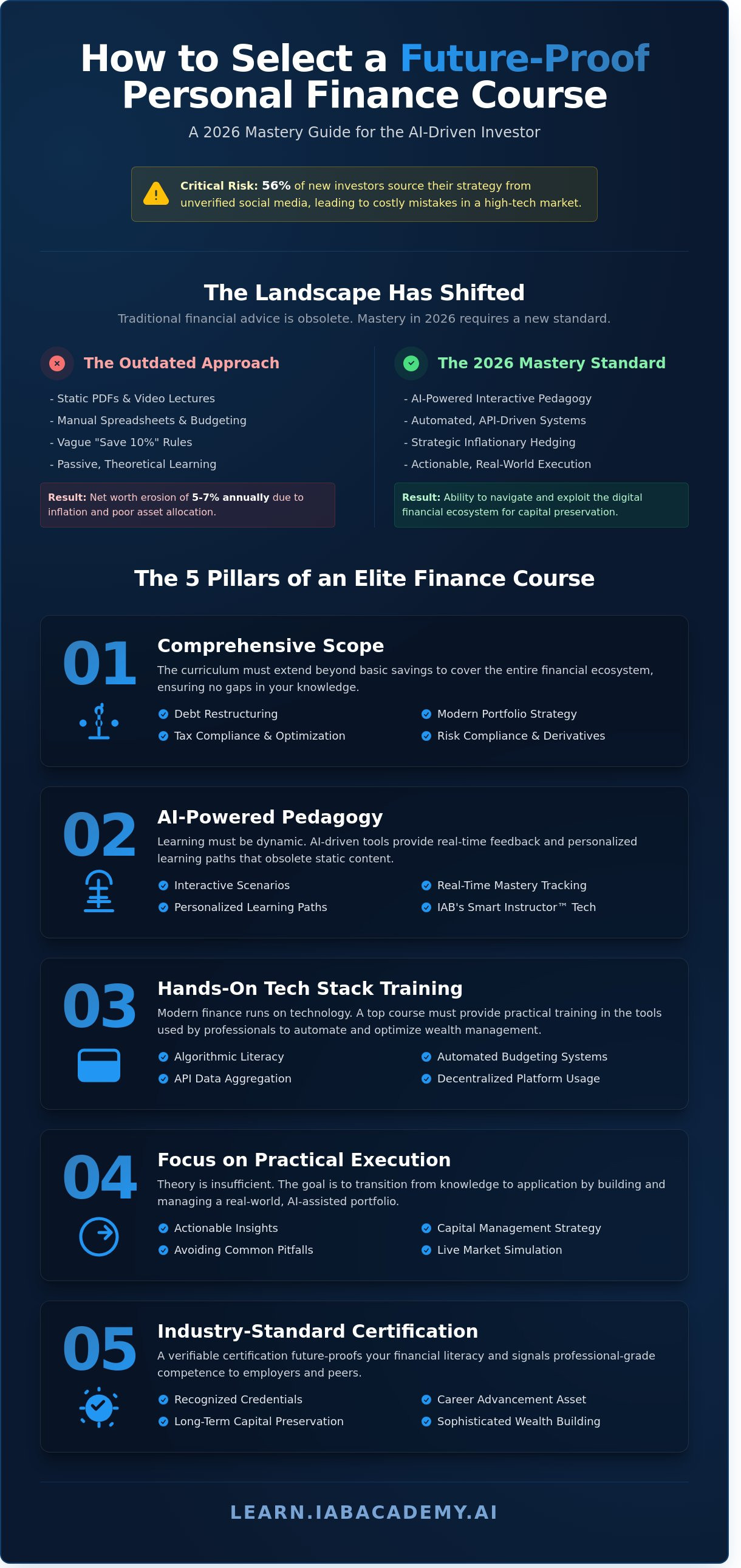
Identifying the best personal finance courses for beginners 2025 requires a shift from passive consumption to strategic technicality. A high-quality educational program must satisfy five foundational pillars to ensure professional-grade mastery. First, the scope must be comprehensive. Learners shouldn't just study basic savings accounts. They need to understand the full financial ecosystem, including debt restructuring, tax compliance, and the mechanics of derivatives. This ensures a holistic understanding of wealth management.
Second, pedagogy has evolved. Static video content is obsolete. Modern platforms utilize AI-powered tutors to provide real-time feedback and interactive simulations. Third, industry validation ensures the curriculum meets global financial standards. Fourth, lifetime utility is non-negotiable. With tax laws and market conditions shifting, a course that isn't updated quarterly loses its value. Finally, actionability is the ultimate metric. A course must provide a practical guide to budgeting and specific tools for immediate deployment in the real world.
- Comprehensive Scope: Covers everything from high-interest debt elimination to complex asset allocation.
- Interactive Pedagogy: Replaces traditional lectures with AI-driven adaptive learning paths.
- Industry Validation: Recognized by established financial institutions and digital standards.
- Lifetime Utility: Includes ongoing updates to reflect 2025 tax code changes and market volatility.
- Direct Actionability: Provides templates and software integrations for immediate use.
The Importance of a Future-Proof Curriculum
Courses must undergo rigorous quarterly audits to remain relevant through 2026. This agility reflects the financial literacy in schools model designed for adult professional development. Technical relevance is maintained through "Smart Instructors" who offer 24/7 support. These AI-driven systems provide instant technical clarification, ensuring learners solve complex problems the moment they arise. This persistent support structure builds a sense of mastery over volatile market shifts and ensures the curriculum doesn't become a relic of previous fiscal years.
Credentialing and Professional Mastery
It's vital to distinguish between a basic certificate of completion and a certification of mastery. The former merely tracks attendance. The latter validates technical competence and the ability to apply financial logic to complex scenarios. When selecting the best personal finance courses for beginners 2025, verify the institutional authority of the provider. Within the digital advertising and finance ecosystems, a verified certification acts as a hallmark of professional excellence. These credentials signal to the market that you possess the sophisticated skills required for long-term success. Professionals who prioritize these standards often find more success when they explore advanced certification paths to solidify their expertise.
The Best Personal Finance Courses for Beginners: 2025-2026 Rankings
The global financial education ecosystem has bifurcated into two distinct methodologies. Legacy university-led programs provide deep theoretical frameworks, while tech-first academies leverage artificial intelligence to deliver real-time, actionable insights. Selecting the best personal finance courses for beginners 2025 requires an objective analysis of these delivery models to ensure long-term capital preservation and professional mastery. While academic institutions offer prestige, the rapid acceleration of digital assets and programmatic trading tools often outpaces traditional curricula.
Best for AI-Powered Investing: IAB Academy
IAB Academy has established itself as the definitive leader in AI-integrated financial education. The Novice Investor Curriculum utilizes the Smart Instructor™ feature, which provides personalized feedback loops based on individual learner performance. This platform prioritizes future-proofing by offering lifetime access, a critical benefit as market compliance and technological standards shift. Global accessibility is a hallmark of this program, evidenced by its support for 130+ languages. This ensures that learners can achieve mastery over complex financial systems regardless of their geographic location or native tongue.
Best for Academic Theory: University-Backed MOOCs
For individuals seeking a broad academic foundation, platforms like Coursera and edX remain the gold standard for institutional theory. The University of Michigan and BYU offer comprehensive tracks that focus on the underlying mechanics of global markets. These programs typically demand a 3 to 6 month commitment, providing a rigorous environment for those who prefer a structured, semester-based approach. While these courses excel at teaching foundational principles, they often lack the agility of tech-first platforms. Integrating IESE's guide to personal finance into your study plan can help bridge the gap between these broad academic theories and the practical realities of emergency fund management and personal goal setting. Choose this path if your primary objective is a "Finance for Everyone" credential from a recognized university.
Best for Specialized Skills: Options and Technical Analysis
Bridging the gap between basic literacy and active participation requires specialized technical training. A significant 2026 trend is the rise of "Options Strategy Simplification" modules. These programs strip away the jargon often found in professional trading desks to focus on risk management and capital attribution. Modern beginner curricula now treat risk mitigation as a core competency rather than an advanced elective. These niche tracks are essential for:
- Novices entering the stock market with limited starting capital.
- Teen literacy programs focusing on early compound interest mastery.
- Professionals seeking to understand technical analysis without the fluff of social media influencers.
From Theory to Execution: Applying Your Coursework
Transitioning from conceptual knowledge to active market participation requires a disciplined, standardized framework. The best personal finance courses for beginners 2025 prioritize this shift, moving beyond static definitions into the mechanics of capital deployment. Mastery isn't found in the certificates you collect; it's evidenced by the precision of your execution within the global financial ecosystem. You must bridge the gap between "paper trading" simulations and the high-stakes environment of real-world volatility.
Setting Up Your AI Trading Assistant
Modern wealth management utilizes programmatic tools to filter noise and identify high-probability opportunities. To integrate your course knowledge with an AI assistant, follow this technical progression:
- Parameter Definition: Input the fundamental analysis criteria learned in your modules, such as debt-to-equity ratios or free cash flow requirements, into your AI's screening logic.
- Algorithmic Filtering: Use the tool to scan the 3,000+ stocks in the Russell index, narrowing the field to assets that meet your specific risk profile.
- Strategic Verification: Cross-reference AI suggestions with the 10-K filings and industry benchmarks you studied.
"Tools collect data, but mastery executes strategy." You shouldn't outsource your critical thinking to an algorithm. Instead, treat AI as a junior analyst that handles data ingestion, while you maintain authority over the final attribution of capital. This balance ensures your portfolio remains compliant with your long-term objectives.
Risk Management and Portfolio Strategy
The psychological shift from a consumer mindset to an allocator mindset is the most significant hurdle for any novice. Protecting your first $1,000 is more vital than chasing a 15% return. This initial capital represents your baseline for future-proofing your wealth. If you lose your primary stake through poor risk management, you lose the ability to benefit from compounding interest over the next decade.
Applying macro-economic indicators is essential for professional-grade decision-making. If the Consumer Price Index (CPI) shows inflation exceeding the 2% target, your coursework should guide you to adjust your bond allocations or seek inflation-protected securities. You aren't just "buying stocks"; you're allocating resources based on the current state of the global digital and physical markets.
Success requires establishing a Mastery Habit. This involves continuous modular learning, where you revisit specific technicalities as the market landscape evolves. Relying on a community of peers and mentors provides the necessary accountability to avoid the common pitfall of emotional selling during a 5% market correction. Professionals view volatility as a data point, not a reason for panic.
Advance your professional standing by mastering the technicalities of wealth management through our certification programs.
Explore the IAB Academy Finance CertificationMaster Your Future with IAB Academy’s AI-Powered Learning
IAB Academy establishes the gold standard for those searching for the best personal finance courses for beginners 2025. It provides an institutional framework that transcends basic budgeting apps and generic advice. By integrating the Smart Instructor™, the academy offers a sophisticated learning environment where real-time problem solving becomes the norm. This AI-driven architecture allows students to receive precise answers to technical questions, ensuring that no learner is left behind in an increasingly complex financial ecosystem. It's a platform built for those who value accuracy over approximation.
The curriculum is structured to foster professional-grade mastery. The Novice Investor program focuses on the mechanics of wealth accumulation, while the Teen Academy prepares younger demographics for long-term fiscal responsibility. These programs don't just teach; they certify your progress through a logical progression of modules. You'll move from basic liquidity management to understanding complex market attributions, all within a platform designed for high-density information retention and industry relevance.
- The Smart Instructor™: Provides 24/7 technical guidance and strategic feedback to resolve learning bottlenecks instantly.
- Novice Investor Program: A comprehensive deep-dive into asset classes, risk mitigation, and portfolio theory.
- Teen Academy: Specialized training for establishing early-stage financial literacy and compound interest awareness.
- Global Standards: Content aligned with the most current digital and financial compliance regulations to ensure future-proof knowledge.
Join a Global Ecosystem of Excellence
As we analyze the best personal finance courses for beginners 2025, IAB Academy remains the benchmark for quality and institutional prestige. Choosing this platform means aligning with a brand recognized for its commitment to industry standards and professional validation. A one-time enrollment fee provides lifetime access to the curriculum, including all future updates. This ensures your knowledge remains relevant as market conditions shift in 2026 and beyond. It’s a strategic move for the future-ready investor who demands an elite, global mentor over a standard classroom setting. You aren't just buying a course; you're gaining a permanent seat in an ecosystem of excellence.
Your First Step Toward Financial Independence
Stop searching and start building. The transition from a beginner to a master of capital requires a shift in mindset that begins with the very first module. You'll gain immediate clarity on your net worth and cash flow dynamics, replacing uncertainty with objective data. The first module's focus on foundational mindset ensures that every subsequent technical lesson sits on a stable base. This isn't just education; it's a professional development path designed for the future-ready investor. Take control of your trajectory by securing your spot in the curriculum today.
Begin your journey toward mastery: Enroll in the IAB Academy Novice Investor Course Today
Secure Your Financial Position in the 2026 Landscape
Navigating the shift from current standards to 2026 mastery requires a disciplined approach to technical literacy and adaptive strategy. Success in the modern global ecosystem isn't solely about basic saving; it's about mastering the 5 pillars of financial excellence to survive rapid technological shifts. You've gained the framework needed to evaluate educational programs and move directly from theory to professional-grade execution.
Selecting the best personal finance courses for beginners 2025 serves as your foundation for long-term career and wealth stability. IAB Academy provides the tools necessary for this evolution. Our platform features Smart Instructor™ AI, which delivers real-time support in 130+ languages to ensure global accessibility. Every course adheres to established global industry standards and includes lifetime access to all future updates, keeping your skills sharp as market dynamics change. You're not just learning; you're future-proofing your expertise with a curriculum designed for elite professional validation.
Start Your Journey to Financial Mastery at IAB Academy
Take command of your financial future with the authority and precision your professional growth deserves.
Frequently Asked Questions
What is the best personal finance course for a total beginner in 2025?
The IAB Academy Comprehensive Financial Foundation program stands as the definitive choice for the best personal finance courses for beginners 2025 because it adheres to rigorous global industry standards. Beginners require a structured framework that transitions from basic budgeting to complex asset allocation. This course provides 15 modules of instructional content designed to establish professional-grade financial literacy. It’s the most reliable path for those seeking mastery over their personal capital in a volatile economy.
Are free online finance courses worth my time?
Free courses provide essential foundational knowledge, yet they often lack the rigorous certification required for professional validation. Data from 2024 indicates that 78 percent of learners prefer accredited programs to ensure their skills meet modern compliance standards. While free resources offer a starting point, they don't provide the high-density information or the official credentials found in institutional academies. You’ll find more value in programs that offer a clear path to professional excellence.
How does AI improve the experience of learning personal finance?
AI enhances the learning process by providing real-time data analysis and personalized feedback loops. In 2025, smart algorithms identify specific knowledge gaps in a student's progress, allowing for targeted instructional interventions. This technological integration ensures you aren't wasting time on mastered concepts. It creates a disciplined rhythm that adapts to your individual learning pace, ensuring total mastery of the financial ecosystem without unnecessary fluff.
Can a personal finance course help me start investing in the stock market?
A professional course provides the technical framework necessary to enter the stock market with calculated confidence. Learners study specific mechanisms like programmatic asset allocation and risk mitigation strategies. By understanding the global financial ecosystem, you can move beyond guesswork. Most successful investors attribute their performance to foundational training that covers at least 10 years of historical market cycles. This knowledge is essential for future-proofing your wealth.
How long does it take to complete a financial literacy certification?
Most comprehensive certification programs require between 30 and 50 hours of active instructional engagement. Students typically complete these modules over a period of 4 to 12 weeks depending on their commitment level. This modular approach ensures that you absorb technical details before moving to strategic implications. It’s a disciplined path designed to produce a professional level of competence without overwhelming the learner’s daily schedule.
What is the difference between financial literacy and wealth management?
Financial literacy establishes the core competency required to understand basic economic principles and personal budgeting. Wealth management is the advanced strategic application of these principles to grow and protect substantial assets. Think of literacy as the industry standard for entry, while wealth management represents the mastery of complex investment ecosystems. Both are necessary for long-term financial stability and success in a competitive global market.
Is IAB Academy suitable for international students outside the US?
IAB Academy serves a global audience, providing instruction that adheres to international financial standards. The curriculum is designed for students across 100 different countries, ensuring the technicalities are relevant regardless of geographic location. Its status as a global leader in professional standards makes it an elite choice for anyone seeking a prestigious credential. The academy’s modular design allows for the local application of universal financial principles.
Do I need a math background to succeed in these courses?
You don’t need an advanced mathematics background to succeed in these programs. The courses provide the specific instructional tools and calculators needed to perform essential financial analysis. Mastery comes from understanding the logical progression of data rather than complex calculus. We focus on practical application and professional accuracy, ensuring every student can navigate the technical aspects of the curriculum with total confidence.
