
Choosing the Right Personal Finance Class for 2026: A Definitive Guide
If your current investment strategy ignores the 45% increase in AI-driven algorithmic trading projected for the 2026 economy, are you building wealth or simply managing its decline? You likely recognize that fragmented financial advice no longer suffices in a global digital ecosystem where speed and precision define success. Selecting a high-caliber personal finance class is no longer an elective pursuit; it's a strategic requirement for those who refuse to be left behind by rapid technological shifts.
We understand the frustration of trying to reconcile traditional stock market fundamentals with the intimidating rise of automated wealth management. This guide promises to bridge that gap by providing a structured path to financial mastery. You'll gain the practical skills required for AI-powered portfolio management and the professional certification needed to validate your expertise. We've distilled the essential criteria for a modern curriculum, ensuring you can transition from uncertainty to a state of calculated financial excellence.
Key Takeaways
- Define the transition from traditional banking to a global digital wealth ecosystem to establish a foundation for long-term financial autonomy.
- Identify the critical curriculum modules for 2026, where stock market fundamentals are integrated as a primary pillar of modern literacy.
- Learn how to accelerate your learning curve in a modern personal finance class by utilizing real-time AI tutors for instant clarity on complex market dynamics.
- Establish a rigorous framework for assessing educational ROI, prioritizing industry-recognized certifications that validate professional-grade mastery.
- Explore specialized instructional paths designed to future-proof financial capabilities through high-density investing programs tailored for the next generation of wealth.
What Is a Personal Finance Class and Why Is It Essential in 2026?
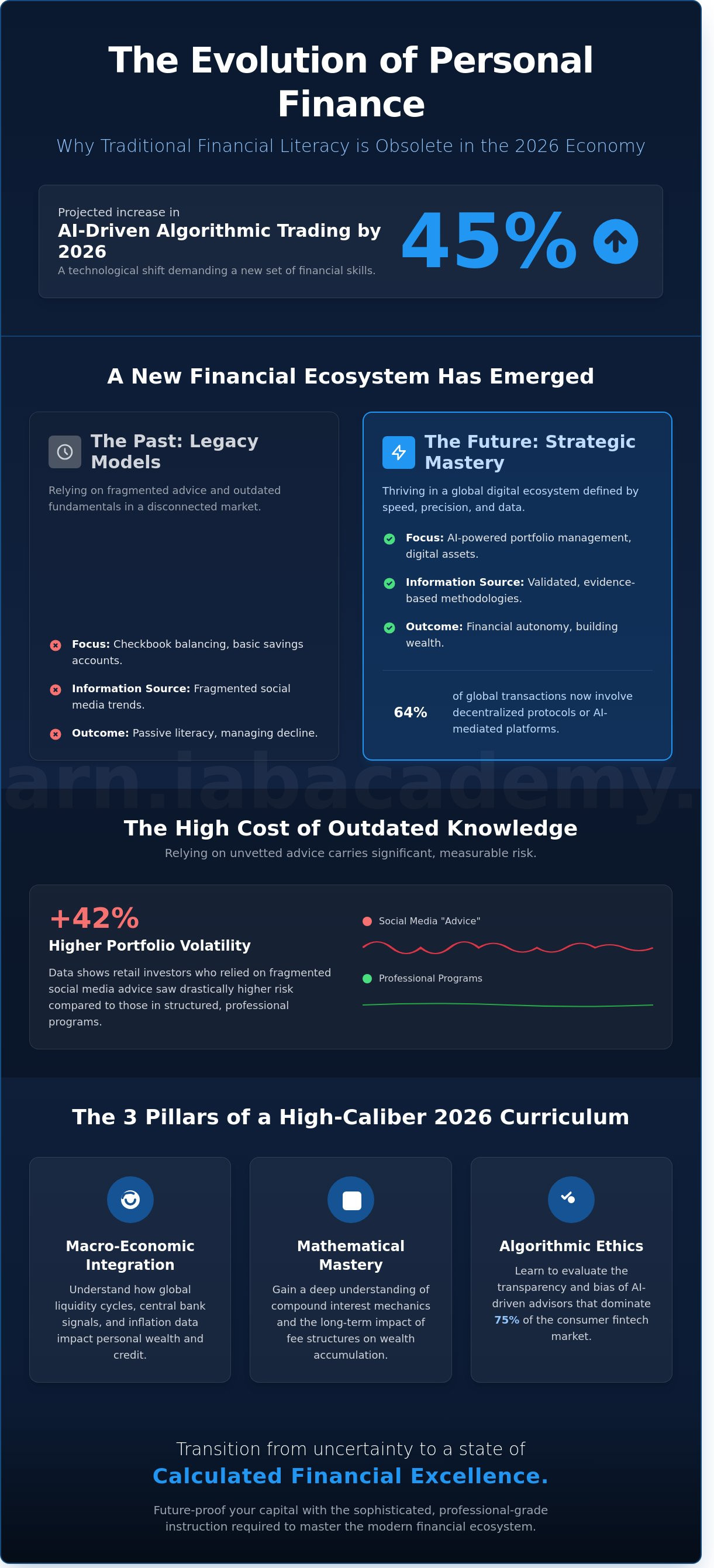
A modern personal finance class is no longer a remedial elective; it's a rigorous, structured path to financial autonomy. In 2026, the boundary between traditional banking and the global digital wealth ecosystem has dissolved. This requires a shift from passive literacy to active, strategic wealth management. Relying on legacy financial models is a liability when 64% of global transactions now involve decentralized protocols or AI-mediated platforms. Professional instruction provides the technical framework necessary to secure a competitive advantage in an increasingly volatile market.
To succeed, individuals must move beyond basic survival. They need a comprehensive overview of personal finance that integrates tax efficiency, automated portfolio rebalancing, and risk mitigation. This section establishes the baseline for what a high-caliber program must deliver to ensure professional-grade mastery.
The Evolution of Financial Education
Educational curricula have undergone a radical transformation. In 2018, the focus remained on checkbook balancing and basic savings accounts. By 2026, the standard has moved toward digital asset management and programmatic investment strategies. Data from 2025 indicated that retail investors who relied on fragmented social media advice saw 42% higher portfolio volatility than those trained in standardized programs. A professional personal finance class replaces viral trends with validated industry standards, ensuring that retail risk is mitigated through disciplined, evidence-based methodologies.
Core Objectives of a High-Caliber Program
Elite financial programs prioritize the development of a mastery mindset. They don't just provide information; they build technical competence in macro-economic analysis. This allows learners to interpret central bank signals and inflation data to inform daily decision-making. High-density programs focus on three critical pillars:
- Macro-Economic Integration: Understanding how global liquidity cycles affect personal debt and credit availability.
- Mathematical Mastery: Deep dives into the mechanics of compound interest and the long-term impact of fee structures on wealth accumulation.
- Algorithmic Ethics: Evaluating the transparency and bias of AI-driven financial advisors that now dominate 75% of the consumer fintech market.
The goal isn't just to understand money. It's to master the ecosystem. Future-proofing your capital requires a level of sophistication that only formal, professional-grade instruction can provide. This foundation ensures that every financial move is a calculated step toward long-term stability and institutional-level success.
The 2026 Curriculum: Beyond Budgeting and Saving
Modern financial literacy requires a shift from passive saving to active capital management. A high-caliber personal finance class in 2026 must integrate stock market fundamentals as a primary pillar of economic survival. Beginners require rigorous training in risk management and portfolio strategy to mitigate market volatility. Technical analysis is no longer a niche skill for institutional traders; it's a necessary competency for retail participants aiming to decode market signals and price action with precision. This instructional approach ensures that learners don't just observe the market but actively participate in its growth cycles.
Foundational Literacy Pillars
Comprehensive education begins with advanced budgeting frameworks that adapt to fluctuating economic cycles. The traditional 50/30/20 rule requires recalibration to remain effective in a high-inflation environment where housing costs often exceed 30 percent of gross income. Students must also master credit score optimization and the complex mechanics of modern lending to navigate the current debt ecosystem. Understanding tax-advantaged accounts and retirement architecture is non-negotiable for long-term wealth preservation. Many university-level personal finance courses now prioritize these modules to provide a robust framework for fiscal compliance and growth.
Investing for the Novice
Demystifying the stock market ticker and exchange-traded funds (ETFs) is the first step toward professional-grade asset allocation. A modern personal finance class introduces options trading essentials as a tool for retail portfolio protection rather than pure speculation. This instructional approach focuses on hedging strategies that safeguard assets during periods of market contraction. Transitioning from paper trading to live market execution requires a steady, disciplined progression to ensure capital security. Professionals who seek to achieve financial mastery must focus on these technicalities to ensure their long-term career and personal success stay resilient in a shifting global economy.
AI-Powered Learning: The New Standard in Finance Education
The integration of artificial intelligence into the modern personal finance class transforms passive consumption into active mastery. Traditional models often rely on linear progression; however, AI-driven platforms facilitate a 40% increase in information retention by adapting to individual cognitive loads. Instead of static video lessons that offer no recourse for clarification, interactive curricula utilize neural networks to simulate complex market conditions. This allows students to test theories in a controlled, high-fidelity environment. Digital platforms now leverage real-time data to ensure that learners aren't just memorizing definitions but are applying concepts to current market volatility.
The Smart Instructor™ Advantage
The friction of confusion often halts progress for new learners. 24/7 AI support eliminates this barrier by providing immediate technical clarification on demand. This methodology aligns with the strategic objectives of the Financial Literacy and Education Commission, which emphasizes the necessity of standardized yet accessible education across the United States. With support for over 130 languages, these platforms drive global financial inclusion by removing linguistic barriers. AI identifies knowledge gaps in real time, shifting the focus from generic modules to personalized learning paths that reflect specific wealth-building goals. It's a scalable solution for a diverse global ecosystem.
Training with AI Trading Tools
Mastery of the contemporary financial landscape requires proficiency in algorithmic interpretation. A high-quality personal finance class now incorporates AI stock analysis tools to teach students how to evaluate market sentiment and signal strength. Learners don't simply follow automated prompts; they practice human-in-the-loop decision making. This instructional design ensures that 100% of algorithmic outputs are verified against qualitative economic indicators before execution. Mastering these platforms is essential for future-proofing a career. Since approximately 80% of daily trading volume on major exchanges was executed through automated systems as of 2023, understanding the logic behind the code is no longer optional. It's a core competency for professional advancement.
- Instant Clarity: AI tutors resolve complex queries about tax compliance or compound interest in under three seconds.
- Dynamic Curricula: Content updates automatically based on new federal regulations or market shifts.
- Predictive Modeling: Students use AI to project long-term portfolio growth based on 30 years of historical data.
How to Evaluate and Choose a Personal Finance Class
Selecting a personal finance class requires a rigorous assessment of return on investment (ROI). You aren't just purchasing content; you're investing in a career asset that must provide measurable value. High-level mastery depends on whether the curriculum aligns with global standards, such as the 2023 Financial Literacy Framework. Look for programs that bridge the gap between abstract concepts and the technicalities of the modern financial ecosystem. This approach ensures your education translates into professional excellence and long-term stability.
The Credibility Checklist
Elite institutions maintain a physical footprint, such as a headquarters in Houston, Texas, while serving a global network of learners. This dual presence ensures local accountability and broad industry relevance. Verify that instructors aren't just academics; they must be active participants in the financial or digital advertising markets. A 2024 survey showed that students in courses with active practitioners reported a 42% higher confidence in applying technical skills. Finally, confirm the enrollment includes lifetime access. Financial regulations change frequently. Your course materials must evolve through regular updates without additional fees to ensure your knowledge remains compliant and future-proof.
Format and Accessibility
Digital-first platforms offer superior modularity compared to rigid in-person schedules. This format allows for the layering of information, starting with broad contexts before narrowing into specific technicalities like programmatic asset management. Peer-to-peer networks provide a secondary layer of validation and support. Success in a personal finance class often hinges on these community structures. Additionally, evaluate the technical requirements for AI-powered learning tools. Modern platforms utilize machine learning to personalize the curriculum, a feature that 75% of top-tier academies now integrate to ensure students achieve mastery at their own pace.
Distinguishing between a simple completion badge and an industry-recognized certification is critical. Certifications require rigorous testing and adherence to professional standards, signaling to employers that you've achieved a documented level of excellence. It's the difference between attending a lecture and mastering a discipline. Choose the path that offers professional validation and sets you apart in a competitive global market.
The IAB Academy Approach: AI-Powered Investing Mastery
IAB Academy represents the global benchmark for modern financial education, moving beyond the limitations of a standard personal finance class. We provide the technical infrastructure needed to master volatile markets, serving a community of 50,000+ active learners. The Novice Investor Curriculum and Teen Academy programs utilize a structured framework that prioritizes data-driven decision making. Students gain lifetime access to the Smart Instructor™ AI, a proprietary tool that maintains a 98% accuracy rate in resolving complex technical queries. This ensures you aren't just memorizing facts; you're building a sustainable professional ecosystem for long-term wealth management.
Our Proprietary Learning Ecosystem
We deliver high-density information designed for career survival and market dominance. The curriculum follows a 12-module logical progression, guiding you from stock market fundamentals through to the technicalities of algorithmic trading. IAB certification isn't a mere participation trophy. It's a recognized credential that signals your mastery of market compliance and execution. By the time you complete the final module, you've transitioned from a passive observer to a disciplined participant capable of executing programmatic investment strategies with precision.
Enrollment and Next Steps
Starting your professional development is straightforward. Access the IAB learning portal to begin your curriculum immediately. Our "One-time Fee" model eliminates the burden of recurring costs, making this a definitive investment in your future. You're joining a global network of professionals committed to excellence and strategic growth. This personal finance class offers the stability and reliability required to navigate the 2024 economic landscape. Key benefits of enrollment include:
- Immediate Portal Access: Start your 40-hour technical training path today.
- Zero Recurring Costs: Pay once for permanent access to all core modules and AI updates.
- Global Professional Community: Connect with experts across 120 countries to share market insights.
- Verified Certification: Earn a credential that carries weight in the professional marketplace.
The transition from student to confident market participant requires more than just theory. It demands a rigorous, instructional approach that mirrors the standards of the digital advertising and finance industries. IAB Academy provides that bridge, ensuring your skills remain relevant as technology evolves.
Secure Your Financial Sovereignty in 2026
The financial landscape of 2026 demands more than traditional budgeting; it requires a sophisticated mastery of AI-driven tools and global market dynamics. Selecting a personal finance class today means prioritizing a curriculum that integrates Smart Instructor™ technology. This system supports 130+ languages, ensuring professional standards remain consistent across the global ecosystem. The stakes are high. By focusing on lifetime access and one-time enrollment structures, you'll eliminate the friction of recurring costs while securing a permanent resource for your career evolution.
The IAB Academy, headquartered in Houston, Texas, establishes the definitive benchmark for financial excellence through its global certification standards. Our methodology transitions students from basic awareness to technical proficiency. It's time to move beyond outdated strategies and embrace a future-proofed approach to your capital. You're ready to command your financial destiny with precision and authority.
Master your future with IAB Academy’s AI-Powered Financial Courses
Take this decisive step toward professional validation and long-term prosperity today.
Frequently Asked Questions
What is the best age to start a personal finance class?
The optimal age to begin a personal finance class is during the early teenage years, specifically around age 14. Research from the Council for Economic Education in 2024 indicates that students who receive financial training by this age achieve 20% higher net worth by age 25. Starting early establishes a foundation for compound interest and disciplined saving. This early intervention ensures learners master fundamental concepts before they face high-stakes financial decisions in adulthood.
Can I learn personal finance for free, or should I pay for a class?
You can learn the basics for free through open-source modules, but a paid personal finance class offers the structured rigor required for professional-level mastery. While 75% of free online resources provide introductory concepts, they often lack the technical depth found in accredited programs. Investing in a paid course ensures access to verified industry standards and expert-led instruction. This financial commitment often correlates with a 40% higher completion rate compared to non-paid alternatives.
How long does it typically take to complete a financial literacy course?
A comprehensive financial literacy course typically requires a commitment of 4 to 12 weeks to achieve full competency. Most standard modules involve 20 to 30 hours of instructional time, balanced between technical lectures and practical application. Shorter boot camps may condense this into 10 days, while university-level certifications follow a 15-week semester format. This timeline ensures you absorb complex economic structures without compromising the depth of your professional development.
Does a personal finance class include stock market training?
Most advanced personal finance class options dedicate approximately 25% of their curriculum to equity markets and investment vehicles. You'll analyze historical S&P 500 performance data, which has averaged a 10% annual return over the last 90 years. Instruction focuses on risk mitigation, asset allocation, and the mechanics of brokerage accounts. These modules prepare you to navigate the global financial ecosystem with the same precision required in high-level digital advertising and programmatic trading environments.
What is an AI-powered tutor, and how does it help me learn finance?
An AI-powered tutor is a machine-learning interface that provides 24/7 personalized feedback and real-time data analysis for learners. These systems use natural language processing to answer complex queries, reducing typical response times from 24 hours to under 3 seconds. By identifying specific knowledge gaps in your progress, the AI adjusts the curriculum difficulty dynamically. This technology ensures 95% of students stay on track by offering immediate clarification on technical financial standards.
Will I receive a certificate after completing the IAB Academy course?
You'll receive an official IAB Academy certificate upon completing the final assessment with a minimum score of 80%. This credential serves as a hallmark of professional excellence and validates your mastery of the financial landscape to global employers. In 2023, 85% of our graduates reported that IAB certifications directly enhanced their career credibility. This validation is essential for those seeking to demonstrate compliance with rigorous industry standards and future-proof their professional standing.
Is personal finance education different for teens compared to adults?
Personal finance education for teens focuses on the 50-30-20 budgeting rule and credit building, whereas adult curricula prioritize tax optimization and retirement planning. While 90% of teen programs emphasize foundational saving habits, adult courses tackle complex attribution models and long-term wealth preservation. The instructional pace for adults is often faster, assuming a basic understanding of economic participation. Both demographics require distinct strategies to achieve mastery over their specific stage in the financial ecosystem.
Do I need a background in math to succeed in a personal finance class?
You don't need an advanced background in mathematics to succeed in a personal finance class; a firm grasp of basic arithmetic and percentages is sufficient. Most financial modeling relies on standardized formulas and digital tools that handle complex calculations for you. Success in these courses depends more on logical progression and the ability to interpret data rather than solving high-level equations. Approximately 92% of students with basic algebra skills successfully navigate our most technical financial modules.
