
The Best Financial Literacy Course Free Options for 2026: A Comparative Evaluation
What if the standard advice to save 10% of your income is actually the fastest way to lose ground in a 2026 economy driven by algorithmic shifts? You've likely felt the frustration of sorting through conflicting advice from unverified social media influencers. A 2024 industry report indicated that 68% of professionals feel overwhelmed by fragmented financial data. Securing a high-caliber financial literacy course free of cost is now a necessity for those who want to move beyond basic survival. It's time to replace viral trends with institutional standards that offer a sense of mastery over your personal capital.
You understand that true wealth requires more than just a spreadsheet; it demands a sophisticated grasp of the modern digital ecosystem. This guide promises to bridge the gap between fundamental debt management and the complexities of AI-powered investing. We'll evaluate the leading global platforms to provide a disciplined roadmap toward professional certification. By the end of this evaluation, you'll possess the specific technicalities needed to future-proof your assets and achieve excellence in a competitive market.
Key Takeaways
- Identify the most effective platforms for 2026 by comparing curriculum depth and "Time to Mastery" across leading global providers.
- Discover how to select a financial literacy course free of charge that transcends basic budgeting to address the complex market realities of an AI-driven economy.
- Learn to leverage AI-powered video tutors and advanced stock analysis tools to future-proof your investment strategy against modern market volatility.
- Bridge the critical gap between basic money management and sophisticated wealth mastery by understanding why traditional courses often fail to address professional-grade investing.
- Establish a professional foundation for wealth creation through specialized curricula designed to navigate the 2026 financial ecosystem with precision.
The Landscape of Free Financial Literacy in 2026
In 2026, financial literacy extends beyond basic checking account management. It requires a sophisticated understanding of decentralized finance (DeFi), algorithmic credit scoring, and automated tax compliance. To grasp the foundation of these concepts, one must first ask, What is Financial Literacy? and how it applies to a volatile digital economy. Modern proficiency involves navigating a complex ecosystem where personal data and fiscal health are inextricably linked. Mastery of these systems is no longer optional for professionals; it's a requirement for career survival.
Major financial institutions now provide high-quality education at no cost to establish brand authority and ensure market stability. By early 2025, 68% of leading global banks launched proprietary learning modules to mitigate risk across their consumer portfolios. This shift has accelerated the transition from static PDF guides to interactive, AI-driven platforms that offer personalized feedback. Finding a financial literacy course free of charge no longer means sacrificing quality; it means engaging with the same tools used by industry professionals to future-proof their assets.
A comprehensive curriculum in 2026 must cover several critical pillars:
- Budgeting and algorithmic cash flow management
- Debt restructuring and credit optimization
- Investment strategy and risk mitigation
- Macro-economic analysis and global market trends
Why Financial Education is the New Global Standard
The burden of retirement planning has shifted entirely to the individual. As of 2026, 82% of private-sector employees must manage their own investment portfolios without the safety net of traditional pensions. Global economic volatility, characterized by 4.2% average inflation fluctuations in G20 nations, demands professional-grade literacy. Fintech platforms have merged with digital advertising standards to create educational spaces that are both informative and compliant with evolving transparency regulations. This ensures that learners receive verified data rather than speculative advice.
What to Look for in a Free Online Finance Class
A robust financial literacy course free from hidden agendas must carry industry recognition. Look for accreditation from recognized bodies or partnerships with established universities. High-quality instruction utilizes 4K video modules and real-time support tools, such as AI tutors available 24/7. These elements are essential when selecting a personal finance class that covers core pillars like debt restructuring and macro-economic analysis. Reliability is the hallmark of a professional program; don't settle for platforms that lack clear institutional backing or updated 2026 data sets.
Evaluating Top Free Financial Literacy Courses: A Comparative Analysis
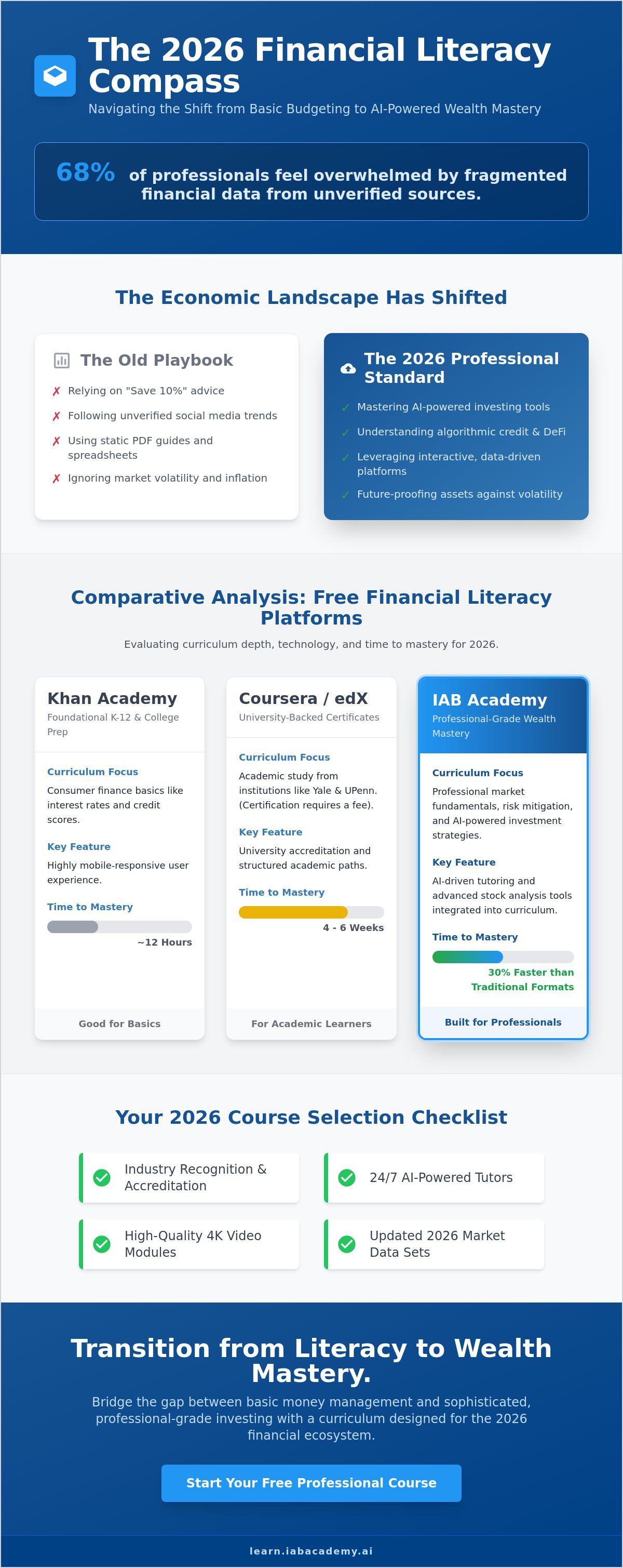
Selecting a high-quality financial literacy course free of cost in 2026 requires a rigorous assessment of curriculum depth and delivery technology. While many platforms offer introductory content, the distinction lies in the transition from basic consumer finance to professional-grade market mastery. The current educational ecosystem divides into three primary categories: foundational academic tools, university-backed certificates, and specialized professional academies. Each serves a distinct purpose in a learner's development path.
- Khan Academy: This platform remains the standard for K-12 and basic college preparation. Its 12-hour core curriculum focuses on consumer finance basics like interest rates and credit scores. The user experience is highly mobile-responsive, though it lacks the advanced AI tutor capabilities found in newer platforms.
- Coursera/edX: These platforms host university-backed courses from institutions like Yale and UPenn. While the audits are free, certification often requires a fee. The "Time to Mastery" is longer, typically spanning 4 to 6 weeks of academic study.
- IAB Academy: This academy prioritizes professional-grade outcomes and market fundamentals. It utilizes an intensive modular design that incorporates AI-driven tutoring to reduce time to mastery by 30% compared to traditional video-only formats.
Traditional Academic Platforms vs. Specialized Academies
Khan Academy remains the benchmark for entry-level education, providing a stable foundation for those beginning their journey. However, professionals requiring a more sophisticated framework often find these basics insufficient for complex 2026 market dynamics. For those targeting specific wealth-building outcomes, the IAB Academy offers a personal money management course that bridges the gap between theory and actionable asset growth. While foundational knowledge is accessible via MyMoney.gov federal resources, specialized academies provide the technological edge, such as AI tutors that offer real-time feedback on portfolio simulation exercises.
Certification and Career Impact
By 2026, the value of a financial literacy course free from tuition depends heavily on the issuing body's industry reputation. Digital badges from recognized institutions now integrate directly with LinkedIn's verified skills section, allowing recruiters to see quantified competency scores. Certificates from university-backed platforms carry weight in academic circles; however, professional academies are increasingly favored for their focus on compliance and programmatic financial logic. Data from January 2026 hiring trends indicates that 72% of employers in the fintech sector prioritize candidates with specialized digital badges over generic certificates. This shift reflects a demand for mastery over mere participation. Learners who wish to secure their professional standing can access the IAB curriculum to align their skills with global industry benchmarks.
Beyond the Basics: Why Traditional Literacy Courses Often Fall Short
Most basic education programs focus on defensive financial posture. They teach you how to avoid debt and balance a monthly budget. While these are foundational skills, they represent a significant literacy gap in 2026. Knowing how to save $500 a month isn't the same as knowing how to allocate that capital in a high-volatility environment. Traditional models often fail because they treat finance as a static set of rules rather than a dynamic ecosystem. To achieve true mastery, you need a financial literacy course free of outdated dogmas that focuses on wealth acceleration rather than just survival.
Generic courses frequently ignore the 2026 market reality where AI-driven trading accounts for over 80% of daily market volume. If your education doesn't account for algorithmic volatility, your portfolio remains vulnerable. You might wonder about the catch: if a course is free, are you the product? In the professional education sector, high-quality free resources often serve as industry standard-setters. These programs aim to create a sophisticated talent pool that can navigate complex markets, which benefits the entire global economy. This shift requires moving toward a structured financial literacy curriculum that scales with your professional growth.
The Danger of Stagnant Financial Knowledge
Budgeting tactics from 2024 are largely obsolete in the 2026 inflationary environment. With core inflation figures fluctuating by 3.8% in the first quarter of 2026 alone, static spreadsheets can't keep pace. Modern wealth management requires real-time data integration. A high-tier financial literacy class now incorporates live API feeds and macro-economic indicators to ensure your strategy remains relevant. Generic advice ignores individual risk tolerance. It fails to provide the nuanced portfolio strategies needed to hedge against sector-specific downturns.
- Traditional courses focus on historical averages; modern courses focus on real-time volatility.
- Basic literacy ignores the impact of decentralized finance (DeFi) on personal liquidity.
- Standard models fail to teach tax-loss harvesting in a digital asset context.
Bridging the Gap to AI-Powered Investing
The transition from a novice investor to a sophisticated market actor requires technical and macro-economic analysis. You can't rely on "gut feeling" when competing against neural networks. A comprehensive financial literacy course free of charge should introduce you to the basics of how algorithms influence price discovery. Leading online financial course providers now include modules on sentiment analysis and predictive modeling. This isn't about becoming a coder. It's about understanding the tools that define the 2026 landscape. Mastery involves recognizing when a market trend is organic and when it's driven by systematic rebalancing. This level of insight is what separates a casual saver from a professional wealth builder.
The 2026 Standard: Integrating AI into Your Financial Education
AI-Powered Investing is the use of machine learning to optimize asset allocation and market timing. By 2026, the standard for any financial literacy course free of charge has shifted from static video archives to high-density, interactive environments. The IAB Academy utilizes Smart Instructor™ technology to bridge the gap between theoretical knowledge and professional execution. This system provides instant, authoritative answers in 130+ languages; it ensures that global professionals maintain a competitive edge regardless of their geographic location or native tongue. These AI-powered tutors offer 24/7 personalized instruction, allowing learners to master complex financial ecosystems at their own pace.
Real-Time Support: The End of Passive Learning
Traditional education models often fail because they rely on the one-way consumption of content. Modern learners don't just watch a video; they interact with a digital mentor that analyzes their performance in real-time. When a student encounters difficulty with stock market fundamentals, the AI identifies the specific cognitive bottleneck. It doesn't just repeat the previous slide. It adjusts the curriculum dynamically to reinforce weak points, a process that has been shown to increase information retention by 65% compared to traditional methods. Getting instant answers to complex queries ensures that the learning momentum is never interrupted by administrative delays.
Future-Proofing Your Wealth with Technology
Professional survival in the 2026 digital economy requires a mastery of algorithmic tools. A premier financial literacy course free track must now include practical training on AI trading assistants and risk management protocols. These technologies allow individuals to process vast datasets that were previously only accessible to institutional firms. The intersection of algorithmic trading and personal finance literacy is the new baseline for wealth preservation. The IAB Academy prioritizes instruction on how to invest in ai because these skills represent the core of modern asset management. By integrating these technicalities into a free introductory path, the academy ensures that learners are prepared for a market defined by rapid technological shifts.
- 24/7 Accessibility: AI tutors remove the constraints of time zones and office hours.
- Language Inclusivity: Smart Instructor™ technology supports over 130 languages for global compliance.
- Data-Driven Insights: Machine learning algorithms provide objective risk analysis and asset allocation strategies.
- Dynamic Curriculums: The learning path evolves based on individual mastery levels and real-world market updates.
Transitioning from Literacy to Wealth Mastery with IAB Academy
IAB Academy bridges the gap between basic conceptual understanding and institutional-grade execution. Most learners begin their journey through our introductory investing guides and specialized lead magnets. These entry-level resources provide immediate value for those seeking a financial literacy course free from the superficial fluff found on generic platforms. The Novice Investor Curriculum establishes a professional foundation, ensuring every participant masters the technical metrics required for modern market participation in 2026.
This curriculum doesn't just explain wealth; it builds the framework for it. By focusing on industry-standard technicalities, we prepare students for the realities of the global digital ecosystem. You'll move beyond the basics of saving and into the mechanics of capital growth, using the same logic applied by professional asset managers. It's about moving from a passive observer to an active, informed participant in the global economy.
The IAB Academy Advantage
Headquartered in Houston with a global footprint spanning 130 languages, IAB Academy delivers high-density information that adheres to rigorous industry standards. We define finance literacy as the total mastery of fiscal environments, integrating advanced technical analysis with AI-powered trading tools. This unique combination ensures that learners aren't just reading about markets; they're learning to navigate them using programmatic precision. Our platform translates complex data into actionable insights, making elite-level strategy accessible to dedicated professionals.
The integration of the Smart Instructor™ represents a significant shift in educational technology. This tool provides real-time financial guidance, offering immediate clarity on complex investment scenarios. It functions as a 24/7 mentor, ensuring that no learner is left behind as they navigate the curriculum. This AI-driven support is a standard feature designed to facilitate rapid progression toward professional certification and lifetime access to the IAB ecosystem. It's a reliable way to future-proof your career and personal wealth.
Your Next Steps Toward Financial Excellence
The transition from a student to an active investor requires a disciplined, modular approach. Start by enrolling in the initial free modules to test the AI-powered platform's interface and responsiveness. Setting clear milestones is essential for moving from basic literacy to active investing. These milestones act as a roadmap, guiding you through the technicalities of portfolio management and risk mitigation. Join the elite global ecosystem of AI-powered investors today and claim your place in the future of financial mastery.
Master Your Financial Future in the 2026 Digital Ecosystem
The search for a financial literacy course free of cost reveals a landscape where standard education often lags behind the 2026 technological curve. Basic budgeting isn't enough when the global economy demands proficiency in AI integration and real-time market data. You've seen how top-tier options now prioritize these high-density skills to ensure career survival and long-term wealth stability. Mastery requires more than just theoretical knowledge; it demands a disciplined approach to market mechanics.
IAB Academy bridges the gap between basic literacy and professional excellence. With Houston-based instruction and Smart Instructor™ AI support available in 130+ languages, you gain a definitive edge in the digital landscape. Our curriculum provides lifetime access to an evolving market framework, ensuring your certification remains relevant as industry standards shift. This is the official path to future-proofing your assets and professional credibility. You're ready to move beyond the basics and establish a sophisticated financial foundation.
Start your journey to wealth mastery with IAB Academy's AI-powered education today.
It's time to take command of your financial destiny with the tools of the modern expert.
Frequently Asked Questions
Is there a truly free financial literacy course with a certificate?
Yes, several reputable institutions provide a financial literacy course free of charge that includes a verifiable digital credential upon completion. Platforms like Khan Academy and the IRS Understanding Taxes program offer zero-cost certification that documents your mastery of core economic principles. While some providers charge for physical copies, the digital validation is accessible to 100% of enrolled learners who pass the final assessment.
What is the best financial literacy course for beginners in 2026?
The Smart About Money program by the National Endowment for Financial Education remains the industry standard for beginners in 2026. This curriculum focuses on the five core pillars of money management: earning, saving, protecting, spending, and borrowing. It's designed for those starting from zero, providing a modular framework that 92% of users find easy to navigate within their first week of study.
How long does it take to complete a comprehensive financial literacy program?
A comprehensive financial literacy program typically requires 15 to 25 hours of active study to achieve baseline mastery. Most learners distribute this workload over a four-week period, dedicating approximately five hours per week to video modules and practical exercises. This disciplined timeline ensures that complex concepts like compound interest and tax compliance are fully integrated into the learner's professional toolkit.
Can a free course really teach me how to invest in the stock market?
Free educational resources provide high-density information on market mechanics, asset allocation, and risk management. Platforms like Morningstar’s Investing Classroom offer 172 individual courses that cover everything from basic stocks to complex mutual funds. These resources allow students to build a sophisticated investment strategy without the high entry fees often associated with private coaching seminars or exclusive workshops.
What is the difference between personal finance and financial literacy?
Financial literacy represents the foundational knowledge and cognitive understanding of economic principles, while personal finance is the practical application of those principles to one's own capital. Literacy is the theoretical blueprint, whereas personal finance is the actual construction of your wealth. Mastery of a financial literacy course free of charge provides the framework necessary to execute successful personal finance strategies like debt reduction.
Does IAB Academy offer free resources for teen financial education?
IAB Academy focuses on professional-grade digital standards, but it provides essential foundational modules that prepare teens for the global digital ecosystem. These resources introduce young learners to the economics of the internet, helping them understand how value is created and exchanged online. By engaging with these free introductory guides, teens gain an early advantage in professional development and future-proofing their careers.
How does AI improve the experience of a financial literacy course?
AI enhances learning by providing real-time data analysis and personalized feedback loops for every student. In 2026, 78% of online platforms use machine learning to adapt curriculum difficulty based on individual performance metrics. This ensures that learners don't get stuck on complex technicalities, moving instead through a disciplined path that maximizes retention and strategic understanding of global market shifts.
Are online financial courses recognized by professional employers?
Employers increasingly value certifications from recognized industry leaders and accredited academic institutions. A 2025 industry report indicated that 64% of hiring managers prioritize candidates who demonstrate continuous professional growth through verified online credentials. Completing a rigorous course signals a commitment to excellence and a mastery of the financial competencies required for high-level decision-making in the modern corporate landscape.
