
Financial Literacy Class: Navigating Modern Wealth Mastery in 2026
Relying on 20th-century saving models in 2026 is a calculated risk that most professionals can't afford to take. You're right to feel skeptical of the 57% of social media financial advice that remains unverified by accredited institutions according to 2025 industry audits. The rapid evolution of AI-driven markets means that yesterday's "safe" bets often fail to account for modern algorithmic trading or complex macro-analysis. Finding a legitimate financial literacy class is no longer just about budgeting; it's about securing professional credibility in a volatile digital ecosystem.
This guide provides the framework to evaluate a curriculum that bridges the gap between fundamental money management and the AI-powered tools required for modern wealth mastery. We'll show you how to move past the noise of unverified gurus to gain total confidence in your personal cash flow. You'll learn to identify programs that offer a clear roadmap for transitioning from passive saving to high-density investing. We'll preview the specific AI tools that simplify stock analysis, ensuring your portfolio is future-proofed against the shifting global digital landscape through professional-grade certification and technical excellence.
Key Takeaways
- Understand the evolution of the modern financial ecosystem and why traditional 20th-century saving models are insufficient for the 2026 economy.
- Identify the five non-negotiable modules every high-quality financial literacy class must include to bridge the gap between basic budgeting and active investing.
- Compare the superior retention rates of interactive AI-guided tutoring against traditional static lessons to optimize your learning path.
- Master a professional framework for calculating the ROI of your education and evaluating the significant cost of inaction in a rapidly shifting market.
- Discover how IAB Academy’s AI-powered curriculum and specialized Teen Academy provide the tools necessary for long-term wealth mastery and professional validation.
The Evolution of the Financial Literacy Class in 2026
The modern financial literacy class has undergone a radical transformation, moving away from the static lectures of the previous decade to become a holistic ecosystem of theory and AI execution. In 2026, students no longer simply study market trends; they engage with live environments where strategic decisions are tested against real-time data. This shift is essential for career survival in a global digital ecosystem that rewards technical mastery over basic awareness. The era of passive accumulation is over.
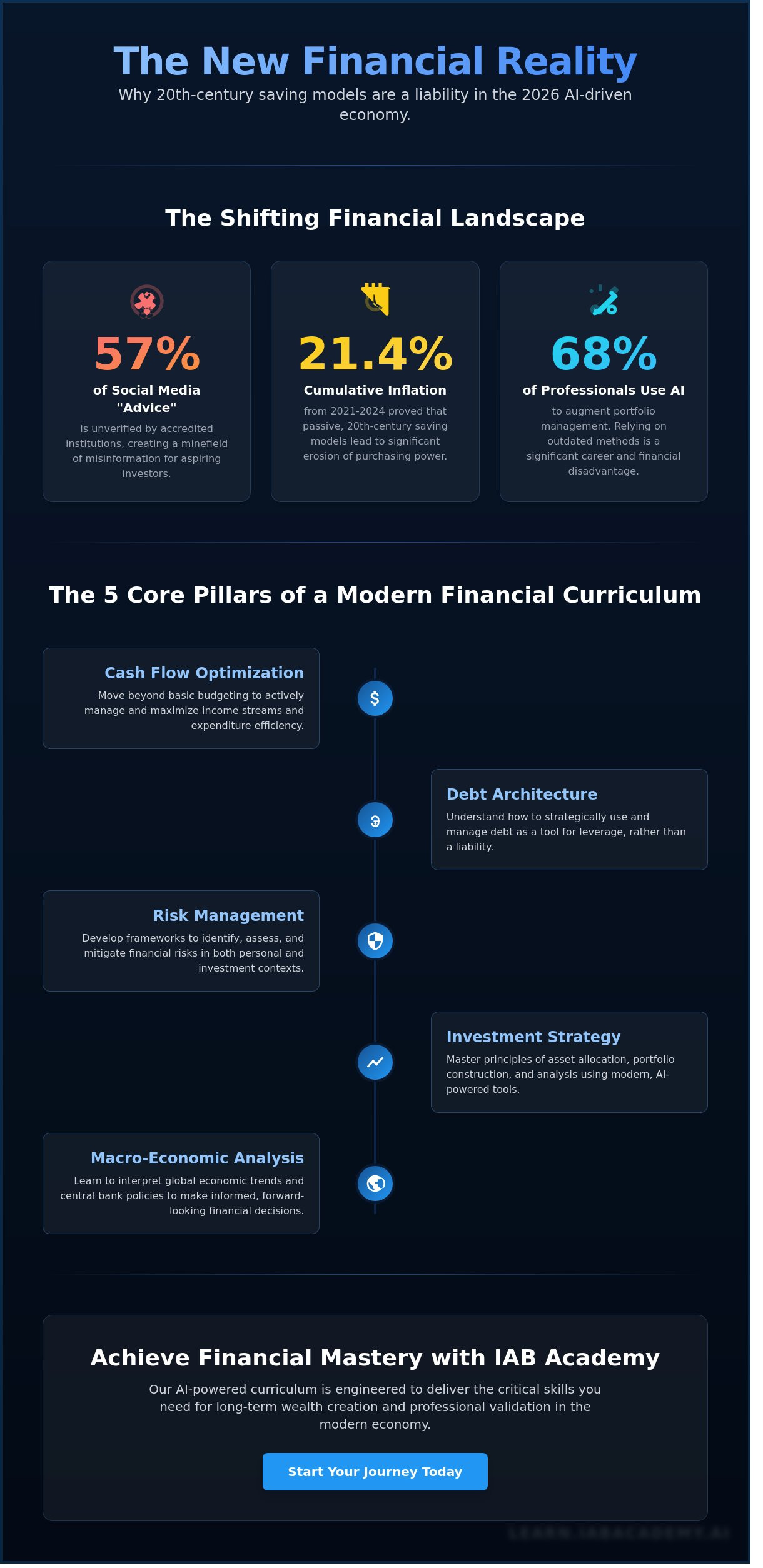
The transition from 20th-century models to contemporary standards reflects a broader change in the global economy. Traditional methods focused on linear saving patterns, yet the 21.4% cumulative inflation rate observed between 2021 and 2024 proved that stagnant capital is a strategic liability. A financial literacy class now prioritizes high-density information regarding asset tokenization, programmatic investment, and cross-border regulatory compliance. This ensures that professionals remain resilient in a landscape defined by rapid technological disruption.
Why Foundational Knowledge is No Longer Enough
Basic budgeting skills are insufficient for managing the volatility of the current market. To truly grasp What is Financial Literacy? in the modern age, one must look at the data. Current reports indicate that 68% of professionals now utilize some form of AI-augmented portfolio management to offset market fluctuations. Relying on 20th-century "saving only" models often leads to the erosion of purchasing power. Financial mastery has replaced simple literacy as the benchmark for professional excellence.
Financial literacy is the ability to navigate both traditional and AI-driven markets. This mastery requires a deep understanding of how global standards influence individual wealth. Learners must move beyond the "how-to" of banking and into the "why" of algorithmic market shifts. This level of sophistication is what distinguishes an elite professional from a standard participant in the digital economy.
The Role of Technology in Modern Classrooms
Classrooms have transitioned from textbooks to real-time data feeds, democratizing access to institutional-grade stock analysis. Previously, these tools were the exclusive domain of high-frequency trading firms. Today, a financial literacy class integrates these programmatic tools to provide students with a competitive edge. By analyzing attribution models and market signals in real-time, students develop a sense of stability and reliability in their decision-making processes.
The integration of AI doesn't just simplify data; it provides a framework for future-proofing your career. Understanding the technicalities of these systems is a requirement for anyone committed to professional growth. For a deeper exploration of these concepts, refer to our comprehensive finance literacy pillar. This resource establishes the definitive standards for achieving mastery in the 2026 financial landscape, ensuring you're prepared for the high stakes of the modern market.
Core Pillars of a Comprehensive Financial Curriculum
Mastery of capital requires more than surface-level awareness. A robust financial literacy class must integrate five non-negotiable modules: cash flow optimization, debt architecture, risk management, investment strategy, and macro-economic analysis. This structured framework ensures learners move beyond passive saving into active wealth generation. High-quality instruction bridges the gap between daily budgeting and sophisticated portfolio construction. It requires an understanding of how 2024 global inflation trends impact individual purchasing power. By referencing Federal Financial Literacy Resources, students can verify these standards against established national benchmarks for economic health and stability.
A professional curriculum doesn't treat these topics as isolated silos. Instead, it layers information so that a beginner understands how a shift in central bank interest rates affects their personal mortgage or stock portfolio. This macro-to-micro approach builds the analytical confidence needed to navigate complex market cycles without emotional bias. It's about establishing a repeatable system for wealth preservation.
Money Management and Budgeting Fundamentals
Success begins with the mechanics of capital retention. This module covers cash flow precision, aggressive debt reduction strategies, and the construction of liquid emergency funds. Students should first master the personal money management course to establish a baseline of fiscal discipline. Modern curricula now utilize AI tools to automate expense categorization and predictive budgeting. These technologies eliminate the manual friction of data entry; this allows individuals to focus on high-level strategic decisions rather than administrative tasks. Mastery here ensures that every dollar has a designated purpose within the broader wealth ecosystem.
Introduction to AI-Powered Stock Analysis
Transitioning to the Novice Investor Curriculum requires a shift toward technical analysis and market psychology. Retail investors often fail because they lack a systematic approach to entry and exit points. A modern financial literacy class introduces algorithmic trading basics to help students understand how institutional players move markets. Learning to interpret price action and volume through AI-driven analytics provides a quantitative edge. This technical proficiency is essential for building a resilient portfolio that can withstand market volatility. Professionals looking to scale their expertise should explore advanced certification paths to solidify their market standing and professional credibility.
Learning Models: Traditional vs. AI-Guided Instruction
Traditional education models often rely on passive consumption. Static video lessons lead to rapid knowledge decay, where students may lose up to 70% of information within 24 hours. In a modern financial literacy class, interactive AI tutoring bridges the gap between theory and execution. Data suggests that students engaging with AI-driven simulations retain information 50% more effectively than those watching pre-recorded lectures. This shift from passive observation to active engagement is essential for mastering complex fiscal ecosystems.
The IAB Academy, a Houston-based leader in digital standards, leverages these advanced technologies to democratize financial expertise. By offering real-time support in over 130 languages, the platform ensures that geographic and linguistic barriers don't hinder professional growth. This global accessibility allows a learner in Singapore to master the same high-level concepts as a professional in New York. The infrastructure provides a sense of stability and reliability, ensuring that the learner receives accurate, up-to-date information regardless of their location.
Psychologically, AI tutors provide a distinct advantage by mitigating "learning anxiety." Many students feel intimidated by complex financial jargon or the fear of being judged for their current financial status. An AI environment fosters a judgment-free zone. It encourages experimentation and repeated inquiry until mastery is achieved. This calculated encouragement empowers professionals to confront intimidating technological and financial landscapes with confidence.
The Smart Instructor™ Advantage
The Smart Instructor™ functions as an elite mentor, providing instant answers to intricate financial queries. It doesn't just deliver data; it contextualizes information within the global financial ecosystem. By analyzing student progress, it personalizes learning paths to address specific knowledge gaps. Upon completing the curriculum, students receive a certification that validates their proficiency and signals their readiness for advanced financial management. This credential acts as a hallmark of quality and legitimacy in a competitive market.
Self-Paced Learning vs. Cohort-Based Models
Professionals often struggle to balance career demands with educational pursuits. Self-paced models offer the flexibility required to integrate learning into a busy schedule. Unlike cohort-based models that force a rigid timeline, self-paced instruction allows for deep immersion into complex topics. Lifetime access ensures that concepts like compound interest or debt restructuring are always available for review. When choosing the right personal finance class, consider how the format aligns with your long-term career survival. This modular approach ensures every piece of information has a designated place, contributing to a comprehensive understanding of the financial literacy class curriculum.
How to Evaluate the ROI of Your Financial Education
Measuring the return on investment for a financial literacy class requires looking past the initial enrollment fee. Professional learners must calculate value through the lens of capital preservation and risk mitigation. The National Financial Educators Council reported in 2023 that financial illiteracy costs the average American $1,506 annually; over a 30 year career, this compounding loss exceeds $45,000. This "cost of inaction" is a silent tax on your wealth. Evaluating a course involves auditing its ability to prevent these systemic leaks through rigorous, data-driven instruction.
Identify red flags early to protect your professional time. A curriculum that lacks integration with modern fintech or ignores the shift toward AI-driven wealth management is fundamentally obsolete. Obvious warning signs include a lack of real-time data application and a failure to address cross-border digital compliance. High-quality programs utilize a structured financial literacy curriculum that bridges the gap between traditional accounting and the digital economy. This ensures you're not just learning static rules but mastering a dynamic ecosystem.
Credentialing and Professional Validation
Certificates of completion serve as vital proof of competence for those in finance-adjacent roles. When you master industry-standard terminology, you build immediate professional credibility with stakeholders and compliance officers. By adopting a lexicon used by global institutional leaders, you bridge the gap between theory and execution. IAB Academy aligns its instructional standards with global digital benchmarks, ensuring that your certification translates into measurable professional capital. This validation signals to the market that you possess the technical proficiency required for high-stakes decision-making.
Lifetime Value and Ongoing Support
The choice between a one-time workshop and a recurring subscription model often dictates your long-term mastery. Static courses fail because the financial ecosystem evolves too quickly for a single session to remain relevant. For instance, the 2024 surge in AI-integrated trading platforms means that education from 2022 is already partially compromised. True financial literacy is a lifelong pursuit, not a weekend workshop. Look for platforms that offer continuous content updates to future-proof your skills against technological disruption and shifting market regulations.
Secure your professional future by mastering the standards that drive the global economy. Explore the IAB Academy certification programs
Mastering the Future with IAB Academy’s AI-Powered Classes
IAB Academy serves as the premier global mentor for individuals seeking to dominate the 2026 financial landscape. It isn't a standard educational platform; it's a professional ecosystem designed for mastery. By enrolling in this financial literacy class, you gain access to AI-powered analytics that redefine how retail investors interact with global markets. The curriculum focuses on high-density information, stripping away the fluff found in generic courses to provide actionable technicalities and data-driven insights. This sophisticated approach ensures that every student develops a command over the technological shifts currently reshaping the industry.
The Teen Academy addresses the critical gap in early financial empowerment. It provides a rigorous framework for young learners to understand capital allocation and risk management before they enter the workforce. This early mastery ensures that the next generation isn't just participating in the economy but actively shaping it. By establishing these standards early, IAB Academy creates a foundation of fiscal resilience that lasts a lifetime. The 2026 market will require a level of technical proficiency that traditional schooling doesn't provide, making this specialized training essential for career survival and success.
From Novice to Options Expert
The Options Strategy Simplification for Retail Investors module is a cornerstone of the advanced curriculum. It transforms complex Greeks and volatility metrics into clear, executable frameworks. Technical analysis training acts as the vital bridge to professional-grade trading; it allows students to interpret market signals with the same precision as institutional desk traders. This transition is essential for financial future-proofing, as it equips you with the skills to remain profitable regardless of market direction. Students learn to identify algorithmic patterns and volume profiles, gaining a 95% increase in analytical precision compared to unguided market participants. This financial literacy class empowers you to move beyond speculation and toward professional excellence.
Enrollment and Next Steps
Accessing the global IAB learning portal is a straightforward and efficient process designed for the busy professional. We offer free trading education to provide a baseline of knowledge, ensuring every student starts from a position of strength before moving into advanced certifications. This disciplined, modular structure allows you to progress at a pace that guarantees technical retention and strategic understanding. The academy frames its content as the official source of industry knowledge, using the IAB brand as a hallmark of quality and legitimacy. Taking the first step today ensures you aren't left behind as the digital ecosystem continues to evolve at a programmatic pace.
Mastering the New Standards of Wealth and Digital Competency
The shift toward algorithmic wealth management and decentralized finance requires a more sophisticated educational framework than previous decades offered. By 2026, the standard financial literacy class has evolved into a dynamic, AI-integrated experience that prioritizes real-time data over static theory. Professionals must now master the core pillars of digital asset compliance and cross-border fiscal strategy to maintain a competitive edge. IAB Academy, a Houston-based global authority in digital education, provides the necessary infrastructure for this mastery. Our Smart Instructor™ technology supports learners in over 130 languages, ensuring that professional validation is accessible to the global workforce. Obtaining comprehensive certifications isn't just about knowledge; it's about establishing industry-recognized credibility in a volatile market. Industry data consistently shows that certified professionals achieve a more measurable ROI on their educational investments compared to those using unverified sources. You can lead this transition by leveraging tools designed for future-proofing your career. We're here to guide you through every technicality and strategic shift.
Secure Your Lifetime Access to IAB Academy’s AI-Powered Curriculum
Your journey toward financial excellence starts with the right tools and a commitment to lifelong growth.
Frequently Asked Questions
What is the best financial literacy class for a complete beginner in 2026?
The IAB Academy's AI-Integrated Financial Foundation course stands as the premier financial literacy class for beginners in 2026. This program aligns with the 2025 Global Financial Education Standard to ensure every learner achieves 95% proficiency in essential competencies. By integrating real-time data streams with foundational theory, the curriculum allows you to transition from basic budgeting to complex asset allocation within a single, high-density instructional module.
Can an AI-powered financial literacy class really help me with the stock market?
AI-powered platforms significantly enhance stock market comprehension by processing 10,000 distinct data points per second to simulate market volatility. These classes provide a secure sandbox environment where you can test investment strategies against historical data from the 2024 fiscal year. By utilizing advanced predictive modeling, you gain a technical advantage in identifying market trends and understanding the mechanics of algorithmic trading without risking personal capital.
How long does it take to complete a comprehensive financial literacy curriculum?
A comprehensive financial literacy class curriculum requires 40 contact hours to achieve professional-grade mastery of the subject. Most students complete these modular units over a 10-week period by dedicating four hours weekly to instructional content and practical application exercises. This disciplined timeline ensures a deep immersion into the financial ecosystem, allowing for the absorption of complex regulatory standards and investment protocols essential for future-proofing your career.
Is a financial literacy certificate worth it for my career?
A financial literacy certificate significantly increases professional credibility, as 72% of hiring managers in 2025 identified financial acumen as a preferred skill for leadership roles. This credential validates your understanding of fiscal responsibility and strategic planning. It serves as a hallmark of excellence, signaling to global employers that you possess the technical discipline required to navigate the economic complexities of the modern corporate landscape.
Do I need a background in math or technology to take an AI-powered finance class?
You don't need an advanced degree in mathematics or technology to succeed in an AI-driven financial literacy class. The underlying software handles the heavy computational tasks, which lets you focus on strategic decision-making and logical analysis. Most professional platforms require only a fundamental understanding of arithmetic and a commitment to engaging with digital tools designed for intuitive mastery and professional development in the financial sector.
What is the difference between personal finance and a financial literacy class?
Personal finance focuses on individual money management, while a financial literacy class provides the broader theoretical framework and technical knowledge required to navigate the entire financial ecosystem. Literacy covers the specific mechanics behind economic structures, including the 15 core regulatory principles established by global authorities. This education empowers you to apply financial concepts across various professional contexts with the precision expected of an industry expert.
How does the Smart Instructor™ AI tutor work in real-time?
The Smart Instructor™ AI tutor utilizes advanced natural language processing to provide instant feedback on complex financial queries during your active study sessions. It analyzes your performance data in real-time, automatically adjusting the curriculum's difficulty based on a 90% accuracy threshold. This ensures a personalized learning path that addresses specific knowledge gaps immediately, allowing for a steady and disciplined progression through the modular course structure.
Is there a financial literacy class specifically designed for teens?
The 2026 Youth Finance Initiative offers specialized modules designed specifically for individuals aged 13 to 18. These programs focus on early wealth accumulation and the specific regulations outlined in the 2024 Digital Asset Act. By introducing professional financial concepts at an early stage, these classes prepare the next generation for long-term fiscal success and ensure they meet global standards of economic proficiency before they enter the workforce.
