
Risk Management in Trading for Retail Investors: The 2026 Professional Framework
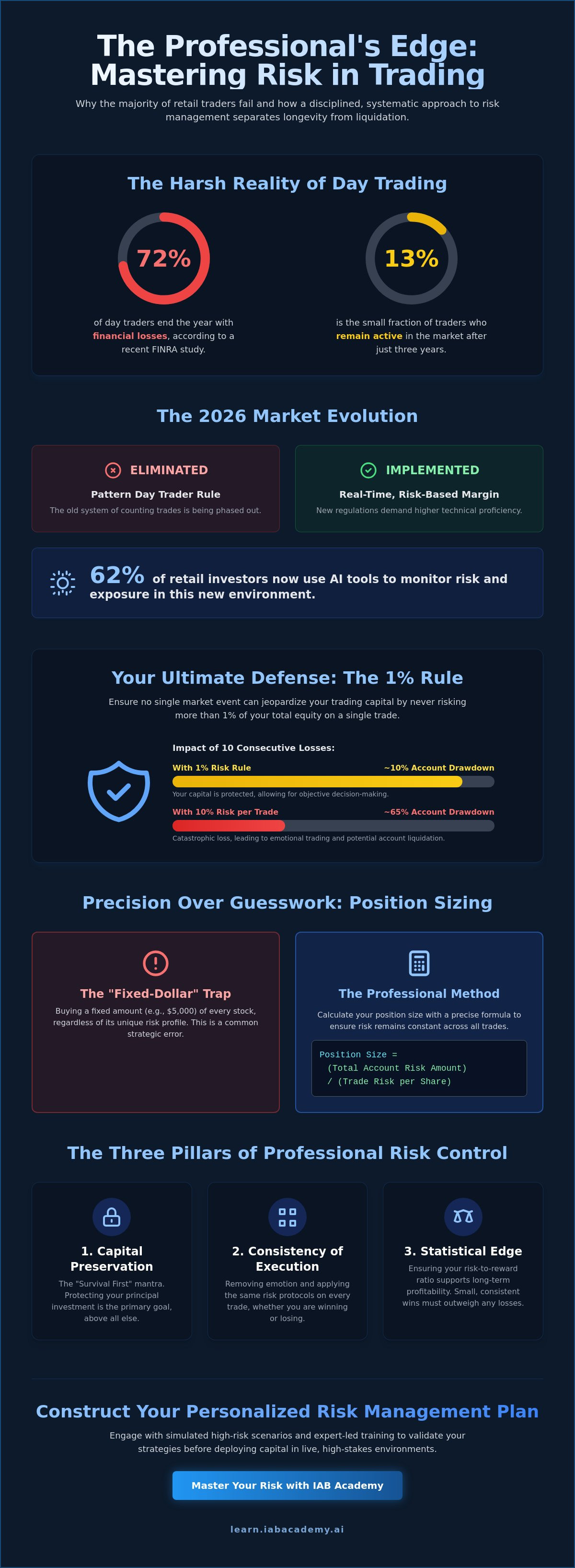
A recent FINRA study reveals that 72% of day traders end the year with financial losses, while a mere 13% maintain their activity after three years. These figures underscore a harsh reality; most market participants lack a disciplined system to protect their capital against volatility. You recognize that the fear of a total account liquidation is a constant pressure, especially when over-leveraging or complex mathematics cloud your decision making. Effective risk management in trading for retail investors serves as the vital operating system that distinguishes professional longevity from retail failure.
The 2026 regulatory shift, specifically the June 4 elimination of the Pattern Day Trader rule, has replaced trade counting with real-time, risk-based intraday margin calculations. While this provides greater freedom, it also demands a higher level of technical proficiency. You'll learn to implement institutional-grade strategies and leverage the AI tools that 62% of retail investors now use to monitor exposure. This framework provides the specific protocols needed to manage margin requirements and tax implications, ensuring you remain in the market with the confidence of a global professional.
Key Takeaways
- Apply the 1% Rule and precise position sizing formulas to ensure that no single market event can jeopardize your total trading capital.
- Master the systematic framework for risk management in trading for retail investors to maintain stability amidst the real-time margin requirements of the 2026 regulatory landscape.
- Utilize AI-powered monitoring tools to identify and mitigate hazards associated with algorithmic volatility and sudden liquidity shifts.
- Construct a personalized Risk Management Plan (RMP) that establishes disciplined drawdown limits to protect your portfolio during extended market downturns.
- Engage with simulated high-risk scenarios and expert-led training to validate your strategies before deploying capital in live, high-stakes environments.
What is Risk Management in Trading for Retail Investors?
Risk management in trading for retail investors is the systematic process of identifying, analyzing, and mitigating financial hazards before they compromise your portfolio's integrity. It isn't a secondary task; it's the primary architecture of any professional trading operation. While many believe trading is about predicting price movement, the data suggests otherwise. Industry research consistently shows that roughly 90% of retail traders fail. This failure rarely stems from poor entry signals. Instead, it's a direct result of a fundamental lack of capital preservation strategies.
In the high-velocity 2026 market, the distinction between gambling and calculated speculation has never been more critical. Gambling involves taking positions based on intuition or social media hype without a predefined exit strategy. Calculated speculation, however, relies on Financial Risk Management Principles to ensure that no single trade can cause catastrophic damage. Professional traders adopt a "Survival First" mantra. They recognize that the primary goal is staying in the game long enough for their statistical edge to manifest.
The Three Pillars of Professional Risk Control
Success requires a disciplined adherence to three core pillars that stabilize your performance across varying market cycles:
- Capital Preservation: This is the commitment to protecting your principal at all costs. You don't trade to get rich; you trade to protect what you have while seeking growth.
- Consistency of Execution: Professionalism means removing emotional variance from your management process. You execute the same risk protocols whether you're on a winning streak or a losing one.
- Statistical Edge: You must ensure your risk-reward ratio supports long-term profitability. A high win rate is useless if your average loss is significantly larger than your average gain.
Systemic vs. Unsystematic Risk
Understanding the layers of risk is essential for effective mitigation. Systemic risk refers to market-wide events, often called "Black Swans," that affect all assets simultaneously. Unsystematic risk is specific to a single company or sector, such as a surprise earnings miss or a regulatory change. Retail investors can hedge against these threats by maintaining a deep focus on stock market fundamentals. When you understand the underlying health of an asset, you can distinguish between a temporary market panic and a structural change in the investment's value. This clarity allows you to remain calm during broad market volatility while others make emotional, fear-based decisions.
The Mechanics of Protection: Essential Risk Management Tools
Professional trading isn't a game of guessing; it's a game of precise arithmetic. To implement risk management in trading for retail investors effectively, you must move beyond vague intentions and adopt mechanical tools that remove guesswork. The most fundamental of these is the 1% Rule. By never risking more than 1% of your total equity on a single trade, you ensure that even a string of ten consecutive losses only draws down your account by approximately 10%. This buffer is what allows institutional traders to remain objective while retail accounts often collapse during periods of heightened volatility.
Mastering Position Sizing
Many novices fall into the "fixed-dollar" trap. They decide to buy $5,000 worth of every stock regardless of the specific setup's risk profile. This is a strategic error. Professional position sizing requires you to calculate your exposure based on the distance between your entry price and your stop-loss. Use the standard formula: (Total Account Risk Amount / Trade Risk per Share) = Position Size. If you're risking $100 on a trade and your stop-loss is $2 below your entry, you buy exactly 50 shares. This precision ensures your risk remains constant even when asset prices fluctuate. You can refine these technical skills through specialized risk management training to ensure your execution matches institutional standards.
Advanced Stop-Loss Techniques
A stop-loss shouldn't be a random number. In the 2026 market, high-frequency algorithms often trigger "noise-based" stops, causing retail traders to exit prematurely. To avoid this, use Average True Range (ATR) stops. These adjust based on current market volatility, placing your exit point just outside the asset's normal "breathing" room. Alternatively, structural stops use technical levels like support or resistance to define exactly where the trade's logical thesis is invalidated. If the structure breaks, the trade is over.
Always prioritize "Hard Stops" over "Mental Stops." A hard stop is a programmed order resting on the exchange; a mental stop is an intention that often evaporates when emotions run high during a fast market move. By automating your exits, you remove the psychological burden of decision-making during a crash. Combine these with trailing stops to lock in gains as a trend develops. This ensures you capture profit while still allowing the trade room to grow. Success isn't about being right every time. It's about being disciplined every time you're wrong.
Managing Risk in an AI-Driven, High-Volatility 2026 Market
The market environment of 2026 is defined by the dominance of high-frequency algorithms and AI-powered trading bots. These systems account for the vast majority of volume, creating a unique set of challenges for risk management in trading for retail investors. While these bots provide deep liquidity during stable periods, they can withdraw from the market in milliseconds during stress. This sudden absence of buyers or sellers creates liquidity gaps, leading to "Flash Crashes" that can bypass standard limit orders. Emergency stop-losses are no longer optional; they're the only safeguard against systemic glitches that can erase weeks of gains in a heartbeat.
Professional retail traders now utilize AI stock analysis tools to identify hidden correlations within their portfolios. Often, assets that appear unrelated on the surface are actually tied to the same underlying economic drivers. If your portfolio is heavily weighted in AI-adjacent sectors, a single regulatory shift could trigger a simultaneous decline across all holdings. Understanding how to invest in ai requires a different risk profile than traditional equities, as volatility remains structurally higher in these pioneering sectors.
The Impact of Algorithmic Trading
Institutional bots are programmed to "hunt" for retail liquidity. They often target obvious support and resistance levels where large clusters of retail stop-losses are placed. When these levels are breached, the resulting wave of automated selling allows institutions to buy at a discount. To avoid being shaken out by this algorithmic noise, you must use structural stops, placing exits where the price action truly invalidates the trade rather than at round numbers or obvious psychological levels.
AI-Assisted Risk Monitoring
Modern risk management involves more than just setting stops. It requires an active digital Early Warning System. AI trading assistants now allow you to track portfolio Heat Maps, which visualize your real-time exposure across different sectors and asset classes. Automated alerts can notify you if a specific sector's volatility exceeds a predefined threshold, allowing you to hedge or reduce size before a breakdown occurs.
The role of the Smart Instructor™ is pivotal in this process. This technology provides real-time risk feedback, simulating high-volatility events to help you practice your response in a safe environment. By mastering these AI-driven tools, you transition from a passive observer of market volatility to a proactive manager of your own financial destiny. This level of preparation ensures that your portfolio survives and thrives despite the speed of the 2026 digital ecosystem.
Building Your Personal Risk Management Plan (RMP)
A formal Risk Management Plan (RMP) is the constitution of your trading business. Without it, you aren't trading; you're reacting to market noise. The first phase of constructing a professional RMP involves defining your risk tolerance within the context of your broader financial literacy curriculum goals. You must determine exactly how much capital you can afford to lose without compromising your psychological stability or long-term solvency. This isn't a suggestion. It's a requirement for survival.
Once your tolerance is defined, establish non-negotiable drawdown limits. A professional framework often includes a 2% daily loss limit and a 6% monthly limit. If these thresholds are breached, all trading activity must cease until a comprehensive review is completed. This discipline ensures that a single period of poor performance doesn't lead to a total account liquidation. Risk management in trading for retail investors requires this level of institutional rigor to prevent emotional decision-making during high volatility.
Your plan must also mandate a minimum 3:1 risk-reward ratio for every entry. Before execution, utilize a pre-trade checklist to verify that the setup aligns with your technical criteria and position sizing rules. Finally, implement a post-trade review process to distinguish between "Bad Wins," which are trades where you broke your rules but got lucky, and "Good Losses," where you followed your RMP but the market simply didn't cooperate. Distinguishing between these two is vital for long-term growth.
The Risk-Reward Ratio (RRR) Framework
Most retail investors believe they need a high win rate to be successful. Mathematically, this is incorrect. With a 3:1 RRR, you can lose 66% of your trades and still remain break-even, excluding commissions. Long-term survival depends on your ability to resist the common retail impulse to cut winners short while letting losers run. By adhering to a strict RRR matrix, you ensure that your few large winners significantly outweigh your more frequent small losses. This is the core of statistical edge.
The Professional Trading Journal
A journal is not just a log of entries and exits; it's a data-rich diagnostic tool. You must record your emotional state during each trade to identify psychological triggers like FOMO or revenge trading. Additionally, track slippage and commission costs to calculate your "Real Risk," which often differs from theoretical projections. Use this data to refine your RMP every quarter, ensuring your strategy evolves alongside the 2026 market dynamics. To build these foundational habits, you can enroll in our comprehensive risk management course today.
The IAB Academy Advantage: Mastery Through AI-Powered Education
Mastering risk management in trading for retail investors requires more than theoretical knowledge; it demands a structured environment where strategies are tested against institutional standards. IAB Academy’s Novice Investor Curriculum builds this defensive mindset into the very foundation of your education. We don't treat risk as an afterthought. Instead, we integrate it into every module, ensuring that you develop the technical proficiency needed to navigate the 2026 market. By aligning your learning with established industry frameworks, you gain the professional credibility necessary for long-term portfolio survival.
The transition from foundational concepts, such as those found in our guide to financial literacy for teens, to the high-stakes complexities of options risk management is a significant leap. IAB Academy bridges this gap through a pedagogical path that scales with your growth. As you progress, you'll move from basic capital preservation to advanced strategies involving delta hedging and volatility monitoring. This progression ensures that you never deploy capital without a comprehensive understanding of the associated hazards.
Professional certification in risk management serves as the ultimate differentiator in the retail space. It signals to the global professional ecosystem that you operate with a level of discipline usually reserved for institutional desk traders. This validation isn't just about a credential; it's about the psychological confidence that comes from knowing your Risk Management Plan (RMP) has been vetted through rigorous simulation and expert-led instruction.
Interactive Learning with the Smart Instructor™
Our Smart Instructor™ technology provides a level of personalized tutoring previously unavailable to individual investors. It offers instant answers to complex risk-reward calculations in over 130 languages, ensuring that language barriers never hinder your professional development. By mastering personal finance class concepts through AI-driven simulations, you can practice your response to flash crashes and liquidity gaps in a safe, real-time environment. This adaptive tutoring responds to your specific portfolio challenges, offering data-driven feedback to refine your execution.
Lifetime Access to Evolving Risk Standards
The financial landscape of 2026 is in constant flux, with new regulatory shifts and algorithmic trends emerging quarterly. IAB Academy provides lifetime access to a curriculum that evolves alongside these changes. You'll remain at the forefront of industry standards as we update our modules to reflect 2027 market projections and beyond. Joining our global community connects you with other risk-aware investors, fostering a culture of disciplined speculation and mutual growth. Don't leave your financial survival to chance. Enroll in the Risk Management & Portfolio Strategy Module today to secure your future in the digital wealth ecosystem.
Securing Your Professional Longevity in the 2026 Ecosystem
The evolution of the digital market has transformed risk management in trading for retail investors from a defensive precaution into a sophisticated operational standard. Success in this high-velocity environment requires a transition from emotional reaction to algorithmic discipline. By implementing a rigorous Risk Management Plan and utilizing advanced position sizing formulas, you protect your capital against the liquidity gaps and systemic volatility inherent in modern trading. Professionals don't rely on luck; they rely on a repeatable framework that ensures statistical survival across all market cycles.
IAB Academy stands as the global standard-setting platform for this critical transition. Our Comprehensive Novice Investor Curriculum provides the technical foundation needed to master these complex systems. With the support of our AI-Powered Smart Instructor™, available in over 130 languages, you can simulate high-risk scenarios and receive real-time feedback to refine your execution. Now is the time to validate your expertise and join an elite community of disciplined market participants. Master Professional Risk Management with IAB Academy’s AI-Powered Curriculum and take command of your financial future with the confidence of an institutional professional.
Frequently Asked Questions
What is the most important rule of risk management for a beginner?
The most fundamental rule for any novice is the prioritization of capital preservation over profit generation. You must ensure that no single market event can terminate your trading career. This involves strictly limiting your exposure per trade and maintaining a "survival first" mindset to allow your statistical edge to develop over time. Without this defensive foundation, even the most accurate entry signals will eventually lead to account liquidation.
How do I calculate my position size for a trade?
You calculate your position size by dividing your total account risk amount by the risk per share of a specific trade. If you're risking $100 and your stop-loss is $2 below your entry price, you purchase exactly 50 shares. This mechanical approach ensures that your financial exposure remains constant regardless of the asset's price or current market volatility, preventing the common retail error of over-leveraging on a single position.
Is a 1:1 risk-reward ratio good for retail investors?
A 1:1 risk-reward ratio is statistically challenging for most participants because it requires a win rate significantly higher than 50% to account for slippage and commissions. Professional risk management in trading for retail investors typically mandates a minimum 2:1 or 3:1 ratio. This structural advantage allows you to remain profitable even if you lose more than half of your trades, providing a necessary buffer against market unpredictability.
Can AI tools help me manage risk automatically?
AI tools provide automated risk monitoring by tracking real-time portfolio correlations and volatility shifts that are often invisible to the human eye. These systems can trigger emergency alerts or adjust trailing stops based on dynamic Average True Range data. While AI enhances your execution speed and data analysis, the final responsibility for the strategic integrity of your Risk Management Plan remains with the human operator to ensure alignment with personal goals.
What is the difference between a stop-loss and a take-profit order?
A stop-loss is a defensive order designed to limit your downside by automatically exiting a position at a predetermined price level if the trade thesis fails. Conversely, a take-profit order is an offensive tool that closes your position once a specific profit target is reached. Both orders are essential for removing emotional variance from your management process, ensuring that your exits are dictated by logic rather than fear or greed.
How much money do I need to start trading with proper risk management?
While the 2026 elimination of the Pattern Day Trader rule removed the $25,000 requirement, a minimum of $2,000 is still required for a margin account. To practice effective risk management in trading for retail investors, you need enough capital so that a 1% risk per trade is manageable within your brokerage's minimum share lot requirements. This ensures your position sizing remains precise and your drawdowns stay within professional limits.
What should I do if I hit my maximum daily drawdown limit?
You must immediately cease all trading activity for the remainder of the session if your maximum daily drawdown limit is breached. This period of inactivity is mandatory to prevent "revenge trading" and emotional escalation during high-stress periods. Use this time to conduct a comprehensive post-trade review and determine if the losses were due to technical execution errors or simply standard market variance that falls within your plan's parameters.
How often should I update my risk management plan?
You should conduct a formal review and update of your Risk Management Plan every quarter to align with evolving market regimes and liquidity profiles. Additionally, updates are necessary following significant personal financial changes or major regulatory shifts in the digital ecosystem. This disciplined revision ensures that your defensive protocols remain relevant and effective as technological advancements and institutional behaviors continue to reshape the professional trading landscape.
