
Is It Too Late to Start Investing in 2026? A Professional Framework for Late Starters
If you're asking yourself is it too late to start investing in 2026, you're likely operating under an obsolete financial paradigm. While time is a linear constraint, modern AI-augmented strategies act as a non-linear multiplier that can fundamentally compress the wealth-building timeline. It's natural to feel regret over lost decades or fear that market complexity has moved beyond your reach. However, the current regulatory and technological environment provides specific mechanisms designed to bridge the gap for late-start professionals.
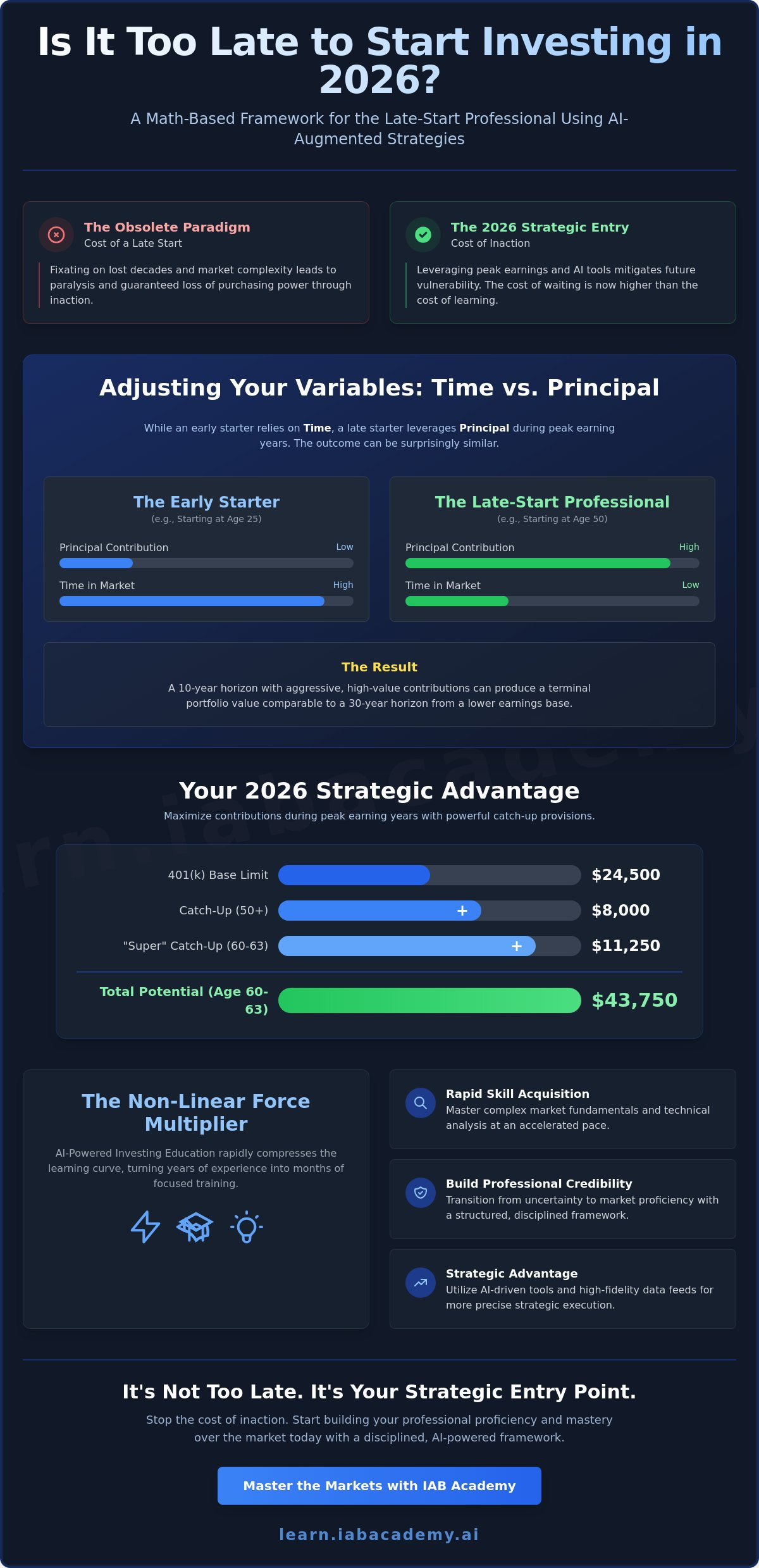
You'll discover why the current economic landscape offers a unique window for late starters to build sustainable wealth. The convergence of increased 401(k) contribution limits, such as the $11,250 "super catch-up" for those aged 60 to 63, and sophisticated AI-powered trading tools provides a high-leverage path to financial security. This framework examines the math-based justification for starting now and introduces the technical analysis and algorithmic training necessary to accelerate your professional proficiency and mastery over the market.
Key Takeaways
- Shift your perspective from regret to strategy by quantifying the cost of inaction versus the strategic advantages of entering the 2026 digital ecosystem.
- Analyze the mathematics of wealth accumulation to determine why is it too late to start investing is a fallacy when you leverage peak-earning contribution limits.
- Utilize AI-powered investing education as a non-linear force multiplier to rapidly compress the learning curve and master complex market fundamentals.
- Implement a disciplined framework to audit your current financial literacy and establish a high-fidelity budget that maximizes investable capital.
- Transition from uncertainty to market proficiency by engaging with a structured curriculum designed to build long-term professional credibility.
Overcoming the 'Too Late' Fallacy: Why 2026 is Your Strategic Entry Point
The question of whether is it too late to start investing often stems from a fundamental misunderstanding of risk. In professional financial frameworks, we distinguish between the "cost of a late start" and the "cost of inaction." A late start requires higher capital intensity and more precise strategy to achieve specific benchmarks, but inaction results in a guaranteed erosion of purchasing power. For the professional entering the market in 2026, the objective isn't to reclaim lost decades but to mitigate future vulnerability. Market participation has transitioned from a discretionary wealth-building tool to a mandatory requirement for capital preservation.
The psychological barrier known as the sunk cost fallacy frequently paralyzes late starters. You can't recover the time not spent in the market; however, fixating on that loss prevents you from leveraging the current digital ecosystem. In 2026, entry points are more accessible than ever due to fractional ownership and high-fidelity data feeds. Waiting for a "perfect" moment is a strategic error that compounds daily. Professionals must treat their investment journey as a technical upgrade to their career security rather than a speculative hobby.
The Economic Reality of 2026
With inflation moderating to approximately 2.8%, stagnant cash savings continue to lose real-world value against a backdrop of rising living costs. Holding excess cash in a shifting interest rate environment is becoming a less viable long-term strategy as yields on traditional savings accounts and CDs begin to normalize. Professionals must understand that the modern stock market infrastructure has significantly lowered technical barriers to entry. Starting today, even with a compressed timeline, is mathematically superior to waiting another twelve months in a futile attempt to "time" an entry. If you're asking is it too late to start investing, you're ignoring the reality that the cost of waiting is now higher than the cost of learning.
The Myth of the "Perfect Time"
Elite investors prioritize time in the market over timing the market. The belief that one should wait for a significant market correction before deploying capital ignores the power of compound interest, which remains the most potent tool for wealth accumulation. Even if you're starting in your 40s or 50s, a disciplined 15-year horizon can yield substantial results when backed by a professional framework. 2026 offers a stabilized regulatory environment where the SEC has clarified expectations for AI-driven tools, providing a level of transparency that didn't exist in previous cycles. A disciplined, professional entry today beats a theoretical perfect entry that never materializes.
The Mathematics of Late-Start Investing: Adjusting Your Variables
Wealth accumulation is governed by three primary variables: time, rate of return, and principal. While the early starter relies on the duration of time to drive growth, the professional late starter leverages the magnitude of principal. If you're analyzing whether is it too late to start investing, it's essential to recognize that your current peak earning capacity is a strategic asset that a younger investor simply doesn't possess. Institutional-grade projections demonstrate that a 10-year horizon with aggressive, high-value contributions can often produce a terminal portfolio value comparable to a 30-year horizon built on entry-level wages.
The transition from a long-term compounding model to a compressed accumulation model requires a shift in technical execution. You aren't just catching up; you're optimizing a high-velocity capital deployment strategy. By focusing on maximizing contributions during your highest-earning years, you effectively front-load the wealth-building process. This approach mitigates the loss of time by utilizing the sheer volume of capital to trigger significant market exposure quickly.
Contribution Power in Peak Earning Years
In 2026, the regulatory environment has adjusted to support late-career professionals. The traditional 401(k) employee contribution limit has increased to $24,500, but the real leverage lies in catch-up provisions. For those aged 50 and over, an additional $8,000 contribution is permitted. The 2026 "super catch-up" also allows individuals aged 60 to 63 to contribute $11,250 beyond the standard limit if their plan allows. This total potential contribution of $35,750 per year creates a massive principal base. The mathematical reality is that doubling your annual contribution can effectively halve the time required to reach a specific capital milestone. If you're still wondering is it too late to start investing, consider that these increased limits are specifically designed to solve your exact problem.
Strategic Asset Allocation for Shorter Horizons
Late starters can't afford the same level of volatility as those with a 40-year window, yet they still require growth to outpace the 2.8% inflation rate. A "Core and Satellite" portfolio approach is often the most professional solution; it anchors the majority of capital in stable index funds while using a smaller percentage for higher-alpha opportunities. Developing a high level of finance literacy is the first step in identifying which asset classes fit this shorter timeline. You can find unbiased information on investing through regulatory resources to understand the historical performance of these structures. For professionals seeking a structured path to mastery, engaging with comprehensive financial literacy courses ensures that your capital is deployed with precision rather than guesswork.
Leveraging AI to Accelerate the Investment Learning Curve
Traditional financial education historically required years of trial and error, a luxury late-start investors don't possess. In 2026, artificial intelligence functions as a non-linear force multiplier, allowing professionals to compress decades of market experience into months of disciplined study. By utilizing AI-powered investing education, you can bypass the "novice" phase where most unforced errors occur. Technology has effectively equalized the playing field, providing retail investors with the same high-fidelity data analysis tools once reserved for institutional desks. If you're concerned about whether is it too late to start investing, you must recognize that the speed of knowledge acquisition has fundamentally changed.
The transition from manual research to AI-augmented strategy is not merely a convenience; it's a requirement for navigating increased market dispersion. With about 40% of the S&P 500 on track for a negative year in 2025, selective, active strategies have become essential. AI trading assistants and automated stock analysis tools allow you to identify high-probability opportunities without the cognitive load of traditional fundamental analysis. This technological leverage ensures that your entry into the market is backed by data rather than intuition, providing a sense of mastery over an intimidating landscape.
The Smart Instructor™: Real-Time Financial Mastery
The primary barrier for many beginners is the fear of the unknown, often exacerbated by complex sector-specific terminology. AI-powered tutoring systems provide 24/7 accessibility, offering instant feedback and technical clarification during the learning process. This real-time interaction reduces the friction of financial literacy, allowing busy professionals to master market fundamentals on their own schedule. Modern AI translation capabilities ensure that complex regulatory alignments and infrastructure details are accessible in one's native language, ensuring total comprehension of the global professional ecosystem. This structured path to proficiency is a core component of AI-powered investing education.
From Data Overload to Actionable Insights
Modern markets generate an overwhelming volume of data that can paralyze unassisted investors. AI stock analysis tools filter this noise, isolating relevant technical indicators and macro-economic trends that impact portfolio security. Learning how to invest in ai involves understanding how these algorithms function to protect initial capital through automated risk management. The SEC's 2026 examination priorities emphasize that firms must substantiate their AI capabilities, ensuring that the tools you use for algorithmic trading for beginners are transparent and reliable. By integrating these technicalities into your roadmap, you ensure that the answer to is it too late to start investing is a definitive no, provided you utilize the right technological framework.
A Disciplined Roadmap for Beginning Your Journey Today
Success for the late-start investor depends on the transition from reactive anxiety to proactive technical execution. If you're questioning is it too late to start investing, the answer lies in your ability to follow a rigorous, step-by-step framework that prioritizes capital preservation. This roadmap isn't a suggestion; it's a professional standard for those operating on a compressed wealth-building timeline. By following a structured path, you replace the uncertainty of a late start with the precision of a calculated strategy.
- Step 1: Audit current financial literacy. Conduct a critical self-assessment to identify specific knowledge gaps in market mechanics and regulatory alignment.
- Step 2: Establish a high-fidelity budget. Perform a granular analysis of cash flow to maximize investable capital while maintaining essential liquidity.
- Step 3: Select a validated educational platform. Choose a system that integrates 2026 technological standards, including AI-powered analysis and real-time data feeds.
- Step 4: Implement a paper trading phase. Execute strategies in a simulated environment to build technical proficiency without exposing your principal to market risk.
- Step 5: Transition to live markets. Deploy capital into a diversified, AI-monitored portfolio that balances growth with established risk controls.
Building the Educational Foundation
Foundational knowledge is the most effective hedge against market volatility. Enrolling in a structured personal finance class prevents the expensive, unforced errors that often plague novice investors. A comprehensive financial literacy curriculum provides the necessary immersion in sector-specific terminology and infrastructure. Understanding the nuances of options trading and technical analysis allows you to use these advanced tools as precision instruments for portfolio growth rather than speculative gambles. When you understand the underlying mechanics, the question of whether is it too late to start investing becomes irrelevant because your strategy is based on data, not timing.
Operational Setup and Risk Controls
Your technical infrastructure must match your strategic objectives. Select a brokerage platform that offers robust technical analysis tools and seamless integration with AI trading assistants. Implementing disciplined risk controls, such as stop-loss orders and precise position sizing, is non-negotiable for late starters. These mechanisms ensure that a single market downturn doesn't jeopardize your entire retirement horizon. Additionally, maintaining a steady pulse on macro-economic analysis provides the context needed for long-term portfolio health. Professionals who want to master these technicalities should enroll in our Novice Investors Course to establish a secure and validated investment path.
Mastering the Markets with IAB Academy’s AI-Powered Ecosystem
The transition from theoretical understanding to market mastery requires a structured environment that adheres to global professional standards. IAB Academy, a Houston-based global authority in financial education, provides this environment through its Novice Investor Curriculum. If you are still questioning is it too late to start investing, the answer is found in the technical proficiency you gain through our validated educational frameworks. We don't just provide simple guides; we offer a path to professional validation in a competitive market landscape. Our platform ensures that late starters have the tools to build a significant retirement portfolio with precision and speed.
Our ecosystem is designed for the serious professional who demands high-density information without the fluff found on generic digital platforms. By joining our global community, you align yourself with an elite group of investors who prioritize data analysis and rigorous risk management. This isn't a casual learning experience. It's a commitment to long-term career and financial security. Our "Lifetime Access" model reflects this institutional commitment to your ongoing growth as the professional landscape continues to evolve through 2026 and beyond.
Why IAB Academy is the Professional Choice
IAB Academy distinguishes itself by providing a sense of mastery over the intimidating technological shifts of the current decade. The AI Smart Instructor™ is a critical component of our training, specifically engineered to solve the "time poverty" problem faced by busy professionals. This tool provides real-time technical feedback, ensuring that your learning curve is compressed and your execution is precise. Obtaining a certification through our financial literacy courses signals your immersion in market infrastructure and regulatory alignment. Through this disciplined approach, you complete the technical transformation from an apprehensive late starter to a confident, certified investor.
Next Steps: Securing Your Financial Future
The only true mistake for a professional in 2026 is further delay. To begin your journey, explore our diverse offerings, ranging from Stock Market Fundamentals Training to Algorithmic Trading for Beginners. For those focused on establishing a family legacy, our financial literacy for teens program ensures that the next generation is equipped for digital wealth mastery. High-level proficiency is not a matter of luck; it's a matter of choosing the right educational partner. Stop asking is it too late to start investing and start executing your high-fidelity wealth strategy today by enrolling in our Novice Investors Course.
Secure Your Financial Trajectory with Technical Mastery
The question of whether is it too late to start investing is ultimately answered by the technical leverage you apply to your strategy. By utilizing peak earning years to maximize capital contributions and adopting AI-augmented stock screening, you effectively compress the wealth accumulation timeline. You've seen that a disciplined roadmap and real-time data analysis are the definitive factors in wealth preservation for the modern late starter. Time is a variable, but strategy is the multiplier that determines your terminal portfolio value.
Establishing this level of proficiency requires a curriculum that meets global institutional standards. IAB Academy, a Houston-based global leader in financial literacy, provides the infrastructure needed for this transition. With our AI-Powered Smart Instructor™ available in over 130 languages and lifetime access to institutional-grade curricula, you gain the mastery required to navigate complex market dispersion with confidence. You're not just catching up; you're building a foundation of long-term professional credibility.
Begin Your Professional Investment Education at IAB Academy Today and transform your late start into a calculated advantage. The 2026 digital ecosystem is built for those ready to execute with precision. Your path to financial security is waiting for you to take the first step.
Frequently Asked Questions
Is 40 too late to start investing for retirement?
No, starting at 40 provides a 25-year window before traditional retirement, which is sufficient to build substantial capital. Professionals in this age bracket often possess higher disposable income, allowing them to deploy larger principal amounts than younger investors. Leveraging catch-up contributions and disciplined asset allocation ensures that your portfolio can still achieve significant terminal value despite a compressed timeline.
How much should I invest if I am starting late?
You should prioritize maximizing all available tax-advantaged accounts to leverage the principal as a multiplier. For 2026, this means targeting the $24,500 401(k) limit and utilizing the $8,000 catch-up provision if you're over 50. High-fidelity budgeting is essential to identify the maximum investable capital without compromising your immediate liquidity needs or emergency reserves.
Can AI tools really help a beginner investor catch up?
Artificial intelligence acts as a non-linear force multiplier that allows you to bypass years of manual trial and error. If you're wondering is it too late to start investing, AI-powered tutoring and analysis tools compress the learning curve by providing real-time technical insights. These systems identify high-probability opportunities and automate risk management, ensuring your entry into the market is backed by institutional-grade data.
What are the best stocks to buy for a late-start portfolio in 2026?
A professional late-start portfolio typically anchors on a "Core and Satellite" strategy. The core should consist of low-cost index funds that track the S&P 500 or total market indices for stability. The satellite portion can include selective equities in sectors like AI infrastructure or energy, provided they're identified through rigorous technical analysis and macro-economic screening to ensure they align with your shorter recovery window.
Is it better to pay off debt or start investing if I am over 40?
Prioritize liquidating high-interest debt, typically defined as any rate exceeding 7%, before deploying significant capital into the markets. However, if your debt consists of low-interest obligations like a mortgage, starting your investment journey concurrently is often mathematically superior. This approach ensures you don't lose more time in the market, which is the most critical variable for late-start wealth accumulation.
What is the fastest way to learn stock market fundamentals?
Enrolling in a structured, AI-powered financial literacy curriculum is the most efficient path to mastery. Fragmented self-study often leads to knowledge gaps and expensive early-stage errors. A disciplined program that covers technical analysis, macro-economic factors, and risk management provides the immersion needed to transition from a novice to a proficient investor in months rather than years.
How does IAB Academy’s Smart Instructor™ work for beginners?
The Smart Instructor™ provides 24/7 technical feedback and instructional support in over 130 languages. It solves the "time poverty" problem by allowing busy professionals to absorb complex sector-specific terminology on their own schedule. This real-time interaction ensures that beginners understand every technicality of their trading strategy before capital is deployed into live markets.
Are there specific risks for older investors starting today?
Older investors face higher sequence of returns risk because they have a shorter window to recover from market downturns. If you think is it too late to start investing because of these risks, the solution lies in automated risk management and precise position sizing. Implementing stop-loss orders and maintaining a diversified portfolio helps mitigate volatility and protects your principal during the critical accumulation phase.
