
How to Use AI for Stock Analysis: A Professional 2026 Guide
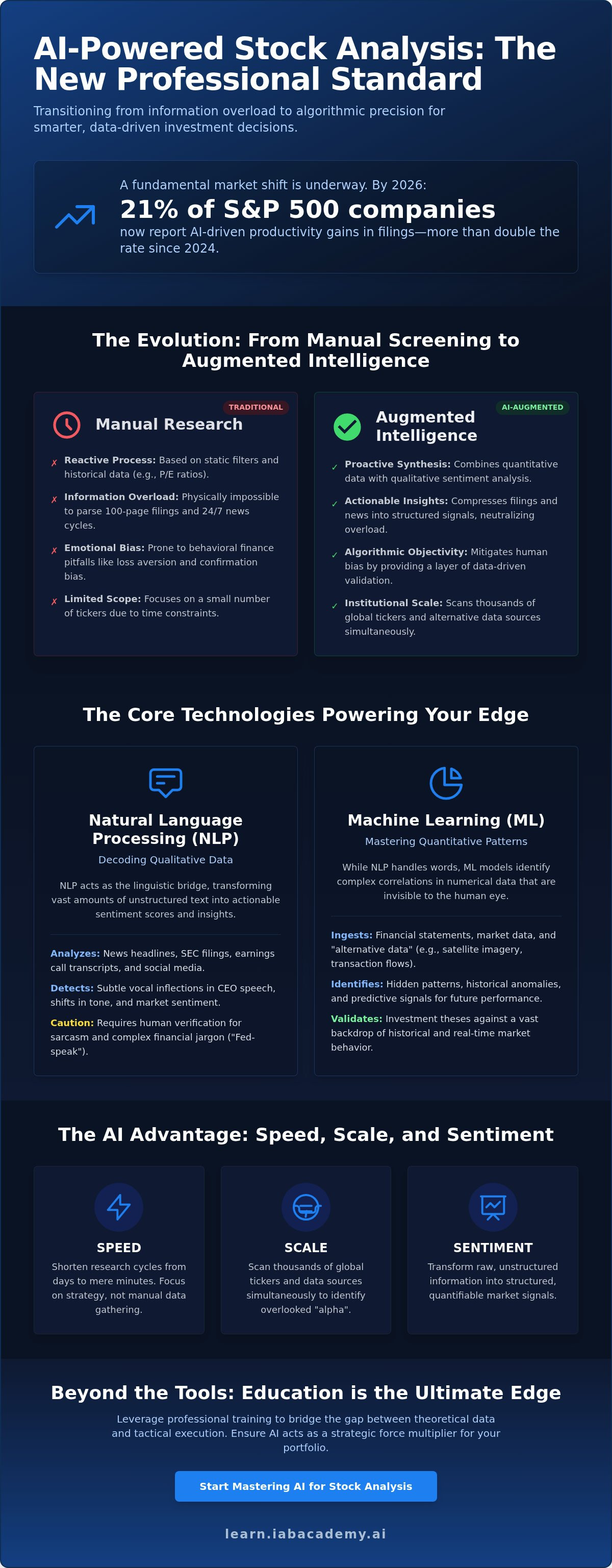
21% of S&P 500 companies now explicitly report AI-driven productivity gains in their 2026 filings, a figure that has more than doubled since 2024. Learning how to use AI for stock analysis is no longer a peripheral skill for the curious investor; it's a fundamental requirement for professional survival. In a market where AI infrastructure investment drove over 90% of U.S. GDP gains in the first half of 2025, the gap between data-rich institutions and the individual researcher is widening at an institutional pace.
You're likely exhausted by the relentless noise of 24-hour news cycles and the burden of parsing 100-page SEC filings that often trigger emotional, reactionary trades. It's difficult to maintain objectivity when information overload becomes a physical barrier to clear execution. This guide provides the professional framework to master the tools required for high-density market research and smarter, data-driven investment decisions. We'll examine the technicalities of AI-assisted workflows, from navigating the new Transparency in Frontier AI Act disclosures to establishing a repeatable analysis system that replaces emotional bias with cold, algorithmic precision.
Key Takeaways
- Transition from traditional manual screening to a sophisticated model of augmented intelligence that synthesizes quantitative data with qualitative market sentiment.
- Implement a repeatable framework on how to use AI for stock analysis that prioritizes the definition of your investment thesis before deploying automated screening tools.
- Utilize specialized Natural Language Processing to compress 10-K filings and global news cycles into actionable insights, effectively neutralizing the burden of information overload.
- Leverage professional training to bridge the gap between theoretical data and tactical execution, ensuring AI acts as a strategic force multiplier for your portfolio.
Understanding the Role of Artificial Intelligence in Modern Stock Analysis
AI stock analysis is the systematic synthesis of high-density quantitative data and nuanced qualitative insights through machine learning frameworks. It represents a fundamental shift from the reactive, manual screening processes of the past decade toward a proactive, augmented intelligence model. In 2026, the professional standard has moved beyond simple data retrieval. Success now requires the ability to interpret complex correlations that remain invisible to the naked eye. Mastering how to use AI for stock analysis allows you to operate with the precision of an institutional desk, regardless of your capital base.
It is vital to distinguish this methodology from pure algorithmic trading. While algorithmic systems focus on high-frequency execution and rigid rule-based automation, AI-assisted analysis enhances human judgment. It acts as a cognitive filter. By processing vast datasets, AI provides a layer of data-driven objectivity that mitigates the behavioral finance biases, such as loss aversion or confirmation bias, that frequently derail retail portfolios. The goal is not to replace the investor but to empower them with a high-fidelity view of market dynamics.
The Evolution from Screeners to Predictive Models
Traditional stock screeners from the 2010 era were limited to static filters like debt-to-equity ratios or market capitalization. Modern predictive models utilize deep learning to ingest "alternative data" that was previously the exclusive domain of elite hedge funds. Today's professionals analyze satellite imagery of retail parking lots or real-time credit card transaction flows to forecast quarterly earnings before they are officially reported. This institutional-grade analysis is now accessible to any retail investor committed to professional growth and structured training.
Key Benefits: Speed, Scale, and Sentiment
The primary advantages of AI integration are speed and the processing of unstructured data. Humans are biologically incapable of reading 10,000 earnings transcripts or monitoring global social sentiment in real time. AI identifies "alpha" in overlooked market sectors by scanning thousands of global tickers simultaneously. It transforms raw, unstructured information into structured signals. This allows you to focus on strategic asset allocation rather than the manual labor of data entry. Efficiency is the new currency of the 2026 market.
By leveraging these models, you can shorten your research cycle from days to minutes. AI doesn't just find stocks; it validates your investment thesis against historical anomalies and current regulatory shifts. It provides a sense of mastery over a technological landscape that often feels intimidating to the uninitiated.
The Core Technologies Powering AI Investment Research
To truly master how to use AI for stock analysis, you must look past the user interface and understand the computational engines driving your data. Blindly following a "buy" signal is a professional risk; understanding the logic behind that signal is a professional asset. The role of AI in the stock market has matured into a multi-layered ecosystem where different technologies handle specific analytical burdens. In 2026, the professional standard demands a working knowledge of these mechanisms to ensure the outputs you receive are both valid and actionable.
Natural Language Processing for Sentiment Analysis
Natural Language Processing (NLP) serves as the linguistic bridge between raw text and actionable sentiment scores. It doesn't just read news headlines. It categorizes them by relevance, urgency, and historical impact. Sophisticated NLP models now analyze the subtle vocal inflections and linguistic hesitations of CEOs during earnings Q&A sessions. These models can detect a lack of confidence that a human listener might overlook. However, professional caution is necessary. NLP still faces hurdles when interpreting high-level sarcasm or the dense, intentionally vague "fed-speak" used by central bankers. Relying on NLP for qualitative analysis requires a human-in-the-loop to verify nuances that machines may misinterpret as literal.
Machine Learning for Quantitative Patterns
While NLP handles words, Machine Learning (ML) masters the numbers. Standard technical analysis often relies on linear indicators like moving averages. ML models, however, excel at identifying non-linear correlations. They process thousands of variables simultaneously to identify which financial ratios, or "features," are currently driving price action. This process, known as feature selection, ensures you aren't distracted by lagging indicators. Unlike rigid algorithms, ML models are designed to adapt. They recognize when a market regime shifts from a low-volatility bull cycle to a high-volatility bear market, recalibrating their weighting of risk factors accordingly.
Deep Learning takes this a step further by using neural networks to simulate macro-economic scenarios. These networks can model the ripple effects of a sudden interest rate hike or a geopolitical supply chain disruption across an entire sector. This level of simulation was once reserved for global investment banks. Today, specialized AI stock analysis tools training allows retail professionals to harness these same neural networks to stress-test their portfolios against future volatility. Understanding these "under the hood" mechanics transforms AI from a black box into a transparent, high-fidelity research assistant.
Qualitative vs. Quantitative: Leveraging LLMs and Specialized Tools
Understanding how to use AI for stock analysis requires a clear distinction between general-purpose Large Language Models (LLMs) and specialized fintech platforms. While LLMs like ChatGPT-5 offer unparalleled linguistic flexibility, specialized tools like Bloomberg GPT or Trade Ideas are engineered for high-density financial accuracy. Professionals use LLMs to navigate the thousands of documents within the SEC's EDGAR database, distilling 10-K filings into concise summaries of operational risks. However, the inherent risk of "hallucination" remains. You must always verify AI-generated summaries against established stock market fundamentals to ensure the data aligns with real-world financial reporting standards.
The professional investor treats LLM outputs as a sophisticated first draft rather than a final verdict. Hallucinations, or the generation of plausible but false data, can be catastrophic in a high-stakes trading environment. Cross-referencing AI-generated summaries with raw data is a non-negotiable step in any professional workflow. This ensures that your investment decisions are rooted in verified filings and historical context rather than an algorithm’s linguistic prediction. By combining the broad synthesis of LLMs with the precise calculations of fintech tools, you create a robust, multi-layered research process.
Using LLMs for Earnings Call Synthesis
LLMs excel at synthesizing earnings call transcripts to reveal hidden corporate sentiment. A sophisticated prompt framework involves asking the AI to compare the current transcript with the previous four quarters, specifically looking for contradictions in management’s tone or forward-looking guidance. This identifies shifts in corporate strategy that a single-document review might miss. Modern tools also integrate audio-to-text capabilities, converting live earnings calls directly into searchable text analysis. This allows you to identify "alpha" during the high-volatility window immediately following a release.
Specialized AI for Technical and Fundamental Data
Specialized AI tools focus on the quantitative heavy lifting that general models cannot handle. These platforms automate chart pattern recognition, identifying non-linear breakouts across thousands of tickers simultaneously. Beyond technicals, AI-driven fundamental analysis models now project future cash flows by correlating macro-economic data with micro-level company performance. For those exploring how to invest in ai, these specialized tools are essential for identifying companies with sustainable margin expansion rather than just temporary market hype. They provide the structural stability required for long-term portfolio growth.
A Strategic Framework for Implementing AI in Your Investment Workflow
Successful integration of artificial intelligence is not a matter of software acquisition; it is a matter of procedural discipline. A professional workflow starts with the investor's intent, not the algorithm's output. To master how to use AI for stock analysis, you must follow a layered approach that prioritizes strategic objectives over raw computational speed. This ensures that every data point serves a specific investment thesis rather than contributing to the information overload mentioned earlier. A structured framework transforms AI from a chaotic data source into a precision instrument.
The following five-step sequence establishes a professional standard for AI-assisted research:
- Step 1: Thesis Definition. Establish your investment parameters, risk tolerance, and time horizon. AI cannot tell you what your goals are; it can only help you achieve them.
- Step 2: Broad-Spectrum Screening. Deploy AI to scan the global market for tickers that meet your specific quantitative criteria. This is where how to use AI for stock analysis becomes a significant time-saver, narrowing thousands of possibilities into a manageable shortlist.
- Step 3: Qualitative Synthesis. Utilize LLMs to parse earnings transcripts, news sentiment, and regulatory filings for the shortlisted companies.
- Step 4: Predictive Stress-Testing. Run your potential picks through neural networks to simulate performance under various macro-economic shocks.
- Step 5: Executive Decision. The final "buy" or "sell" remains a human responsibility. AI provides the evidence, but you provide the conviction.
Developing Your AI-Powered Screener
Your screener parameters must align with your specific style. A growth investor might instruct the AI to prioritize companies with a high correlation to AI infrastructure spending, which drove over 90% of U.S. GDP gains in early 2025. Conversely, a value investor might use AI to find "look-alike" stocks that share the fundamental characteristics of historically undervalued industry leaders. The human-in-the-loop concept defines a system where AI processes high-density data, but the final executive decision rests solely on human judgment and ethical oversight. This ensures that your portfolio remains a reflection of your professional strategy.
Stress-Testing and Risk Management
Risk management is where AI truly earns its place in a professional toolkit. You can use predictive models to simulate how your portfolio would react to a sudden 50-basis-point interest rate hike or a localized supply chain failure. AI also identifies "correlation clusters," revealing if your supposedly diversified assets are actually moving in lockstep due to hidden macro factors. Mastering these technicalities is a core component of risk management & portfolio strategy training. For those ready to move from theory to tactical application, our AI-Powered Trading Tools Training provides the hands-on experience needed to build these workflows with institutional precision.
Beyond the Tools: Why AI Education is the Ultimate Competitive Edge
Artificial intelligence serves as a neutral force multiplier. For the educated professional, it provides 10x intelligence and research velocity. For the novice, it creates 10x danger by accelerating the execution of flawed investment theses. The 2026 market doesn't reward those who simply prompt a chatbot for stock picks. It rewards those who understand the underlying mechanics of value. Learning how to use AI for stock analysis is an empty exercise if you cannot interpret a balance sheet or recognize a liquidity trap. Education remains the definitive bridge that converts raw data into sustainable, long-term wealth.
The global professional ecosystem is shifting toward a "knowledge-first" paradigm. While tools change quarterly, the principles of risk management and capital allocation are constant. Relying on a tool without a foundational education is a strategy destined for obsolescence. To outlast AI trends, you must master the cognitive frameworks that allow you to verify, challenge, and refine machine outputs. This mastery ensures that you remain the architect of your portfolio rather than a passive observer of an algorithm's decisions.
The IAB Academy Advantage
The IAB Academy’s Smart Instructor™ serves as the critical link between theoretical knowledge and tactical AI execution. This system provides real-time, multilingual support, ensuring that professionals can calibrate their strategies across diverse global markets with precision. Our Novice Investor Curriculum is specifically designed to prepare you for this automated era, focusing on the high-level cognitive skills that neural networks cannot replicate. This includes a dedicated focus on financial literacy for teens. We recognize that the next generation of investors must enter the digital ecosystem with a complete mastery of both financial fundamentals and technological infrastructure.
Building a Future-Proof Investment Career
Becoming an AI-literate investor is the definitive career security for 2026. As new regulatory frameworks like the Transparency in Frontier AI Act reshape the industry, those who possess professional certification will lead the market. However, success begins with the basics. A comprehensive personal finance class remains the essential prerequisite for advanced AI success. Without a firm grasp of cash flow and risk parameters, even the most advanced neural network becomes a liability.
Mastery over the 2026 financial landscape requires more than just access to software. It requires a commitment to a structured, financial literacy curriculum that outlasts temporary tech cycles. This approach ensures your credibility and professional advancement in an increasingly competitive market. Join IAB Academy and Master AI-Powered Investing Today to secure your position at the forefront of the global professional ecosystem.
Securing Your Professional Position in the AI-Driven Market
Mastering how to use AI for stock analysis requires a disciplined transition from manual data entry to strategic, high-level oversight. As we've established, the professional standard for 2026 demands a synthesis of quantitative machine learning patterns and qualitative sentiment analysis, all governed by a rigorous five-step framework. By prioritizing foundational financial literacy over mere tool acquisition, you ensure that artificial intelligence remains a force multiplier for your expertise rather than a source of unmanaged risk. The ability to stress-test portfolios against macro-economic shocks is no longer a luxury reserved for institutional desks; it's a prerequisite for retail success.
The path to professional mastery is defined by continuous growth and validation. Our Smart Instructor™ AI tutor provides real-time guidance in over 130 languages, bridging the gap between complex theory and tactical execution. With a curriculum spanning from novice fundamentals to professional-grade strategy, we provide the stable infrastructure you need to navigate this evolving landscape. Master AI-Powered Investing with IAB Academy today and gain lifetime access to all 2026 market updates. Your commitment to high-density information and industry standards is the ultimate safeguard for your long-term career security.
Frequently Asked Questions
Can AI accurately predict stock market crashes?
AI models cannot definitively predict a market crash because these events are often triggered by non-linear "black swan" events or irrational human behavior that lacks historical precedent. However, they excel at identifying structural vulnerabilities and "correlation clusters" that often precede significant volatility. By monitoring high-density data like credit default swap spreads and rapid changes in liquidity, AI provides a probabilistic warning system rather than a crystal ball.
What is the best free AI tool for stock analysis in 2026?
Several platforms offer entry-level access to advanced analytics without an initial financial commitment. Tickeron and StockHero provide limited free tiers that allow users to explore basic AI-driven signals and technical pattern recognition. For those learning how to use AI for stock analysis at a professional level, these free tools serve as an excellent sandbox for testing frameworks before transitioning to more robust, institutional-grade suites.
Do I need to know how to code to use AI for investing?
Coding proficiency is no longer a prerequisite for leveraging artificial intelligence in the 2026 market. Modern interfaces utilize natural language processing and "no-code" dashboards, allowing investors to build complex screeners and predictive models through simple commands. While understanding the underlying logic is essential for professional advancement, the technical burden of writing Python or C++ has been replaced by intuitive, high-minded user experiences.
How does AI sentiment analysis actually work?
Sentiment analysis utilizes Natural Language Processing (NLP) to convert unstructured text into structured numerical scores. Algorithms scan news headlines, earnings transcripts, and social data to identify keywords associated with bullish or bearish outlooks. Advanced models in 2026 also analyze linguistic nuances and executive tone during Q&A sessions to detect confidence levels that standard quantitative data might miss, providing a qualitative edge.
Is it safe to link my brokerage account to an AI trading assistant?
Security depends on the specific platform's encryption standards and its alignment with current regulatory frameworks. Under 2026 regulations like California’s Transparency in Frontier AI Act, legitimate developers must publicly disclose their safety protocols and risk management systems. Always ensure the tool uses OAuth for secure authentication. This allows the AI to view data or execute trades without ever gaining access to your actual brokerage password.
What are the biggest risks of relying on AI for stock picks?
The primary risks include algorithmic "hallucinations" and the danger of overfitting historical data to future scenarios. If a model is trained exclusively on a decade of low interest rates, it may fail to adapt to a high-inflation regime. Additionally, relying solely on AI without a human-in-the-loop can lead to significant losses if the system misinterprets a black swan event or a sudden regulatory shift.
How can I tell if an AI stock analysis tool is legitimate?
Professional legitimacy is signaled by transparency and compliance with established global standards. Check if the developer provides the clear disclosures required by the Texas Responsible AI Governance Act or the EU AI Act. Legitimate tools avoid "black box" promises of guaranteed returns. Instead, they offer detailed documentation on their data sources and backtesting methodologies, allowing for independent professional validation.
