
Financial Literacy for Young Adults: The 2026 Mastery Checklist
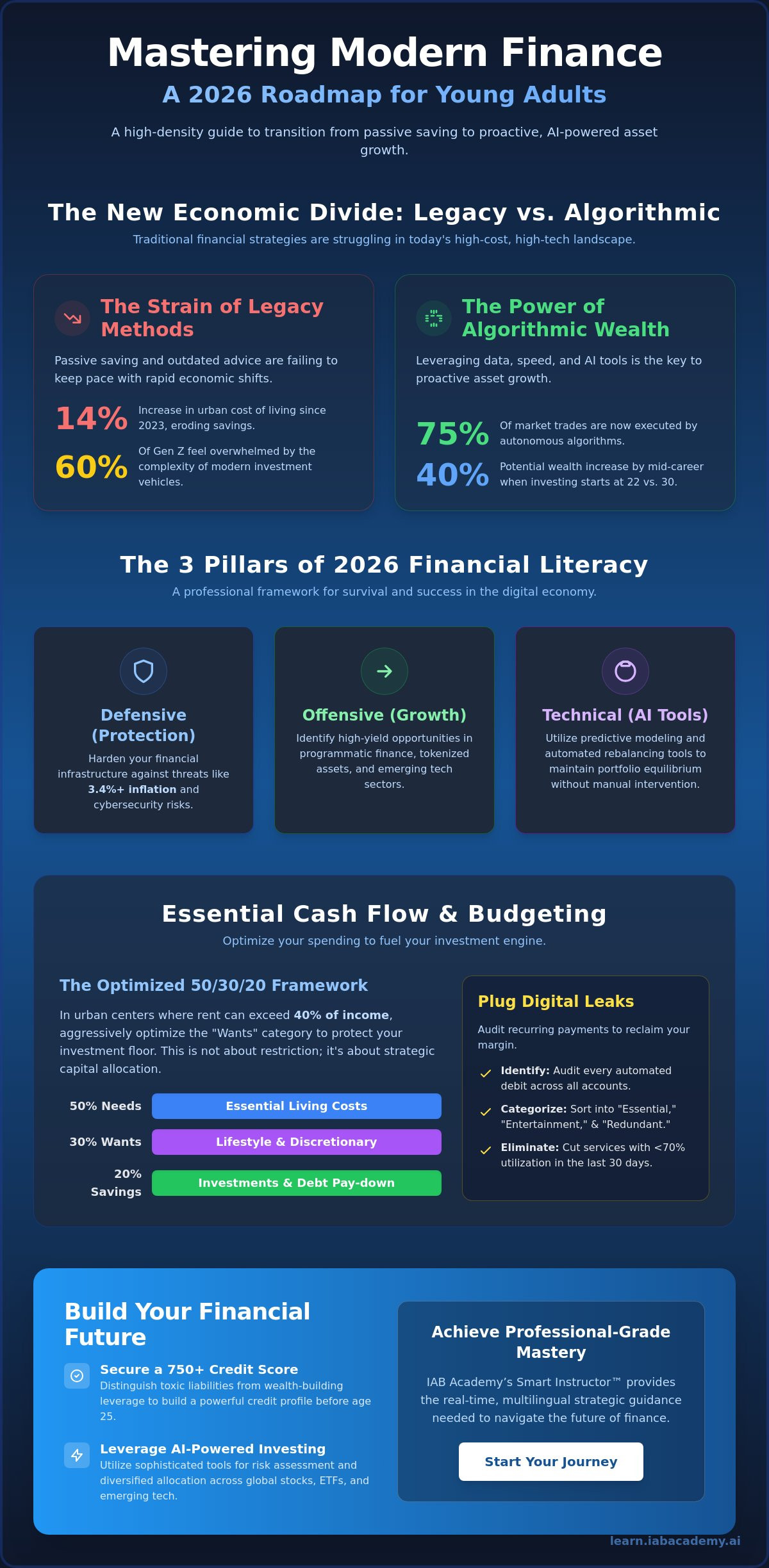
By 2026, the gap between those who rely on legacy budgeting methods and those who leverage algorithmic wealth management will define the next decade's economic divide. You likely feel that traditional saving is nearly impossible as the cost of living in major urban centers has increased by 14% since 2023. It's frustrating when complex market terminology feels like a barrier to entry, especially when you're pressured to keep up with rapid tech trends. Achieving true financial literacy for young adults requires more than just a piggy-bank mentality; it demands a strategic immersion into a digital-first ecosystem where data and speed are the primary currencies.
This guide provides a definitive, actionable roadmap to mastering your personal capital, credit health, and the implementation of AI-powered investing. We've synthesized industry standards into a high-density checklist designed to move you from financial anxiety to professional-grade mastery. You'll gain the specific technicalities needed to transition from passive saving to proactive asset growth. We'll examine the core pillars of modern money management, from programmatic debt reduction to the precise deployment of digital financial tools.
Key Takeaways
- Master the foundational principles of financial literacy for young adults by navigating a digital-first economy driven by algorithmic markets and AI integration.
- Optimize your capital allocation using an evolved 50/30/20 framework designed for high-cost urban environments and the systematic elimination of digital subscription leaks.
- Implement a strategic framework to secure a 750+ credit score before age 25 while learning to distinguish between toxic liabilities and wealth-building leverage.
- Utilize AI-powered tools for sophisticated risk assessment and diversified asset allocation across global stocks, ETFs, and emerging technology sectors.
- Ensure long-term professional credibility and financial mastery by leveraging IAB Academy’s Smart Instructor™ for real-time, multilingual strategic guidance.
Defining Financial Literacy for Young Adults in the 2026 Ecosystem
In the 2026 fiscal landscape, Defining Financial Literacy requires a shift from basic arithmetic to technological fluency. It's no longer enough to understand interest rates; you must comprehend how capital flows through a digital-first economy governed by decentralized protocols and instant settlement. For the modern professional, financial literacy for young adults represents the ability to manage resources within a system where AI integration and algorithmic markets dictate the pace of growth. Mastery in this era isn't a passive achievement. It's a rigorous standard of excellence that demands a future-proof mindset.
The IAB Academy approach moves beyond the surface-level advice found in traditional workshops. We categorize modern literacy into three essential pillars that ensure professional survival and success:
- Defensive (Protection): Hardening your financial infrastructure against cybersecurity threats and inflationary pressures that exceeded 3.4% in recent cycles.
- Offensive (Growth): Identifying high-yield opportunities within programmatic finance and tokenized asset classes.
- Technical (AI Tools): Utilizing predictive modeling and automated rebalancing tools to maintain portfolio equilibrium without manual intervention.
The Shift from Static Savings to Dynamic Wealth Building
The era of the static savings account is over. In 2026, the digital ecosystem has redefined what constitutes a safe financial foundation. With core inflation frequently outstripping the 0.5% yields offered by legacy banks, young adults must pivot toward dynamic wealth building. This involves a sophisticated mix of digital assets, tokenized real estate, and automated ETFs. Data indicates that starting this process at age 22 instead of age 30 can lead to a 40% increase in total wealth by mid-career. Leveraging compound interest in high-volatility markets requires a disciplined, modular strategy that accounts for rapid price discovery and 24/7 market cycles.
Why Traditional Schooling Falls Short
The current gap in financial literacy in schools has left a generation unprepared for the technicalities of modern finance. Most institutional curricula rely on 20th-century models that ignore the reality of algorithmic trading and global digital compliance. Over 60% of Gen Z report feeling overwhelmed by the complexity of modern investment vehicles. To bridge this gap, the IAB Academy introduces the Elite Mentor concept. We replace generic classroom instruction with professional-grade certifications. This transition ensures that financial literacy for young adults is treated as a high-stakes technical skill. In a market where 75% of trades are executed by autonomous algorithms, your education must be as advanced as the systems you're participating in.
The Essential Cash Flow and Budgeting Checklist
Mastering the importance of financial literacy is the first step toward achieving financial literacy for young adults in a volatile market. The traditional 50/30/20 rule requires a strategic pivot to remain relevant in 2026's high-cost urban environments. While the framework suggests allocating 50% to needs, 30% to wants, and 20% to savings, professionals in metropolitan hubs often face rent-to-income ratios exceeding 40%. In these scenarios, you must optimize the "wants" category aggressively to protect your 20% investment floor. This isn't just about restriction; it's about ensuring your capital works as hard as your labor.
Digital leaks represent a significant threat to modern liquidity. Recurring payments often go unnoticed, creating a fragmented cash flow that prevents wealth accumulation. Use this subscription audit checklist to reclaim your margin:
- Identify every automated debit across all banking and credit accounts.
- Categorize subscriptions into "Essential Professional," "Core Entertainment," and "Redundant."
- Eliminate any service that hasn't reached a 70% utilization rate in the last 30 days.
- Consolidate fragmented media bundles into high-value aggregate plans.
Mastering the Art of the 'Runway'
A flat savings goal is often insufficient for the 2026 economic landscape. You must calculate a "Runway" that accounts for six months of absolute essential expenses. To calculate this, sum your housing, utilities, basic caloric needs, and mandatory debt obligations; then multiply by six. Store this liquidity in a High-Yield Savings Account (HYSA) or a money market fund currently offering between 4.5% and 5.2% to ensure accessibility and inflation protection. For a technical breakdown of capital preservation, refer to how to learn savings for advanced techniques.
High-Density Budgeting Tools
Manual tracking offers high tactile awareness, but AI-powered aggregators provide real-time attribution of every cent spent. Cash Flow is the lifeblood of any personal investment strategy. These digital tools allow you to set up real-time push notifications for budget deviations. For instance, if your discretionary spending exceeds 5% of its monthly allocation by the second week, the system triggers an alert. This creates an immediate feedback loop, forcing a correction before the deficit impacts your long-term goals.
Effective financial literacy for young adults requires moving beyond spreadsheets into automated ecosystems. Establish a digital infrastructure that triggers transfers on payday. This "pay yourself first" protocol ensures that 20% of your gross income reaches your investment accounts before it can be misallocated. By automating these flows, you remove the friction of decision-making and ensure consistent growth. To further refine your financial strategy, explore our professional development resources for more industry-standard insights.
Navigating the Credit and Debt Management Framework
Credit functions as the fundamental currency of the modern financial ecosystem. Mastering financial literacy for young adults requires moving beyond basic awareness toward technical proficiency in credit optimization. Achieving a 750+ FICO score before age 25 is not an accident. It is the result of disciplined compliance with scoring algorithms and strategic utilization of available leverage. Professionals who treat their credit profile as a career asset gain access to lower interest rates, which preserves capital for long-term investment.
The Anatomy of a Credit Score
The FICO scoring model relies on five weighted factors that every young adult must monitor with precision. Payment history remains the most critical, accounting for 35% of the total score. Credit utilization follows at 30%. To optimize this metric, keep your reported balances below 10% of your total limits. The remaining 35% is split between length of credit history (15%), credit mix (10%), and new credit inquiries (10%).
- Monthly Optimization: Pay your balance in full 48 hours before the statement closing date to ensure a 0% to 3% utilization rate is reported to bureaus.
- Compliance Monitoring: Review your TransUnion, Equifax, and Experian reports quarterly.
- Dispute Protocols: Use the Fair Credit Reporting Act (FCRA) standards to challenge inaccuracies. Errors must be investigated by bureaus within 30 days of a formal digital filing.
Leveraging Debt for Career Excellence
Debt is often framed as a burden, yet elite financial mastery recognizes it as a tool for human capital investment. Strategic debt includes low-interest student loans for high-ROI degrees or professional certifications that increase your market value. Toxic debt, such as credit card balances carrying 22% APR or higher, acts as a trap that erodes net worth. Zero debt is not always the optimal state for those seeking elite financial status. Leveraging low-interest capital to fund assets that appreciate at a higher rate is a hallmark of sophisticated financial management.
In the current high-interest rate environment, choosing a repayment strategy is a mathematical decision. The Debt Avalanche method targets the highest interest rates first, minimizing total interest paid. Conversely, the Debt Snowball method prioritizes the smallest balances to build psychological momentum. While the Snowball offers emotional wins, the Avalanche is the technically superior choice for those focused on total capital preservation.
Identity protection is now a mandatory component of financial literacy for young adults. AI-driven fraud, including voice cloning and sophisticated phishing, contributed to $43 billion in identity fraud losses in 2023 according to Javelin Strategy & Research. Protect your financial data by implementing the following checklist:
- Enable hardware-based multi-factor authentication (MFA) for all banking portals.
- Freeze your credit reports at all three major bureaus to prevent unauthorized account openings.
- Utilize passkeys rather than traditional passwords to eliminate credential-harvesting risks.
From Saving to Investing: The AI-Powered Growth Checklist
Transitioning from passive saving to active investing is the most critical phase of financial literacy for young adults. In 2026, the barrier to entry has vanished, but the complexity of the market has increased. You must begin with a rigorous risk assessment rooted in macro-economic analysis. This involves evaluating how inflation trends and central bank policies impact your specific timeline. You shouldn't rely on gut feelings. Instead, use quantitative tools to define your risk tolerance, ensuring your portfolio can handle a 15 percent drawdown without triggering a panic sale. Modern asset allocation requires a sophisticated blend of traditional and emerging sectors. A diversified 2026 portfolio typically includes:- Broad-market ETFs: These provide a foundation of stability across multiple industries.
- Tech Sector Focus: Targeted exposure to AI infrastructure and semi-conductors.
- Defensive Assets: Bonds or commodities that hedge against programmatic trading volatility.
Fundamentals of the 2026 Stock Market
Mastering stock market fundamentals is essential for long-term growth. Today's market movements are frequently dictated by programmatic trading, where automated systems execute high-volume trades in milliseconds. This creates sharp, short-term volatility that can trap uneducated investors. When choosing a brokerage, prioritize platforms that offer AI-powered trading assistants and transparent fee structures. These tools help you align your strategy with the global digital ecosystem.The Novice Investor’s First 90 Days
The first three months of your investment journey determine your long-term success. Follow this disciplined three-step protocol to establish your presence in the market:- Step 1: Open a tax-advantaged account, such as an IRA or 401k, to shield your gains from immediate taxation.
- Step 2: Automate a monthly "Mastery Contribution." Consistency outperforms market timing in 92 percent of historical cases.
- Step 3: Engage with daily market analysis via IAB’s Smart Instructor™ to gain real-time clarity on shifting trends.
Future-Proofing Your Wealth with IAB Academy Mastery
Professional credibility in 2026 requires more than a baseline understanding of markets. It demands a commitment to continuous education that mirrors the pace of technological change. Achieving financial literacy for young adults is the first milestone, but maintaining that edge requires a sophisticated framework for skill retention. The IAB Academy serves as this framework, providing the technical standards necessary to navigate a globalized economy with precision.
The IAB Smart Instructor™ technology facilitates this by offering real-time, high-density support in over 130 languages. This isn't a static textbook; it's a responsive digital mentor that ensures compliance with the latest financial regulations and market shifts. Because the academy provides lifetime access, your educational investment functions as a permanent hedge against evolving standards. As the digital ecosystem shifts, your curriculum updates, ensuring you never fall behind industry benchmarks or lose your competitive advantage.
Transitioning from a literate participant to a master of your own wealth involves moving through a modular, disciplined path. This progression ensures that you don't just understand concepts but can execute them with precision in high-stakes environments. By layering technical knowledge over practical habits, you move beyond basic survival into the realm of institutional-grade wealth management.
Choosing the Right Educational Path
Selecting a curriculum is a strategic decision that impacts your long-term career trajectory. You should begin by choosing the right personal finance class that prioritizes technical accuracy over generic advice. An IAB certification provides a hallmark of quality, signaling your proficiency to the global digital ecosystem. For those at the start of their journey, reviewing the best personal finance courses for beginners will help establish the foundational knowledge required for advanced certification.
Next Steps for the High-Achieving Young Adult
The path to financial dominance is structured and deliberate. High-achievers don't leave their growth to chance. Follow this final checklist to secure your position in the 2026 market:
- Audit your skills: Identify gaps in your current understanding of digital asset management and tax compliance.
- Select a module: Choose a specialized track within the IAB curriculum that aligns with your specific professional objectives.
- Engage the AI tutor: Use the Smart Instructor™ to clarify complex technical points and simulate market scenarios.
Mastery is the intersection of disciplined habits and cutting-edge technology.
Join the global community of IAB-certified investors and practitioners to ensure your financial literacy for young adults evolves into a lifelong professional asset. The standards of 2026 are already here, and your path to mastery starts with a single, disciplined step into the IAB ecosystem.
Secure Your Financial Future in the 2026 Ecosystem
Mastering financial literacy for young adults requires moving beyond basic savings toward a sophisticated understanding of the 2026 digital economy. You've identified the critical benchmarks for managing credit frameworks and leveraging AI-powered investment tools for wealth growth. These technical competencies are no longer optional for those seeking professional stability. Success in this landscape depends on your ability to implement structured cash flow strategies and maintain high-level debt compliance.
Professional validation remains the most effective way to signal your expertise to the global market. The IAB Academy offers a comprehensive curriculum that includes support from our AI-Powered Smart Instructor™ in 130+ languages. You'll gain lifetime access to every future curriculum update and earn an industry-recognized certification that accelerates career advancement. Don't leave your financial trajectory to chance when you can follow a proven, institutional-grade path to mastery.
Enroll in the IAB Academy Financial Literacy Curriculum for 2026 Mastery and establish your authority in the modern financial world. You're ready to take command of your economic future.
Frequently Asked Questions
What is the most important part of financial literacy for young adults?
Understanding cash flow management and the time value of money represents the most critical pillar of financial literacy for young adults. According to 2024 Federal Reserve data, 40 percent of adults can't cover a 400 dollar emergency expense. Mastery over your personal balance sheet ensures you capitalize on compound interest early. This foundational knowledge allows you to navigate the global digital ecosystem with confidence and professional credibility.
Can I start learning about investing if I have student loan debt?
You can and should start investing while managing student loan debt, provided your interest rates are below 7 percent. The 2025 Bureau of Labor Statistics reports indicate that delaying retirement contributions by five years can reduce your final portfolio value by 25 percent. Balance your debt repayment with employer-sponsored 401k matches. This strategic approach ensures you aren't sacrificing long-term capital growth for short-term liability reduction.
How much money do I need to start a 2026 investment portfolio?
You can initiate a 2026 investment portfolio with as little as 1 dollar through fractional share platforms. Modern brokerage ecosystems have eliminated commission fees, which previously accounted for 5 to 10 dollars per trade in 2015. Starting with 50 dollars monthly allows you to practice disciplined asset allocation. This low barrier to entry empowers you to achieve technical mastery without requiring substantial initial capital reserves.
Is AI-powered investing safe for absolute beginners?
AI-powered investing is safe for beginners when utilizing platforms that comply with SEC and FINRA standards. These systems use algorithmic attribution to optimize portfolios based on your risk tolerance. A 2023 Vanguard study showed that automated advisors can add 3 percent in net returns through tax-loss harvesting and rebalancing. You must verify the platform's compliance protocols to ensure your data and capital remain protected at all times.
What are the biggest financial mistakes young adults make in their 20s?
The most significant mistakes include lifestyle inflation and ignoring credit score optimization. Data from 2024 suggests that 35 percent of a FICO score depends on payment history. Missing a single payment can drop your score by 100 points, increasing future borrowing costs by thousands. Young adults often prioritize immediate consumption over building a resilient financial ecosystem, which hampers their long-term professional advancement and wealth accumulation.
How does the IAB Academy Smart Instructor™ help with financial literacy?
The IAB Academy Smart Instructor™ facilitates financial literacy for young adults by providing personalized, modular learning paths. It uses real-time data to adjust the curriculum based on your performance and industry relevance. This ensures you achieve certification in core competencies like programmatic budgeting and fiscal compliance. The tool acts as a global mentor, guiding you through complex technical details to ensure your financial decisions meet professional standards.
What is a 'Future-Proof' financial curriculum?
A future-proof financial curriculum is an instructional framework that integrates traditional economic principles with emerging technologies like blockchain and AI. It focuses on adaptive mastery, ensuring your skills remain relevant as the digital advertising world and global markets evolve. By 2026, 60 percent of financial tasks will likely involve automation. This curriculum prepares you to manage these shifts with the authority and precision required for career survival.
Are online finance classes worth the investment in 2026?
Online finance classes are essential investments in 2026 for obtaining professional validation and industry-recognized certifications. Research from the 2024 Global Education Report indicates that certified professionals earn 15 percent more than their non-certified peers. These courses offer a steady, disciplined flow of information that translates directly into career success. Choosing a prestigious platform ensures your learning is backed by the latest standards in the global digital ecosystem.
