Common Mistakes New Traders Make: A Professional Framework for 2026
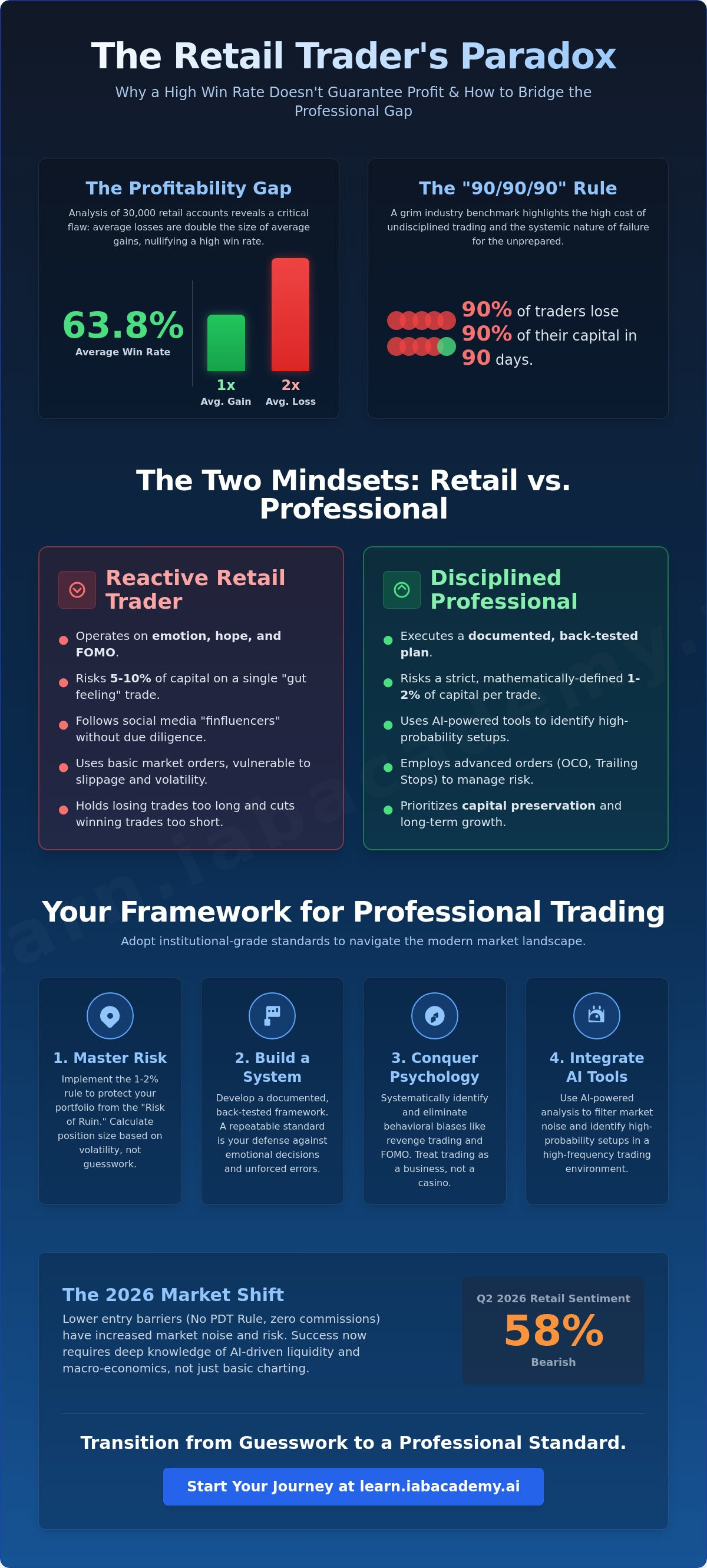
A 2025 analysis of nearly 30,000 retail accounts revealed a staggering paradox: while the average win rate was 63.8%, the majority of participants still suffered net losses because their average loss was double the size of their average gain. It's a sobering reality that highlights the systemic and psychological common mistakes new traders make when entering a market that doesn't forgive a lack of discipline. You likely recognize the emotional exhaustion of watching a technically sound entry turn into a significant capital drain, leaving you to question if the failure resulted from bad luck or a fundamentally broken strategy.
This article provides the professional framework necessary to bypass these pitfalls and achieve mastery over market fluctuations. We'll analyze the recent regulatory shifts, including the June 2026 elimination of the Pattern Day Trader (PDT) rule, and examine how to implement a repeatable trading standard. You'll learn how to transition from reactive retail habits to a disciplined methodology that prioritizes capital preservation and long-term professional growth in an increasingly volatile global landscape.
Key Takeaways
- Bridge the "Retail Gap" by adopting institutional-grade execution standards that replace speculative guesswork with a disciplined professional methodology.
- Identify and systematically eliminate the common mistakes new traders make, focusing specifically on psychological triggers like revenge trading and FOMO-driven entries.
- Establish a rigorous risk management protocol to calculate position sizing accurately and protect your portfolio from the technical "Risk of Ruin."
- Integrate AI-powered analysis tools to filter market data and identify high-probability setups within a volatile, high-frequency trading landscape.
- Transition from a novice to a standardized professional by utilizing a documented, back-tested trading framework designed for the 2026 market environment.
The Anatomy of Failure: Why Most New Traders Struggle in the 2026 Market
The "Retail Gap" represents the systemic divergence between institutional precision and the speculative guesswork that characterizes most novice portfolios. In the 2026 market, this gap has widened. High-frequency AI algorithms now execute trades in microseconds, frequently exploiting the predictable patterns and emotional reactions of unprepared beginners. One of the most prevalent common mistakes new traders make is entering this environment with a "gambler mindset" rather than acting as a professional operator. A professional understands that hope is not a technical indicator; it's a liability. Success requires a transition to standardized execution where every action is governed by data rather than intuition.
The Statistical Reality of Retail Trading
The 90/90/90 rule remains a grim industry benchmark: 90% of retail participants lose 90% of their capital within 90 days. This high failure rate often stems from an inability to distinguish between market variance and unforced errors. Variance is the natural, uncontrollable fluctuation of price; unforced errors are the result of poor discipline or inadequate education. To survive, you must build a standardized stock market foundation that prioritizes capital preservation over rapid gains. Many of these failures are rooted in behavioral finance principles, where cognitive biases lead traders to hold losing positions too long while cutting winners short. In Q2 2026, with 58% of retail clients reporting bearish sentiment, the pressure to make emotional decisions has never been higher.
The Evolution of Market Entry Barriers
The removal of the Pattern Day Trader (PDT) rule in June 2026 and the ubiquity of zero-commission trading have lowered the barrier to entry, but they've also increased the "noise" within the ecosystem. Social media "finfluencers" often promote high-risk tactics that lack professional rigor, leading to a surge in common mistakes new traders make. These influencers capitalize on the accessibility of modern platforms without explaining the underlying risks of liquidity and slippage. In 2026, basic technical analysis is no longer a competitive advantage. The market now demands a comprehensive understanding of macro-economic shifts and AI-driven liquidity cycles. Without a structured framework, the ease of access provided by modern brokerages becomes a trap for the undercapitalized. You must move beyond surface-level charts to understand the institutional mechanics that actually move the needle.
Operational Errors: The Technical Pitfalls of Unstructured Trading
Operational failure in a professional context is rarely about "bad luck." It's the direct result of a mechanical breakdown in execution. Professionals treat trading as a high-stakes infrastructure project, yet many retail participants operate without a documented, back-tested protocol. This lack of structure is among the most damaging common mistakes new traders make, as it prevents the isolation of variables when a strategy underperforms. Without a technical standard, you can't tell if a loss was a statistical certainty or a failure of your system.
Effective execution in the 2026 market also requires a mastery of advanced order types. Relying solely on market orders exposes your capital to unnecessary slippage and volatility. Professionals leverage trailing stops to lock in gains and OCO (One-Cancels-the-Other) orders to manage exits without constant screen monitoring. Additionally, ignoring the macro-economic calendar is a fatal oversight. With 58% of retail clients reporting bearish sentiment in Q2 2026 according to Charles Schwab, staying informed on high-impact data releases and geopolitical shifts is essential for maintaining a competitive edge.
The Position Sizing Trap
Mathematical ruin is often a choice made at the moment of entry. Many beginners calculate their position size based on a "gut feeling" about a stock's potential, often risking 5% or 10% of their total equity on a single setup. This is a mathematical death sentence. Professional standards dictate risking no more than 1-2% of total capital per trade. By calculating size based on technical volatility rather than arbitrary dollar amounts, you ensure your portfolio can survive a string of losses. Engaging in risk management & portfolio strategy training is the most efficient way to internalize these preservation techniques before capital depletion occurs.
Neglecting the Trading Journal
If you don't track your data, you aren't trading; you're guessing. A professional trading journal is a diagnostic tool used to identify "leaks" in your strategy. You must record more than just entry and exit prices. A high-density journal tracks your Win Rate, Profit Factor, and Expectancy. Monthly audits of these metrics reveal whether your losses are clustered around specific times of day or certain sectors. This data-driven self-reflection is the only repeatable path to improvement. For those seeking to formalize their approach, our Novice Investors Course provides the templates and training needed to turn scattered data into a professional edge.
The Psychological Retail Gap: Behavioral Biases in Action
While technical protocols and risk management provide the structural framework for success, psychological discipline remains the primary differentiator between institutional operators and retail participants. The most damaging common mistakes new traders make are rarely due to a lack of intelligence; they're the result of biological impulses overriding logical systems. When a trade moves against you, the brain's survival mechanisms often trigger a fight-or-flight response, leading to "Revenge Trading." This is the destructive urge to immediately recoup losses by increasing position size or abandoning entry criteria, which often compounds the initial error.
Fear of Missing Out (FOMO) represents the opposite side of this emotional spectrum. In the high-volatility environment of 2026, beginners often chase parabolic price moves after the optimal entry point has passed, effectively buying at the peak of retail euphoria. This behavior is frequently reinforced by confirmation bias, where a trader ignores bearish technical signals and only seeks data that validates their existing position. Conversely, a string of lucky wins can induce a "God Complex," leading to overleveraging and a total disregard for the risk management standards established in previous chapters. Professionalism requires the suppression of these ego-driven impulses in favor of standardized execution.
The Neuroscience of the Trade
Modern neurobiology explains why these biases are so difficult to overcome. During periods of drawdown, the amygdala highjacks the prefrontal cortex, effectively disabling the rational decision-making centers of the brain. To counter this, professionals cultivate a state of professional detachment, viewing P&L fluctuations as mere data points rather than personal reflections of competence. Emotional equilibrium is the state of maintaining a neutral psychological posture regardless of short-term P&L outcomes, ensuring that internal states do not dictate external execution.
Overtrading and the Dopamine Loop
Overtrading is often a symptom of the brain's search for a dopamine hit rather than a pursuit of profit. It's essential to distinguish between trading for a professional edge and trading for excitement. Many beginners fall victim to "Action Bias," the belief that doing something is always better than doing nothing, even when the market offers no high-probability setups. Establishing strict daily loss limits acts as a critical circuit breaker, preventing an emotional meltdown from turning into a catastrophic account wipeout. Recognizing when the market doesn't provide an opportunity is as vital as identifying an entry signal. Mastering these psychological hurdles is a prerequisite for anyone serious about career survival in a competitive financial landscape.
Mitigating Risk Through Standardised Frameworks and AI Integration
Modern trading is a battle of systems, not opinions. To transition from a reactive retail participant to a disciplined operator, you must implement a rules-based entry and exit protocol. This architectural approach to the market ensures that no trade is executed without satisfying a predetermined set of technical and macro-economic criteria. By establishing these standardized frameworks, you effectively neutralize the common mistakes new traders make, such as entering positions based on social media sentiment or vague intuition. Professionalism is defined by the repeatability of your process, not the outcome of a single trade.
Integrating machine intelligence into your workflow provides an objective layer of defense against market noise. AI-powered stock analysis tools process vast datasets to filter out low-probability setups that the human eye might miss. Understanding how to invest in ai training helps you leverage these tools to modernize your portfolio, ensuring your strategy aligns with the high-frequency environment of 2026. This technological integration is not about replacing human judgment but refining it through data-driven filtration.
Leveraging AI for Bias Detection
AI assistants now offer the capability to flag emotional trading patterns in real-time. By monitoring your execution data, these tools identify when you are deviating from your back-tested protocol or exhibiting signs of revenge trading. This automation removes subjective chart-reading errors and creates a synergy between human intuition and machine-level discipline. It acts as a digital referee, holding you accountable to your own professional standards before a minor error turns into a significant capital loss.
Establishing Professional Standards
Adopting a "Pre-Flight" checklist for every trade is a non-negotiable requirement for career longevity. This checklist must verify liquidity, technical alignment, and risk-to-reward ratios before a single dollar is committed to the market. You must define your "A+ Setups" with clinical precision and possess the discipline to ignore everything else. Ultimately, comprehensive finance literacy is the prerequisite for technical success. Without a grasp of the underlying economic machinery, even the most advanced AI tools will be misapplied. Formalize your professional development by accessing our AI-Powered Trading Tools Training to master these institutional-grade frameworks.
Mastering the Markets: How IAB Academy Eliminates the Learning Curve
Transitioning from an amateur participant to a professional operator requires more than just reading charts. It demands a structured environment where theory meets standardized execution. IAB Academy provides this ecosystem through the Novice Investor Curriculum, a comprehensive path designed to dismantle the common mistakes new traders make before they impact your capital. By replacing speculative guesswork with a modular learning path, students gain the proficiency required to navigate the 2026 market with institutional-grade precision. This isn't just about learning to trade; it's about adopting a professional identity that prioritizes longevity and capital preservation.
Our platform integrates the Smart Instructor™ AI video tutor to provide real-time support during the learning process. This ensures that technical concepts are not just memorized but internalized through interactive validation. When you encounter a complex macro-economic shift or a technical setup that seems ambiguous, the Smart Instructor™ provides immediate clarity based on established industry frameworks. This eliminates the confusion that often leads to common mistakes new traders make, such as misidentifying high-probability setups or failing to account for intraday margin shifts. Mastery is achieved through this constant loop of instruction and feedback.
The IAB Methodology
We believe that foundational knowledge is a lifelong asset that should be accessible at every stage of life. Our curriculum prioritizes financial literacy for teens and adults alike, establishing a baseline of competence that scales as the market evolves. Students transition from paper trading to live markets under the protection of AI guardrails. These tools flag deviations from your documented protocol, acting as a digital mentor that prevents emotional overrides. You get lifetime access to evolving market strategies and toolsets, ensuring your methodology remains relevant as high-frequency AI trading continues to reshape the landscape.
Your Professional Development Path
Trading is often an isolated pursuit, which is why bad habits frequently go unchecked in the retail space. IAB Academy fosters a global community of professionals who share a commitment to standardized frameworks. This community-led approach prevents the isolation that leads to "Action Bias" and revenge trading. By enrolling in a personal finance class that scales with your ambition, you build the technical proficiency required for long-term career security. Certification from IAB Academy serves as a hallmark of professional-grade knowledge, signaling that you have mastered the rules of the industry.
Join IAB Academy today and automate your path to professional trading.
Establishing a Professional Standard for 2026 and Beyond
Navigating the modern financial landscape requires a transition from speculative retail habits to a standardized, rules-based methodology. We've established that the most frequent common mistakes new traders make are rooted in psychological biases and a lack of documented technical protocols. By implementing a framework that integrates rigorous risk management with AI-driven analysis, you effectively insulate your portfolio from the volatility that derails 90% of retail participants. Discipline is the only sustainable competitive advantage in an era defined by high-frequency algorithms and global macro-economic shifts.
Success is no longer a matter of intuition; it's a result of professional-grade education and continuous refinement. Master the Markets with IAB Academy’s AI-Powered Curriculum and join a global community of over 10,000 students dedicated to financial excellence. With our Smart Instructor™ AI providing support in more than 130 languages and lifetime access to our evolving curricula, you'll have the tools necessary to maintain high-level proficiency. It's time to move beyond the novice learning curve and secure your long-term career security. Your path to professional mastery starts with a commitment to these higher standards.
Frequently Asked Questions
What is the most common mistake new traders make?
The most frequent error is the absence of a standardized, back-tested protocol, which forces the trader to rely on intuition rather than data. This lack of structure is one of the primary common mistakes new traders make, as it leads to inconsistent execution and an inability to isolate variables when a strategy fails. Without a documented system, you're essentially gambling on market noise rather than exploiting a verified statistical edge.
How much money do I need to start trading without risking ruin?
While the June 2026 elimination of the Pattern Day Trader rule allows for a minimum margin equity of $2,000, professional standards suggest starting with enough capital to maintain a 1% risk per trade. Risking ruin occurs when your position size is too large relative to your total equity, leaving no room for the natural variance of the market. You should prioritize capital preservation by ensuring your account can withstand a standard string of losses without total depletion.
Can AI really help me avoid emotional trading mistakes?
AI acts as an objective digital guardrail by identifying deviations from your pre-set trading rules in real-time. These tools can flag signs of revenge trading or FOMO before you execute a suboptimal position, effectively neutralizing the common mistakes new traders make during periods of high stress. By automating the technical filtration process, AI removes the subjective bias that often leads to catastrophic emotional overrides.
Why do I keep losing money even when the market is going up?
Losing money in a bullish environment usually stems from poor entry timing, such as chasing parabolic moves, or improper position sizing that triggers stop-losses prematurely. High-frequency AI algorithms frequently exploit retail liquidity at key psychological levels, causing unprepared beginners to be "shaken out" of technical trends. Success in a bull market still requires a rigorous adherence to institutional-grade execution standards and macro-economic awareness.
Is it better to day trade or swing trade as a beginner?
Swing trading is often the more professional path for beginners because it reduces the impact of intraday noise and high-frequency algorithm competition. It allows for more deliberate analysis and significantly lowers the risk of emotional exhaustion. Day trading requires a level of mechanical discipline and technological infrastructure that most novices haven't yet developed through standardized training.
How do I create a professional trading plan from scratch?
A professional plan must define your entry and exit criteria, risk-to-reward parameters, and a maximum daily loss limit with clinical precision. You should start by documenting a rules-based system and validating it through extensive back-testing or paper trading before committing live capital. This framework acts as your operational manual, ensuring every action taken in the market is a repeatable, data-driven decision.
What should I do after a major trading loss to recover?
The first imperative is to cease all trading activity immediately to prevent the destructive cycle of revenge trading. You must conduct a forensic audit of your trading journal to determine if the loss resulted from a statistical outlier or a fundamental breakdown in your execution. Recovery is a psychological and analytical process; you should only return to the market once you've regained emotional equilibrium and verified your strategy's integrity.
How long does it take to become a profitable trader?
Profitability is a function of structured education and screen time, though industry data indicates that 80% of traders quit within their first two years. Achieving a state of professional-grade proficiency typically requires hundreds of hours of disciplined study and thousands of simulated executions. It's a marathon of professional development where longevity is prioritized over the pursuit of rapid, unearned gains.
