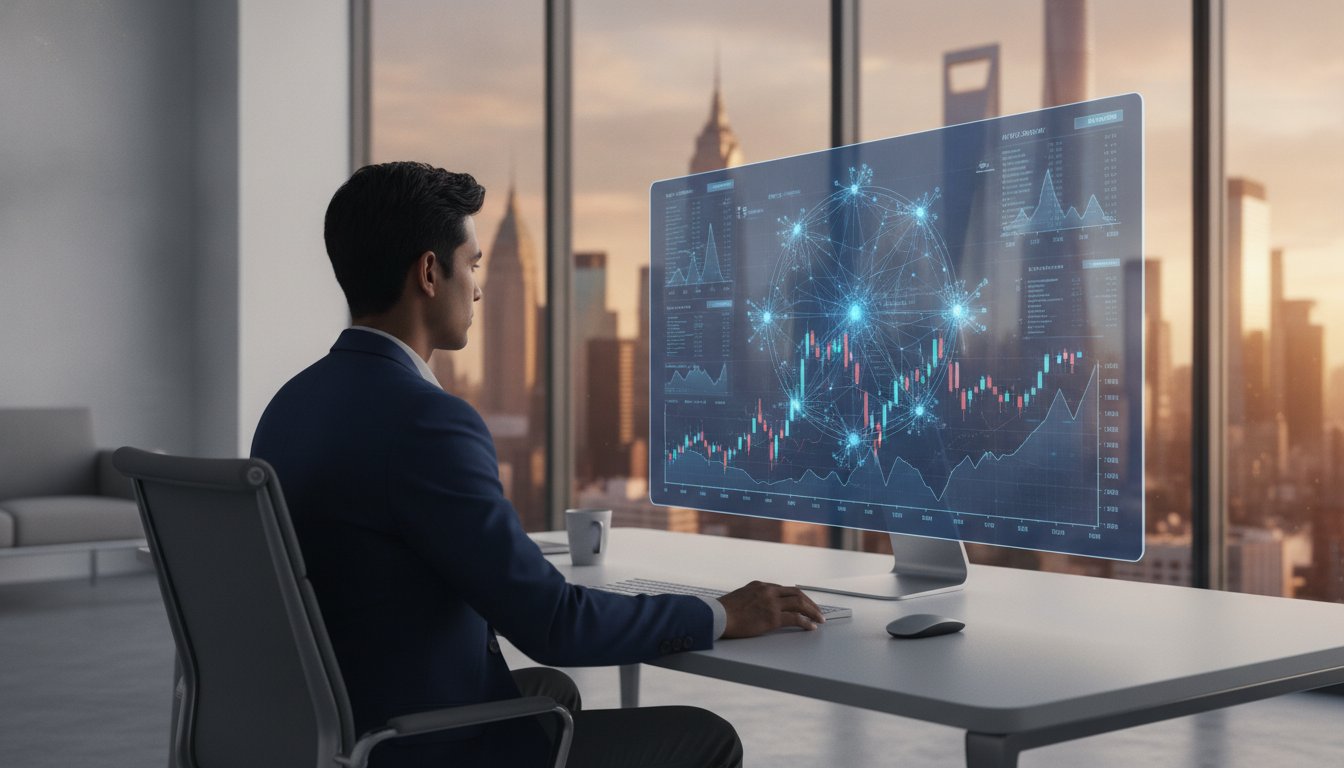
Automated Trading Strategy Explained: The 2026 Professional Guide
With the SEC eliminating the $25,000 pattern day trader minimum as of June 4, 2026, the barrier between retail investors and high-frequency execution has finally collapsed. As the automated algo trading market scales toward a projected $27.17 billion this year, the priority for any serious investor is no longer if they should automate, but how to do so with professional precision. Having an automated trading strategy explained through a systematic lens is the first step toward reclaiming your time and capital from the volatility of emotional decision-making.
It's exhausting to monitor global markets 24/7, and even harder to maintain discipline when a trade moves against you. You recognize that consistency requires a systematic approach, yet the technical jargon often feels like a gated wall. This guide will help you master the mechanics of systematic investing. You'll learn how to leverage AI-driven frameworks to remove human error from your execution and establish a rigorous "if-then" logic for every position.
We'll evaluate current methodologies, from no-code platforms to cloud-based deployment, and provide a definitive roadmap to professional-grade investing education. By the end of this guide, you'll possess the framework necessary to manage automation as a professional tool rather than a "set-and-forget" experiment.
Key Takeaways
- Define the 2026 standard for systematic investing, focusing on the transition from opaque "black-box" coding to transparent, AI-powered frameworks.
- Analyze the "if-then" architecture that translates technical indicators and AI sentiment analysis into precise, programmatic market execution.
- Evaluate core methodologies such as trend-following and mean reversion to select the optimal framework for your specific risk profile.
- Identify the "curve-fitting" trap during the backtesting phase to ensure your logic remains viable in volatile, real-world conditions.
- Master the mechanics of an automated trading strategy explained within a professional educational ecosystem featuring the IAB Smart Instructor™.
What is an Automated Trading Strategy? Defining the 2026 Standard
An automated trading strategy is a systematic method of executing financial transactions based on pre-defined, objective criteria. It replaces human discretion with programmed logic, ensuring that every market entry or exit is the result of a calculated rule rather than a momentary impulse. Having an automated trading strategy explained through this lens helps you see it as a professional framework rather than a simple software tool. It's the difference between guessing where the market will go and having a verified plan that reacts to where the market actually is.
The industry has moved away from the opaque "black box" systems of the past decade. Previously, Algorithmic trading was often reserved for institutional players who could afford proprietary code that hid its logic from the user. In 2026, the standard is transparency. Modern AI-powered investing frameworks allow you to see the underlying data points and sentiment analysis driving each decision. This visibility is essential for professional growth; you must understand the "why" behind your system's performance to manage it effectively.
Systematic execution is the only reliable way to eliminate human psychological bias. Fear and greed are the primary drivers of retail losses, often leading traders to hold losing positions too long or exit winning ones too early. Automation enforces a discipline that the human mind can't replicate. When you have an automated trading strategy explained in technical terms, the distinction between simple order automation and a complex algorithmic strategy becomes clear. While a basic bot might execute a trade at a specific time, a true strategy evaluates multiple data streams to verify that the conditions for success are met before committing capital.
The Core Components of an Automated Framework
- Entry Rules: These define the precise technical or fundamental triggers required to open a position. They leave no room for "gut feelings."
- Exit Rules: Professional systems establish profit targets and stop-loss parameters before the trade is even placed, protecting your capital from unexpected volatility.
- Money Management: This dictates your position sizing based on your total portfolio risk. It's the most critical component for long-term career security in the markets.
Why Retail Investors are Switching to Automation in 2026
The shift toward automation is driven by the need for 24/7 global market coverage. Modern traders must monitor the NASDAQ Composite and international indices simultaneously, a task impossible for a single human. Automated systems offer a speed of execution that capitalizes on micro-movements occurring in milliseconds. Most importantly, they provide the discipline to adhere to a verified plan during periods of market capitulation, ensuring you aren't paralyzed by the headlines of the day.
The Logic of Execution: How Automated Systems Translate Data into Action
Execution logic is the foundational layer of any automated trading strategy explained in a professional context. It functions as a digital nervous system, converting raw market data into decisive financial actions. This process begins with an "If-Then" architecture, a series of conditional statements that dictate exactly how the system reacts to specific market environments. For example, if the price of an asset crosses a specific moving average while volume exceeds its 20 day mean, then the system triggers a buy order. This eliminates the hesitation that often plagues manual traders during high volatility.
The "engine" serves as the central processing unit where these instructions are handled. It must process incoming data packets, compare them against your logical parameters, and transmit orders to the exchange in a fraction of a second. This Federal Reserve analysis of algorithmic trading highlights how these high-speed systems influence market liquidity and price discovery by reducing the gap between data perception and order entry. To ensure this connectivity is seamless, professional platforms use Application Programming Interfaces (APIs) to bridge the gap between the strategy's logic and the broker's order book, ensuring that orders are filled at the best possible price without the slippage common in manual entry.
From Technical Indicators to AI Predictive Modeling
While foundational logic often relies on traditional technical indicators like the Relative Strength Index (RSI) or MACD, the 2026 standard incorporates artificial intelligence investing frameworks. Unlike static rules, these AI systems identify non-linear patterns that human eyes typically miss, such as subtle shifts in market sentiment or complex correlations between disparate asset classes. Understanding this transition is vital for those seeking an automated trading strategy explained with a focus on future-proofing. Professionals often begin their journey by exploring AI-Powered Trading Tools Training to bridge the gap between theory and systematic execution.
The Infrastructure of a Professional Trading System
Reliability in 2026 depends on robust infrastructure. With cloud-based deployment now accounting for approximately 59.8% of the market, traders no longer rely on home hardware. Hosting your strategy on a Virtual Private Server (VPS) ensures 99.9% uptime, protecting your capital from local internet outages or power failures. Low-latency connections are also essential; placing your system's logic in data centers geographically close to exchange servers can save precious milliseconds. Furthermore, a professional framework must include redundancy protocols that automatically pause trading if the system detects a data anomaly or a break in the broker connection, preventing erroneous trades before they occur.
Core Methodologies: Comparing Trend-Following, Arbitrage, and AI Strategies
Selecting a methodology is the most consequential decision in systematic investing. When you have an automated trading strategy explained through a professional lens, it becomes clear that no single approach excels in every market environment. Trend-following remains the most accessible entry point for novice investors. This strategy relies on the premise that assets moving in a specific direction tend to continue that movement. By using programmed indicators to confirm momentum, the system captures the core of a market move while ignoring minor price fluctuations that often trigger emotional exits in manual trading.
Mean reversion operates on the opposite statistical principle. It assumes that price extremes are temporary and that an asset will eventually return to its historical average. Automated systems are uniquely suited for this approach because they can monitor hundreds of securities simultaneously, waiting for a "rubber band" effect to trigger a trade. Arbitrage, by contrast, is a high-frequency approach that exploits price discrepancies for the same asset across different global exchanges. While highly profitable, it requires the low-latency infrastructure mentioned previously to beat competitors to the order book. Having an automated trading strategy explained in terms of these core mechanics allows you to identify which logic best suits your capital constraints.
AI-enhanced sentiment trading represents the 2026 frontier. These systems don't just look at price charts; they ingest millions of data points from news wires, social media, and earnings reports to gauge the market mood. This allows the algorithm to anticipate volatility before it manifests in the price action. By integrating non-traditional data, these frameworks provide a competitive edge over static, indicator-based systems.
Which Strategy Fits Your Investor Profile?
Choosing a methodology requires aligning your technical approach with your broader financial objectives. Conservative investors often favor long-term trend following or automated index rebalancing to ensure steady growth. In contrast, aggressive traders might deploy scalping or high-frequency mean reversion strategies to capture small, rapid gains. It's essential to match your chosen strategy to the goals established in your personal finance class to maintain portfolio stability and long-term career security.
The Rise of Machine Learning in Strategy Selection
Machine learning has introduced "switching logic," where a system identifies the current market regime, whether it's trending or ranging, and selects the best methodology for that specific moment. This dynamic adjustment is a hallmark of professional-grade automation. This level of sophistication has even transformed options trading for beginners, as AI can now manage complex Greeks and expiration risks that were once too intimidating for retail participants. Mastery of these tools ensures that your strategy evolves alongside the market rather than becoming obsolete.

Building the Framework: Risk Management and Backtesting in Automation
A robust automated trading strategy explained in a professional capacity is more than just a set of instructions; it's a battle-tested framework. Before any capital is deployed, the logic must undergo rigorous backtesting. This process involves running your algorithm against years of historical market data to determine how it would've performed during various economic cycles. However, most retail investors fall into the "curve-fitting" trap. This occurs when you over-optimize a strategy to perfectly match historical data, resulting in a system that looks flawless on paper but fails immediately in live markets because it can't adapt to new price patterns.
To avoid this, professionals utilize forward testing, often referred to as paper trading. This allows you to run the strategy in real-time market conditions without financial risk, providing a true reflection of how your system handles slippage and latency. The golden rule of systematic investing is simple: never automate a strategy you haven't manually mastered first. You must understand the underlying mechanics of the trade to recognize when the automation is behaving as intended or when a logic error has occurred. For those ready to move beyond basic concepts, our Risk Management & Portfolio Strategy Training provides the technical foundation needed to build resilient systems.
Essential Risk Management Protocols
- Maximum Drawdown: You must define the exact percentage of capital loss that will trigger an automatic system shutdown. This protects your portfolio from catastrophic events.
- Circuit Breakers: Professional frameworks include automated pauses during periods of extreme market volatility. This prevents the algorithm from executing trades when price action becomes erratic or disconnected from historical norms.
- Diversification through Multiple Algos: Reducing dependency on a single strategy is vital. By running multiple algorithms with low correlation, you ensure that a period of underperformance in one strategy is balanced by another.
The Human Element: The Role of the Strategy Manager
Automation doesn't eliminate the need for human oversight; it shifts the role from execution to management. A strategy manager is responsible for monitoring system health and ensuring data integrity. You must also remain vigilant for macro-economic shifts, such as sudden regulatory changes or geopolitical events, that an algorithm isn't programmed to "see." Building this level of strategic thinking starts early. The concepts found in financial literacy for teens establish the long-term mindset required to view trading as a professional business rather than a hobby. Success in 2026 requires a disciplined synergy between machine precision and human intuition.
Mastering the Future: How IAB Academy Bridges the Gap to Automated Trading
Professional education serves as the essential prerequisite for transitioning from a manual trader to a systematic manager. While having an automated trading strategy explained provides the theoretical blueprint, the practical application in a live environment requires a level of proficiency that generic tutorials cannot provide. IAB Academy bridges this gap by offering a disciplined, modular curriculum designed to evolve alongside the market. We focus on the underlying logic of the "if-then" framework, ensuring you understand the strategic "why" behind every programmatic decision before you ever commit capital to an algorithm.
Our platform features the IAB Smart Instructor™, a proprietary tool that provides real-time support for complex algorithmic concepts. This ensures that as you move through the curriculum, you're never overwhelmed by the technical jargon of high-frequency execution or data analysis. By providing high-density information in an accessible format, we empower you to master the digital ecosystem at your own pace. This educational foundation is vital for long-term career security; it transforms an intimidating technological landscape into a manageable professional toolset.
The IAB Learning Path for Systematic Investing
The journey to mastery is structured into three distinct phases to ensure a logical progression of skills. You'll begin by mastering stock market fundamentals, which establishes the necessary context for all future strategies. In the second phase, you'll dive into the logic of options and rigorous risk management protocols. Finally, you'll learn to implement AI-powered analysis and automated frameworks. This layered approach ensures that every automated trading strategy explained within our courses is backed by a deep understanding of market mechanics and portfolio protection.
Securing Your Career in the AI-Driven Financial Ecosystem
In a rapidly evolving market, the value of professional validation cannot be overstated. IAB Academy certifications signal to the global professional ecosystem that you possess a high-level proficiency in modern investing tools. Our commitment to providing lifetime access means your education doesn't become obsolete as new technologies emerge. You'll have the resources to continuously update your AI-powered investing skill set, ensuring you remain a leader in the field rather than a bystander to automation. Join IAB Academy and master the art of AI-powered investing today.
Securing Your Competitive Edge in the Systematic Era
The transition toward systematic execution is no longer optional for those seeking long-term career security in the 2026 financial markets. You've seen how the "if-then" architecture removes emotional bias and how AI-driven sentiment analysis identifies patterns that traditional indicators miss. With an automated trading strategy explained through a professional framework, the path to market mastery becomes a matter of discipline rather than guesswork. Validating your logic through backtesting and managing your infrastructure with redundancy protocols ensures that your capital remains protected during periods of high volatility.
True proficiency requires a structured environment that evolves alongside technological advancements. IAB Academy provides this through lifetime access to our 2026 curriculum and 24/7 support from the Smart Instructor™ AI in over 130 languages. By joining our global community of professional-grade retail investors, you gain the validation and technical skills necessary to thrive in an AI-driven ecosystem. Enroll in the IAB Academy AI-Powered Investing Course and begin your transition toward systematic excellence today. Your journey to mastering the future of finance starts with the right foundation.
Frequently Asked Questions
Is automated trading legal for retail investors in 2026?
Automated trading is entirely legal for retail investors and is governed by regulatory bodies like the SEC, CFTC, and FINRA. These organizations focus on maintaining fair markets by preventing manipulative practices such as spoofing or layering. A landmark shift occurred on June 4, 2026, when the SEC eliminated the $25,000 minimum account balance for pattern day traders, significantly lowering the legal barrier for retail participants engaging in frequent algorithmic execution.
Can I start automated trading with a small amount of capital?
You can certainly begin with a modest account, especially following the 2026 regulatory changes that removed the $25,000 pattern day trader requirement. Modern brokerages facilitate this through fractional share trading and competitive fee structures, such as the SEC transaction rate of $20.60 per million dollars. Having an automated trading strategy explained in terms of capital scaling allows you to refine your logic with smaller positions before committing significant wealth.
Do I need to know how to code to use an automated trading strategy?
Programming knowledge is no longer a prerequisite for systematic investing. The 2026 market landscape is defined by the rise of no-code and low-code platforms that use visual interfaces to build "if-then" logic. These AI-driven frameworks allow you to focus on strategic design and risk parameters rather than writing syntax, making professional-grade automation accessible to those with a background in stock market fundamentals rather than computer science.
What is the difference between automated trading and a trading bot?
Automated trading refers to a comprehensive professional framework, whereas a trading bot is often a single-task script. A professional automated trading strategy explained involves rigorous backtesting, multi-asset diversification, and integrated risk management protocols. Conversely, a bot typically follows a solitary technical trigger without the broader logic required to manage a portfolio through shifting market regimes or complex macro-economic events.
How much does it cost to set up a professional automated trading system?
The monthly cost for a professional setup typically ranges from $15 to $340 depending on your software requirements. You'll generally spend between $15 and $40 per month for a Virtual Private Server (VPS) to ensure 24/7 execution. Professional-grade software subscriptions can reach $300, though many investors successfully leverage free API-based tools provided by their brokerage to maintain a high-density information flow without excessive overhead.
What happens if my internet goes out while an automated trade is active?
If you use a Virtual Private Server (VPS), your strategy remains active regardless of your local internet status. These servers are hosted in professional data centers with 99.9% uptime and redundant power sources, ensuring your logic executes even if your home hardware fails. Most professional frameworks also include "fail-safe" instructions that can automatically close open positions if the system detects a loss of connectivity to the broker's order book.
Can automated trading strategies work in a bear market?
Systematic frameworks are exceptionally well-suited for bear markets because they can be programmed to execute short-selling and mean-reversion strategies without hesitation. While human investors often struggle with the fear associated with falling prices, an algorithm follows its objective criteria to capitalize on downward momentum or volatility spikes. This clinical approach ensures that your portfolio remains active and opportunistic during periods of market capitulation.
How do I choose the best platform for automated trading?
You should prioritize platforms that offer low-latency execution, robust backtesting engines, and seamless API connectivity. It's essential to select a provider that maintains strict regulatory alignment with FINRA and provides transparent data streams for AI-powered analysis. The ideal platform for 2026 should also support cloud-based deployment, allowing you to manage your strategies remotely while benefiting from the scalability and security of a professional infrastructure.
