
Recovering Confidence After a Trading Loss: A Professional Recovery Protocol
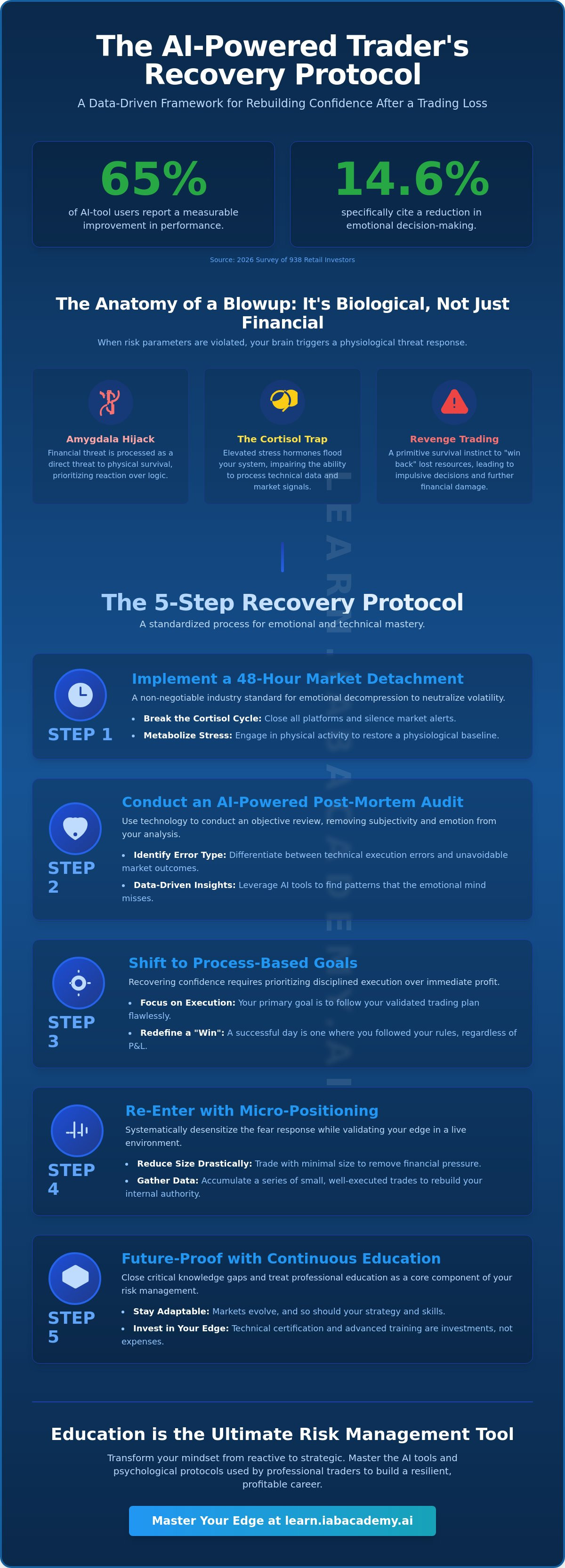
A 2026 survey of 938 retail investors revealed that 65% of those utilizing AI tools experienced a measurable improvement in performance, with 14.6% specifically citing a reduction in emotional decision-making. You've likely felt the paralyzing physical stress of a cortisol spike after a drawdown, leading to a loss of trust in your strategy and a profound fear of placing the next trade. Recovering confidence after a trading loss isn't about waiting for a vague feeling to return. It's a technical process of rebuilding your edge through objective data and standardized risk management protocols.
The regulatory environment has shifted in your favor, as the elimination of the Pattern Day Trader rule on June 4, 2026, has removed significant capital barriers for traders. You'll master the psychological shifts and AI-driven analytical steps required to restore your market belief and return to profitability. This protocol provides a clear, data-backed path to emotional stability and professional mastery. We'll examine how to leverage real-time intraday exposure metrics and backtesting to remove subjectivity from your execution, ensuring your return to the markets is disciplined and evidence-based.
Key Takeaways
- Identify the physiological triggers of a trading blowup and implement a mandatory 48-hour market detachment protocol to neutralize emotional volatility.
- Utilize AI-powered stock analysis tools to conduct an objective post-mortem audit, separating technical execution errors from unavoidable market outcomes.
- Establish a structured path for recovering confidence after a trading loss by transitioning to process-based goals that prioritize disciplined execution over immediate profit.
- Re-enter the markets using micro-positioning techniques to desensitize the fear response while validating your trading edge in real-time environments.
- Close critical knowledge gaps and future-proof your strategy by integrating professional education and technical certification as core components of your risk management framework.
The Anatomy of a Trading Blowup: Why Shaken Confidence is a Physiological Response
A trading blowup is rarely a result of market unpredictability alone; it's a fundamental violation of risk management standards. When a trader allows a drawdown to exceed predetermined parameters, the event transitions from a tactical loss to a psychological crisis. This breach triggers what neuroscientists call an amygdala hijack. During this state, your brain processes a financial hit as a direct threat to your physical survival. It prioritizes immediate reaction over strategic deliberation, making it nearly impossible to follow a complex trading plan. Understanding the Disposition Effect is vital here, as it illustrates the cognitive bias that forces investors to hold losing assets too long while liquidating winners prematurely to seek emotional relief.
This biological response creates the Cortisol Trap. Elevated stress hormones flood your system, impairing the prefrontal cortex's ability to process technical data and market signals. You lose the capacity for objective analysis. Recovering confidence after a trading loss starts with recognizing that your hesitation isn't a lack of character; it's a physiological defense mechanism. You must distinguish between normal variance, which is a statistical certainty in any edge, and systemic failure, which is a breakdown in your execution or strategy logic. Professionals treat these categories differently to ensure their long-term survival.
The Biological Reality of Market Loss
The sudden surge of norepinephrine during a loss increases your heart rate and decision-making speed, but it drastically reduces your accuracy. This physiological state often leads to revenge trading. This isn't a strategy; it's a primitive survival instinct to win back lost resources. Professionals must recognize this state to prevent further damage. Emotional drawdown is the precursor to financial ruin. By acknowledging the surge in stress chemicals, you can implement a circuit breaker before your account balance suffers further.
Identifying the 'Confidence Gap'
Differentiating between a loss of luck and a loss of skill is essential for institutional-grade performance. Cognitive dissonance frequently occurs when price action directly contradicts your understanding of stock market fundamentals. This conflict erodes your internal authority and makes you second-guess proven setups. Elite traders don't view confidence as a permanent personality trait but as a renewable resource. Recovering confidence after a trading loss involves rebuilding this resource through small, data-driven wins that prove your technical edge still exists within the current digital ecosystem.
The Immediate Reset: A Standardized Protocol for Emotional Decompression
Professional recovery isn't a passive event. It's a sequence of controlled actions designed to restore cognitive function and neutralize the physiological threat response described in the previous section. When you experience a significant drawdown, your primary objective is to stop the emotional bleeding before it contaminates future decision-making. Recovering confidence after a trading loss requires a structured protocol that prioritizes mental clarity over immediate capital recovery. This process moves through four distinct phases: detachment, auditing, reframing, and re-entry.
Step 1: Implementing the Mandatory Detachment
The 48-Hour Rule is a non-negotiable industry standard for emotional decompression. You must close all trading platforms, silence market alerts, and disconnect from financial news cycles for a minimum of two full trading days. This detachment is essential to breaking the cortisol cycle that keeps your brain in a state of high alert. Without this break, you remain susceptible to impulsive "revenge trades" driven by the amygdala rather than your technical edge.
Physical activity plays a critical role during this phase. Engaging in high-intensity exercise or long-distance walking helps your body metabolize stress hormones like norepinephrine more effectively. By focusing on physical movement, you shift your internal state from "fight or flight" back to a baseline of calm. Set a firm date and time for your post-mortem audit during this break. Having a scheduled return prevents avoidance behavior, ensuring you confront the data without the accompanying emotional weight.
Step 2: Conducting the Objective Audit
Once the 48-hour window closes, you must perform a clinical dissection of the loss. Review the trade details against your established financial literacy curriculum to determine if the setup met your institutional standards. You are looking for a clear distinction between execution errors and statistical variance. If you followed your plan perfectly and still lost money, the event is simply a cost of doing business. However, if the error was psychological, such as failing to honor a stop-loss, you must document the specific trigger in a professional trading journal.
- Technical Audit: Did the entry align with your technical analysis training? Was the position size calculated correctly based on your risk parameters?
- Psychological Audit: Did you hesitate at the entry? Did you move your profit target or stop-loss mid-trade due to fear or greed?
- Outcome Documentation: Write a single declarative sentence summarizing the lesson. For example: "I exited early due to a 1-minute chart fluctuation, violating my 15-minute trend-following rule."
Reframing the loss as "market tuition" transforms a negative experience into a tangible asset. In the 2026 trading environment, data is your most valuable commodity. Each loss provides a specific data point that can be used to refine your strategy. If you find that your confidence remains low after this audit, consider reviewing our risk management and portfolio strategy training to reinforce your technical foundations before risking live capital again.
Finally, utilize low-stakes re-entry through high-fidelity paper trading or micro-positioning. This allows you to validate your strategy in live market conditions without the stress of significant financial exposure. This step-by-step approach ensures that when you finally return to full position sizes, your confidence is built on a foundation of recent, successful execution rather than hope.
Rebuilding the Edge: Using AI and Data to Remove Subjectivity
Subjectivity is the primary catalyst for psychological erosion in the markets. When you rely on intuition rather than empirical evidence, a single drawdown can feel like a personal failure rather than a statistical event. As of 2026, 62% of retail investors utilize AI tools to inform their decisions, with 14.6% reporting a direct reduction in emotional interference. Recovering confidence after a trading loss requires replacing these internal narratives with algorithmic validation. AI-powered stock analysis tools provide an unbiased second opinion, acting as a digital referee that audits your performance without the cloud of human shame.
The Smart Instructor™ allows you to simulate the exact parameters of your failed trade to identify optimal exit points that you might've missed during the heat of the moment. This simulation removes the emotional weight of the loss by demonstrating where the technical edge existed, regardless of the financial outcome. Numbers don't have emotions. By shifting your focus from "what I did wrong" to "what the data suggests," you transition from guessing to a state of institutional-grade certainty. This objective distance is essential for maintaining a professional presence in a high-stakes ecosystem.
Leveraging AI Trading Assistants
AI trading assistants enable you to backtest the specific market conditions present during your loss with surgical precision. You can identify hidden correlations, such as sector-wide liquidity shifts or macro-economic volatility spikes, that your manual analysis might've overlooked. Integrating how to invest in ai principles into your recovery strategy ensures your next entry is backed by multi-agent logic rather than just a technical indicator. This level of verification is the ultimate future-proofing tool for the modern trader.
Data-Driven Confidence Building
A high-probability setup is the only true antidote to market fear. Instead of seeking a "lucky" win to restore your mood, use AI stock analysis to identify your next high-conviction trade based on historical win rates. You must focus on Expected Value (EV) rather than individual trade outcomes. Professional excellence is defined by the quality of the process, not the variance of a single day. When you view every position as one of a thousand data points in a larger sequence, the sting of a single loss disappears. Recovering confidence after a trading loss becomes a predictable result of returning to a data-backed system that you know works over time.
The Confidence-Competence Loop: Transitioning Back to Live Markets
Transitioning back into the live market environment requires a deliberate bridge between technical analysis and psychological execution. You cannot simply flip a switch and return to full position sizes after a traumatic drawdown. Recovering confidence after a trading loss is a graduated process. It relies on the "Confidence-Competence Loop," where small, successful actions reinforce the neural pathways required for disciplined trading. This phase is about proving to yourself that you can follow your protocol under the pressure of real market fluctuations without the physiological interference described in earlier sections.
Phase 1: The Micro-Positioning Strategy
The primary goal of re-entry is to desensitize the fear response without risking significant capital. Start by reducing your position size to exactly 10% of your standard risk-per-trade. This reduction ensures that the financial outcome of any single trade is negligible, allowing you to focus entirely on perfect execution. The elimination of the Pattern Day Trader rule on June 4, 2026, provides the necessary flexibility for this approach. Traders are no longer restricted by fixed equity requirements when executing multiple intraday setups. You must complete five consecutive "Process-Perfect" trades before considering an increase in size. A Process-Perfect trade is defined as one where every rule for entry, stop-loss placement, and exit was followed precisely, regardless of whether the trade resulted in a profit or loss.
Phase 2: Process Over Profits
During the first week of your recovery protocol, hide your unrealized P&L from your trading dashboard. Focusing on the fluctuating dollar amount triggers the same cortisol spikes that led to your initial blowup. Instead, your objective is to achieve excellence in execution. Set process-based goals, such as verifying the macro-economic calendar before every trade or exiting immediately when technical criteria are met. These metrics provide a sense of mastery that profit targets cannot offer during a recovery phase.
Establish a "Hard Stop" for the day to prevent emotional cascading. If you lose a specific, predetermined amount, you must cease all trading activities immediately. This standard protects your capital and your mental state from the revenge trading instinct. Every small win, even with micro-positions, contributes to neuroplasticity by providing positive reinforcement. You are training your brain to associate the market with discipline rather than pain. To accelerate this transition, you should utilize AI-powered investing education to reinforce your strategic framework. Recovering confidence after a trading loss becomes a predictable outcome when you prioritize repetitive, disciplined action over short-term financial gains.
Future-Proofing Your Mindset: Why Education is the Ultimate Risk Management Tool
A lack of confidence is rarely a character flaw; it's a technical symptom of an unaddressed knowledge gap. When you cannot articulate the specific reason for a strategy's underperformance, your brain defaults to a state of high-alert anxiety. Recovering confidence after a trading loss requires more than just a break from the screen. It demands a transition from the mindset of a retail participant to that of a certified market professional who operates within a standardized framework. By establishing a foundation through a structured personal finance class, you create a strategic baseline that remains resilient regardless of intraday market volatility.
Professional certification serves as a psychological anchor. It replaces the "hoping" phase of trading with an internal sense of authority derived from mastery. While the IRS allows you to deduct up to $3,000 in net capital losses against ordinary income for the 2026 tax year, true risk management focuses on preventing the loss through superior technical proficiency. Education is the only tool that yields a permanent increase in your performance metrics by refining your execution and eliminating the cognitive dissonance that plagues under-educated traders. This transition ensures that you're no longer guessing at market direction but are instead executing a validated protocol.
Closing the Knowledge Gap
Identifying specific weaknesses in your technical or macro-economic understanding is the first step toward long-term stability. Many traders find that their confidence erodes because they don't have a cohesive understanding of how multi-agent AI systems or global liquidity cycles impact their specific setups. Utilizing lifelong access to tools like the Smart Instructor™ provides a technical safety net. It allows you to validate your logic against industry-standard benchmarks before risking capital. The psychological benefit of knowing you're following a curriculum designed by global experts cannot be overstated. It shifts the burden of proof from your ego to the system.
The Path to Professional Mastery
The IAB Academy Novice Investor Curriculum acts as the definitive reset button for traders who've lost their technical edge. Recovering confidence after a trading loss is significantly easier when you're building a diversified strategy that doesn't rely on the success of a single asset class. Mastery involves understanding the entire ecosystem, from programmatic order flows to macro-economic attribution. This comprehensive approach ensures that a single drawdown is viewed as a minor data point rather than a career-ending event. Enroll in the IAB Academy curriculum to turn your losses into professional mastery. This investment in your intellectual capital is the only way to future-proof your career in a competitive, AI-driven market.
Establishing Professional Mastery in the Global Ecosystem
Recovering confidence after a trading loss is a technical achievement rather than a psychological mystery. By implementing the 48-hour detachment protocol and utilizing AI-powered auditing tools, you transform subjective failures into objective data points. This systematic approach ensures that your return to the markets is governed by risk management standards rather than emotional volatility. You've bridged the gap between competence and confidence through micro-positioning and process-based goals.
The IAB Academy, a Houston-based global leader in financial literacy, provides the infrastructure necessary for this professional evolution. Our AI-Powered Smart Instructor™ is available in 130+ languages, ensuring that technical mastery is accessible across the global digital landscape. With lifetime access to our industry-standard curricula, you possess a permanent resource to future-proof your strategy against evolving market conditions. It's time to replace hesitation with a verified, data-backed edge.
Master the Markets with IAB Academy’s AI-Powered Education. Your path to excellence begins with a commitment to standardized, professional growth.
Frequently Asked Questions
How long does it typically take to recover confidence after a major trading loss?
Confidence recovery isn't measured in days but in the volume of successful evidence you collect. Most professional protocols require 5 to 10 "Process-Perfect" trades to reset the neural pathways associated with market fear. This evidence-based approach replaces emotional trauma with technical validation, ensuring your return to the markets is based on data rather than a calendar date.
Should I stop trading entirely after a big loss, or just reduce my position size?
You must execute a mandatory 48-hour market detachment before making any further decisions. Following this reset, professionals typically reduce position sizes to 10% of their standard risk. This allows for execution practice without the threat of further account depletion. Total cessation is only necessary if your post-mortem audit reveals a systemic failure in your strategy logic.
Is paper trading actually effective for rebuilding confidence, or does it feel too 'fake'?
Paper trading serves as a critical diagnostic tool for verifying your technical edge without financial pressure. While it doesn't replicate the physiological stress of live capital, it allows you to confirm that your strategy remains sound in the 2026 digital ecosystem. Use it as a bridge for 5 to 10 trades before transitioning to micro-live positions to rebuild your execution stamina.
What is the fastest way to lower cortisol levels after a stressful trading day?
Engaging in high-intensity exercise is the most efficient method for metabolizing elevated stress hormones like norepinephrine. Studies in behavioral finance suggest that physical movement reduces these levels significantly faster than passive rest. A 20-minute session can reset your biological baseline, allowing you to conduct an objective audit without the interference of a lingering threat response.
How do I explain a significant trading loss to my spouse or partner?
Transparency is essential for maintaining professional and personal stability. Explain the loss as a breach of risk management standards and mention the $3,000 IRS capital loss deduction limit for the 2026 tax year to provide financial context. Detail the specific steps of your recovery protocol to demonstrate that you're operating within a disciplined, educational framework rather than gambling.
Can AI tools really help me trade better if I'm already feeling emotional?
AI tools act as an objective digital referee during periods of high emotional volatility. By using AI trading assistants, you can audit your setups against historical win rates and multi-agent logic. This data-driven approach is a primary method for recovering confidence after a trading loss because it removes human bias and focuses on the technical edge.
When is the right time to return to my normal position sizes after a blowup?
Recovering confidence after a trading loss requires hitting specific execution milestones rather than following a calendar. You should return to standard position sizes only after five consecutive trades that achieve 100% execution compliance. This performance-based threshold ensures your confidence is built on a foundation of competence. Scaling back up too quickly is a leading cause of secondary account blowups.
What are the most common psychological signs that I am 'revenge trading'?
Revenge trading is characterized by an increased heart rate, rapid clicking, and the abandonment of predetermined stop-losses. You'll likely feel a desperate urge to "break even" within a single session, often doubling down on losing positions. These are primitive survival instincts that signal your prefrontal cortex is no longer in control. If you identify these triggers, you must implement an immediate market detachment.
