
Investment Strategies for Long Term Growth: A 2026 Professional Framework
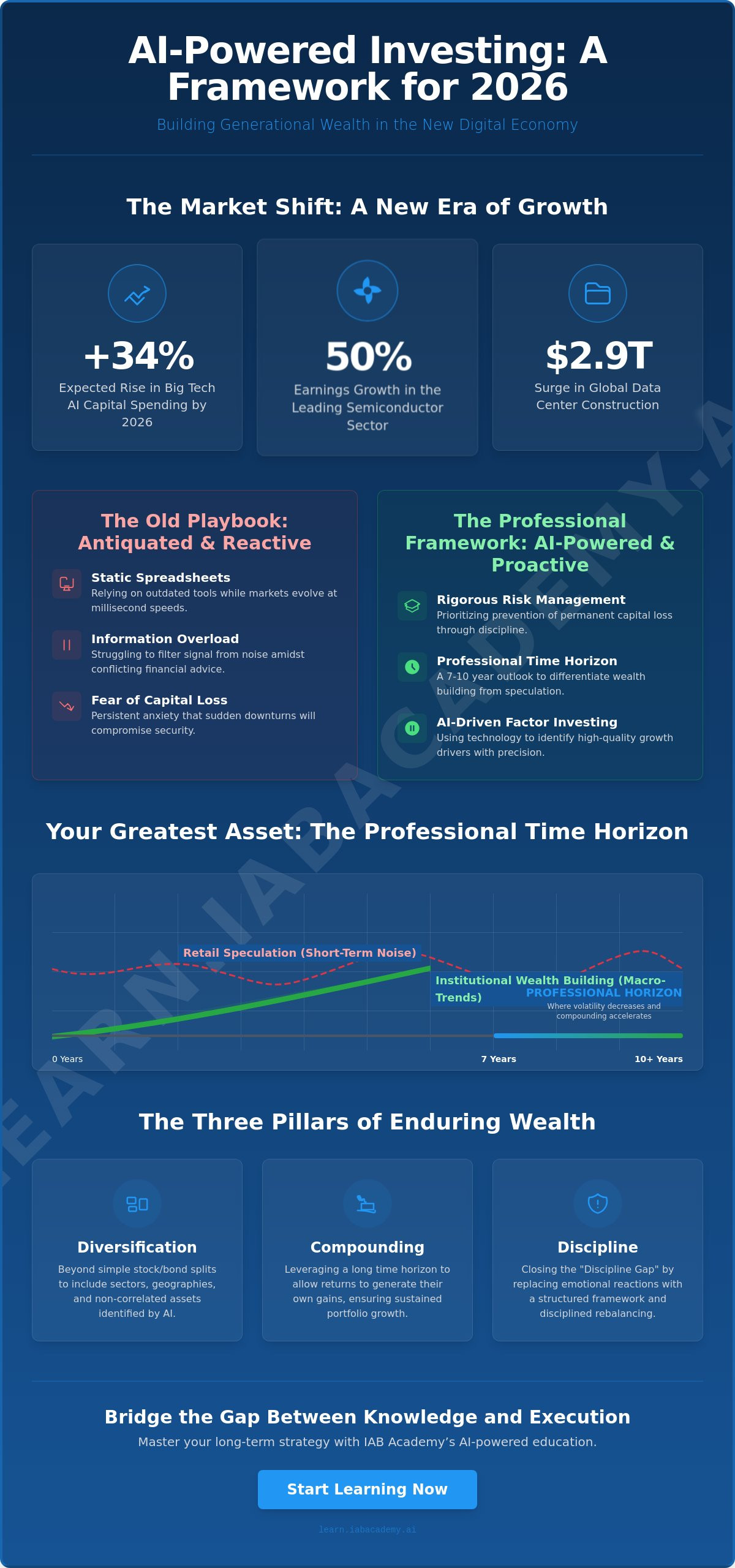
Capital spending by Big Tech on AI infrastructure is expected to rise by more than 34 percent in 2026, signaling a fundamental shift in how global markets operate. If you are still relying on static spreadsheets while the semiconductor sector leads with 50 percent earnings growth, you are essentially fighting a modern war with antiquated tools. Mastering the art of using AI for long term investment strategy has become the definitive requirement for filtering through the noise of conflicting financial advice and the $2.9 trillion surge in global data center construction. You likely feel the pressure of information overload and the persistent fear that a sudden market downturn could compromise your capital security.
This professional framework provides the authoritative methodologies required to build and sustain generational wealth by merging traditional risk management with modern technical precision. We will examine the specific mechanics of AI-driven growth, risk profile alignment, and the high-level tools necessary to maintain a competitive advantage in the 2026 digital economy. By the end of this analysis, you will possess a cohesive execution plan that transforms technological complexity into a structured engine for long-term capital appreciation.
Key Takeaways
- Establish a professional investment horizon of seven to ten years to differentiate institutional-grade wealth building from speculative retail trading.
- Master the integration of factor-based investing by using AI for long term investment strategy to identify high-quality growth drivers with institutional precision.
- Adopt a rigorous risk management framework that prioritizes the prevention of permanent capital loss through disciplined semi-annual portfolio rebalancing.
- Apply Modern Portfolio Theory and the mechanics of compounding interest to ensure sustained portfolio growth across a multi-decadal professional career.
- Bridge the gap between theoretical knowledge and market execution through structured, AI-powered investing education designed for the modern digital economy.
Defining Long-Term Growth in the 2026 Digital Economy
In the 2026 fiscal environment, a professional long-term horizon isn't a suggestion; it's a mandatory standard defined by a minimum period of seven to ten years. While retail traders often succumb to the psychological trap of "get rich quick" schemes, institutional-grade wealth building relies on a rigorous, curriculum-based discipline. This approach, known as Strategic Growth, replaces the reliance on market luck with a structured framework of data analysis and risk mitigation. The transition from static, "set and forget" portfolios to dynamic, tech-enabled frameworks allows for more precise capital allocation. Professionals are now using AI for long term investment strategy to navigate a market where Big Tech capital expenditures on infrastructure have exceeded $500 billion. This isn't about chasing the next trend; it's about establishing a resilient foundation that can withstand cyclical volatility and the $2.9 trillion surge in global data center construction.
The Core Objectives of Growth Investing
Successful growth investing requires a clear distinction between capital appreciation and income generation. For those in the middle of a decadal plan, prioritizing appreciation is essential to outpace 2026 inflationary pressures. With the effective Federal Funds Rate at 3.62 percent, protecting your purchasing power is a primary objective that demands more than passive index tracking. You must define success through a combination of absolute returns and benchmark-relative performance. While absolute returns ensure your capital grows in real terms, relative performance indicates whether your strategy is effectively capturing the broader technological expansion seen in sectors like semiconductors, which are leading with 50 percent earnings growth this year. This dual focus ensures that your portfolio remains competitive within the global professional ecosystem.
Why Time Horizon is Your Greatest Asset
Mathematical reality dictates that market volatility decreases as your holding period increases. In 2026, market cycles move with unprecedented speed due to the dominance of Algorithmic Trading, which processes vast datasets in milliseconds. This high-frequency environment can create short-term noise that distracts the undisciplined investor. However, by using AI for long term investment strategy, you can filter these micro-fluctuations to focus on macro-trends that define generational wealth. A professional approach treats these technological shifts as opportunities for rebalancing rather than reasons for panic. Time horizon is the primary risk-mitigation tool that transforms market volatility into a mechanism for compounding wealth.
The Three Pillars of Enduring Wealth: Diversification, Compounding, and Discipline
Modern Portfolio Theory (MPT) remains the bedrock of institutional capital management. It optimizes the relationship between risk and return by ensuring that assets do not move in perfect correlation. For the modern investor, MPT is no longer a manual exercise. By using AI for long term investment strategy, you can automate the identification of non-correlated assets across global markets. This technological edge is vital for closing the "Discipline Gap," the psychological failure that occurs when investors abandon their strategy during periods of high volatility. Success in this area requires a deep immersion in a financial literacy curriculum that prioritizes structural logic over emotional reaction. Professionals don't guess; they execute based on established frameworks.
Diversification Beyond Simple Asset Allocation
In 2026, diversification must account for geopolitical shifts and technological dominance. A simple split between stocks and bonds is insufficient when the U.S. and China competition in semiconductors influences sector stability. True diversification spans sectors, geographies, and asset classes while avoiding "diworsification," the over-complication that dilutes potential returns. Professional frameworks rely on stock market fundamentals to select assets with intrinsic value. This selection process must also consider the Ethical Use of AI in Investments to ensure long-term regulatory alignment and governance. For those seeking to refine their approach, exploring our AI-powered trading tools training provides the technical proficiency needed for precise asset selection.
The Mechanics of Compounding Interest
Compounding interest is the most powerful mathematical force in wealth creation. Over a 20-year career, the exponential growth curve typically accelerates in the final third of the period. If you're in the 24 percent federal income tax bracket, which applies to single filers with income over $100,800 in 2026, tax-efficient compounding becomes a critical priority. High fees and unnecessary capital gains taxes act as friction that erodes the terminal value of your portfolio. Starting early is statistically superior to investing larger sums later. The time your capital spends in the market is more significant than the timing of your entries. Understanding these mechanics is a core component of professional growth, ensuring your capital works as hard as your professional expertise.
Maintaining this level of technical discipline requires constant validation against market data. With the effective Federal Funds Rate at 3.62 percent, the cost of capital remains a significant factor in how you structure your long-term debt and equity holdings. Professionals who master these pillars don't just survive market cycles; they use them as catalysts for growth. Using AI for long term investment strategy allows for the continuous monitoring of these pillars, ensuring your portfolio remains aligned with your 20-year wealth objectives without requiring constant manual intervention.
Strategic Asset Allocation vs. AI-Driven Factor Investing
Traditional asset allocation has historically relied on a static "Buy and Hold" mentality, yet the 2026 digital economy demands a more granular approach. While passive indexing remains the efficiency standard for capital preservation, professionals are increasingly using AI for long term investment strategy to implement "Smart Beta" and factor-based models. These strategies go beyond simple market exposure by targeting specific drivers of return like momentum, quality, and low volatility with institutional precision. This evolution is documented in the AI in Investment Management Survey, which highlights the industry's shift toward data-driven decision making. To balance these objectives, many successful frameworks utilize a Core-Satellite structure. The core provides stability through broad market exposure, while active satellite positions capture high-growth opportunities. Data defines the winner.
Passive Indexing: The Bedrock of Growth
Passive indexing through the S&P 500 and Total Market ETFs provides the necessary bedrock for any growth-oriented portfolio. Low-cost expense ratios are vital here; they minimize the drag on compounding returns over a decadal period. In the 2026 economy, understanding the difference between market-cap weighting and equal weighting is essential. Market-cap weighting naturally tilts toward the largest technology firms, a strategic choice given that 21 percent of S&P 500 companies are citing direct benefits from AI. However, equal weighting can provide broader exposure to emerging sectors that haven't yet reached mega-cap status. Both methods offer a transparent, rules-based foundation for long-term wealth preservation.
AI-Enhanced Active Management
The satellite portion of your portfolio is where AI-enhanced active management creates a distinct advantage. Professionals are now learning how to invest in AI as a core growth sector rather than a speculative satellite. With the semiconductor sector leading with roughly 50 percent earnings growth, algorithmic screening allows you to identify undervalued assets in real-time. Tools like the IAB Smart Instructor™ guide learners through these complex signals, transforming raw data into actionable technicalities. This level of screening ensures that your active positions are based on measurable revenue growth and productivity improvements rather than market hype. Using AI for long term investment strategy ensures that your satellite positions remain aligned with the rapidly evolving technological infrastructure of 2026. Precision matters more than volume.
Risk Management and Portfolio Rebalancing for Decadal Success
Professional risk management distinguishes itself by defining risk not as temporary market volatility, but as the permanent loss of capital. While fluctuations are inherent in any growth cycle, the total destruction of a position is an avoidable failure of strategy. Systematic risk reduction often begins with Dollar Cost Averaging (DCA), a method that removes emotional timing from the equation by deploying capital at fixed intervals. For larger, decadal portfolios, advanced concepts like hedging through options become necessary to protect significant gains. Using AI for long term investment strategy allows for the continuous monitoring of these risk parameters, ensuring that your exposure never exceeds your calculated capacity for loss. This disciplined approach transforms a reactive mindset into a proactive, institutional-grade execution framework.
Determining Your Professional Risk Profile
Your risk profile is a combination of mathematical capacity and psychological endurance, often referred to as the "Sleep Test." In the 2026 economy, where the effective Federal Funds Rate is 3.62 percent, your risk capacity must be measured against the real cost of capital. As you approach your target date, you must implement a "Glide Path" methodology, gradually shifting from aggressive growth to capital preservation. This resilience is vital for surviving "Black Swan" events that disrupt traditional market logic. A professional strategy anticipates these outliers by stress-testing the portfolio against various economic scenarios, ensuring that a single sector downturn does not compromise your generational wealth objectives.
The Rebalancing Protocol
Rebalancing is the mechanical process of restoring your portfolio to its strategic intent. Without this discipline, a portfolio naturally drifts toward higher-risk assets that have recently outperformed, leaving you overexposed. Follow this four-step protocol to maintain equilibrium:
- Step 1: Establish target allocation percentages based on your long-term risk profile.
- Step 2: Identify "drift" by flagging any asset class that has deviated more than five percent from its target.
- Step 3: Sell portions of overperforming winners and buy underperformers to restore the original balance.
- Step 4: Manage the tax implications of these moves, accounting for the 2026 capital gains brackets where the 15 percent rate applies to single filers earning up to $545,500.
By using AI for long term investment strategy, you can automate the detection of these drift thresholds, ensuring that rebalancing occurs based on data rather than intuition. Professionals seeking to master these technicalities should enroll in our Risk Management & Portfolio Strategy Training to ensure their execution matches global institutional standards. Precision in rebalancing is the primary mechanism for selling high and buying low over a multi-year horizon.
Mastering Long-Term Strategy with IAB Academy’s AI-Powered Education
IAB Academy serves as the definitive bridge between theoretical market concepts and the rigorous technical execution required in the 2026 digital economy. Static information platforms often offer surface-level insights, but our framework provides a disciplined path to professional proficiency. The Novice Investor Curriculum establishes the foundational logic needed for long-term strategic thinking, ensuring that beginners don't merely participate in the market but master its mechanics. Enrolling in a personal finance class allows professionals to align their individual capital objectives with the institutional standards established by global leaders. This structural alignment is essential for those committed to building generational wealth in an environment defined by rapid technological disruption.
Successfully using AI for long term investment strategy requires more than access to software; it demands mastery of the underlying data structures. Our Smart Instructor™ technology facilitates this through real-time, 130-language support, allowing for the immediate absorption of complex technical details. This immediate feedback is critical when sectors like semiconductors are leading with 50 percent earnings growth and market cycles are moving at high-frequency speeds. The platform's ability to provide instant validation transforms the learning process into a steady, modular development path. You'll gain the technical proficiency needed to filter out market noise and focus on measurable revenue growth.
The IAB Advantage: AI-Powered Mentorship
The IAB advantage lies in our commitment to high-density information and sector relevance. Instant AI feedback accelerates the learning curve, allowing professionals to master complex strategies that would otherwise require years of trial and error. Lifetime access ensures your knowledge base remains current with 2026 market updates, including the latest SEC examination priorities and regulatory shifts. IAB certifications provide the professional validation necessary to establish credibility in a competitive market where the stakes are high. This elite mentorship model ensures you're receiving the most accurate and up-to-date information available in the global professional ecosystem.
Next Steps: Your Roadmap to Financial Mastery
Identifying the correct roadmap is the final step toward financial mastery. Whether you begin with Stock Market Fundamentals Training or advance to Risk Management & Portfolio Strategy Training, every module contributes to a cohesive understanding of the professional landscape. You're not just taking a course; you're joining a global network of investors who prioritize data over speculation. This community of forward-thinking professionals shares a commitment to technical discipline and long-term security. Secure your position in the future economy by enrolling in the IAB Academy curriculum to secure your financial future and master the tools of the modern digital economy.
Establishing Your Decadal Advantage
Sustaining capital growth in the 2026 economy requires a transition from passive observation to technical mastery. Professional frameworks prioritize the prevention of permanent capital loss and the rigorous application of factor-based investing. By using AI for long term investment strategy, you can automate complex rebalancing protocols and isolate growth drivers with institutional precision. This disciplined approach ensures your portfolio remains resilient against market drift and geopolitical volatility, transforming the "Discipline Gap" into a competitive advantage.
True mastery is a continuous process rather than a final destination. IAB Academy provides the infrastructure for this evolution through our AI-powered Smart Instructor, available in over 130 languages to ensure global accessibility. You'll gain lifetime access to evolving financial frameworks and join a prestigious global community of professional-grade investors committed to technical excellence. Secure your financial future with IAB Academy’s AI-powered curriculum. The tools for building generational wealth are within your reach; it's time to execute your strategy with confidence and professional authority.
Frequently Asked Questions
What is the best investment strategy for a 20-year growth horizon?
The optimal strategy for a twenty-year horizon involves a Core-Satellite framework that merges broad market indexing with factor-based active positions. This approach prioritizes long-term capital appreciation and the compounding of returns while minimizing the drag of expense ratios and capital gains taxes. By focusing on asset classes with historical resilience, you ensure your portfolio can withstand multiple market cycles without compromising its terminal value.
How does AI improve long-term investment outcomes in 2026?
AI improves outcomes by providing institutional-grade precision in identifying growth factors like momentum and quality. Using AI for long term investment strategy allows for the real-time analysis of vast datasets, such as the $2.9 trillion surge in global data center construction. These tools enable you to filter market noise and execute data-driven rebalancing, which reduces the emotional bias that often leads to the permanent loss of capital during periods of high volatility.
Is growth investing or value investing better for long-term wealth?
A professional framework often incorporates both styles to capitalize on different economic conditions. Growth investing captures the expansion of high-performing sectors like semiconductors, while value investing identifies undervalued assets with strong fundamentals. In the 2026 digital economy, the distinction is blurring as AI tools help investors find growth at a reasonable price, ensuring that your portfolio remains balanced across varying market environments.
How much money do I need to start a long-term investment strategy?
You can initiate a long-term strategy with minimal capital thanks to the availability of fractional shares and low-cost ETFs. The primary factor in wealth generation isn't the initial deposit but the consistency of your contributions and the duration of your investment period. Starting early allows the mechanics of compounding to work more effectively, even if your initial allocation is modest. Professional growth is built on the habit of disciplined, systematic investment.
Can I use AI-powered tools if I am a complete beginner in investing?
Beginners can effectively leverage AI-powered tools when they're integrated into a structured educational curriculum. Using AI for long term investment strategy is most successful when the user understands the underlying market signals. Tools like the IAB Smart Instructor™ are specifically designed to translate complex technicalities into actionable insights, providing the necessary mentorship to help novice investors navigate the technological landscape with professional-grade confidence from the start.
What are the biggest risks to long-term growth in the current market?
The most significant risks include geopolitical competition in technology sectors and the potential for permanent capital loss due to over-concentration. While the effective Federal Funds Rate is 3.62 percent, the cost of capital remains a factor that can influence sector stability. Investors must also account for regulatory scrutiny from bodies like the SEC regarding AI governance. A resilient strategy mitigates these risks through broad diversification and a disciplined rebalancing protocol.
How often should I rebalance my long-term investment portfolio?
Professionals generally rebalance on a semi-annual or annual basis to restore their target asset allocation. Rebalancing should also occur whenever a specific asset class drifts more than five percent from its intended weight. This mechanical process forces you to sell winners and buy underperformers, ensuring your risk profile remains aligned with your long-term objectives. Using automated alerts can help maintain this discipline without requiring constant manual oversight of market fluctuations.
Why is financial literacy considered the most important investment?
Financial literacy is the foundational asset that determines the success of all other capital allocations. Without a deep understanding of market mechanics and risk management, even the most advanced AI tools can't be utilized to their full potential. Investing in your own education creates a sense of mastery over an intimidating technological landscape, providing long-term career security and the technical proficiency required to build generational wealth in a competitive market.
