How to Stop Revenge Trading After a Loss: A Professional 5-Step System
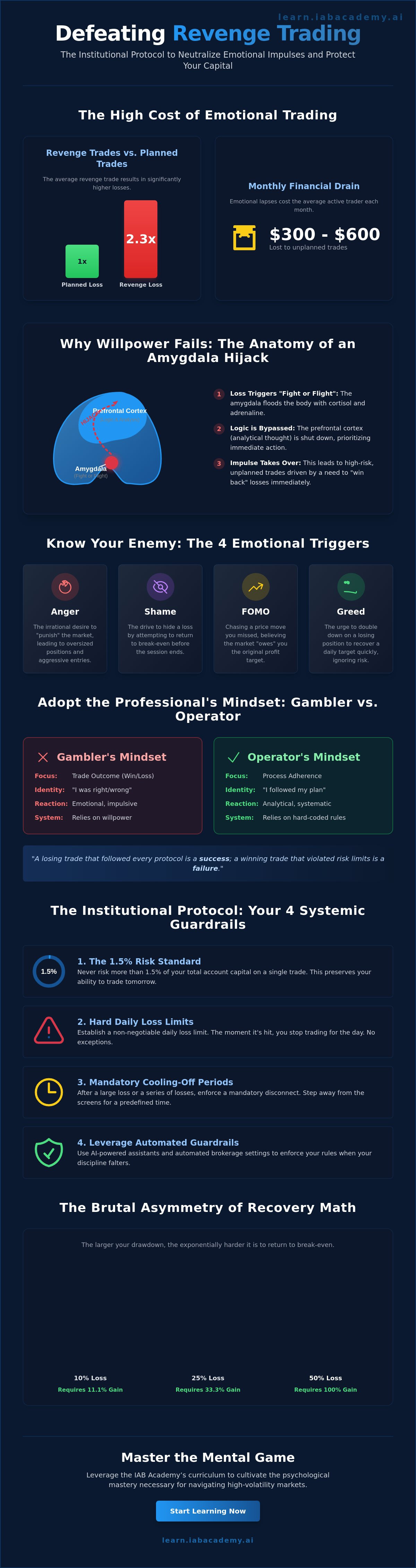
Did you know that the average revenge trade loses 2.3 times more than a planned trade? In the high-volatility 2026 market, these emotional lapses cost the average active trader between $300 and $600 every month. You've likely experienced the frustration of watching a manageable loss spiral into a blown account because the amygdala hijacked your decision-making process. It's a common struggle for those committed to growth, but professional excellence in the digital ecosystem requires moving beyond raw willpower.
This guide provides the authoritative protocol on how to stop revenge trading after a loss by implementing the same systematic guardrails used by institutional desks. You'll master a repeatable 5-step system designed to neutralize emotional impulses and protect your capital from the traps set by AI-driven algorithms. We'll explore the 1.5% risk standard, mandatory cooling-off periods, and the specific journaling metrics that shift your focus from individual trade outcomes to long-term portfolio mastery.
Key Takeaways
- Transition from a gambler's mindset to an institutional operator framework where success is defined by process adherence rather than singular trade outcomes.
- Discover the specific protocol on how to stop revenge trading after a loss, including the implementation of mandatory disconnects and hard daily loss limits.
- Deploy AI-powered trading assistants and automated brokerage guardrails to neutralize emotional impulses and ensure compliance with your risk strategy.
- Leverage the IAB Academy’s financial literacy curriculum to cultivate the psychological mastery necessary for navigating high-volatility market ecosystems.
- Master the physiological mechanics of the amygdala hijack to recognize and neutralize the "I was right" fallacy before it impacts your capital.
What is Revenge Trading? The Anatomy of an Amygdala Hijack
Revenge trading is a specific form of emotional volatility where a trader attempts to "win back" market losses through impulsive, high-risk executions. It isn't merely a lack of discipline; it's a physiological failure of the executive function. In the current 2026 market ecosystem, where algorithmic bots and AI-driven traps dominate price action, retail traders often fall victim to the "I was right" fallacy. This occurs when the brain interprets a standard market stop-out as a personal insult or a technical error that must be rectified immediately. Understanding how to stop revenge trading after a loss begins with recognizing that your biological hardware is fundamentally ill-equipped for high-stakes probability without systemic intervention.
The physiology of a loss is a violent internal process. When a trade hits a stop-loss, the amygdala initiates a "fight or flight" response, flooding the bloodstream with cortisol and adrenaline. These chemicals prioritize immediate action over analytical thought, effectively bypassing the prefrontal cortex. This state triggers a cognitive bias known as loss aversion, where the pain of losing is perceived as twice as powerful as the joy of gaining. This explains why revenge trading remains the primary cause of blown accounts, as traders abandon the 1.5% risk rule to chase "recovery" trades that lack any statistical edge.
The Four Emotional Triggers of Revenge Trading
- Anger: The irrational desire to "punish" the market for an "unfair" move, often leading to oversized positions and aggressive entries.
- Shame: The drive to hide a loss from a peer group or spouse by attempting to return the account to "break even" before the session ends.
- Fear of Missing Out (FOMO): Chasing a price move you missed after being stopped out, believing the market "owes" you the original profit target.
- Greed: The urge to double down on a losing position to recover a daily target quickly, ignoring the 2.3 times higher loss probability associated with unplanned trades.
Willpower vs. Systems: Why You Can't "Think" Your Way Out
Professional institutions don't rely on the "human element" for risk management because they recognize that cognitive resources are depleted after high-stress market events. This decision fatigue makes it nearly impossible to maintain excellence through willpower alone. While a novice trader tries to stay calm, a professional operator relies on hard-coded protocols that remove the choice to trade entirely. The "Point of No Return" in an emotional trading spiral is reached the moment you enter a position without a pre-defined exit strategy simply to soothe the discomfort of a previous loss.
Establishing Professional Standards: The Institutional Approach to Risk
Transitioning from a retail participant to a market professional requires a fundamental shift from a gambler's mindset to an operator's mindset. While a gambler focuses on the immediate profit or loss of a single position, an operator focuses on the integrity of the execution process. Professional institutions maintain their edge because they prioritize Trade Quality over Trade Outcome. A losing trade that followed every protocol is considered a success; conversely, a winning trade that violated risk limits is a failure. Understanding this distinction is the first tactical step in learning how to stop revenge trading after a loss.
Institutional desks employ Risk Desks or Compliance Officers who act as external limiters. These entities enforce Hard Stops that a trader cannot override. For the individual investor, mastering stock market fundamentals involves building these same barriers within a personal trading plan. You must treat your capital with the same clinical detachment as a global fund manager. By removing the choice to deviate from the plan, you eliminate the possibility of an emotional spiral before it begins.
The Mathematical Reality of Drawdowns
The necessity of a system is rooted in the brutal asymmetry of Recovery Math. If you suffer a 10% loss, you need an 11.1% gain to recover. However, if revenge trading leads to a 50% drawdown, you must generate a 100% return just to reach breakeven. This reality is why sizing creep, or increasing position sizes to "make it back faster," is the fastest path to insolvency. Professional excellence requires adhering to the 1.5% risk rule to preserve your Expectancy and ensure that your R-multiple data remains statistically significant over a 100-trade sample.
Developing a Professional Trading Plan
Professionalism is defined by preparation. Your pre-market routine must include a mental stop-loss, which is a pre-determined point where you will walk away regardless of market conditions. Use an A+ Setup filter to ensure you only commit capital to high-probability edges after a loss. Documenting these rules is essential. If a protocol isn't written down, it doesn't exist. To refine these standards and protect your equity, consider exploring risk management and portfolio strategy training to future-proof your career in the 2026 ecosystem.
The 5-Step Protocol to Stop Revenge Trading in Real-Time
Execution of a high-level strategy depends on the immediate application of binary rules. When the amygdala hijack occurs, as analyzed in previous sections, your ability to reason is compromised. Implementing a structured protocol is the only verified method for how to stop revenge trading after a loss while the market is still active. These five steps act as a circuit breaker, preventing a single technical failure from evolving into a catastrophic equity drawdown.
- Step 1: The Mandatory 30-Minute Disconnect. You must physically remove yourself from the trading terminal immediately after a loss. This 30-minute window allows your cortisol levels to stabilize and your prefrontal cortex to regain control over decision-making.
- Step 2: The Daily Loss Limit (DLL). Establish a hard dollar or percentage cap, such as the 2026 industry standard of 1.5% of total capital. Once this limit is reached, your session is over. No exceptions are permitted.
- Step 3: The "Three Strikes" Rule. If you experience three consecutive losing trades, you must enter a mandatory 24-hour cooling period. This prevents the "death by a thousand cuts" scenario often seen in high-volatility environments.
- Step 4: Position Size Reduction. Upon returning from a disconnect, cut your position size by 50% for the next trade. This reduces the financial stakes and allows you to rebuild confidence without risking significant capital.
- Step 5: Post-Loss Audit. Before any re-entry, you must tag the losing trade in your journal and identify the specific market trigger. Professional mastery requires understanding the "why" before attempting the "how" of the next execution.
Externalizing Your Discipline
Internal willpower is a finite resource that fails under pressure. To maintain excellence, you should externalize your discipline through accountability partners or automated friction. Telling a peer your specific loss limit for the day creates a social contract that is harder to break than a private thought. Additionally, using physical triggers, like locking your trading app or closing your laptop, creates the necessary resistance to impulsive actions. For those seeking to automate these standards, our AI trading strategy tutorials provide frameworks for building systematic guardrails into your workflow.
The "Breakeven Chasing" Trap
The desire to "get back to green" is the most dangerous objective a trader can hold. This mindset shifts your focus from high-quality execution to a desperate need for a specific outcome. Professional operators accept a "Red Day" as a standard cost of doing business in a 2026 market dominated by complex AI algorithms. You must reframe every market stop-out as a tuition payment to the market for a lesson in risk management excellence. Accepting the loss today preserves the capital you need to exploit a high-probability edge tomorrow.
Leveraging AI and Automated Guardrails to Enforce Discipline
The 2026 digital ecosystem has rendered traditional willpower-based discipline obsolete. In an environment where institutional bots execute in microseconds, relying on your emotional state to manage risk is a structural vulnerability. Professionals now utilize high-density technological solutions to maintain operational integrity. By integrating AI-powered trading assistants, you can monitor real-time sentiment and trade frequency against your established benchmarks. These tools act as a digital compliance officer, flagging deviations from your strategy before they manifest as capital losses. This technological layer is the definitive answer for how to stop revenge trading after a loss when your internal biological systems are compromised.
Automated "Hard Locks" represent the ultimate safety net for the modern operator. Many professional-grade brokerages now offer API-driven features that prevent new orders once a Daily Loss Limit (DLL) is triggered. Unlike a mental rule, these hard locks cannot be overridden during an amygdala hijack. Moving toward algorithmic execution further removes the human element from the equation. Transitioning to "Set and Forget" orders ensures that your exits are handled by a machine, effectively neutralizing the impulse to double down or "revenge" a previous stop-out. AI-driven trade audits then provide a clinical review, automatically distinguishing between impulse trades and strategy-aligned executions with 98% accuracy based on historical volatility patterns.
The Role of AI in Emotional Regulation
Future-proofing your career involves adopting biometric monitoring tools that track heart rate and skin conductance. These systems suggest a mandatory trading break the moment they detect the physiological markers of stress. Utilizing AI-powered investing tools allows you to objectively filter setups during high-stress periods, ensuring that only A+ opportunities reach your terminal. Our Smart Instructor™ technology even provides real-time support, helping you talk through a loss in 130+ languages to stabilize your cognitive state before the next session.
Building an Automated "Safety Net"
To establish a professional circuit breaker, you must configure your brokerage API with a hard 1.5% maximum daily loss limit. This ensures that your personal trading desk mirrors the standards of a global stock exchange, where trading halts are triggered by specific volatility thresholds. Automated trade tagging for "Revenge" or "FOMO" allows for data-driven monthly audits, revealing the exact financial cost of emotional lapses. To master these advanced protocols and secure your capital, explore our AI-powered trading tools training to implement these guardrails today.
Mastering the Mental Game with IAB Academy
Mastering the market ecosystem requires more than just a profitable strategy; it demands a psychological infrastructure that can withstand the high-volatility events of 2026. While the previous sections established the physiological triggers and the automated guardrails necessary for survival, the final step in learning how to stop revenge trading after a loss is the integration of these protocols into a comprehensive educational framework. Professional excellence is achieved when risk management becomes a subconscious habit rather than a manual checklist. By internalizing these standards through a structured financial literacy curriculum, you transform from a reactive participant into a disciplined market operator.
The IAB Academy facilitates this transition by providing the Smart Instructor™, a proprietary AI-driven interface that offers real-time answers to complex trading dilemmas in 130+ languages. This tool acts as a global mentor, ensuring that learners have access to authoritative industry standards at the exact moment they face an emotional hurdle. Whether you're a novice investor or a professional seeking certification, the path to mastery is rooted in the clinical application of data. Risk management isn't just a defensive tactic; it's the foundational pillar taught in our personal finance classes to ensure long-term capital preservation and career survival.
Continuous Education as an Emotional Hedge
In-depth mastery of technical analysis and macro-economic trends acts as a powerful emotional hedge. When you understand the statistical probability of a setup, a loss no longer feels like a personal failure; it's simply a data point within a larger sample. This perspective reduces the "surprise" factor that often triggers an amygdala hijack. Furthermore, the IAB Academy ecosystem emphasizes the role of community and mentorship. Engaging with a global network of professionals helps reinforce the 1.5% risk rule and ensures that you remain accountable to the institutional standards required for professional-grade trading certification.
Ready to Future-Proof Your Trading?
The 2026 market doesn't forgive emotional lapses, but it rewards those who treat trading as a professional discipline. By joining our Novice Investor Curriculum, you gain immediate access to the latest AI trading tools and strategy tutorials, ensuring your skills remain relevant in a rapidly evolving technological landscape. You'll receive lifetime updates on algorithmic execution protocols and psychological resilience training designed to neutralize the impulses that lead to blown accounts. It's time to move beyond the shame of repeating emotional mistakes and step into a role of authority over your financial future. Enroll in IAB Academy and Master the Markets to secure your position in the global digital ecosystem today.
Future-Proofing Your Capital Through Professional Mastery
Transitioning from a reactive trader to an institutional operator requires more than just raw willpower. You've learned that the 2.3 times higher loss multiplier associated with revenge trades isn't a character flaw; it's a physiological event driven by cortisol. By implementing the 1.5% risk rule and the mandatory 30-minute disconnect protocol, you've established the systematic guardrails necessary for learning how to stop revenge trading after a loss. These standards are your primary defense against the algorithmic traps of the 2026 market ecosystem.
Professional excellence is a continuous path of development that demands the right resources. The IAB Academy provides the infrastructure for your success, featuring our AI-Powered Smart Instructor™ for real-time guidance and a global community of disciplined investors. Our comprehensive curricula are designed to elevate traders of all ages, from novice to certified professional. Start Your Professional Trading Journey with IAB Academy to master the psychological and technical skills required for long-term capital preservation. Your journey toward market mastery and professional validation begins now.
Frequently Asked Questions
How do I know if I'm revenge trading or just following my strategy?
You identify revenge trading by comparing your entry metrics to your documented trading plan. If a trade occurs within 10 minutes of a previous loss or involves an unplanned increase in position size, it's an emotional reaction rather than a strategic execution. Professional operators use trade tagging to maintain objective standards and ensure total compliance with their risk protocols.
What is the fastest way to calm down after a major trading loss?
Physical removal from your trading terminal is the most effective method to stabilize your physiology. A mandatory 30 minute disconnect allows cortisol levels to return to baseline and restores the executive function of your prefrontal cortex. Engaging in a non market related activity during this window prevents the emotional spiral that leads to catastrophic equity drawdowns in the 2026 market environment.
Can a professional trader still fall victim to revenge trading?
Professional traders are biologically susceptible to emotional impulses, but they rely on institutional systems to neutralize them. Even elite performers experience the "fight or flight" response after a significant market stop out. The primary difference lies in their use of hard coded risk desks and automated guardrails that remove the human ability to deviate from the established plan.
How much should my maximum daily loss limit be?
The industry standard for a maximum daily loss limit in 2026 is 1.5% of your total account equity. This conservative threshold protects your capital during periods of high market volatility and ensures that no single session can jeopardize your long term survival. Once this 1.5% cap is breached, you must cease all trading activities for the remainder of the session.
Is it better to stop trading for the day or just for an hour after a loss?
Terminating the session for the day is the superior protocol for learning how to stop revenge trading after a loss. While a one hour break can lower immediate stress, a losing session often indicates a lack of alignment with current market conditions. Closing the terminal ensures you don't chase breakeven targets that compromise your broader portfolio strategy.
What happens if I break my own rules and continue revenge trading?
Breaking your own rules leads to a loss multiplier effect where unplanned trades lose 2.3 times more than strategic ones. Beyond the financial cost, this behavior erodes your psychological resilience and confidence in your personal edge. This cycle of indiscipline is the primary cause of account failure for a high percentage of retail participants in the digital ecosystem.
How can AI help me identify my trading triggers?
AI identifies triggers by analyzing your historical execution data for patterns of high frequency trading and emotional entries. By using AI powered trading assistants, you can receive real time alerts when your behavior deviates from your certified strategy. These tools provide an objective audit of your performance, highlighting specific market conditions that lead to impulsive decision making.
Why do I feel a physical 'need' to trade after losing money?
This physical urge is a neurobiological response to loss aversion and a sudden drop in dopamine levels. Your brain interprets a financial loss as a threat to survival, triggering a drive to recover the lost resources immediately. Understanding this biological hardware is a core component of our financial literacy curriculum, helping you master the mental game through clinical awareness.
