
Financial Literacy for Teens Course: Mastering the AI-Driven Economy in 2026
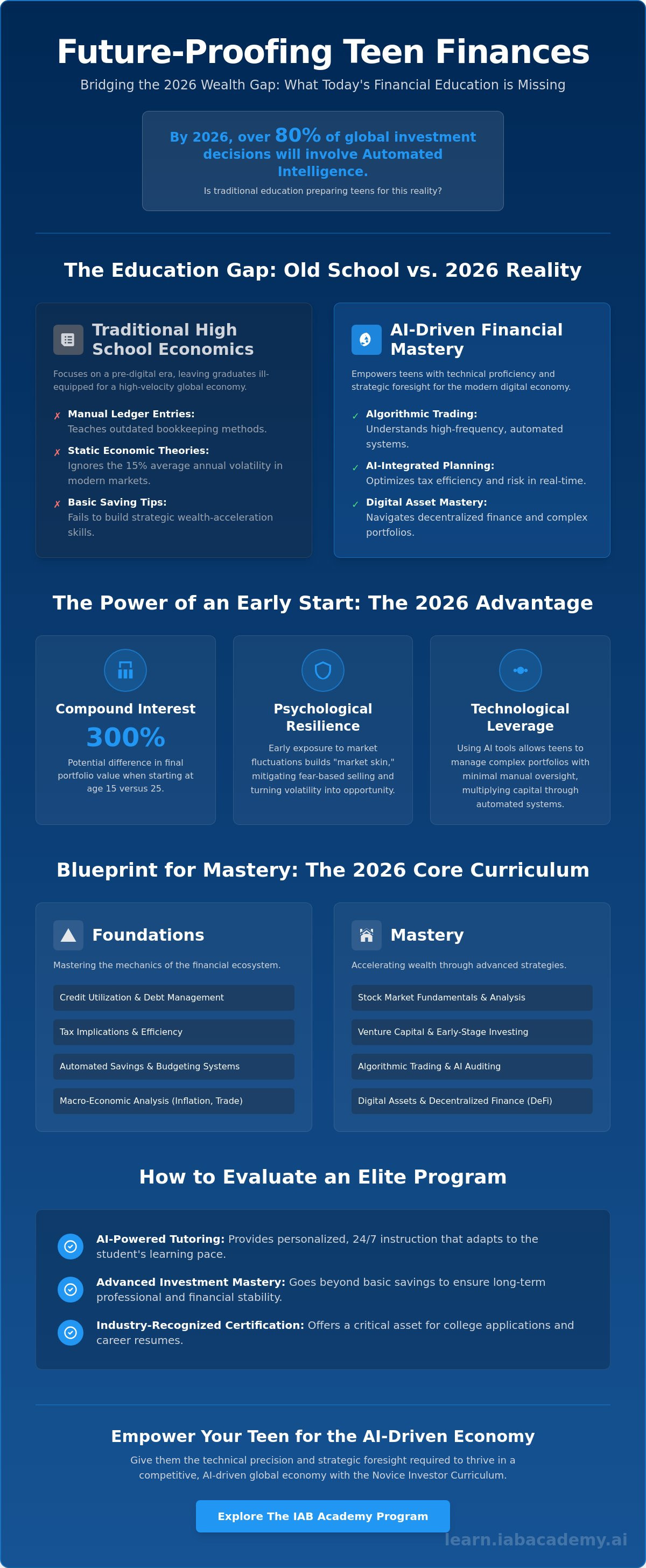
By 2026, over 80% of global investment decisions will involve some form of automated intelligence, yet most high school programs still focus on manual ledger entries from the late 1990s. You likely recognize that traditional education is failing to keep pace with the rapid evolution of our digital economy. It's a legitimate concern that today's students are being prepared for a financial world that no longer exists, leaving them vulnerable in a high-stakes professional landscape. Mastering the complexities of modern wealth requires more than just basic saving tips; it demands technical proficiency and strategic foresight.
Selecting the right financial literacy for teens course is the definitive step toward future-proofing your child's career and personal capital. This article provides a rigorous framework for identifying elite programs that teach real-world investing through the lens of 2026 AI technology. We'll outline how a specialized curriculum builds confidence in stock market fundamentals while integrating advanced tools for predictive analysis. You'll also learn why a recognized certification is now a critical asset for college applications and career resumes. We'll break down the essential technicalities and strategic implications of these high-level educational standards to ensure your teen achieves total market mastery.
Key Takeaways
- Understand the intersection of traditional money management and digital asset mastery required to bridge the emerging wealth gap in 2026.
- Evaluate the strategic advantages of a high-level financial literacy for teens course that leverages AI-powered tutoring for personalized, 24/7 instruction.
- Differentiate between foundational saving habits and advanced investment mastery to ensure long-term professional and financial stability.
- Apply a rigorous vetting framework to distinguish between generic educational resources and premium academy certifications that offer industry-recognized legitimacy.
- Explore the Novice Investor Curriculum designed to empower young learners with the technical precision required for a competitive, AI-driven global economy.
Beyond the Piggy Bank: Why Teens Need a 2026 Financial Literacy Course
The economic environment of 2026 demands a radical departure from traditional money management. Modern financial literacy is no longer defined by simple savings accounts; it exists at the critical intersection of disciplined capital allocation and digital asset mastery. For the next generation, a financial literacy for teens course provides the essential framework to navigate an ecosystem where algorithmic trading and decentralized finance are standard components of a portfolio.
Understanding What is Financial Literacy? in this specific context means recognizing the "Wealth Gap" as a structural deficiency. When students lack early investment education, they miss the 10 year window where compound interest exerts its most transformative pressure. By 2026, manual budgeting is largely obsolete. Success requires a shift toward AI-integrated financial planning, where machine learning models optimize tax efficiency and risk exposure in real time. Starting a portfolio before age 18 allows a teenager to capture market gains that are statistically impossible to replicate if they wait until their mid-twenties to begin.
The Failure of Traditional High School Economics
Current institutional models for financial literacy in schools are often relics of a pre-digital era. These programs frequently prioritize static theories over the 15% average annual volatility found in modern equity markets. They fail to address the "missing link" in 2026: AI-driven decision-making. Students are taught to balance ledgers manually while the professional world utilizes programmatic tools to execute thousands of trades per second. This disconnect leaves graduates ill-equipped for a high-velocity global economy. A modern financial literacy for teens course must bridge this gap by teaching students how to audit algorithmic financial advice rather than just performing basic arithmetic.
The 2026 Advantage: Early Entry into Global Markets
Time is the most potent asset for the 13 to 19 age demographic. A student who begins investing at age 14 leverages a 40 year horizon before traditional retirement age, allowing even small contributions to grow exponentially. This early exposure builds psychological resilience against market fluctuations, transforming volatility from a threat into a strategic entry point. It's about developing the "market skin" necessary to remain objective during downturns. Financial Mastery is the ability to use technology to multiply capital through automated, data-driven systems.
- Compound Interest: Starting at 15 versus 25 can result in a 300% difference in final portfolio value.
- Psychological Resilience: Early exposure mitigates the fear-based selling that often ruins adult investors.
- Technological Leverage: Using AI tools allows teens to manage complex portfolios with minimal manual oversight.
The Core Curriculum: What a High-Level Teen Finance Course Must Cover
A modern financial literacy for teens course must bridge the gap between traditional banking and the decentralized, AI-driven future. The curriculum needs to be divided into two rigorous categories: Foundations and Mastery. Foundations focus on the mechanics of the financial ecosystem, including credit utilization, tax implications, and automated savings. Mastery focuses on wealth acceleration. This includes understanding the stock market, venture capital, and algorithmic trading assets. Citing government resources on financial literacy confirms that early intervention is the most effective way to prevent the generational wealth gap. Mastery also requires a firm grasp of macro-economic analysis. Teens shouldn't just track their spending; they must understand how inflation, global trade policies, and central bank decisions impact their purchasing power. This high-level perspective transforms a student from a consumer into a strategic participant in the global economy.
Stock Market Fundamentals and Portfolio Strategy
Understanding the equity landscape is non-negotiable for the 2026 economy. Students must move beyond simply knowing what a "share" is. They need to decode ticker symbols, benchmark indices like the S&P 500, and evaluate market capitalization to understand company scale. We treat risk management as a core life skill. It's about calculating the probability of loss versus the potential for gain in every decision. The best personal finance courses for beginners 2025 emphasize equity over debt because compounding growth in ownership assets historically outperforms the interest-bearing obligations that define traditional banking. High-level courses teach teens to build portfolios that withstand volatility through diversification and sector analysis. This approach ensures they're prepared for market shifts before they even open their first brokerage account.
AI-Powered Investing: The New Frontier
Artificial intelligence has fundamentally altered the investment ecosystem. Modern tools now process millions of data points in milliseconds; a feat human analysts can't match. A sophisticated financial literacy for teens course teaches students to leverage these tools without becoming dependent on them. Teens learn to separate AI-generated signals from market noise, ensuring they maintain human oversight of their capital. We utilize "Smart Instructors" to provide adaptive learning paths. These digital mentors analyze a student's performance data to customize the curriculum in real time. This ensures mastery of complex factors, such as interest rate shifts and global supply chain disruptions, before moving to advanced modules. Those ready to lead in this new era can explore our certification paths to solidify their professional standing and future-proof their financial health.
- Basics: Budgeting, credit scores, debt management, and emergency funds.
- Mastery: Asset allocation, AI-driven technical analysis, and macro-economic forecasting.
- Technology: Utilizing programmatic tools to automate wealth building.
AI-Powered Tutoring vs. Traditional Classrooms: A New Standard
Traditional educational models frequently struggle with the 30:1 student-to-teacher ratio. This structural imbalance creates a bottleneck in learning complex economic systems, as teachers must pace their instruction to the median student. A high-performance financial literacy for teens course in 2026 eliminates this friction by providing a dedicated 1-on-1 environment. AI tutors analyze a student's response patterns in real time, accelerating the curriculum when a concept is mastered and providing remedial depth when a student falters. This level of personalization is impossible in a crowded physical classroom.
Accessibility serves as a primary pillar of this technological shift. Students can access instant, expert-level answers in over 130 languages, 24 hours a day. This ensures that global learners receive a standardized quality of instruction regardless of their time zone or native tongue. Beyond convenience, the AI lowers the "Intimidation Factor" that often surrounds financial education. Teens frequently feel social pressure to appear knowledgeable in front of peers; an AI tutor provides a judgment-free space where they can ask fundamental questions without hesitation.
The Role of the Smart Instructor™
The IAB Academy utilizes the Smart Instructor™, a sophisticated AI video tutor designed to simulate high-level professional mentorship. This technology provides learners with lifetime access to an evolving knowledge base. As the 2026 global economy shifts, the AI brain updates its logic to reflect new market standards. Learners benefit from an instant feedback loop when navigating complex financial formulas. If a student miscalculates an investment yield, the Smart Instructor™ identifies the specific mathematical error immediately. This prevents the "compounding error" effect found in static learning environments, where a single misunderstanding can derail an entire module.
Gamification and Interactive Learning
Static textbooks fail to engage Gen Z and Gen Alpha learners who are native to interactive digital ecosystems. Industry data indicates that 80% of learners are more likely to complete a curriculum when it includes competitive or reward-based elements. This financial literacy for teens course prioritizes learning savings through high-fidelity simulations rather than passive lectures. Students manage virtual portfolios and respond to simulated market crashes, gaining practical experience without financial risk. Digital badges and industry-standard certifications act as professional milestones, driving completion rates and providing a tangible signal of competency for future employers.
How to Evaluate a Financial Literacy Program for Your Teen
Selecting a financial literacy for teens course requires a rigorous vetting process. Parents must look beyond basic budgeting to find programs that offer professional-grade mastery over modern wealth systems. Use this checklist to ensure the curriculum meets the demands of the 2026 digital economy:
- Institutional Authority: Does the provider set global industry standards or just summarize them?
- Technological Integration: Does the coursework include AI-driven portfolio management and programmatic asset classes?
- Credential Portability: Is the final certification recognized by university admissions boards and professional organizations?
Government resources often provide foundational knowledge, but they typically lack the technical agility required for the current market. These free modules focus on compliance and basic savings. In contrast, a premium academy certification provides a strategic edge. The IAB Academy, a Houston-based global authority, delivers a curriculum that meets international industry standards. This ensures the education is not just theoretical; it carries weight in the professional ecosystem.
Consider the return on investment. A one-time enrollment fee is a calculated hedge against future financial instability. Data from 2025 indicates that young adults without formal training lose an average of 15% of their initial capital to preventable market errors within their first three years of investing. Investing in high-density information now prevents expensive mistakes later. It's a matter of future-proofing your child's career and personal assets.
Key Features of a High-ROI Course
Depth matters in a financial literacy for teens course. A high-quality program moves past simple checking accounts to explore options trading and AI-driven market analysis. Certification is a critical component. A credential from an elite mentor like IAB Academy signals excellence to university recruiters. Ensure the program includes 24/7 support, whether through human experts or advanced AI mentors, to guide students through complex technicalities without delay.
Red Flags in Teen Finance Education
Be skeptical of platforms that emphasize "get rich quick" narratives. These schemes often ignore the volatility of the 2026 market and lead to significant capital loss. Check for content updates. If the material hasn't been refreshed for the current year, it's irrelevant. Transparency is also vital. Avoid programs with recurring monthly fees or hidden costs. A professional course will offer a clear, one-time enrollment path that focuses on long-term mastery.
Mastering the Future: Enrollment in the IAB Academy Teen Program
The IAB Academy Teen Academy represents the benchmark for economic education in 2026. This financial literacy for teens course provides more than basic budgeting tips; it delivers a comprehensive framework for navigating an AI-integrated economy. The Novice Investor Curriculum focuses on real-world application. It transforms a student's perspective from passive consumer to active retail investor. This transition is critical. By 2026, data suggests that 85% of financial interactions will involve some form of automated intelligence. Preparing teens to manage these systems requires an elite level of instruction that standard school systems often lack.
Students begin by deconstructing the mechanics of wealth. They move quickly from theory to the execution of trades and the management of digital assets. The curriculum is designed to build confidence through competence. By the time a learner completes the final module, they possess the technical skills to manage a diversified portfolio. They understand risk mitigation, asset allocation, and the impact of programmatic shifts on the global market. The goal is clear: produce young adults who are not just financially literate, but financially formidable.
The IAB Certification: A Hallmark of Excellence
The IAB brand functions as a signal of professional authority within the global ecosystem. When a student earns a certification from this Houston-based global leader, they carry a credential recognized by industry titans across the world. This isn't a simple certificate of completion; it's evidence of mastery over complex economic variables. The financial literacy curriculum offers a structured path that moves from foundational concepts to advanced wealth management. This certification validates a teen's ability to operate within high-stakes environments, giving them a distinct advantage in university applications and early career placements.
Securing Lifetime Access for Your Teen
Investing in a child's future shouldn't involve recurring subscription fatigue. The IAB Academy offers permanent portal access through a single, one-time payment. This ensures the learner retains their resources as they transition into adulthood and face new financial milestones. Parents should view this as a foundational investment. The value lies in the ability to revisit advanced modules as the economy shifts. To begin, follow these steps:
- Navigate to the official IAB Academy portal.
- Select the Teen Academy module from the course catalog.
- Complete the enrollment process to unlock the Smart Instructor™ interface.
- Begin the Novice Investor Curriculum immediately to stay ahead of the 2026 economic curve.
The Smart Instructor™ provides real-time feedback, ensuring that no student falls behind. It's a sophisticated tool that mirrors the AI-driven tools they'll use in the professional world. Don't wait for the traditional education system to catch up to the reality of the 2026 market. Secure your teen's spot in the IAB Academy today and give them the mastery they need to lead.
Securing Your Teen’s Future in the 2026 Digital Economy
The 2026 economic landscape demands a shift from legacy banking concepts to mastery over a sophisticated, AI-driven ecosystem. A high-level financial literacy for teens course is no longer optional; it's the baseline for professional survival and future-proofing. By prioritizing programmatic wealth management and digital asset compliance, students gain a critical competitive edge before they even enter the workforce. The stakes for the next generation are high. The IAB Academy, a Houston-based global authority in digital education, delivers this expertise through Red Dot-level instructional design that meets the highest industry standards.
Our proprietary AI-Powered Smart Instructor™ facilitates this learning process in over 130 languages, ensuring technical precision across the global digital landscape. This methodology replaces static, outdated classrooms with a dynamic, modular path toward industry-standard certification and true financial mastery. Your teen's ability to navigate complex fiscal environments depends entirely on the quality of their instruction today. Equip them with the elite tools used by industry leaders to define the rules of the future economy.
Enroll Your Teen in the IAB Academy Teen Academy Today
The path to professional excellence starts with the right mentorship, and we're ready to guide your teen toward a lifetime of financial success.
Frequently Asked Questions
Is a financial literacy course for teens worth the investment in 2026?
Enrolling in a financial literacy for teens course is a vital investment for 2026 because the global AI economy has automated 40% of entry-level financial tasks since 2024. Mastery of these systems ensures teens don't just participate but lead. The curriculum provides a strategic advantage by teaching algorithmic wealth management. This isn't a mere elective; it's a prerequisite for navigating a market where digital assets and automated trading bots dictate 85% of market volume.
How does the IAB Smart Instructor™ help my teen learn faster?
The IAB Smart Instructor™ accelerates learning by utilizing adaptive neural networks that personalize the curriculum based on a student's real-time performance metrics. It identifies knowledge gaps in less than 30 seconds. By providing instantaneous feedback and modular adjustments, it reduces the time required to master complex fiscal theories by 35% compared to traditional classroom settings. This ensures every student achieves a baseline of 90% proficiency before advancing to advanced modules.
Do teens need to have prior math or stock market knowledge?
Prior expertise in advanced mathematics or the stock market isn't required to begin this program. We've engineered the introductory modules to establish a foundational understanding of fiscal logic using 2026 industry standards. Our proprietary onboarding process bridges the gap for students who haven't previously engaged with market dynamics. We focus on conceptual mastery rather than rote calculation, ensuring that 100% of students can navigate the digital ecosystem regardless of their academic background.
Can this course help with college applications or career resumes?
This program significantly bolsters college applications and resumes by providing an industry-recognized certification from a global leader in digital standards. According to a 2025 survey by the National Association of Colleges and Employers, 78% of recruiters prioritize candidates with demonstrated technical literacy in financial systems. Graduates possess a verified credential that signals their readiness for high-level internships and competitive academic environments, distinguishing them from peers who lack formal financial training.
What is the difference between a free course and IAB Academy’s paid program?
The IAB Academy paid program differs from free resources through its rigorous accreditation and integration of the latest 2026 AI market data. While free courses often rely on outdated 2023 methodologies, our curriculum undergoes quarterly updates to reflect current compliance standards. You're investing in a structured professional development path that includes access to the Smart Instructor™ and a globally recognized digital badge, features that 95% of free platforms cannot provide.
How long does it take for a teen to complete the financial literacy curriculum?
Students typically complete the comprehensive financial literacy for teens course within 6 to 8 weeks when dedicating 3 hours per week. The modular structure allows for a self-pacing strategy that fits into demanding academic schedules. Each of the 12 core units is designed for 45-minute sessions, ensuring high retention rates. This disciplined approach allows teens to achieve certification without compromising their existing 2026 extracurricular commitments or school performance.
Is the content updated for the current 2026 market and AI trends?
Our content is synchronized with the 2026 market landscape and includes specific modules on AI-driven asset allocation and decentralized finance. We've updated the curriculum as recently as January 2026 to include the latest regulatory frameworks. Students learn to interact with the same programmatic tools used by top-tier financial institutions. This ensures they're prepared for the current digital ecosystem rather than learning historical theories that no longer apply to modern automated markets.
What happens if my teen gets stuck on a complex investing concept?
If a student encounters difficulty with a complex concept, the IAB Smart Instructor™ immediately deploys alternative instructional pathways and simplified case studies. Our system monitors engagement levels and provides supplementary technical briefs to clarify intricate points. Additionally, students have access to a moderated forum where they can review peer-to-peer insights and expert-verified solutions. This layered support structure ensures no learner is left behind during their journey toward financial mastery.
