
Building Financial Confidence for Young Adults: A Strategic Roadmap for 2026
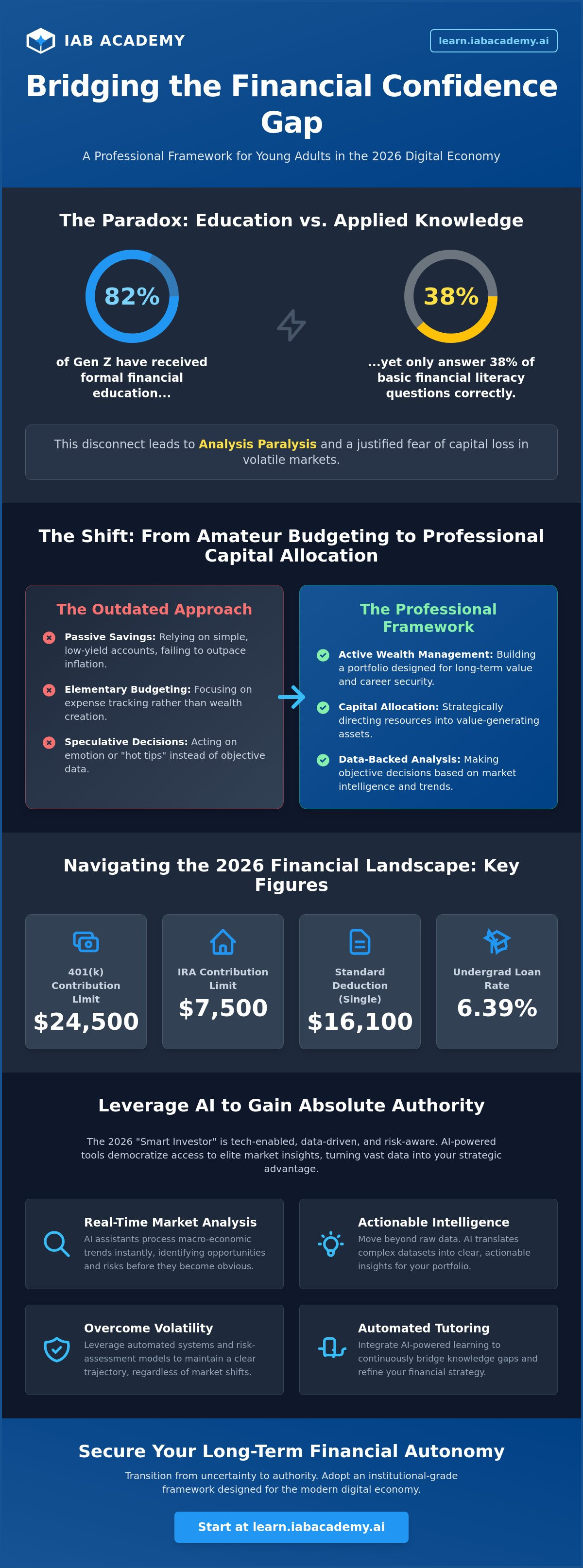
While 82% of Gen Z have received some form of formal financial education, the average young adult correctly answers only 38% of basic financial literacy questions. This disconnect explains why building financial confidence for young adults remains a significant challenge despite the abundance of digital tools. You're likely facing a paradox where the desire to capitalize on 2026's bullish AI stock trends is tempered by a justified fear of losing capital in high-volatility environments.
We understand that information overload often leads to analysis paralysis rather than professional growth. You deserve more than generic advice; you require a structured, institutional-grade framework to achieve absolute authority over your capital. This article promises to bridge that gap by providing the psychological and technical proficiencies necessary to command the modern digital economy with precision.
We'll examine the 2026 regulatory environment, including the updated $24,500 401(k) and $7,500 IRA contribution limits. You'll also learn to leverage AI-powered tools for market analysis, ensuring your career and wealth trajectory align with global industry standards.
Key Takeaways
- Define financial confidence as a technical proficiency rooted in the intersection of literacy and strategic execution rather than a mere emotional state.
- Transition from elementary budgeting to professional capital allocation to better navigate the complexities of the 2026 digital economy.
- Master the technical frameworks for building financial confidence for young adults by replacing speculative decision-making with objective, data-backed market analysis.
- Establish a clear wealth trajectory by adopting a structured financial literacy curriculum that integrates institutional standards with modern technological applications.
- Utilize advanced AI trading assistants and automated tutoring to gain absolute authority over your portfolio and secure long-term financial autonomy.
The Evolution of Financial Confidence in the 2026 Digital Era
Financial confidence is not a vague emotional state or a sense of comfort with one's bank balance. In the 2026 market, it is strictly defined as the intersection of technical literacy and strategic execution. Building financial confidence for young adults requires a shift away from 20th-century advice that prioritized linear career paths and passive savings. Those traditional models fail to address the high-velocity, volatile realities of the modern digital economy. True confidence emerges when you possess the technical proficiency to interpret market signals and the institutional-grade frameworks to act on them with absolute authority.
The current "Confidence Gap" isn't a result of individual indecision; it's a systemic lack of access to professional-grade data and analytical tools. While institutional players have long utilized sophisticated infrastructure, retail investors often find themselves overwhelmed by information overload. Establishing a global perspective is now a mandatory requirement for survival. In a borderless economy where capital flows across digital assets and international markets instantly, your strategy must be as expansive as the landscape itself. You must replace speculative habits with a disciplined, modular approach to wealth building.
Why Literacy is the Foundation of Professional Authority
Professional authority in any sector begins with understanding financial literacy as an evolving discipline. It's the primary engine of "Economic Agency," which is the power to make high-stakes, data-driven decisions that secure your long-term career and personal autonomy. We're witnessing a necessary transition from passive saving to active, informed wealth management. This shift demands a lexicon characterized by sector-specific terminology and an understanding of regulatory alignment. When you master these concepts, you aren't just managing money; you're building the infrastructure for professional advancement and career security in a competitive market.
The Role of AI in Bridging the Knowledge Divide
AI-powered investing tools have fundamentally democratized access to the complex market insights that were once the exclusive domain of elite analysts. The "Smart Investor" profile for 2026 is defined as tech-enabled, data-driven, and risk-aware. Modern finance literacy has matured into a digital-first discipline where AI trading assistants provide real-time analysis of macro-economic trends. These tools bridge the knowledge divide by translating vast datasets into actionable intelligence. By integrating these technologies, you can move beyond the fear of market volatility. Building financial confidence for young adults today means leveraging these automated systems to maintain a clear, professional trajectory regardless of broader economic shifts.
Core Competencies: Moving Beyond Simple Budgeting
Many entry-level financial guides position budgeting as the pinnacle of fiscal responsibility. This perspective is a myth that limits your potential for professional growth. While tracking expenses is a necessary administrative task, it doesn't constitute a strategy for wealth creation. Building financial confidence for young adults involves transitioning from the defensive mindset of 'spending' to the offensive discipline of capital allocation. Capital allocation is the deliberate, high-level process of directing your resources into assets that generate long-term value and career security.
In 2026, your personal wealth trajectory is inextricably linked to macro-economic trends. For instance, the standard deduction for single filers has risen to $16,100, and interest rates on undergraduate direct loans are established at 6.39%. These aren't just numbers; they're the parameters of your operational environment. You must establish a clear hierarchy of financial needs that prioritizes immediate liquidity and risk management before moving into diversified growth. Utilizing professional financial education resources allows you to align your personal strategy with these institutional benchmarks.
Mastering Stock Market Fundamentals
Success in the digital economy requires a deep immersion in stock market fundamentals. You must understand how to use indices like the S&P 500 and NASDAQ as benchmarks for your own performance. Speculative trading, driven by social media trends, often leads to capital loss. Strategic investing, conversely, relies on technical analysis and algorithmic tools to identify long-term value. If you're ready to move past the basics, our Stock Market Fundamentals Training provides the technical framework needed for professional-grade execution.
Understanding the Global Professional Ecosystem
Global interest rates and inflation don't just affect corporations; they directly impact your purchasing power and the cost of capital. Understanding regulatory frameworks and industry-wide standards is essential for anyone committed to professional advancement. Financial education isn't a one-time event but a lifetime access requirement for career survival. By framing your learning as a continuous professional development path, you ensure that your skills remain relevant as technology and markets evolve. This disciplined approach to building financial confidence for young adults distinguishes the novice from the professional who commands respect in a competitive market.
Overcoming the 'Risk Barrier' Through Data and AI
Building financial confidence for young adults requires a fundamental shift in how one perceives market risk. Loss aversion, the psychological tendency to prefer avoiding losses over acquiring equivalent gains, remains the primary barrier to wealth entry. In the 2026 economy, complexity adds a second layer of resistance. You must dismantle these barriers by replacing speculative 'gut feelings' with objective, institutional-grade analysis. Data-backed strategies provide a shield against the volatility that often paralyzes novice investors. While 71% of Gen Z express optimism regarding AI stocks, that sentiment must be backed by technical proficiency to prevent capital erosion.
Professional execution begins with risk management as a core discipline. You don't simply buy stocks; you manage a position. Transitioning from paper trading to real-market execution is a critical step in this development path. Simulation allows you to master technical frameworks without capital exposure, but absolute authority is only forged in live markets where your risk management training is tested. A structured approach ensures that when you enter the market, you're doing so with a calculated plan rather than a hopeful guess. This transition marks the move from a consumer mindset to that of a professional capital allocator.
AI-Powered Analysis vs. Retail Guesswork
The 2026 landscape has rendered traditional stock picking obsolete for the individual investor. Retail guesswork cannot compete with AI-enhanced sentiment analysis and technical modeling. Learning how to invest in ai is now a mandatory skill for those seeking to outperform standard benchmarks. Automated tools act as a neutral arbiter, maintaining portfolio discipline during periods of extreme volatility. These systems ensure you don't succumb to panic-driven liquidations, keeping your long-term wealth trajectory intact despite short-term market noise.
The Psychology of Market Cycles
Market capitulation occurs when investors collectively abandon their positions during a steep decline, often marking the final stage of a bear cycle and providing a strategic entry point for disciplined capital. Maintaining professional detachment during these fluctuations is essential for long-term success. You must view market cycles as structural events rather than personal crises. Building a mastery mindset requires continuous, structured education that prioritizes technical proficiency over emotional reactions. This disciplined focus is the hallmark of building financial confidence for young adults who aim to navigate the digital economy with absolute authority.
A Strategic Roadmap to Building Long-Term Financial Autonomy
Transitioning from theoretical knowledge to operational mastery requires a disciplined, step-by-step approach. Building financial confidence for young adults is not achieved through sporadic market participation but through the rigorous application of institutional-grade frameworks. To secure your position in the 2026 digital economy, you must treat your wealth trajectory with the same professional scrutiny as a corporate audit. This roadmap provides the structural milestones necessary for achieving absolute financial autonomy.
- Step 1: Audit your current proficiency. Utilize established industry frameworks to identify gaps in your understanding of macro-economic indicators and regulatory standards.
- Step 2: Commit to a structured financial literacy curriculum. Your education must integrate both fundamental principles and the latest AI-driven analytical tools to remain relevant.
- Step 3: Deploy a tiered investment strategy. Establish a stable foundation using low-volatility, tax-advantaged assets. For 2026, this includes maximizing the $24,500 401(k) contribution limit or the $7,500 IRA limit before moving into more aggressive growth sectors.
- Step 4: Leverage AI tutors. Use automated assistants for real-time technical clarification on complex instruments like options or algorithmic models.
- Step 5: Pursue formal certification. Validating your proficiency through professional training programs signals your competence to the broader global professional ecosystem.
Setting Institutional-Grade Financial Goals
Professional wealth management involves moving from vague 'saving' targets to precise capital compounding objectives. You must establish clear liquidity ratios and debt-to-income benchmarks. For instance, maintaining a current ratio that ensures immediate obligations are met while capital is efficiently deployed into growth assets is a hallmark of the Smart Investor. Use conservative and aggressive growth models to project your wealth over ten and twenty-year horizons. This level of data-driven planning replaces hope with a predictable trajectory for career survival and success.
Continuous Professional Development
Financial education is not a static achievement; it's a recurring professional seminar. The 2026 market evolves too rapidly for a one-time learning approach to suffice. Lifetime access to updated market curricula and AI assistants ensures your strategy adapts to shifting regulatory alignments and technological breakthroughs. Engaging with global professional ecosystems allows you to identify emerging trends before they reach the mainstream retail market. To begin this journey of professional validation, enroll in our Financial Literacy Courses and start building financial confidence for young adults through expert-led instruction.
Leveraging IAB Academy to Accelerate Your Financial Mastery
Mastering the complexities of the 2026 digital economy requires a transition from passive consumption to active, tech-enabled learning. IAB Academy serves as the definitive institutional source for this transformation, providing the structured environment necessary for professional validation. Building financial confidence for young adults isn't a byproduct of luck; it's a deliberate outcome of engaging with a globally recognized learning portal. By bridging the gap between high-level theory and institutional-grade practice, our platform ensures you don't just learn about wealth but develop the technical proficiency to manage it with absolute authority.
The Academy's Novice Investors Course is specifically architected for the next generation of wealth. It moves beyond the basic financial literacy that only 38% of Gen Z currently masters, offering instead a path toward high-level proficiency. You'll gain lifetime access to a modular curriculum that evolves alongside market standards and regulatory shifts. This commitment to continuous professional development is essential for career survival in a market characterized by both high cost-of-living barriers and unprecedented technological opportunities.
The Smart Instructor™: Your 2026 Global Mentor
The Smart Instructor™ represents the pinnacle of AI-powered investing education. It provides 24/7 tutoring in over 130 languages, effectively removing the learning friction that often stalls professional growth. This system is particularly effective for establishing financial literacy for teens and young adults who require instant, data-driven clarification on complex market instruments. Through video-based AI tutors, the platform simulates high-level professional seminars, allowing you to absorb technical details at a disciplined pace.
Customization is a core feature of this global mentorship. You can tailor your learning path to align with specific professional goals, whether you're focusing on algorithmic trading for beginners or macro-economic analysis. This precision ensures that every hour spent on the platform contributes directly to your economic agency and long-term career security. By utilizing these AI trading assistants, you replace the intimidation of the technological landscape with a sense of mastery and calculated encouragement.
Securing Your Seat in the Future Economy
Early enrollment in AI-focused financial education provides a strategic advantage that cannot be overstated. As 71% of your peers look toward AI stocks with optimism, your competitive edge will be your ability to use AI stock analysis tools with professional-grade precision. IAB Academy certifications act as a hallmark of quality, validating your proficiency to the broader global professional ecosystem. These credentials signal that you possess the technical frameworks and risk management discipline required for success in 2026 and beyond. Enroll in IAB Academy and begin your journey toward financial mastery today.
Securing Your Position in the 2026 Wealth Landscape
Achieving long-term autonomy in a borderless digital economy requires a transition from rudimentary savings habits to sophisticated capital allocation. Building financial confidence for young adults is a technical proficiency established through data-backed risk management and the adoption of institutional-grade frameworks. You've seen how AI tools bridge the gap between retail guesswork and professional execution, transforming volatility into a manageable variable rather than a source of paralysis.
The roadmap to financial mastery is an ongoing professional seminar. As market standards and regulatory environments shift, your strategy must remain agile and informed. IAB Academy, a Houston-based global authority in AI investing, provides the infrastructure for this evolution. Through the Smart Instructor™ AI Tutor, available in over 130 languages, you receive instant technical clarification to ensure your wealth trajectory remains on course. Our platform provides lifetime access to all future course updates, ensuring your skills never become obsolete in a competitive market.
Master the Markets with IAB Academy’s AI-Powered Curriculum and validate your proficiency today. Your commitment to structured, professional development is the most reliable hedge against economic uncertainty.
Frequently Asked Questions
How can a young adult start building financial confidence with no prior experience?
Begin by auditing your current knowledge level against established industry benchmarks rather than diving into the market immediately. Building financial confidence for young adults starts with mastering technical terminology and understanding macro-economic indicators before committing capital. You should transition from passive observation to active learning through a structured curriculum. This foundational step ensures that your future market participation is based on objective analysis rather than speculative guesswork.
Is AI-powered investing safe for beginners in 2026?
AI-powered investing is safe when integrated with a rigorous risk management framework and professional-grade education. These tools are designed to remove emotional bias and provide data-backed insights into market volatility. However, beginners must first undergo training to understand the underlying algorithmic logic. Safety in the 2026 market is a function of technical proficiency and the ability to interpret AI-generated signals accurately without relying on intuition.
What is the difference between a personal finance class and an investing curriculum?
Personal finance classes typically focus on administrative tasks like budgeting and debt management. In contrast, an investing curriculum provides the technical frameworks for strategic capital allocation and wealth compounding. While the former secures your current liquidity, the latter is essential for building long-term career security and professional authority. You must move beyond simple expense tracking to master the mechanics of the global professional ecosystem and institutional growth.
How much money do I need to start investing in the stock market today?
Modern digital infrastructure allows individuals to begin market participation with minimal capital through fractional shares and low-barrier platforms. However, the focus shouldn't be on the initial dollar amount but on the quality of your strategic execution. You must prioritize investing in your technical literacy before deploying significant capital. A disciplined approach ensures that even small initial allocations are managed according to professional-grade risk management standards and long-term objectives.
Can financial literacy courses actually help me avoid debt traps?
Comprehensive financial literacy courses provide the analytical tools to evaluate the long-term impact of high-interest debt and predatory lending. By understanding concepts like debt-to-income benchmarks and the true cost of leverage, you gain the agency to make informed decisions. These courses replace reactive financial behavior with a proactive strategy. This ensures your capital is allocated toward wealth-building assets rather than interest payments on depreciating liabilities or everyday expenses.
How does the IAB Academy Smart Instructor™ help with real-time investing questions?
The Smart Instructor™ provides instant, AI-driven technical clarification on complex market instruments and economic indicators. It functions as a 24/7 global mentor, delivering precise answers in over 130 languages to reduce learning friction. This real-time support allows you to resolve technical doubts during your study sessions without waiting for traditional instruction. It effectively bridges the gap between theoretical study and the practical requirements of the 2026 digital economy.
What are the most important financial terms for young adults to learn first?
You should prioritize mastering terms that define your operational environment, such as capital allocation, macro-economic indicators, and compound annual growth rate (CAGR). Understanding the difference between speculative assets and institutional-grade benchmarks is also critical. These terms form the lexicon of building financial confidence for young adults. Mastery of this vocabulary is the first step toward achieving professional authority and navigating the high-density information of the modern market.
Why is financial confidence higher in those who use AI tools?
Financial confidence is higher among AI users because these tools replace emotional decision-making with objective, data-driven analysis. When you use AI-powered stock analysis tools, you gain a sense of mastery over complex datasets that would otherwise be intimidating. This technological advantage provides a clear, professional trajectory and reduces the fear of market volatility. It ensures that your actions are aligned with current industry standards and macro-economic realities.
