
Beginner Options Trading Guide: Mastering the 2026 Digital Investment Ecosystem
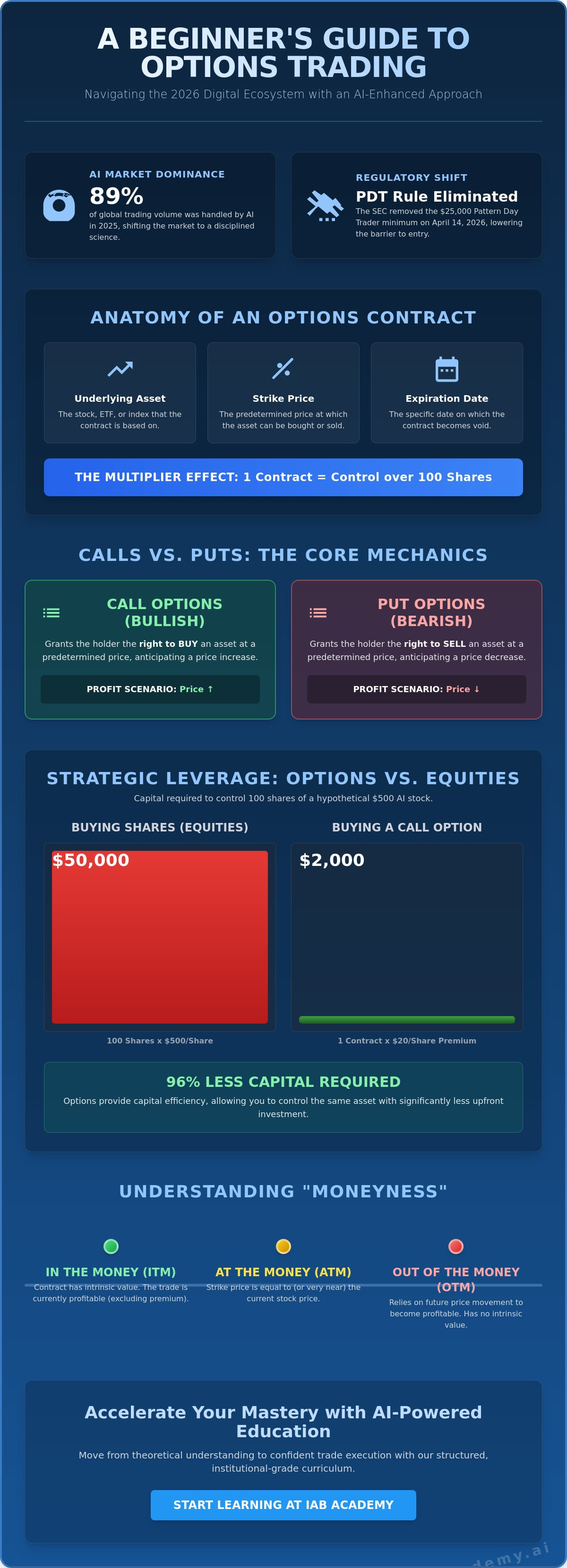
By 2025, artificial intelligence handled nearly 89% of global trading volume; however, most individuals still treat the market as a game of chance rather than a disciplined science. You're likely here because you recognize the potential of the derivatives market but feel overwhelmed by the technical density of implied volatility and complex spreads. It's natural to feel cautious when the stakes involve your financial future. This beginner options trading guide rejects the speculative narrative in favor of a professional, AI-enhanced approach to portfolio engineering.
We'll provide the strategic clarity you need to execute your first trade with institutional confidence. You'll learn how the SEC's April 14, 2026, decision to eliminate the $25,000 pattern day trader minimum has fundamentally lowered the barrier to entry for retail participants. This article outlines a structured path to mastering the 2026 digital ecosystem, covering everything from risk management protocols to the precise vocabulary of modern markets. We'll move from broad economic contexts into specific, actionable techniques that allow you to use options for both protection and consistent income.
Key Takeaways
- Define the strategic role of options as standardized financial instruments that provide capital leverage within the 2026 digital ecosystem.
- Navigate the mechanics of bullish and bearish instruments while mastering "The Greeks" to ensure precise risk management.
- Contrast the capital requirements of high-value AI stocks against strategic derivatives using this beginner options trading guide to optimize your portfolio's efficiency.
- Establish a disciplined risk-first strategy that utilizes position sizing to protect your wealth in a high-volatility market.
- Leverage AI-powered learning tools to demystify complex market data and move from theoretical understanding to confident trade execution.
Understanding Options as Strategic Financial Derivatives
An options contract is a standardized legal agreement that grants the holder the right, but not the obligation, to buy or sell an underlying asset at a predetermined price within a specific timeframe. In the global digital ecosystem, these instruments function as sophisticated tools for capital efficiency. Understanding Financial Options requires a shift from the mindset of simple ownership to one of strategic positioning. While traditional equity involves purchasing shares outright, options utilize leverage to control the same amount of stock with significantly less upfront capital. This beginner options trading guide establishes that options serve two primary functions: speculation on price direction and hedging to provide portfolio insurance. In 2025, total options volume surpassed 15.2 billion contracts, proving that these derivatives are no longer niche products but central components of modern market liquidity.
Standardized exchanges like Cboe and NYSE Arca ensure that every contract follows strict compliance and regulatory standards. These institutions facilitate a transparent environment where buyers and sellers can interact with high confidence. In the first quarter of 2026, market-wide Average Daily Volume reached 68.6 million contracts. This massive liquidity ensures that traders can enter and exit positions with minimal friction. By viewing options through the lens of institutional engineering, you move away from the "gambler" archetype and toward the role of a disciplined portfolio manager.
The Anatomy of an Options Contract
Every option consists of three core components: the underlying asset, the strike price, and the expiration date. The strike price is the specific value at which the contract can be exercised. Because one standard contract controls 100 shares of the underlying stock, a "multiplier" effect is created. This means a small move in the stock price can result in a large percentage gain or loss for the option holder. Traders must also master "moneyness" to evaluate their positions. An "In the Money" (ITM) contract has intrinsic value because the stock price has crossed the strike price. "At the Money" (ATM) contracts have a strike price equal to the current market price, while "Out of the Money" (OTM) contracts rely entirely on future price movement before they expire worthless.
Why Institutional Standards Matter for Retail Traders
Adhering to professional standards is the only way to ensure long-term survival in the 2026 market. This beginner options trading guide emphasizes that you cannot master derivatives without first mastering stock market fundamentals. Options are high-velocity instruments; they amplify both your strategic successes and your technical errors. Framing your education as part of a broader financial literacy curriculum allows you to see how these tools fit into a holistic wealth-building framework. Professionals don't ignore the risks of leverage; they calculate them. By following the same protocols used by institutional desks, retail traders can avoid the common pitfalls of information overload and unmanaged exposure.
The Mechanics of Calls, Puts, and "The Greeks"
Every trade begins with the payment of an option premium, which represents the market price of the contract's rights. This cost isn't arbitrary; it's a dynamic value calculated based on the underlying asset's price, the time remaining until expiration, and the current state of market volatility. This beginner options trading guide asserts that mastering the premium's components is the first step toward professional trade execution. In the 2026 digital ecosystem, where retail participation has surpassed 2021 peaks by 25%, understanding these mechanics differentiates disciplined investors from speculative participants.
Call and Put Dynamics in 2026 Markets
A Call option grants the holder the legal right to control 100 shares of an underlying asset at a specific strike price, providing a pathway to capital appreciation through strategic leverage. Conversely, a Put option serves as a bearish instrument or a protective "floor" for an existing portfolio. During periods of market capitulation, such as in February 2026 when the equity put/call ratio reached 1.28, puts became essential risk mitigation tools. FINRA on Options Mechanics clarifies that while the buyer holds the right to exercise, the seller, or writer, assumes a legal obligation to fulfill the contract terms if assigned. This distinction is critical because the seller's risk profile is fundamentally different from the buyer's limited premium exposure.
Decoding the Greeks: Delta, Gamma, Theta, and Vega
Professional traders monitor the "Greeks" as mathematical vital signs to gauge a contract's health and sensitivity. Delta measures price sensitivity, indicating how much the option's value changes for every $1 move in the stock. It also serves as a statistical proxy for the probability of the contract expiring in the money. Gamma tracks the rate of change in Delta, providing insight into price acceleration. Theta represents time decay, the daily erosion of the contract's value. It is the persistent enemy of the option buyer, especially in short-dated instruments like the 0DTE (Zero-Day-to-Expiry) options that accounted for 59% of total SPX volume in 2025. Finally, Vega analyzes the impact of Implied Volatility (IV) on pricing. A spike in IV increases premiums even if the stock price remains stagnant.
Mastering these variables is essential for anyone seeking to move beyond novice status and achieve long-term portfolio stability. For those ready to accelerate their professional development, exploring an options trading essentials course provides the structured environment necessary to apply these concepts in real-world scenarios. By internalizing these metrics, you gain the ability to predict how your positions will react to shifting market conditions before you commit capital.
Options vs. Equities: Analyzing Strategic Leverage and Risk
The primary distinction between equity ownership and derivatives lies in the efficiency of capital allocation. If you intend to purchase 100 shares of a leading AI stock priced at $400, you must commit $40,000 in liquid capital. In contrast, a single call option might grant you the same price exposure for a premium of $2,000. This beginner options trading guide highlights that while the equity holder owns a tangible portion of a company, the option holder owns a time-bound right to its price action. This strategic leverage allows for a more diversified portfolio, but it fundamentally alters the risk-adjusted return profile. Unlike stocks, which you can hold indefinitely through market cycles, options possess an expiration date that necessitates active management and precise timing.
The complexity of exit strategies also sets these instruments apart. A stock investor simply chooses when to sell. An options trader must navigate three distinct paths: closing the position to capture premium decay, exercising the contract to acquire the underlying shares, or allowing the contract to expire. In the 2026 digital ecosystem, where market-wide Average Daily Volume has reached 68.6 million contracts, the liquidity to exit is abundant, but the decision-making process is more rigorous. You aren't just betting on direction; you're betting on the velocity of price movement within a fixed window.
The Leverage Paradox: Amplified Gains and Losses
Leverage is a double-edged sword that magnifies both success and failure. A modest 5% appreciation in the underlying stock can translate into a 50% or even 100% gain for an option contract. However, if the stock remains stagnant or moves against the position, the entire premium can evaporate. Professionals avoid the "lottery ticket" mentality that often leads novice investors to ruin. Instead, they integrate these tools into sophisticated how to invest in ai strategies to optimize capital. They use options to control large positions with minimal exposure, ensuring that a single market downturn doesn't liquidate their entire net worth.
Strategic Flexibility and Market Neutrality
Equity investors generally rely on upward price movement to generate wealth. Options provide a broader toolkit, allowing you to profit in sideways or "flat" markets where traditional stocks fail to deliver returns. For instance, the concept of income generation through covered calls allows investors to collect premiums on stocks they already own. This effectively lowers the cost basis of the position while providing a buffer against minor volatility. This beginner options trading guide emphasizes that while the "buy and hold" model is passive, the options model is one of active engineering. You must decide whether to close the position for a profit, exercise the right to buy the shares, or let the contract expire. This complexity requires a disciplined exit strategy that most stock investors never have to consider.
Building a Risk-First Options Trading Strategy
A professional approach to derivatives begins with the "Golden Rule": never commit capital to a trade that you cannot afford to lose in its entirety. While traditional equity investors often rely on stop-loss orders, this beginner options trading guide asserts that position sizing is your only true defense against portfolio ruin. Options prices are notoriously volatile; a standard contract can fluctuate 20% in a single hour due to market "noise." If your position size is too large, these routine swings will trigger emotional exits or margin calls. By limiting any single trade to 1% to 2% of your total account value, you ensure that a technical failure does not become a catastrophic financial event.
Before deploying live capital, paper trading is a mandatory prerequisite. This allows you to simulate the mechanics of the 2026 digital ecosystem without financial exposure. You must also master the use of Implied Volatility (IV) Rank. Entering a trade when IV Rank is high means you're paying a premium for "expensive" options, which can lead to a "volatility crush" where the contract loses value even if the stock moves in your favor. Institutional traders wait for specific IV conditions to ensure they aren't overpaying for the Greeks they intend to harvest.
A 5-Step Framework for Your First Options Trade
Success in the options market requires a disciplined, repeatable process. Follow this institutional-grade framework before every execution:
- Step 1: Define your market thesis. Determine if your outlook is Bullish, Bearish, or Neutral based on macro-economic data.
- Step 2: Select a high-liquidity asset. Only trade underlying stocks with tight bid-ask spreads to minimize "slippage" costs.
- Step 3: Balance cost and Theta. Choose an expiration date, typically 30 to 45 days out, to balance the contract cost with the accelerating rate of time decay.
- Step 4: Establish exit parameters. Define your "Max Loss" and "Profit Target" before clicking buy. This removes emotion from the decision-making process.
- Step 5: Execute and Journal. Record the Greek exposure at the time of entry to track how Delta and Vega influence your eventual outcome.
For those seeking to master these protocols, our risk management and portfolio strategy training provides the technical depth required for institutional-grade execution.
Managing the Psychology of Derivatives Trading
The emotional impact of rapid price swings in leveraged positions can compromise even the most logical strategy. Discipline is not a personality trait; it's a skill developed through foundational education. This is why a personal finance class is the essential foundation for trading. Understanding your own risk tolerance and capital requirements allows you to remain objective when the market becomes volatile. Maintaining a detailed trading journal is the final step in this process. By tracking your Greek exposure over time, you move away from reactive "guessing" and toward a data-driven mastery of the digital investment ecosystem.
Accelerating Mastery with AI-Powered Options Education
The AI trading market is projected to reach a valuation of $35 billion by 2030; this rapid evolution demands an equally advanced educational framework. Legacy learning models rely on static videos and outdated manuals that can't keep pace with the 2026 digital investment ecosystem. This beginner options trading guide establishes that mastery is no longer just about memorizing definitions but about utilizing real-time, AI-powered tools to interpret complex market data. IAB Academy serves as the definitive bridge between theoretical derivatives knowledge and professional trade execution.
By 2025, it was estimated that AI handled almost 89% of the world's trading volume. To compete in this environment, retail traders must adopt the same technological advantages as institutional desks. AI-enhanced education provides instant clarification of Greek metrics and implied volatility shifts, ensuring you never enter a trade based on a misunderstanding of your risk profile. This level of technical support is essential for future-proofing your career in a market where retail participation has hit all-time highs.
The Smart Instructor™: Real-Time Mentorship
The IAB Academy’s Smart Instructor™ provides a sophisticated mentorship experience that mimics a professional development seminar. It offers instant answers to complex "What if" market scenarios, allowing you to stress-test your strategy against historical volatility before committing live capital. This tool supports over 130 languages, ensuring a global perspective on derivatives that is essential for understanding cross-border market liquidity. Our "Lifetime Access" model ensures your knowledge remains compliant with evolving market regulations, such as the new Options Regulatory Fee models scheduled for July 1, 2026.
Your Path to Professional Certification
Achieving excellence in the derivatives market requires a modular, disciplined approach to professional growth. We recommend that all learners establish a firm foundation by mastering finance literacy basics before moving into advanced technicalities. The transition from the Novice Investor Curriculum to the Options Essentials course is designed to layer information logically, ensuring you absorb the strategic implications of leverage before handling complex spreads.
Industry-recognized certifications are becoming the hallmark of quality in the 2026 job market. By validating your skills through a structured learning path, you signal a deep immersion in the digital investment ecosystem. Don't leave your financial future to chance in a high-velocity market. Enroll in the Options Trading Essentials Course at IAB Academy to secure the expertise required for institutional-grade wealth building.
Mastering the 2026 Strategic Investment Landscape
The transition from a novice observer to a disciplined market participant requires more than just technical knowledge; it demands a fundamental shift in how you perceive capital leverage. This beginner options trading guide has outlined the essential framework for navigating a market where 0DTE options now represent 59% of SPX volume and SEC regulations have removed traditional day trading barriers as of June 4, 2026. You now understand that success isn't found in high-risk speculation but in the precise calibration of the Greeks and rigorous position sizing. These institutional standards are your primary defense against the inherent volatility of the digital ecosystem.
As a Houston-based global authority in digital education, IAB Academy provides the sophisticated tools necessary to maintain your competitive edge. Our Smart Instructor™ offers real-time AI support in over 130 languages, ensuring you never face market shifts alone. With lifetime access to all course updates, your expertise will remain relevant as the global financial landscape continues to evolve. It's time to move beyond theoretical concepts and embrace professional execution. Master Options Trading with IAB Academy’s AI-Powered Essentials Course. Your journey toward institutional-grade mastery begins today.
Frequently Asked Questions
Is options trading suitable for beginners with small accounts?
Yes, options are accessible for small accounts because they require significantly less capital than buying 100 shares of stock outright. The SEC's April 14, 2026, decision to eliminate the $25,000 pattern day trader minimum means smaller accounts aren't restricted by the same frequency limitations as before. This allows beginners to practice disciplined strategies without a massive initial investment, provided they maintain strict risk management protocols.
How much money do I need to start trading options in 2026?
You can start with as little as a few hundred dollars, provided you have enough to cover the option premium and transaction costs. For example, Charles Schwab charges $0.65 per contract for online trades as of March 2026. This beginner options trading guide recommends maintaining a larger buffer to ensure you aren't risking your entire account on a single position, as leverage can magnify small losses quickly.
What is the biggest risk for a beginner in options trading?
The primary risk for a novice is the rapid erosion of capital due to time decay, also known as Theta. Because options are time-bound instruments, they lose value every day they're held. In 2025, 59% of SPX volume was concentrated in zero-day-to-expiry (0DTE) options, which carry extreme risk because they can become worthless within hours if the market doesn't move exactly as expected.
Can I trade options in a retirement account like an IRA?
Yes, options trading is permitted in IRAs, though most brokers restrict the types of strategies you can employ to minimize risk. You can typically engage in conservative strategies like writing covered calls or cash-secured puts to generate income. These methods allow you to hedge your retirement portfolio against the volatility often seen in the digital investment ecosystem without taking on unlimited risk.
How long does it take to become a proficient options trader?
Proficiency generally requires six to twelve months of consistent education and paper trading. You must move past the speculative mentality and master the mathematical vital signs of a trade, such as Delta and Vega. Following a structured professional development path ensures you understand the strategic implications of leverage before you deploy significant live capital in a competitive market environment.
What happens if an options contract expires out of the money?
If a contract is out of the money at expiration, it expires worthless and ceases to exist. The buyer loses the entire premium paid for the contract; the seller retains that premium as profit. This is a common outcome for speculative trades. It's why professionals focus on high-probability setups rather than buying cheap, out-of-the-money contracts that rely on massive, unlikely price swings.
Do I need a special brokerage account to trade options?
You don't need a separate account, but you must apply for options trading privileges within your existing brokerage. Most firms require you to complete a risk profile and demonstrate basic financial literacy. This beginner options trading guide notes that brokers assign different "levels" of approval, which determine whether you can simply buy calls and puts or engage in more complex spreads.
How does AI help in identifying options trading opportunities?
AI identifies opportunities by analyzing millions of data points across sentiment, implied volatility, and historical price action simultaneously. By 2025, AI handled nearly 89% of global trading volume, providing institutional-grade speed to those who utilize it. Modern tools help retail traders filter for high-liquidity assets and clarify the Greeks in real-time, reducing the learning curve for complex derivatives and future-proofing your strategy.
