
How to Teach Your Teenager About Investing: A Comprehensive 2026 Guide for Parents
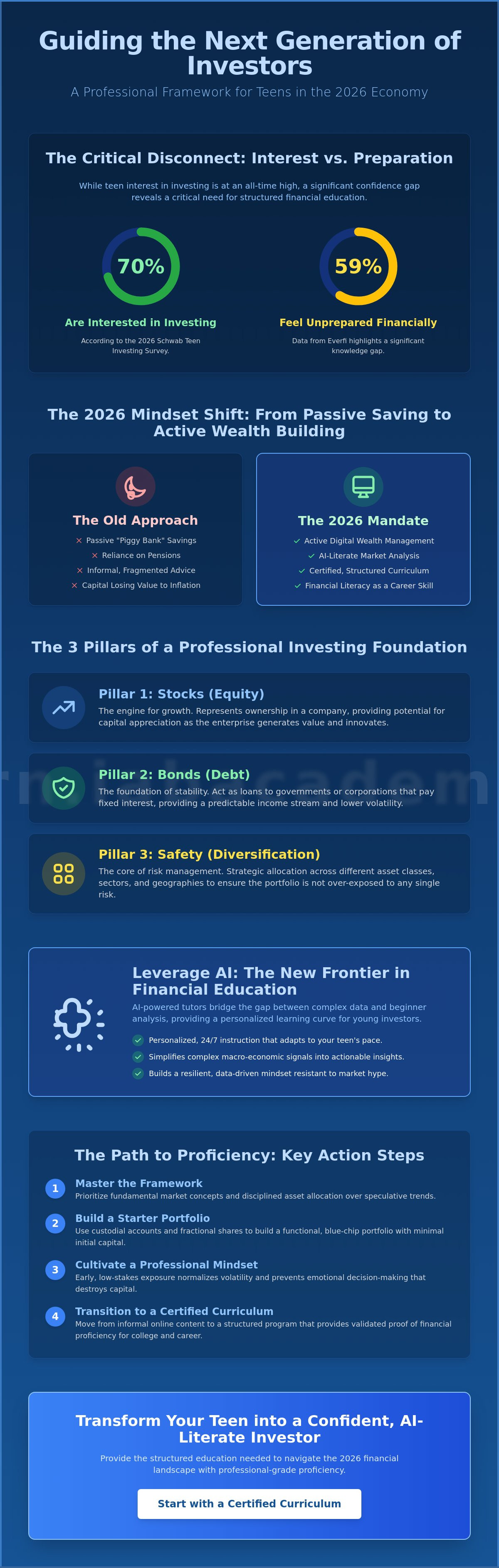
According to the 2026 Schwab Teen Investing Survey, 70% of teenagers are extremely interested in market participation, yet data from Everfi indicates that 59% feel fundamentally unprepared to manage their own finances. This disconnect suggests that curiosity alone is insufficient; without professional-grade instruction, young investors often fall prey to speculative volatility rather than adhering to disciplined asset allocation. You're likely seeking a structured method for how to teach my teenager about investing that avoids the pitfalls of social media hype and ensures long-term security.
We agree that the current financial landscape requires more than just a passing knowledge of equities. This comprehensive guide establishes a professional framework to transform your teenager from a passive consumer into an AI-literate investor capable of sophisticated market analysis. We will examine the 2026 contribution limits for Roth IRAs, the strategic utility of 529 plan rollovers, and the technical application of AI-powered trading tools to ensure capital preservation and professional-level proficiency.
Key Takeaways
- Define financial literacy as a mandatory professional skill for 2026, essential for navigating the shift from traditional savings to active digital wealth management.
- Master a structured framework on how to teach my teenager about investing by prioritizing fundamental market concepts and disciplined asset allocation.
- Leverage AI-powered tutors to provide personalized, 24/7 instruction that simplifies complex macro-economic data for beginner analysis.
- Compare custodial account structures and fractional share strategies to build a functional, blue-chip portfolio with minimal initial capital.
- Transition from informal content consumption to a certified curriculum that provides validated proof of financial proficiency for college applications and career growth.
Why Financial Literacy is the Essential 2026 Career Skill
By 2026, the traditional division between professional labor and capital management has dissolved. Financial literacy is no longer a peripheral life skill; it's a technical requirement for survival in a globalized, algorithmic economy. When parents evaluate how to teach my teenager about investing, the focus must shift from simple stock picking to the mastery of comprehensive market systems. The days of the passive "piggy bank" are over. Today, capital that isn't deployed according to a strategic framework is capital that is losing value. Data from the 2026 Schwab Teen Investing Survey indicates that 70% of teenagers are already interested in the markets, yet many lack the formal training required to manage risk effectively.
Mastering fundamental concepts of investing is now as critical as proficiency in coding or digital communication. While previous generations could rely on institutional pensions or high-interest savings accounts, the 2026 professional ecosystem demands a proactive approach. Understanding the Time Value of Money is particularly vital. In a high-inflation, high-tech era, the cost of waiting to invest is exponentially higher than it was a decade ago. Early exposure ensures that your teenager develops a professional-grade understanding of risk before the financial stakes become life-altering. This proactive education transforms them from a consumer of technology into an architect of their own wealth.
The 2026 Economic Landscape for Young Adults
The global professional ecosystem your teenager is entering is defined by rapid data cycles and algorithmic market shifts. Digital assets and decentralized finance have moved from the fringe to the core of institutional portfolios. Traditional financial models fail to engage modern teenagers because those models don't reflect the speed or the transparency of the digital tools they use daily. To remain competitive, young adults must be able to interpret macro-economic signals and adjust their strategies in real time. This technical immersion is the foundation of modern career security.
The Psychological Advantage of Early Exposure
One of the greatest barriers to wealth is emotional decision-making driven by fear. By providing early, low-stakes exposure to market fluctuations, you help your teen normalize volatility. This builds a "wealth mindset" where a market dip is viewed as a data point rather than a catastrophe. Linking financial literacy for teens directly to long-term career security empowers them to act with the cold, calculated logic of a professional trader. This psychological resilience prevents the panic-selling and speculative chasing that often derail adult investors who lack a structured educational foundation. When you consider how to teach my teenager about investing, remember that you're building a defense against the emotional impulses that destroy capital.
Establishing the Foundation: Fundamental Concepts for Young Investors
Establishing a professional foundation requires moving beyond simplified analogies. When you analyze how to teach my teenager about investing, the initial objective is to demystify the stock market by framing it as a dynamic ledger of global innovation. Rather than viewing "the market" as an abstract entity, teenagers should recognize it as a collection of enterprises competing to solve problems and generate value. For parents seeking official regulatory context to support these lessons, the SEC provides comprehensive resources for getting started with investing safely.
Effective capital deployment rests on a three-pillar model. Stocks represent growth through equity in enterprise. Bonds provide stability by acting as debt instruments that pay fixed interest. Safety is achieved through strategic positioning across various sectors. This structured approach ensures that the learner understands the relationship between risk and potential return from the outset. To accelerate this process, parents can utilize Stock Market Fundamentals Training to provide a curriculum-based alternative to fragmented online advice.
Practical application begins with identifying "investable brands" within a teen's daily digital life. Every application they use, from social media platforms to gaming hardware, represents a corporate entity with a measurable valuation. Analyzing these companies helps teenagers transition from passive users to critical evaluators of corporate performance. This shift in perspective is the first step toward professional-level market analysis.
Breaking Down Core Terminology
Money grows through two primary mechanisms: dividends and capital gains. Dividends are a distribution of a company's earnings to its shareholders, providing a steady stream of passive income. Capital gains occur when the market price of an asset exceeds its purchase price. Understanding market capitalization is equally vital, as it represents the aggregate valuation of a company and dictates its volatility profile. Diversification serves as the primary risk-mitigation framework by distributing exposure across uncorrelated asset classes.
The Concept of Ownership
The transition from a passive consumer to an active equity holder is a critical developmental milestone. This sense of ownership naturally leads to discussions regarding the ethics of investing, specifically Environmental, Social, and Governance (ESG) criteria. Modern teenagers are often highly attuned to corporate responsibility, and linking their values to their portfolio strategy increases engagement. Emphasizing a "Buy and Hold" strategy over a 10-year horizon reinforces the discipline required for wealth accumulation. By visualizing the long-term trajectory of established blue-chip companies, teens learn to ignore short-term market noise in favor of fundamental growth.
Leveraging AI: The New Frontier of Teen Financial Education
In 2026, educational methodologies have evolved beyond static textbooks. When considering how to teach my teenager about investing, parents must integrate artificial intelligence into the educational framework. Financial literacy is no longer a standalone discipline; it's inextricably linked to AI literacy. A teenager who cannot leverage large language models for data synthesis is effectively disadvantaged in the modern market. This integration ensures that the learner develops a sense of mastery over a rapidly evolving technological environment, moving from a passive observer to an active, informed participant.
AI-powered tutors, such as the Smart Instructor™, provide the 24/7 personalized learning that traditional environments cannot match. These systems adapt to a teen's specific learning pace, ensuring that complex financial concepts are fully absorbed before moving to strategic technicalities. This modular approach mimics a professional development path, providing a steady, disciplined rhythm that avoids overwhelming the student. By utilizing AI Stock Analysis Tools Training, your teenager can learn to process vast amounts of macro-economic data, identifying patterns that would be invisible to the unassisted human eye.
AI as a Research Assistant
Professionals use technology to filter noise and prioritize high-density information. You can teach your teen to use AI tools to summarize lengthy annual reports or analyze earnings call transcripts in seconds. This allows them to focus on high-level strategy rather than getting bogged down in manual data entry. It's vital to distinguish between legitimate AI-generated insights and "get-rich-quick" algorithmic scams. True AI literacy involves verifying data sources and understanding the logic behind an AI's output. These tools also help identify emerging trends by scanning global sentiment before those trends reach mainstream retail platforms.
Real-Time Support with Smart Learning
The intimidation barrier often prevents young investors from taking their first steps. Conversational AI tutors reduce this friction by providing instant, objective answers to technical questions. If a teen encounters a term like "P/E ratio" or "alpha" during active research, they can receive an immediate explanation without losing momentum. Integrating these AI feedback loops into a weekly portfolio review ensures that learning is continuous and data-driven. This structured approach to how to teach my teenager about investing establishes a sense of stability and reliability. It transforms the intimidating world of finance into a series of logical, manageable processes that build long-term career security.
From Theory to Practice: Setting Up Your Teen's First Portfolio
Transitioning from conceptual knowledge to active market participation is the most critical phase of financial development. Determining how to teach my teenager about investing requires moving beyond abstract research into the selection of a formal legal structure. Execution must be disciplined and data-driven to ensure that early experiences build professional confidence rather than reckless habits. By establishing a functional custodial account, you provide the infrastructure necessary for your teenager to apply the AI-driven analysis techniques discussed in previous sections.
The selection of an account type dictates the tax implications and long-term flexibility of the capital. In 2026, parents typically choose between three primary structures. Uniform Gift to Minors Act (UGMA) and Uniform Transfer to Minors Act (UTMA) accounts allow for the transfer of assets with a 2026 gift tax exclusion limit of $19,000 per individual. However, these assets are considered the child's property, which may impact future financial aid eligibility. Conversely, a Custodial Roth IRA is an elite tool for teens with earned income, allowing for a maximum 2026 contribution of $7,500 or the total of their earned income, whichever is less. This structure benefits from tax-free growth and the 2026 provision allowing for a lifetime limit of $35,000 in 529 plan rollovers into the account.
Before deploying actual capital, initiate a "Paper Trading" phase. This allows the student to simulate market orders and observe price action without financial risk. Once proficiency is demonstrated, the fractional share revolution permits entry into high-value, blue-chip stocks with as little as five dollars. This lowers the barrier to entry while maintaining a focus on high-quality enterprise ownership. To ensure the transition is successful, parents should consult our Beginner Investing Guides for a detailed breakdown of platform selection and fee structures.
Step-by-Step Account Setup
Identify the legal structure that aligns with your family's 2026 tax strategy, paying close attention to the "Kiddie Tax" thresholds, where unearned income over $2,700 is taxed at the parent's rate. Select a platform that prioritizes institutional-grade educational tools over "gamified" interfaces that encourage over-trading. Establish an automated monthly contribution from the teen's earnings or allowance to instill the "Pay Yourself First" rule. This creates a steady, disciplined rhythm of capital accumulation that mirrors professional wealth management.
Building the First Watchlist
Direct your teenager to select five companies they interact with daily, such as gaming infrastructure providers or apparel conglomerates. This keeps them engaged while teaching them to view these entities through the lens of a shareholder. Enforce a "Research First" rule: no asset is added to the portfolio without a three-sentence justification covering the company's value proposition and recent performance data. Integrating a structured financial literacy curriculum at this stage ensures that their choices are validated by established industry frameworks rather than social media trends.
Cultivating a Professional Mindset Through Structured Learning
The transition from a casual observer to a professional-grade investor requires a fundamental shift in educational methodology. While social media platforms offer fragmented insights, they lack the rigorous validation required for true financial mastery. When parents evaluate how to teach my teenager about investing, they must recognize the distinction between passive entertainment and a certified curriculum. A structured approach ensures that every concept is layered logically, moving from basic equity valuation to complex risk management frameworks. This disciplined progression is what separates speculative participants from sophisticated market actors.
Positioning financial education as a core component of professional development transforms it into a lifelong asset. By 2026, several states, including California, have implemented mandates for high school financial literacy, signaling the industry's shift toward formalizing these skills. A teenager who approaches the market through a professional lens develops a portfolio of knowledge that serves them well beyond their custodial account. This mindset fosters a sense of stability and long-term career security in an increasingly volatile global economy.
The Value of Certification
In a competitive academic and professional landscape, verified proof of proficiency is essential. Completing a formal module provides a tangible marker of initiative that can be highlighted on college applications or early career resumes. These certificates demonstrate a student's ability to engage with high-density information and pass rigorous assessments. Beyond the credential, the psychological boost of mastering a complex subject through formal evaluation builds the confidence necessary for higher-stakes decision-making. Linking your teen's education to a recognized standard ensures their learning is both accurate and current.
Next Steps for the Motivated Teen
Once the fundamentals are secured, the motivated learner should progress toward more advanced technicalities. This includes an introduction to technical analysis and the fundamentals of algorithmic strategy education. These topics provide a deeper understanding of market mechanics and data analysis. To solidify this knowledge, encourage your teenager to "teach back" the concepts they've learned to the family. This practice forces them to synthesize information and identify any gaps in their own understanding. To begin this professional journey today, you can Enroll in IAB's Teen Academy and access our comprehensive suite of AI-powered investing tools.
Ultimately, the goal of how to teach my teenager about investing is to create a self-sufficient adult who views capital as a tool for enterprise and growth. This journey is modular and steady. It starts with a single share and evolves into a sophisticated understanding of the global professional ecosystem. By prioritizing structured learning over casual consumption, you ensure your teenager is prepared for the high stakes of the 2026 financial landscape.
Securing the Next Generation's Financial Leadership
Transitioning from theory to market participation requires a structured path that casual content cannot provide. By establishing a professional foundation through custodial structures and AI-integrated research, you provide your teenager with a competitive advantage in a globalized economy. Mastering how to teach my teenager about investing is ultimately about instilling a mindset of enterprise and risk management that persists throughout their professional life.
As a Houston-based global leader in AI-powered investing education, IAB Academy offers the definitive platform for this development. Our Smart Instructor™ AI provides real-time support in over 130 languages, ensuring that every technicality is understood with absolute precision. With lifetime access to 2026's most advanced financial literacy curriculum, your student can move confidently from basic equities to more sophisticated market strategies. Empower your teen with IAB Academy's AI-Powered Teen Academy and begin their journey toward financial mastery today. You have the tools to turn their curiosity into a formidable professional asset.
Frequently Asked Questions
At what age should I start teaching my teenager about investing?
You should begin the educational process as soon as your child demonstrates interest in market participation, typically between ages 13 and 17. Data from the 2026 Schwab Teen Investing Survey indicates that 70% of teenagers are already interested in the markets. Starting early allows for the normalization of market volatility and the establishment of a long-term growth trajectory before they enter the professional workforce.
What is the best type of investment account for a minor?
The Custodial Roth IRA is often the superior choice for teenagers with earned income. In 2026, the contribution limit is the lesser of $7,500 or the teen's total earned income. This structure offers tax-free growth and significant flexibility. For those without earned income, UTMA or UGMA accounts are standard alternatives, though parents must consider the 2026 gift tax exclusion limit of $19,000 per individual.
How much money does a teenager need to start investing in 2026?
In 2026, a teenager can begin a portfolio with as little as five dollars thanks to the widespread availability of fractional shares. This technological shift allows for diversification into high-value blue-chip stocks without the need for significant initial capital. The focus should remain on the discipline of consistent, automated contributions rather than the total dollar amount, establishing a habit of capital accumulation early in their development.
Is it safe for a teenager to use AI tools for stock market research?
Using AI tools for market analysis is safe and essential for maintaining a competitive edge in the 2026 economy. These tools function as sophisticated research assistants that synthesize annual reports and detect macro-economic trends. However, you must ensure teens distinguish between objective AI-driven insights and speculative bot scams. Integrating AI literacy ensures they use these assistants for data analysis rather than following unverified signals.
How do I explain the difference between investing and gambling to a teen?
Investing is the strategic deployment of capital into productive enterprises based on fundamental data and long-term growth. Gambling relies on chance and short-term speculation with a negative expected return. You can use this comparison to teach my teenager about investing by highlighting the difference between a "meme trend" and a company with a robust market capitalization and consistent earnings. Disciplined risk management is the hallmark of the professional investor.
What are the tax implications of a teen's investment gains?
Investment gains are subject to the "Kiddie Tax" regulations. In 2026, the first $1,350 of unearned income is tax-free, while the next $1,350 is taxed at the child's individual rate. Any unearned income exceeding $2,700 is taxed at the parent's marginal rate. It's vital to monitor these thresholds annually to optimize the portfolio's tax efficiency and ensure compliance with current IRS standards.
Can my teenager invest in options or crypto safely?
High-volatility assets like options or cryptocurrency should only be introduced after a teen has mastered stock market fundamentals. While these tools offer strategic utility, they require advanced training in risk management and technical analysis. In 2026, it's safer to utilize structured courses such as Options Trading for Beginners to ensure the teen understands the mechanics of leverage and capital preservation before deploying real funds.
How can I make financial literacy interesting for a teen who hates math?
You can engage a teen who dislikes mathematics by focusing on the narrative of innovation and brand ownership. Most modern investing platforms and AI assistants handle the complex calculations, allowing the student to focus on high-level strategy and corporate ethics. Linking investment choices to the technology and apparel brands they use daily makes the process relatable. This approach shifts the focus from rote arithmetic to strategic decision-making.
