
How to Overcome Fear of Investing in Stocks: A Professional Framework for 2026
Fear isn't a permanent personality trait; it's a data deficiency that currently costs the average non-investor 3.8% of their purchasing power annually as inflation accelerates. Understanding how to overcome fear of investing in stocks is no longer just a psychological hurdle, it's a necessary step for professional financial survival in 2026. You've likely felt the paralysis that comes from market volatility or found yourself overwhelmed by dense financial jargon. It's frustrating to watch 401(k) contribution limits rise to $24,500 while you remain on the sidelines due to technical uncertainty.
We'll provide you with a professional framework designed to replace emotional anxiety with algorithmic confidence. This article outlines a logical system to manage risk and demonstrates how to utilize AI-powered tools to mitigate human error. You'll gain the technical proficiency needed to move from analysis paralysis to executing your first trade with precision. We'll transition from broad market contexts into the specific, actionable strategies required to master the modern investment landscape and secure your professional future.
Key Takeaways
- Identify the biological basis of loss aversion to understand why investment phobia is often a rational response to information asymmetry.
- Quantify the true cost of inaction by comparing the perceived safety of cash with the 3.8% annual erosion caused by current inflation rates.
- Learn how to overcome fear of investing in stocks by implementing professional-grade risk management protocols like position sizing and automated stop-loss orders.
- Leverage AI-powered stock analysis tools to debunk the "complexity myth" and replace emotional speculation with evidence-based data.
- Establish a structured path toward financial literacy through a curriculum designed to transition learners from technical uncertainty to market mastery.
Understanding the Psychological Barriers to Stock Market Entry
Investment Phobia is frequently mischaracterized as an irrational emotional state. Within a professional framework, we define it as a rational response to information asymmetry. When an individual lacks the technical data required to assess risk accurately, the brain defaults to a defensive posture. This is the primary hurdle for those studying psychological barriers to investing and seeking how to overcome fear of investing in stocks. It's not a lack of courage; it's a lack of verified infrastructure.
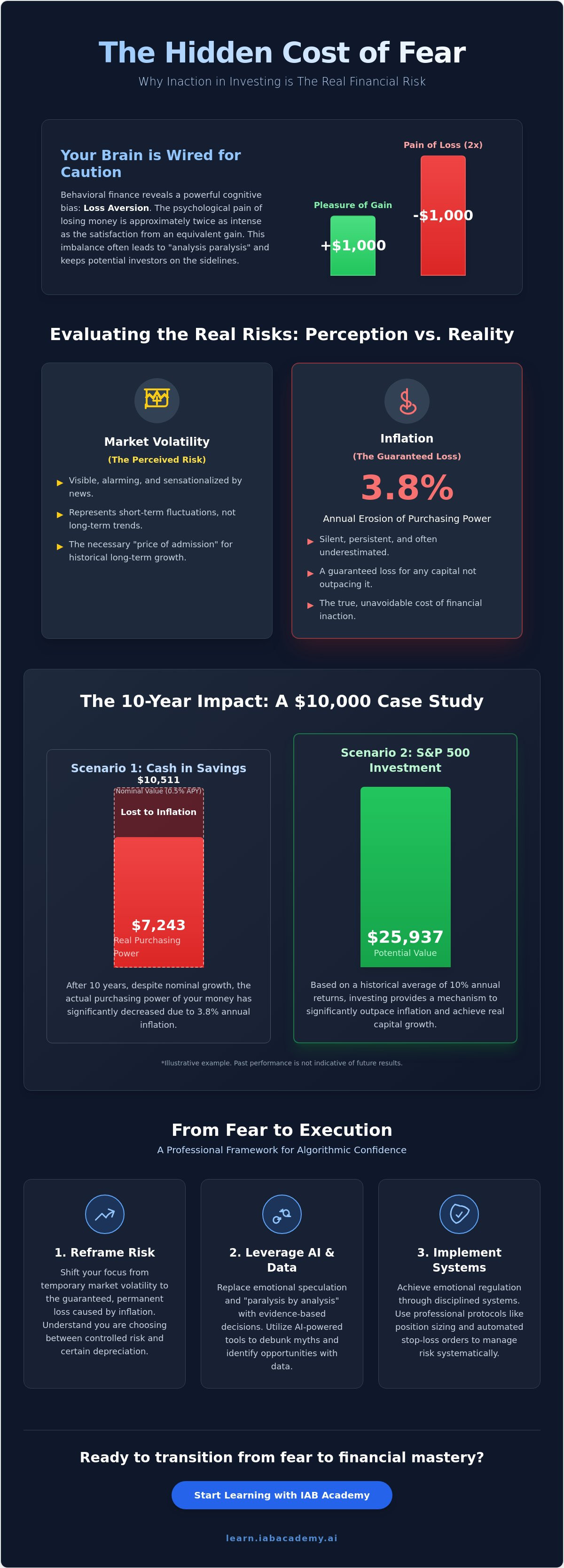
Loss aversion, a cornerstone of behavioral finance, dictates that the psychological pain of losing $1,000 is approximately twice as intense as the satisfaction derived from a $1,000 gain. This biological asymmetry creates a "paralysis by analysis" scenario. The potential for a drawdown outweighs the logical pursuit of capital appreciation in the novice mind. Recency bias further complicates this by forcing investors to project the catastrophic events of the 2008 financial crisis or the 2020 pandemic volatility onto current market conditions. These past traumas distort objective decision-making, making the present feel more dangerous than the data suggests.
Professional financial literacy serves as the primary antidote to this psychological paralysis. By establishing a framework of data-driven confidence, you can transition from reactive fear to proactive strategy. It's about replacing vague anxiety with specific technical protocols that govern every entry and exit. When you understand the mechanics of the market, fear loses its utility and is replaced by calculated execution.
The Biological Basis of Loss Aversion
The human brain isn't naturally wired for equity risk management. Your amygdala, the center for "fight or flight" responses, triggers an immediate fear signal during market downturns. While gains stimulate the dopamine-driven reward system, losses generate a significant cortisol spike. This hormonal fluctuation often leads to impulsive exits at market bottoms. Mastering these biological triggers requires structured investment protocols that prioritize logic over physiological impulse. Emotional regulation is achieved through disciplined systems, not just willpower.
The Impact of Economic Volatility on the Novice Mindset
The modern 24/7 news cycle thrives on sensationalized headlines designed to drive engagement through fear. This constant stream of noise amplifies short-term volatility while obscuring the reality of long-term wealth accumulation. Statistics show that despite periodic corrections, the broader market has historically rewarded those who maintain a disciplined approach. Developing a solid stock market fundamentals foundation is the first step toward filtering this noise. Understanding how to overcome fear of investing in stocks involves recognizing that market noise is a temporary distraction from a long-term professional development path.
Evaluating the Real Risks: Inflation vs. Market Volatility
The primary obstacle to capital growth isn't market fluctuations; it's the invisible erosion of purchasing power. While market volatility is visible and alarming, inflation is silent and persistent. As of May 2026, the 12-month inflation rate stands at 3.8%, an increase from the previous 3.3%. This means any capital sitting in a standard savings account is effectively losing value every day. Understanding this mathematical reality is essential for those learning how to overcome fear of investing in stocks. You aren't choosing between "risk" and "safety." You're choosing between the controlled risk of the market and the guaranteed loss of purchasing power.
Consider a 10-year growth comparison. If you place $10,000 in a savings account at a nominal 0.5% rate, your balance after a decade would be roughly $10,511. However, when adjusted for a 3.8% inflation rate, that money's actual purchasing power drops significantly. In contrast, the S&P 500 has historically delivered average annual returns near 10%. Even with periodic drawdowns, the diversified portfolio provides a mechanism to outpace inflation. Professionals focus on controlling fear during market turbulence by viewing volatility as the "price of admission" for these superior long-term returns.
The cost of inaction is the most significant financial penalty you'll face. Waiting five to ten years to enter the market creates a wealth gap that is nearly impossible to close later in life. With the effective federal funds rate at 3.63%, the era of "easy money" has transitioned into a period where strategic asset allocation is mandatory for wealth preservation. You can't afford to wait for a "perfect" moment that doesn't exist.
Why Playing it Safe is a Guaranteed Long-Term Loss
In the 2026 economic landscape, "playing it safe" is a misnomer. Holding excessive cash creates a high-risk scenario for long-term retirement security. The opportunity cost—the wealth you forgo by not investing—compounds over time, leaving you with fewer resources for the future. Utilizing AI-powered investing education can help you quantify these risks and build a strategy that prioritizes long-term solvency over short-term comfort. Real safety comes from ownership of productive assets, not the accumulation of depreciating currency.
Historical Recovery Cycles: Data that Silences Fear
History provides the most reliable framework for how to overcome fear of investing in stocks. Bear markets are typically much shorter in duration than bull markets. While a bear market might last 14 to 18 months, bull markets often extend for several years. Modern digital markets have also shown a tendency for "V-shaped" recoveries, where prices rebound rapidly as algorithmic trading identifies undervalued assets. "The stock market has a 100% historical success rate of recovering from its all-time lows." These cycles aren't failures of the system; they're the system functioning exactly as designed to reprice assets and create entry points for disciplined investors.
Deconstructing Investment Myths Through Data and AI
The perception that equity markets are reserved for those with advanced degrees in quantitative finance is a pervasive barrier. This "Complexity Myth" suggests you need to master multi-variable calculus to execute a trade. It's simply not true. In the 2026 digital ecosystem, professional-grade strategies are accessible through structured frameworks and technological assistance. Learning how to overcome fear of investing in stocks starts with acknowledging that modern tools have automated the most difficult mathematical hurdles. You don't need to be a programmer; you need to be a disciplined operator of the right systems.
Another common deterrent is the "Gambling Myth." Novice investors often conflate the stock market with a casino. This comparison fails under professional scrutiny. Gambling is a game of chance with negative expected value. Evidence-based investing is a game of probability based on corporate earnings, innovation, and global GDP growth. While speculators "bet" on price movements, investors allocate capital into productive assets. Understanding how to invest in ai strategies provides a clear roadmap for distinguishing between these two paths.
Leveraging AI to Remove Emotional Bias
Human error in the market is almost always driven by emotion. AI stock analysis tools provide an objective layer of validation that ignores the noise of the 24/7 news cycle. These tools analyze data points such as Price-to-Earnings (P/E) ratios and Relative Strength Index (RSI) with cold precision. As psychologist Frank Murtha, PhD, explains how to calm stock market fears, the key is to replace subjective anxiety with objective data. AI tutors and assistants facilitate this by providing instant technical clarity. When you have an algorithmic confirmation for your thesis, the "fear of the unknown" evaporates. You're no longer guessing; you're verifying.
The Fractional Revolution: Why Capital is No Longer a Barrier
The myth that you need significant capital to start has been dismantled by the fractional revolution. In 2026, most brokerage environments allow for $1 minimums. This enables you to own a portion of the world's most valuable companies without high entry costs. Starting small isn't just a financial choice; it's a psychological one. It allows your brain to acclimate to market fluctuations without exposing you to significant financial distress. This low-stakes environment is the perfect laboratory for how to overcome fear of investing in stocks. As you build confidence, you can scale your efforts using a comprehensive financial literacy curriculum to ensure long-term proficiency.
A Strategic Framework for Professional Risk Management
Mastering how to overcome fear of investing in stocks requires a transition from abstract anxiety to specific technical constraints. The most effective tool in this transition is Position Sizing. This involves determining the exact percentage of your total capital allocated to any single equity. By limiting a single position to 1% or 2% of your portfolio, you ensure that even a significant drawdown in one asset cannot compromise your overall solvency. This mathematical ceiling on potential loss provides the logical stability needed to maintain long-term market participation without emotional distress.
Automated technical controls further reinforce this stability. A Stop-Loss order acts as a pre-defined "Emergency Exit," instructing the brokerage to sell a position if it drops to a specific price. This caps your downside automatically, removing the need for real-time emotional decision-making during market hours. When combined with the Rule of 72, which provides a simplified calculation for how quickly your capital can double, these technicalities create a compelling case for persistence. With 2026 401(k) employee contribution limits at $24,500, the stakes for implementing professional-grade risk protocols have never been higher. To master these technicalities, consider enrolling in our Risk Management & Portfolio Strategy Training.
The Power of Paper Trading and Market Simulators
Paper trading serves as a flight simulator for the novice investor. It allows you to execute trades in a real-time environment using virtual currency. This zero-risk training ground is essential for building the muscle memory required to manage real capital. We recommend a minimum of 30 days in a professional-grade simulator to refine your strategy. The brain requires this period of exposure to realize that market fluctuations are not personal attacks, but standard operational data. This practice effectively bridges the gap between theoretical knowledge and confident execution.
Diversification and Stop-Loss Mechanics
Diversification is the only "free lunch" in finance because it mathematically reduces portfolio volatility without necessarily sacrificing expected returns. By spreading capital across different sectors, you mitigate the impact of industry-specific downturns. To determine your personal risk threshold, utilize the "Sleep Test." If you find yourself checking stock prices in the middle of the night, your position sizing is likely too aggressive. Adjust your exposure until you can maintain a disciplined, objective perspective on your holdings. How to overcome fear of investing in stocks is ultimately a process of aligning your technical settings with your psychological capacity for variance.
- Position Sizing: Limit individual asset exposure to manage total risk.
- Stop-Loss Orders: Establish automated exit points to preserve capital.
- Diversification: Distribute capital across multiple sectors to lower volatility.
- Paper Trading: Build technical proficiency in a risk-free environment.
Transitioning from Fear to Mastery with IAB Academy
Transitioning from a state of technical uncertainty to market mastery requires more than just high-density information; it requires a structured educational ecosystem that mirrors professional development standards. The IAB Academy Novice Investor Curriculum is engineered to provide this exact framework, offering a disciplined path for those seeking how to overcome fear of investing in stocks. By moving beyond generic digital education and adopting a formal, standards-based curriculum, learners can validate their proficiency through industry-recognized certifications. These credentials serve as a hallmark of technical quality, ensuring that your entry into the global market is backed by professional-grade training and a deep immersion in algorithmic risk management.
The Role of the Smart Instructor™ in Real-Time Learning
Confusion-led fear is the primary catalyst for investment paralysis. When technical concepts like RSI divergence or macro-economic indicators remain unresolved, the novice brain defaults to a defensive, inactive posture. The Smart Instructor™ AI video tutor eliminates this barrier by providing real-time, expert-level guidance across 130 languages. This technology offers instant feedback to ensure your technical execution is flawless, whether you're configuring a complex stop-loss or analyzing a sector-specific data set. This 24/7 availability transforms the learning process from a solitary struggle into a mentored seminar experience. It allows you to master how to overcome fear of investing in stocks through constant, data-driven validation that removes the "unknown" from the equation.
The Novice to Professional Roadmap
Success in the 2026 digital economy is predicated on a commitment to continuous professional growth and regulatory alignment. Our roadmap begins with the essential building blocks of finance literacy and scales systematically into technical analysis and AI-powered trading tools. This modular progression ensures that each learner absorbs the strategic implications of their trades before transitioning to advanced algorithmic strategies. The IAB Academy lifetime access model provides a sense of stability and reliability, ensuring your skills remain current as market infrastructures evolve. This curriculum is essential for career survival in a competitive market where data proficiency is the baseline for success. Enroll in the IAB Novice Investor Curriculum today and secure your position within a global ecosystem of elite, data-driven investors.
Securing Your Financial Future Through Technical Proficiency
The transition from market anxiety to data-driven confidence is a deliberate professional development path. You've learned that fear is often a rational response to information asymmetry; it's a biological trigger that can be managed through structured risk protocols. By implementing position sizing and automated stop-loss mechanics, you effectively neutralize the physiological impact of loss aversion. Understanding how to overcome fear of investing in stocks is the first step toward reclaiming your purchasing power from the 3.8% annual inflation rate currently eroding uninvested capital.
As a Houston-based global authority in AI investing, IAB Academy provides the infrastructure needed for long-term career security. Our platform offers comprehensive lifetime access to professional frameworks and the Smart Instructor™ AI Tutor, which delivers real-time guidance in over 130 languages. This ensures you're never navigating complex volatility without expert validation. It's time to replace technical uncertainty with algorithmic precision and professional mastery.
Master the Markets with IAB Academy’s AI-Powered Novice Curriculum
Your journey toward financial mastery is a disciplined process. With the right tools and a high-minded approach to risk, you'll find that the market isn't a source of fear, but a powerful engine for long-term wealth accumulation and professional validation.
Frequently Asked Questions
Is it normal to be afraid of losing money in the stock market?
Yes, experiencing anxiety regarding capital loss is a standard biological response to risk. This sensation is a byproduct of loss aversion, where the brain prioritizes the avoidance of pain over the pursuit of gain. In a professional context, this fear is treated as a data deficiency rather than a character flaw. By adopting a structured educational framework, you can recalibrate your physiological response and transition into a state of objective market participation.
How much money do I actually need to start investing in 2026?
You can initiate your investment journey with as little as $1 in the 2026 digital ecosystem. The widespread adoption of fractional shares has effectively dismantled the high capital barriers that once excluded retail participants. This allows you to build a diversified portfolio incrementally while your technical proficiency scales. Starting with smaller amounts is a recommended strategy for those learning how to overcome fear of investing in stocks, as it minimizes initial financial exposure.
Can AI really help me make better investment decisions?
AI significantly enhances decision-making by replacing subjective "gut feelings" with cold, algorithmic validation. These tools analyze vast datasets, including technical indicators and macro-economic trends, with a speed and precision that human analysts cannot match. By utilizing AI-powered trading assistants, you remove the emotional volatility that often leads to impulsive exits. This objective layer of analysis ensures that every trade is backed by verified data points rather than fleeting market sentiment.
What is the safest way for a beginner to start investing without fear?
The most secure entry point involves a combination of formal education and risk-free simulation. Utilizing a professional-grade paper trading environment allows you to build muscle memory without risking real capital. This "flight simulator" approach ensures you understand order types and platform mechanics before you commit. Pairing this practice with a structured financial literacy course provides the conceptual foundation necessary to manage market variance with a disciplined, high-minded perspective.
How do I know if I am ready to move from paper trading to real money?
Readiness is defined by your ability to execute a pre-defined strategy with consistent technical accuracy. If you can manage your virtual portfolio through various market conditions without emotional distress, you've likely achieved the necessary proficiency. We recommend starting with small, fractional positions to bridge the gap between simulation and real-world variance. This incremental approach allows you to test your psychological resilience as the stakes transition from virtual to actual capital.
What happens if the stock market crashes right after I invest?
A market correction is a standard operational cycle, not a failure of your strategy, provided you've implemented professional risk management. Using automated stop-loss orders ensures that your downside is capped at a pre-determined level. This technical safeguard prevents a single event from causing catastrophic loss. Professionals view these cycles as opportunities for asset repricing. Maintaining a long-term perspective allows you to wait for the historical recovery patterns that define global equity markets.
How does financial literacy directly reduce investment anxiety?
Financial literacy replaces the "fear of the unknown" with a mastery over market infrastructure. When you understand the mechanics of price discovery and corporate valuation, market movements become predictable data points rather than sources of panic. Mastering how to overcome fear of investing in stocks is essentially a process of closing the information gap. Professional education provides the stability and reliability needed to maintain a disciplined investment posture even during periods of significant economic volatility.
Is options trading too risky for someone who is afraid of stocks?
Options trading is a sophisticated discipline that can actually reduce risk when used for hedging and strategic income. While it's often perceived as high-risk, simplified options strategies allow retail investors to define their maximum loss upfront. This clarity can be less intimidating than the open-ended volatility of individual stocks. However, this transition requires specific training in risk management to ensure that these advanced tools are used within a professional, instructional framework.
