
How to Build an Investment Strategy as a Beginner: A Professional 2026 Framework
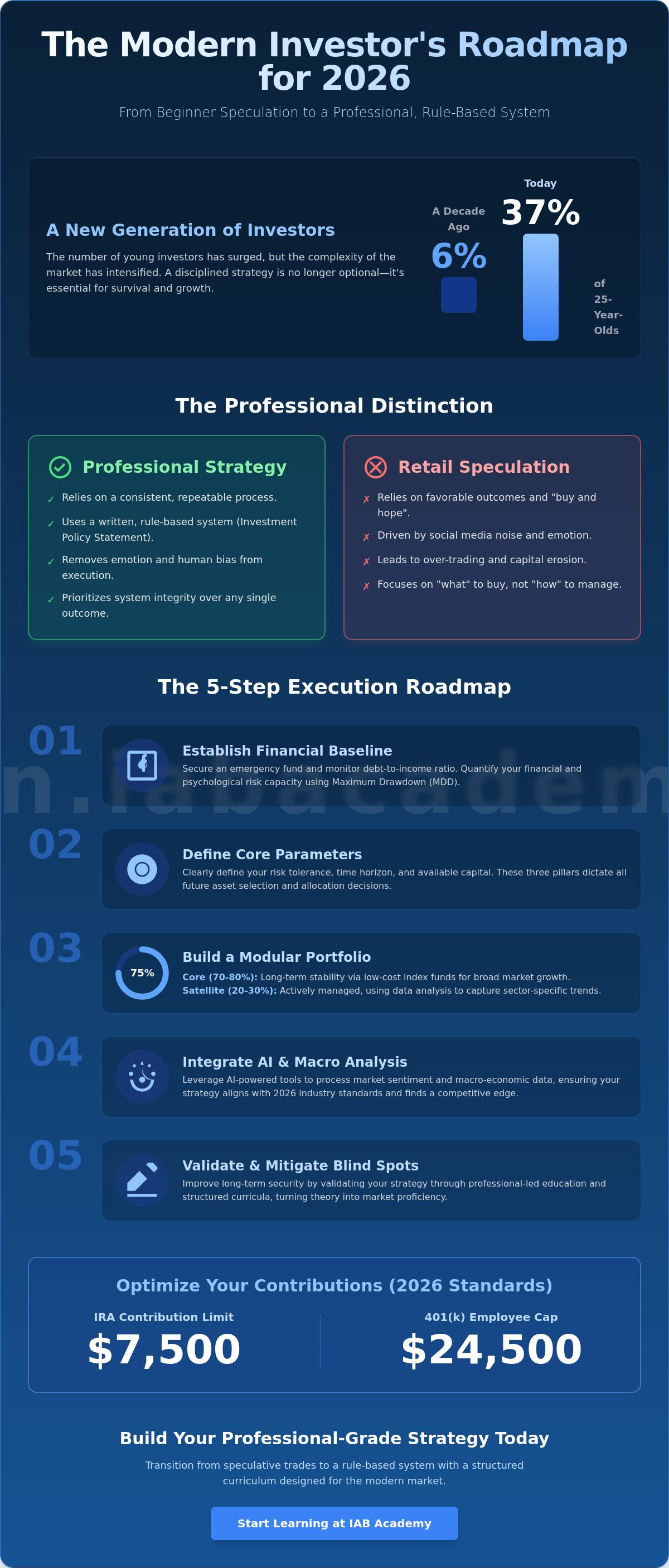
Approximately 37% of 25-year-olds now hold investment accounts, a massive jump from the 6% seen just a decade ago, according to Origin Financial. This surge in participation highlights a critical shift: while entry barriers have vanished, the complexity of managing a portfolio has intensified. Learning how to build an investment strategy as a beginner in 2026 requires more than just picking stocks; it demands a disciplined, modular approach that separates professional execution from retail speculation. You've likely felt the exhaustion of social media noise and the underlying fear that one wrong move could erase your hard-earned capital.
We understand that the lack of a repeatable system is often the only thing standing between you and market proficiency. This article provides the definitive framework for establishing a professional-grade strategy. You'll learn to draft a formal investment policy statement and leverage AI-driven tools for technical analysis. We'll also examine how to optimize your contributions using the latest 2026 standards, such as the $7,500 IRA limit and the $24,500 401(k) employee cap. By the end of this guide, you'll have a clear, data-backed path to professional-level proficiency and long-term security.
Key Takeaways
- Master the fundamental framework of how to build an investment strategy as a beginner by transitioning from speculative trades to a rule-based, modular system.
- Establish a rigorous financial baseline using maximum drawdown expectations and clear debt-to-income ratios before deploying professional capital.
- Integrate AI-powered analysis tools to process sentiment and macro-economic data, ensuring your strategy aligns with 2026 industry standards.
- Follow a disciplined five-step roadmap that begins with a financial literacy audit and defines your specific investment universe.
- Mitigate structural blind spots and improve long-term security by validating your strategy through professional-led education and structured curricula.
The Architecture of a Modern Investment Strategy
An investment strategy is not a collection of assets. It's a repeatable, rule-based system for capital allocation that dictates how you respond to market conditions. Mastering how to build an investment strategy as a beginner requires shifting away from the "buy and hope" mentality toward a structured framework. In 2026, the distinction between active and passive approaches has changed. Active strategies now rely heavily on AI-assisted data processing to find edges, while passive strategies use algorithmic rebalancing to maintain efficiency across global markets. Both require a documented process to succeed.
Without a written investment policy statement, you're vulnerable to the psychological traps of volatility. Professionals use institutional-grade frameworks to remove emotion from the equation. These systems establish clear entry and exit criteria before a single dollar is deployed. Understanding Investment Strategy Fundamentals is the first step in ensuring your capital is managed with the same rigor as a global institution. A written strategy acts as your primary defense against the impulsive decisions that often lead to significant capital loss.
Strategy vs. Speculation: The Professional Distinction
Speculation relies on favorable outcomes; strategy relies on a consistent process. Most beginners fail because they focus on the "what" instead of the "how." This is the Beginner's Paradox. You have access to more tools than any generation in history, yet without a roadmap, these tools often lead to over-trading and capital erosion. Establishing a baseline through stock market fundamentals is essential. It provides the context needed to distinguish between a high-probability setup and a gamble. Professional investors prioritize the integrity of their system over the result of any individual trade.
The Modular Components of a 2026 Strategy
Modern portfolio architecture utilizes a modular approach. This design allows you to maintain a stable foundation while exploring growth opportunities. A professional framework typically includes several key layers:
- The Core: This comprises 70-80% of the portfolio. It's focused on long-term stability and low-cost index alignment to capture broad market growth.
- The Satellite: This comprises 20-30% of the portfolio. Here, you apply AI-driven analysis to capture sector-specific trends or macro shifts.
- Automated Rules: These are the "if-then" statements that trigger actions, effectively removing human bias from the execution phase.
Professionalizing your approach is the only way to achieve long-term career and financial security. Retail traders now account for about a quarter of daily market volume. In this environment, the competition is no longer just other humans; it's high-frequency systems. A modular strategy is your only sustainable defense against an increasingly automated market.
Defining Your Core Parameters: Risk, Time, and Capital
Before deploying capital, you must establish a rigid financial baseline. This begins with securing an emergency fund in a high-yield savings account. As of May 2026, top accounts like Axos Bank offer up to 4.21% APY, providing a stable foundation that national averages of 0.61% cannot match. Professionals also monitor their debt-to-income ratios to ensure they aren't investing capital required for immediate liabilities. Understanding how to build an investment strategy as a beginner involves quantifying risk through Maximum Drawdown (MDD) expectations. This metric defines the largest peak-to-trough decline you can financially and psychologically endure without abandoning your system.
Your time horizon dictates asset selection. Investors with a decade-long window can lean into equities to capture compounding growth, while those with shorter horizons must prioritize fixed income to preserve purchasing power. A fundamental rule of professional capital allocation is to never over-leverage on a single market thesis. Diversification is a mathematical necessity for survival in a landscape where retail traders now drive 25% of daily volume. By spreading capital across uncorrelated assets, you ensure that a single failure does not result in a catastrophic loss of principal.
Calculating Your Personal Risk Capacity
There is a critical distinction between your willingness to take risk and your financial capacity for risk. Willingness is emotional; capacity is mathematical. You might be willing to lose 20% on a trade, but if your housing security depends on that capital, your capacity is effectively zero. Professionals treat a Stop Loss as a strategic imperative, not just a tool. Deep finance literacy allows you to assess these boundaries objectively, removing the cognitive biases that lead to ruinous decision-making during market stress.
Setting Quantifiable Financial Objectives
Vague goals like "getting rich" lead to inconsistent results. You require quantifiable benchmarks, such as a target of 8% annual ROI. In 2026, you must also account for inflation's impact on long-term purchasing power. Align your strategy modules with specific account types to maximize efficiency. For instance, utilize the $7,500 IRA contribution limit or the $24,500 401(k) employee limit for long-term core holdings. Reviewing Fidelity's 6-step investment strategy can help you structure these objectives. For those seeking to master these protocols, our Risk Management & Portfolio Strategy Training provides the technical depth required for institutional-level execution.
Incorporating AI and Macro-Economic Analysis
The transition to AI-assisted investing represents the most significant shift in market mechanics since the advent of electronic trading. In 2026, relying on manual stock screeners is no longer sufficient for maintaining a competitive edge. AI systems now process "Big Data"—including real-time sentiment, global news cycles, and complex earnings reports—at speeds that render traditional research methods obsolete. Learning how to build an investment strategy as a beginner now requires an understanding of how to integrate these high-density data streams into a cohesive decision-making process. This technological integration is a core pillar of how to build an investment strategy as a beginner that can withstand modern market volatility.
It's vital to view AI as a sophisticated co-pilot rather than a "set-and-forget" solution. While algorithms dominate short-term market movements, the human investor's role is to define the strategic parameters and oversee the macro-economic alignment. Professional frameworks use AI to handle the heavy lifting of data synthesis, allowing the investor to focus on high-level capital allocation and risk management. This synergy between human intuition and machine efficiency is the new industry standard for professional-grade retail investing.
Leveraging AI for Stock Analysis and Selection
Modern AI-powered tools provide real-time support and video tutorials that guide you through complex data sets. These systems filter for high-probability setups by comparing current market conditions against decades of historical patterns. Instead of guessing which sectors will outperform, you can use these tools to identify stocks with the strongest technical and fundamental backing. For specific insights into the most promising technological sectors, refer to our how to invest in ai roadmap. Utilizing these specialized AI stock analysis tools ensures your selection process is rooted in data rather than speculation.
Macro-Economic Indicators Every Beginner Should Monitor
Macro-economic analysis serves as the compass for your investment strategy. You must monitor key indicators like Federal Reserve policy and interest rate shifts, as these factors dictate the performance of different asset classes. For instance, as of May 2026, high-yield savings rates sit at 4.21%, a direct result of broader macro trends. Understanding the business cycle allows you to time sector rotations effectively, moving capital into defensive assets during contractions or growth-oriented sectors during expansions. Global professional ecosystems now influence local market trends more than ever; staying informed on these macro shifts is essential for long-term portfolio security.
The 5-Step Execution Roadmap for Beginners
Transitioning from theoretical knowledge to active market participation requires a disciplined execution roadmap. Many novices bypass the preparatory phases and move straight to capital deployment, which often leads to unforced errors. To master how to build an investment strategy as a beginner, you must follow a modular sequence that prioritizes validation before risk. This process ensures that your actions are dictated by a pre-defined system rather than real-time emotional impulses.
- Step 1: Audit Financial Literacy. Assess your understanding of market mechanics and risk protocols. A strategy is only as effective as the operator's ability to execute it.
- Step 2: Define Your Investment Universe. Select the specific sectors or asset classes you'll track. Whether you focus on equities, options, or emerging AI sectors, narrowing your scope allows for deeper data analysis.
- Step 3: Establish Technical Rules. Define the exact conditions required to enter or exit a position.
- Step 4: Backtest and Validate. Use historical data or simulation tools to verify that your rules would have been profitable in past market cycles.
- Step 5: Quarterly Review. Rebalance your holdings based on performance metrics to ensure your portfolio remains aligned with your original risk capacity.
Step 3: Establishing Technical Entry and Exit Rules
Your technical module acts as the filter for your investment universe. Professionals often utilize indicators like Moving Averages to identify trends and the Relative Strength Index (RSI) to spot overextended conditions. We recommend the "Rule of Three." Never execute a trade unless at least three independent signals confirm the setup. While beginners often obsess over finding the perfect entry, exit rules are far more critical for long-term success. A professional strategy dictates exactly when to take profits and, more importantly, exactly where to cut losses to preserve capital. For those looking to refine these skills, our Technical Analysis Training provides the specific frameworks needed for high-probability execution.
Step 4: The Power of Paper Trading
Paper trading is a risk-free simulation that allows you to test your written strategy in live market conditions without committing actual capital. It's an essential validation step that most retail investors ignore. Simulators help you identify structural flaws in your logic and, crucially, help you observe your emotional response to price volatility. You should treat paper trading as a professional "certification" milestone. Don't deploy real capital until you've successfully executed your strategy over a significant sample size of trades. This disciplined approach ensures that when you do enter the market, you're doing so with a proven system and the confidence of a professional.
Validating Your Strategy through Professional Education
Self-taught investment strategies often fail because they lack the rigorous stress-testing required to identify structural blind spots. While the internet provides a wealth of fragmented data, it rarely offers a cohesive system that accounts for cognitive biases or poor risk-to-reward ratios. Learning how to build an investment strategy as a beginner requires a departure from casual exploration and a commitment to a structured financial literacy curriculum. This formal approach ensures that your capital allocation rules are based on established industry frameworks rather than speculative trends found on social media.
IAB Academy utilizes the Smart Instructor™ to provide real-time strategic support, bridging the gap between theory and market execution. This AI-enhanced mentor offers immediate feedback as you develop your technical entry and exit rules, ensuring your strategy remains disciplined. Professional development is a continuous process; therefore, lifetime access is a critical component of our ecosystem. It allows you to adapt your strategy as 2026 technological shifts occur, ensuring your financial security isn't compromised by evolving market mechanics.
The IAB Academy 'Novice Investor' Path
The 'Novice Investor' path is a specialized curriculum designed for beginners and teens entering the global professional ecosystem. It follows a steady, modular rhythm that takes you from basic market mechanics to the successful execution of your first paper trade. Upon completion, you earn certifications that validate your strategic proficiency and signal your readiness for active market participation. To ensure accessibility for all committed learners, we provide support in over 130 languages. This global reach empowers a diverse audience to master how to build an investment strategy as a beginner while adhering to elite standards of financial conduct.
Transitioning to Advanced Strategy Modules
Mastery of the fundamentals is merely the first stage of your professional journey. Once you have validated your core strategy, you can transition into advanced modules like options strategy simplification. These courses are designed to strip away the complexity of derivatives, making them accessible to retail investors who seek to hedge their portfolios or generate income. Preparing for an AI-powered future requires the mental infrastructure to synthesize complex data sets and macro-economic shifts. You must treat your education as a high-stakes investment in your career survival. Enroll in IAB Academy to master your investment strategy today.
Master Your Financial Future in the 2026 Digital Economy
Transitioning from a novice to a proficient investor requires more than just access to market data. It demands a rigorous adherence to a modular framework that prioritizes risk management and technical validation. By mastering how to build an investment strategy as a beginner, you ensure that your capital is managed with the same discipline as institutional portfolios. You now understand that a written policy, combined with AI-enhanced analysis and macro-economic awareness, is your best defense against market volatility.
Securing your financial future in an increasingly automated landscape requires constant adaptation and professional validation. IAB Academy provides the infrastructure you need to succeed. With our AI-Powered Smart Instructor™ support and global certifications in financial literacy, you'll gain the mastery required to navigate complex global markets. We offer lifetime access to our 2026 updated curricula; this ensures your skills remain relevant as technology evolves. Build Your Professional Investment Strategy with IAB Academy and step into the market with professional confidence. You have the roadmap; now it's time to execute.
Frequently Asked Questions
How much money do I need to start building an investment strategy?
You can begin with a minimal amount of capital thanks to fractional shares and low-barrier investment apps. However, the focus of how to build an investment strategy as a beginner is not the dollar amount, but the rule-based system you establish. Prioritize meeting your emergency fund requirements in a high-yield account offering rates like 4.21% APY before scaling your market exposure. Establishing the framework is more critical than the initial deposit.
Is an AI-powered investment strategy safe for a total beginner?
AI-powered strategies are safe when used as an analytical co-pilot rather than an autonomous decision-maker. These tools process sentiment and macro-economic data faster than humanly possible, reducing the risk of missing critical market signals. For a beginner, the safety lies in using AI to validate technical setups and maintain discipline, ensuring that human emotion doesn't override the established risk parameters of the modular framework. This provides a layer of institutional-grade security.
How often should I review or change my investment strategy?
A professional review should occur on a quarterly basis to assess performance against your initial benchmarks. While the core architecture of your strategy should remain stable, you must adjust for macro-economic shifts, such as changes in Federal Reserve policy or new tax regulations. Avoid making frequent changes based on short-term market noise; instead, use these scheduled intervals to rebalance your portfolio and ensure your risk capacity remains aligned with your current financial baseline.
Can I build an investment strategy if I have zero finance background?
You can build a professional-grade strategy without a formal finance background by following a structured education path. Modern platforms provide the technical training and AI-assisted support needed to bridge the knowledge gap. Learning how to build an investment strategy as a beginner involves starting with stock market fundamentals and risk management protocols. This instructional approach allows you to develop the proficiency required to manage capital without relying on external advisory services.
What is the difference between an investment strategy and a trading plan?
An investment strategy is a high-level framework for long-term capital allocation and risk management across various asset classes. In contrast, a trading plan is a specific, technical document that dictates the entry and exit rules for individual positions. While a strategy defines your investment universe and time horizon, a trading plan focuses on the tactical execution of trades within that universe. Both are essential components of a professional and disciplined financial ecosystem.
Should my strategy include options or just stocks as a beginner?
Beginners should focus on mastering stock market fundamentals before incorporating complex derivatives. Once you have established a stable core portfolio, you can introduce options strategy simplification as a modular addition for hedging or income generation. This layered progression ensures that you understand the underlying asset's behavior before adding the technical complexity and leverage associated with options. Professionalization is a step-by-step process that prioritizes structural stability over aggressive growth.
How do I know if my investment strategy is actually working?
Success is measured by your ability to meet specific, quantifiable benchmarks like a target 8% annual ROI while staying within your Maximum Drawdown limits. If your portfolio consistently exceeds your risk tolerance or fails to track its designated index, the strategy requires adjustment. Monitoring these metrics provides an objective view of your system's efficacy, allowing you to separate professional results from temporary market luck or emotional bias. Consistency in execution is the ultimate validator.
What are the most common mistakes beginners make when building a strategy?
The most frequent errors include failing to document the strategy in a written policy statement and making impulsive decisions based on market volatility. Many beginners also fall into the "One Account Trap" by relying solely on a workplace 401(k) without considering IRAs or HSAs. Over-leveraging on a single market thesis without a technical exit rule often leads to significant capital loss, highlighting the necessity of a modular, rule-based approach for long-term security.
