
How to Build a Diversified Investment Portfolio: A Professional Standard for 2026
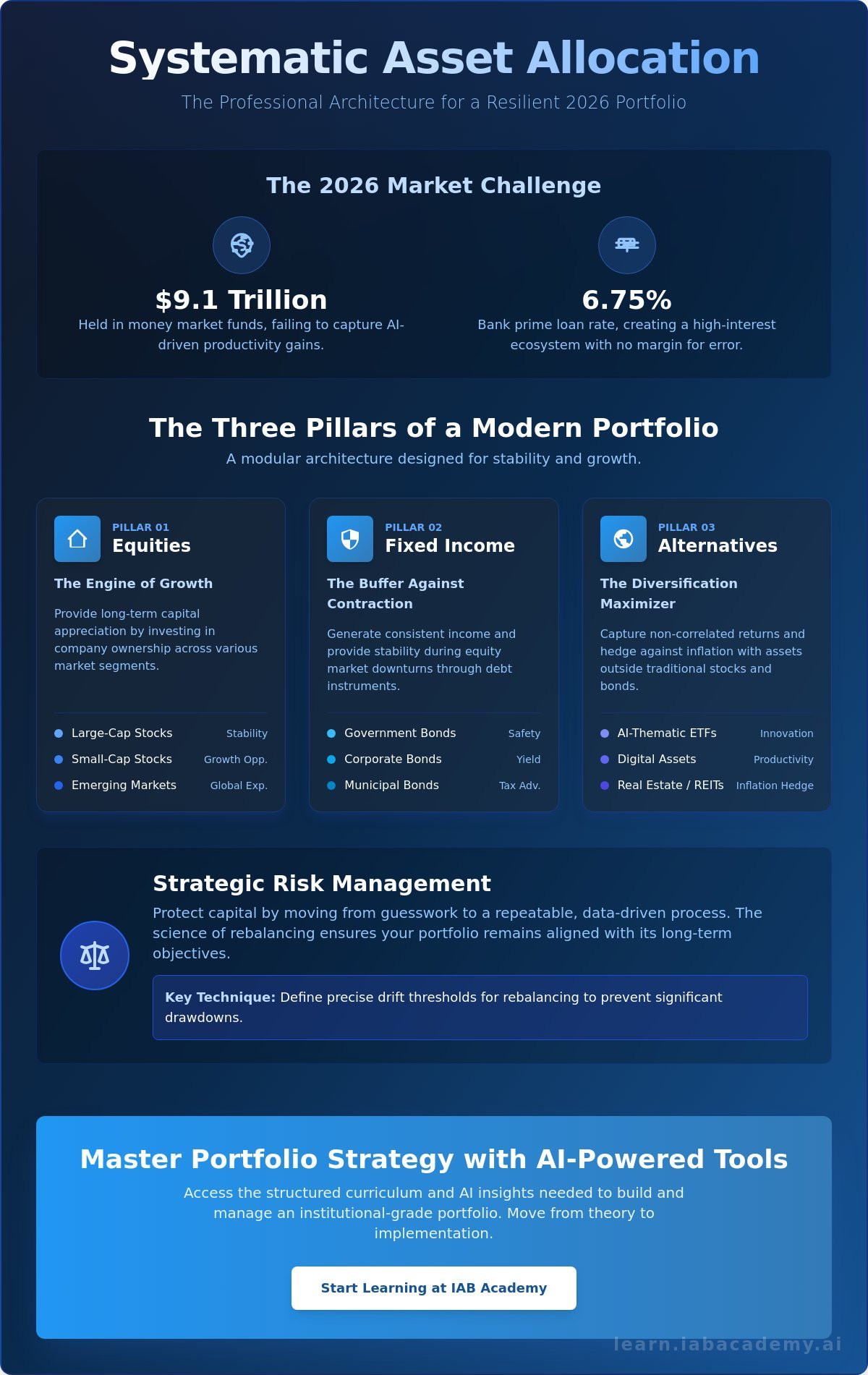
Nearly $9.1 trillion is currently held in money market funds as of early 2026, signaling a global retreat toward liquidity amid unprecedented market noise. You've likely felt the weight of this hesitation, recognizing that while cash offers temporary safety, it fails to capture the productivity gains driven by the current AI implementation cycle. Learning how to build a diversified investment portfolio in this environment requires moving beyond basic asset splits and toward a systematic architecture of risk.
The IAB Academy provides the instructional framework needed to master these technicalities. You will learn to move from experimentation to implementation by using AI-powered insights to manage asset correlations and drawdown risks. This guide establishes the professional standard for 2026, detailing how to integrate core equities with small caps, emerging markets, and alternative assets for superior risk-adjusted returns. We will break down the precise mechanics of modern portfolio construction to ensure your strategy remains resilient in a high-interest rate ecosystem where the bank prime loan rate sits at 6.75%.
Key Takeaways
- Establish a professional architecture by distributing capital across non-correlated assets to maximize stability and long-term growth.
- Discover the definitive framework for how to build a diversified investment portfolio using the three pillars of systematic asset allocation.
- Integrate institutional-grade digital assets and AI-thematic ETFs to capture productivity gains within the 2026 financial ecosystem.
- Apply precise risk management techniques, such as defining drift thresholds for rebalancing, to protect your capital against significant drawdowns.
- Access structured educational resources and AI-powered tools that simplify the complexity of managing multiple asset classes.
The Professional Standard of Portfolio Diversification
The 2026 financial landscape demands a shift from reactive decision-making to a disciplined, institutional-grade architecture. While novice investors often treat diversification as a simple safety net, professionals recognize it as the systematic distribution of capital across non-correlated assets to optimize risk-adjusted returns. This distinction is critical. In an era where the digital ecosystem has compressed correlations across traditional equity markets, relying on a basic 60/40 split is no longer sufficient. You must move beyond "gut feeling" and embrace an evidence-based portfolio structure that accounts for the $9.1 trillion currently sitting idle in money market funds. This massive liquidity pool represents a failure of strategic allocation; it's capital that isn't working because its owners lack a framework for how to build a diversified investment portfolio that survives market noise.
To achieve professional standards in 2026, you must evaluate several technical layers:
- Asset correlations across global and digital sectors.
- Inflation-adjusted yield expectations in a high-rate environment.
- Tax efficiency under the updated 2026 standard deduction of $16,100 for single filers.
The Core Philosophy: Risk vs. Reward Mastery
Professional investors view risk as a quantifiable input, not an emotional hurdle. This perspective is rooted in Modern Portfolio Theory, which establishes the mathematical parameters for balancing expected returns against market variance. By targeting the "Efficient Frontier," you can design a portfolio that maximizes growth for every unit of risk taken. This remains the only "free lunch" in finance. It's the unique ability to lower overall volatility through asset pairing rather than asset avoidance. Transitioning from a novice mindset requires you to stop looking at stocks in isolation. Instead, you must analyze how each component serves the broader technical architecture of your wealth.
Diversification as a Career-Critical Skill
Mastering the science of asset allocation is a prerequisite for professional credibility in today's market. A deep understanding of finance literacy provides the foundation for this mastery, allowing you to navigate a world of rising interest rates and shifting tax brackets. When the bank prime loan rate is 6.75%, the margin for error disappears. Technical mastery of these concepts is essential for long-term wealth preservation. It transforms investing from a series of guesses into a repeatable, instructional process. Mastering how to build a diversified investment portfolio signals a commitment to future-proofing your capital against systemic shocks and signals your readiness for elite financial management.
Systematic Asset Allocation: The Architecture of a Balanced Portfolio
Constructing a resilient portfolio requires a modular architecture. Systematic asset allocation serves as the blueprint for long-term wealth stability. While many retail investors approach the market with a haphazard collection of tickers, professionals adhere to a Strategic Asset Allocation (SAA) framework. This framework categorizes capital into three distinct pillars: Equities, Fixed Income, and Alternative Assets. By layering these components, you create a modular system where each asset class performs a specific function, whether it's driving growth or buffering against market contraction. Consulting Vanguard's guide to portfolio diversification provides a foundational baseline, but for 2026, you must apply these principles within a more volatile, high-yield environment. Mastering how to build a diversified investment portfolio involves moving beyond simple percentages and toward a deep analysis of stock market fundamentals to select high-conviction equity components.
Equities: Categorizing Company Sizes and Sectors
In the current ecosystem, equity allocation must be granular. While large-cap stocks provide institutional stability, the Federal Reserve's 2026 GDP growth forecast of 2.3% suggests a widening opportunity in small-cap and emerging markets. Sector diversification is equally vital. Over-concentration in technology can lead to catastrophic drawdowns if valuation multiples contract. A professional standard requires balancing domestic exposure with international markets to capture global productivity gains. This layering ensures your portfolio isn't overly dependent on a single economy's performance. It's the most effective way to ensure you understand how to build a diversified investment portfolio that survives various market cycles.
Fixed Income and Cash Equivalents
Fixed income is no longer a passive component. With the bank prime loan rate at 6.75% and the federal funds effective rate at 3.63% in May 2026, bonds offer genuine income potential rather than just capital preservation. You should utilize treasury yields to establish a risk-free floor while cautiously evaluating corporate credit risk. Maintaining cash equivalents is also a strategic imperative. It provides the necessary liquidity to execute tactical trades when market dislocations occur. For those seeking to refine these strategies, the IAB Academy curriculum offers advanced training in technical risk management and portfolio strategy.
Beyond Traditional Assets: Navigating the 2026 Digital Ecosystem
Traditional diversification models often fail to account for the rapid convergence of technology and finance. In 2026, the digital ecosystem offers growth verticals that operate outside the constraints of legacy markets. Understanding how to build a diversified investment portfolio now requires you to integrate AI-thematic ETFs and algorithmic trading components. These aren't speculative additions; they're essential for capturing the shift from AI experimentation to full-scale implementation. Learning how to invest in ai provides a professional roadmap to these core growth verticals, ensuring your capital is positioned where productivity gains are most concentrated.
Digital assets have also matured into institutional-grade alternatives. Often referred to as "Digital Gold," crypto-assets now serve as non-correlated hedges in a global market characterized by easing policy and accelerating productivity. Professional standards dictate using AI-powered stock analysis tools to identify non-obvious correlations between these digital assets and traditional sectors. These tools parse high-density data to reveal how a shift in semiconductor supply chains might impact your broader portfolio stability. This level of technical scrutiny is what separates modern portfolio architecture from outdated retail strategies.
AI and Algorithmic Components
Efficiency in 2026 is driven by machine-led execution. AI trading assistants allow you to monitor sector rotation in real-time, identifying when capital flows from infrastructure companies to implementation-phase firms. Automated trading strategies are no longer reserved for hedge funds; they're now accessible components of a sophisticated retail strategy. AI-powered investing is the use of machine learning to parse macro-economic data for alpha. By leveraging these tools, you can maintain a disciplined approach to how to build a diversified investment portfolio without the emotional interference that often plagues human decision-making.
The Role of Options in Diversification
Derivatives offer a technical layer of protection that traditional asset classes cannot provide. Using protective puts acts as a critical hedge against systematic market risk, essentially insuring your equity positions against sudden drawdowns. Conversely, selling covered calls allows you to generate consistent income from your existing holdings, dampening the impact of sideways market movement. The IAB Novice Investor Curriculum simplifies these complex derivative strategies, providing the instructional clarity needed to master risk management. These tools ensure that your portfolio remains resilient even when labor market weakness or high valuations introduce uncertainty into the global ecosystem.
Strategic Risk Management and the Science of Rebalancing
Establishing a professional investment standard requires more than a sophisticated initial allocation; it demands a disciplined rebalancing protocol. Without a systematic approach to risk management, even the most robust portfolios succumb to style drift. Mastering how to build a diversified investment portfolio involves executing a series of technical steps to ensure your risk exposure remains aligned with your long-term objectives. This process transforms portfolio management from a reactive exercise into a proactive, evidence-based strategy.
Professional rebalancing follows a modular five-step framework:
- Step 1: Establishing Drift Thresholds. Set a specific tolerance level, such as +/- 5%, for each asset class. If an equity position grows to represent 65% of a portfolio targeted at 60%, it creates unintended risk that must be corrected.
- Step 2: Quarterly Technical Audits. Conduct a deep-dive analysis of performance every three months. This frequency filters out daily market noise while allowing for adjustments to emerging trends.
- Step 3: Systematic Execution. Sell high-performing assets that have exceeded their thresholds to purchase underperforming ones. This forces a buy-low, sell-high discipline that retail investors often struggle to maintain.
- Step 4: Tax-Loss Harvesting. Optimize net returns by offsetting capital gains with realized losses. In the 2026 tax environment, where the standard deduction for single filers is $16,100, managing your taxable events is critical for wealth preservation.
- Step 5: Macro-Economic Alignment. Adjust your strategy based on shifting interest rate environments. With the federal funds effective rate at 3.63% as of May 2026, your fixed-income laddering must reflect current yield realities.
To refine your ability to execute these steps with precision, you can enroll in the IAB Academy's Risk Management & Portfolio Strategy Training to gain mastery over institutional rebalancing tools.
Managing Volatility Through Technical Analysis
Technical analysis provides the timing mechanism for rebalancing entries and exits. By using key indicators like relative strength or moving average convergence, you can identify when a specific sector is overextended or reaching capitulation. This data-driven approach prevents you from selling too early during a momentum phase or buying too late during a recovery. Implementing strict stop-losses further preserves capital during black swan events, ensuring that a single market dislocation doesn't compromise your entire architecture. Technical mastery allows you to treat volatility as a tactical opportunity rather than a systemic threat.
Macro-Economic Resilience
Future-proofing your wealth requires a globalized perspective that transcends US-centric models. In 2026, diversifying across currencies is essential to mitigate the impact of geopolitical shifts and varying inflation rates. Different asset classes react uniquely to the current bank prime loan rate of 6.75%. While high rates might pressure traditional real estate, they often provide tailwinds for specific fixed-income instruments. A resilient strategy incorporates these macro-economic variables, ensuring that your path to how to build a diversified investment portfolio accounts for the global digital ecosystem's complexity.
Mastering Portfolio Strategy with IAB Academy’s AI-Powered Curriculum
Professional investing in 2026 requires more than a static understanding of market charts; it demands continuous adaptation to a high-velocity digital ecosystem. The IAB Academy provides this through a comprehensive financial literacy curriculum designed to transform how you perceive and manage wealth. Unlike traditional resources or community-led forums, our platform integrates the Smart Instructor™ AI to provide real-time support for complex portfolio queries. This tool ensures you have an elite, global mentor available to clarify the technicalities of how to build a diversified investment portfolio whenever market conditions shift.
Our curriculum establishes the definitive hallmark of excellence through rigorous certification. Learners benefit from lifetime access to evolving market standards, which is essential as interest rates and tax regulations fluctuate. For instance, understanding the technical implications of the 2026 standard deduction of $16,100 for single filers is just the beginning. The academy ensures you possess the technical training to adjust your architecture as the global digital ecosystem evolves, future-proofing your capital against systemic obsolescence. Certification signals to the industry that you've mastered the professional standards of wealth preservation and growth.
The Novice Investor Curriculum
The learning path begins with stock market fundamentals and scales into advanced derivative strategies. This modular approach bridges the gap between theoretical knowledge and practical execution. You won't just study asset classes; you'll participate in real-world simulations. These environments allow you to practice how to build a diversified investment portfolio in a risk-free setting before deploying capital in the live market. This instructional rigour prepares you for the high stakes of 2026, where the bank prime loan rate sits at 6.75% and precision is the only path to success.
Enrolling for Future-Proof Success
Joining the academy grants you entry into an elite professional community and provides access to a global digital ecosystem that defines the rules of modern wealth management. You aren't just enrolling in a course; you're committing to a systematic path of financial mastery. With nearly $9.1 trillion currently held in money market funds, the opportunity cost of remaining on the sidelines is immense. Now is the time to move from passive observation to active mastery. Empower your financial future today by securing your seat in our next certification cycle and taking control of your investment architecture.
Securing Your Financial Architecture for 2026
Mastering the technicalities of systematic asset allocation is the only definitive way to survive market noise. You've explored the modular pillars of equities, fixed income, and alternative assets. You've also seen how AI-powered insights identify non-obvious correlations in a volatile digital ecosystem. Learning how to build a diversified investment portfolio isn't a one-time event. It's a commitment to professional-grade standards and evidence-based architecture.
The IAB Academy, a Houston-based global leader in financial education standards, offers the technical training necessary for this mastery. Our curriculum features the AI-Powered Smart Instructor™, available in over 130 languages to provide real-time support for your complex queries. With lifetime access to institutional-grade investing modules, you can ensure your strategy remains resilient as global market standards evolve.
Master the Art of Diversification with IAB Academy’s Professional Curriculum
Your path to financial mastery starts with a disciplined approach to learning. Take the next step toward future-proofing your wealth today.
Frequently Asked Questions
What is a good diversification ratio for a beginner in 2026?
A standard 60/40 equity to fixed income ratio remains a foundational baseline, though many 2026 professionals suggest a 60/30/10 split to include alternative assets. This 10% allocation into alternatives, such as AI-thematic ETFs or digital assets, provides a growth vertical that traditional bonds currently lack. Beginners should focus on broad-market index funds to ensure immediate exposure to multiple sectors without the risk of individual stock picking.
Can you over-diversify an investment portfolio?
You can absolutely over-diversify, a phenomenon often called "diworsification," where adding too many assets dilutes potential returns without further reducing risk. When a portfolio contains over 30 to 40 individual stocks with high correlation, the marginal benefit of each new addition vanishes. It's more effective to own a few non-correlated asset classes than hundreds of similar equities that all move in tandem during market stress.
How often should I rebalance my diversified portfolio?
Rebalancing should occur quarterly or whenever an asset class drifts more than 5% from its target allocation. This disciplined schedule prevents high-performing assets from over-concentrating your risk profile. While some investors prefer an annual audit, the volatility of the 2026 digital ecosystem often requires more frequent technical reviews to maintain the integrity of your original investment architecture and tax efficiency.
Is it possible to diversify with a small amount of money?
It's entirely possible to diversify with a small initial capital outlay by utilizing fractional shares and exchange-traded funds (ETFs). These instruments allow you to own a piece of hundreds of companies for the price of a single share. Understanding how to build a diversified investment portfolio with limited funds relies on selecting low-cost, broad-market ETFs that provide instant exposure across various global sectors and company sizes.
What is the difference between asset allocation and diversification?
Asset allocation is the strategic decision of what percentage of your capital goes into broad categories like stocks or bonds, while diversification is the practice of spreading those investments within those categories. Think of allocation as the blueprint for your house and diversification as the individual materials used to build it. Both are necessary components of a professional standard, ensuring that no single asset or sector dictates your total performance.
How does AI-powered investing help with portfolio diversification?
AI-powered investing enhances diversification by using machine learning algorithms to identify non-obvious correlations between global asset classes. These tools can parse millions of data points to reveal how a geopolitical shift might impact seemingly unrelated sectors like technology and agriculture. By leveraging AI trading assistants, you can maintain a more precise risk profile that adapts to real-time market shifts more effectively than traditional manual analysis.
What are the risks of a non-diversified portfolio?
The primary risk of a non-diversified portfolio is idiosyncratic risk, where the failure of a single company or sector causes a catastrophic drawdown of your entire capital. Without a spread across non-correlated assets, you're vulnerable to specific market shocks that a balanced architecture would otherwise mitigate. In 2026, where labor market weakness or valuation contractions can occur rapidly, a lack of diversification represents a significant threat to long-term wealth preservation.
Do I need a financial advisor to build a diversified portfolio?
You don't need a financial advisor if you commit to mastering the technical standards through structured education. While advisors provide a service, the IAB Academy empowers you to understand how to build a diversified investment portfolio through our AI-powered curriculum and institutional-grade modules. Developing these skills yourself ensures you maintain full control over your financial destiny while avoiding the high management fees often associated with external advisory services.
