
AI Index Fund: The 2026 Guide to Investing in Artificial Intelligence
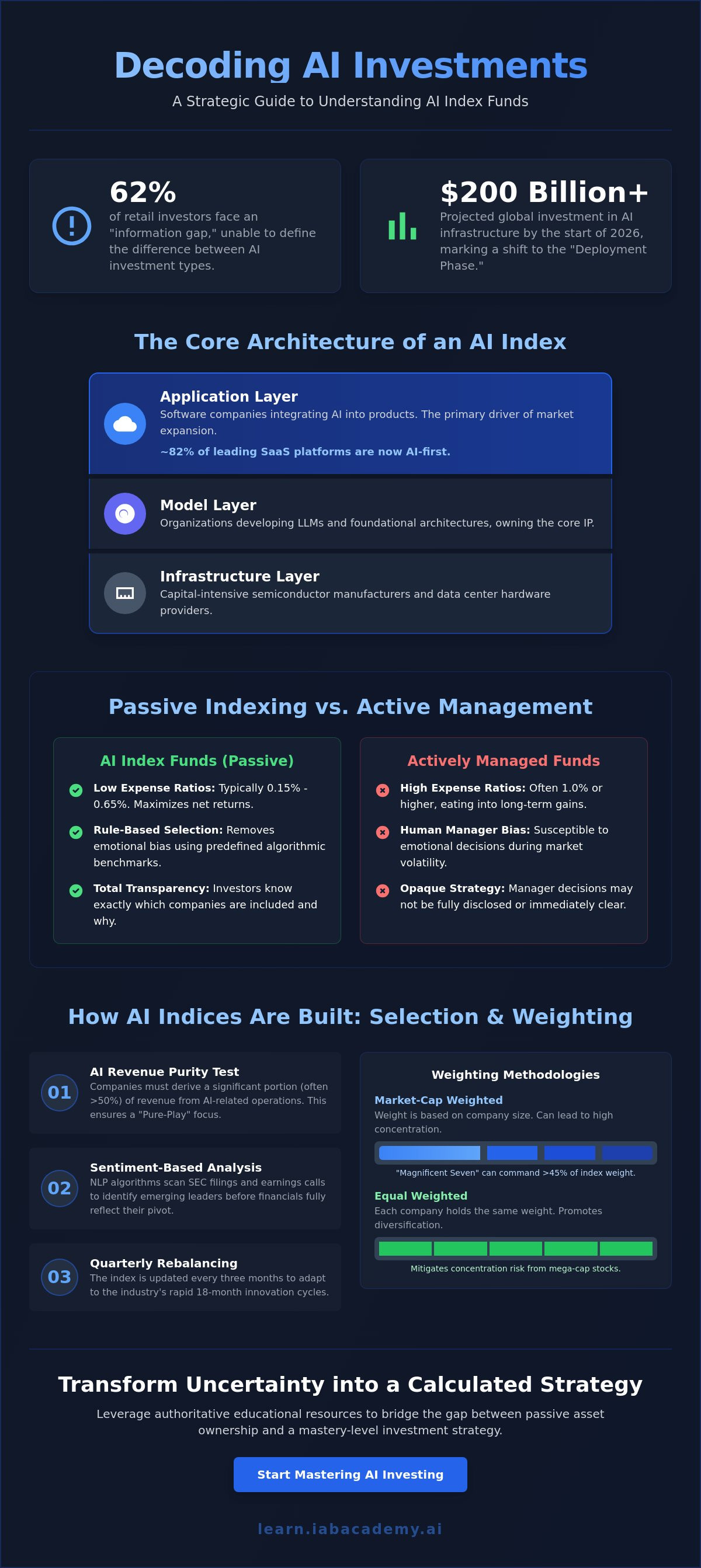
By the start of 2026, global investment in artificial intelligence infrastructure is projected to surpass $200 billion, yet a 2024 industry survey found that 62% of retail investors cannot define the technical difference between an AI-managed portfolio and an ai index fund. You've likely felt the weight of this information gap while trying to capture gains in a market that moves faster than traditional analysis can track. The fear of missing out is real, especially when complex jargon obscures the actual mechanics of your potential returns.
This guide eliminates that confusion by providing a rigorous, instructional roadmap to the AI investment ecosystem. You'll gain the mastery required to distinguish between pure-play innovators and diversified tech giants, allowing you to move from passive observation to strategic execution. We'll break down the essential benchmarks and compliance standards that define top-tier funds, ensuring your portfolio remains resilient as the technological landscape matures. By mastering these fundamentals, you'll transform uncertainty into a calculated long-term strategy that prioritizes both stability and future-proofed growth.
Key Takeaways
- Define the structural parameters of an ai index fund to secure diversified, passive exposure across the global artificial intelligence ecosystem.
- Analyze the selection logic employed by major index providers to differentiate between revenue-driven inclusion and sentiment-based market weighting.
- Identify the critical distinctions in liquidity and accessibility between traditional index funds, ETFs, and managed portfolios to optimize your investment vehicle.
- Apply a rigorous evaluation framework to assess 'purity' scores and align your portfolio with specific AI sub-sectors, from hardware infrastructure to enterprise software.
- Leverage authoritative educational resources to bridge the gap between passive asset ownership and a mastery-level investment strategy.
What is an AI Index Fund? Defining the Asset Class
An Index fund focused on artificial intelligence serves as a systematic investment vehicle that tracks a curated basket of companies within the AI ecosystem. This passive approach provides diversified exposure, mitigating the volatility inherent in individual technology equities. By 2026, the market has moved beyond the speculative "Hype Cycle" of 2023; it's now characterized by the "Deployment Phase." While the era of 2023 was driven by retail sentiment and prototypes, the 2026 landscape focuses on enterprise-level integration and proven revenue metrics. An ai index fund allows investors to capture the growth of the entire sector rather than betting on a single, unproven winner.
Distinguishing between broad market indices and thematic AI indices is vital for strategic asset allocation. A broad index like the S&P 500 includes AI leaders, yet its performance is diluted by traditional sectors like retail, utilities, and energy. In contrast, a thematic ai index fund utilizes strict inclusion rules based on "AI Revenue Purity." This metric, which gained industry-wide adoption in early 2025, ensures that only companies deriving a significant percentage of their EBITDA from AI-related activities are included in the portfolio. This precision ensures that capital is deployed toward the technological core of the industry rather than tangential businesses.
Passive vs. Active: Why Indexing Matters
Passive indexing offers a structural advantage through lower expense ratios, typically ranging from 0.15% to 0.65%, compared to the 1.0% or higher often found in actively managed thematic funds. Rule-based selection removes the emotional bias that frequently plagues human fund managers during rapid technological shifts. This methodology ensures total transparency. Investors know exactly why a company was added or removed based on pre-defined algorithmic benchmarks; this clarity is essential for institutional compliance and long-term future-proofing.
The Core Components of an AI Index
A robust AI index is built on a three-tiered architecture that reflects the modern digital ecosystem:
- Infrastructure Layer: This includes semiconductor manufacturers and data center hardware providers. In 2026, this segment remains the most capital-intensive part of the stack.
- Model Layer: These are the organizations developing Large Language Models (LLMs) and foundational architectures. These companies own the intellectual property that powers cognitive computing.
- Application Layer: This tier consists of software companies integrating AI into consumer and enterprise products. By mid-2026, approximately 82% of leading SaaS platforms have transitioned to an AI-first delivery model, making this layer the primary driver of market expansion.
How AI Indices are Constructed: Understanding the Selection Logic
Index providers such as MSCI and Solactive employ rigorous quantitative frameworks to define the parameters of a modern ai index fund. These providers categorize companies into three distinct tiers: infrastructure providers, platform developers, and application specialists. The selection logic relies heavily on the "Pure-Play" threshold, which dictates that a company must derive a specific percentage of its annual revenue from AI-related operations. As of 2025, most institutional-grade indices set this threshold at 50%, ensuring the fund remains focused on genuine innovators rather than legacy firms using AI as a marketing veneer.
Modern index construction has evolved beyond simple revenue analysis. Providers now utilize Natural Language Processing (NLP) to perform sentiment-based weighting by scanning thousands of SEC filings and earnings call transcripts. This allows indices to identify emerging leaders before their financial statements fully reflect their technological pivot. While some investors prefer these thematic indices, others look toward AI 'trading bots' to manage portfolios through automated, real-time data processing. Rebalancing typically occurs on a quarterly basis to keep pace with the 18-month innovation cycles that define the current hardware and software landscape.
Weighting Methodologies: Market Cap vs. Equal Weight
Market-cap weighting allocates capital based on a company's total market value, which frequently results in the "Magnificent Seven" companies commanding over 45% of the total index weight. This concentration provides stability but limits exposure to smaller, high-growth entities. Equal-weight indices provide a solution by giving every constituent an identical percentage of the portfolio, which captures the growth potential of mid-cap AI firms. Market-cap weighting serves as a benchmark for stability while increasing the index's sensitivity to the price fluctuations of its largest holdings.
Global Exposure: Beyond the Silicon Valley Bubble
The 2026 investment landscape emphasizes global diversification over US-centric models. Indices now include significant allocations to Taiwan and South Korea, which control 80% of the advanced semiconductor manufacturing market. European lithography firms and sovereign AI companies, supported by national governments for technological independence, are now core components. Professionals interested in mastering these investment frameworks can gain a competitive edge by understanding how these geopolitical shifts influence index composition.
AI Index Funds vs. AI ETFs vs. AI-Managed Portfolios
Precision in terminology is essential for any professional navigating the 2026 financial ecosystem. While the term ai index fund is frequently used in casual discourse, it often masks critical structural differences that impact liquidity and tax efficiency. Most products marketed as index funds are technically structured as Exchange-Traded Funds (ETFs). This distinction matters because ETFs trade throughout the day like individual stocks, providing the agility needed to respond to the high volatility inherent in the machine learning sector. Traditional mutual fund structures, which only price at the end of the trading day, have become less common for thematic AI plays due to these settlement constraints.
You must also distinguish between thematic funds and AI-managed portfolios. Thematic funds invest in companies developing AI technology. Conversely, AI-managed portfolios use proprietary algorithms to select a diversified range of assets, which might include non-tech sectors like logistics or healthcare. These "active-algorithmic" funds prioritize predictive alpha over sector-specific exposure. Understanding these structural variations is a fundamental component of AI investing for beginners, as the vehicle you choose dictates your level of control and your total cost of ownership.
The 'AI-Washing' Trap: How to Spot Fake AI Funds
The surge in generative AI adoption led many legacy technology funds to rebrand between 2024 and 2025. This practice, known as AI-washing, involves adding "AI" to a fund's name while maintaining a portfolio dominated by mature hardware companies that lack significant AI revenue streams. To validate a fund's authenticity, perform a rigorous audit of the top 10 holdings. If these holdings represent more than 50% of the fund's weight but show less than 15% revenue growth attributed to AI services, the fund is likely a generic tech proxy. You can verify the specific methodology for asset selection by reading the "Principal Investment Strategies" section of the fund's prospectus to ensure the objectives align with true technological innovation.
Cost Analysis: Expense Ratios and Hidden Fees
Thematic investing requires a higher capital commitment than broad market indexing. While a standard S&P 500 index fund might carry an expense ratio as low as 0.03%, a specialized ai index fund or ETF typically charges between 0.55% and 0.95%. This "thematic premium" covers the costs of specialized research and the frequent rebalancing required in a fast-moving market. In 2026, a fair expense ratio for a passively managed AI index is approximately 0.60%. Investors should also monitor turnover rates. AI funds often experience turnover exceeding 35% annually, which can lead to increased brokerage commissions and higher tax liabilities on realized capital gains. High turnover isn't inherently negative, but it requires that the fund's net performance consistently justifies the additional friction costs.
Strategic Evaluation: How to Choose the Right AI Index Fund
Selecting an ai index fund requires a rigorous, data-driven framework rather than a reliance on brand recognition. Investors must move beyond surface-level marketing to analyze the underlying mechanics of the index. Follow this five-step protocol to ensure your capital aligns with the most resilient growth vectors in the industry.
- Step 1: Define Exposure Goals. Determine if your strategy targets AI infrastructure or software applications. In 2025, hardware-centric funds outperformed software by 14%, but the 2026 forecast suggests a shift toward firms specializing in large-scale model deployment.
- Step 2: Review Methodology and Purity. Analyze the index's inclusion criteria. A high-quality fund maintains a "purity score" by requiring that at least 50% of a constituent's revenue or R&D budget is dedicated to artificial intelligence.
- Step 3: Analyze Tracking Error. Review the fund's performance against its benchmark over a 36-month period. Management efficiency is signaled by a tracking error of less than 0.30% annually.
- Step 4: Assess Liquidity and AUM. Prioritize funds with Assets Under Management (AUM) exceeding $250 million. This scale typically ensures tighter bid-ask spreads and lower execution costs during periods of high market activity.
- Step 5: Compare Expense Ratios. Thematic AI funds often carry higher fees than broad market ETFs. Benchmark your choice against sibling funds; an expense ratio above 0.75% is difficult to justify without evidence of significant proprietary weighting advantages.
The 2026 Regulatory Compliance Check
The implementation of the AI Ethics and Governance Act of 2025 fundamentally altered index construction. This legislation mandates that all companies within a major ai index fund disclose the ethical provenance of their training data. Consequently, ESG scores now serve as a primary filter for inclusion. Funds that ignore these compliance standards face increased litigation risk and potential exclusion from institutional portfolios. Understanding these regulatory shifts requires a firm grasp of stock market fundamentals to contextualize how policy changes impact equity valuations across the tech ecosystem.
Risk Management: Diversification vs. Concentration
Investors frequently fall into the trap of "sector overlap" by holding both the Nasdaq-100 (QQQ) and a specialized AI fund. Because five major tech firms represent nearly 40% of many AI indices, you may inadvertently over-concentrate your risk. To mitigate this, use an AI fund as a "satellite" holding, limiting its weight to 5% or 10% of your total portfolio. This structure allows for participation in the sector's upside while providing a buffer against volatility. In the first half of 2025, AI sector drawdowns reached 19%, highlighting the need for a disciplined core-satellite strategy to protect principal capital.
Success in this sector depends on your ability to distinguish between temporary market hype and sustainable technical standards.
Master the technical standards of the AI ecosystem through IAB Academy certification.
Mastering the AI Ecosystem with IAB Academy
Buying an ai index fund grants exposure, but owning a strategy requires deep technical literacy. IAB Academy bridges this gap by moving investors beyond passive allocation into the realm of professional-grade strategic mastery. In a market where a significant portion of retail investors fail to beat benchmark indices due to poor timing, education acts as the ultimate hedge against volatility. You aren't just learning to trade; you're learning to decode the digital infrastructure of 2026.
The IAB Academy Smart Instructor™ plays a critical role in this transition. This proprietary system analyzes real-time market shifts, allowing learners to see how macroeconomic changes impact their fund performance. It provides a layer of stability in the high-velocity 2026 environment. By obtaining a certification in AI-powered investing, you secure a future-proof asset that validates your ability to navigate complex digital ecosystems. This credential signals your commitment to industry standards and sophisticated analysis, setting you apart in a competitive global market.
To maximize returns, you must integrate the top ai companies to invest in framework directly into your fund analysis. This framework enables you to look beneath the surface of an ai index fund to identify which underlying assets are driving growth and which are merely riding the wave of hype. Understanding these distinctions is essential for long-term capital preservation.
The Novice Investor Curriculum
The learning path is structured through a disciplined, modular approach. It simplifies complex thematic investing into logical steps that retail traders can execute with precision. You'll explore programmatic shifts and attribution models that define AI value. Lifetime access ensures your knowledge remains current as the 2026 technological landscape continues its rapid evolution. This isn't just a course; it's a professional development path designed for your financial growth.
Take Control of Your Financial Future
Stop relying on speculation and start utilizing institutional-grade data. Mastery over the AI landscape is no longer optional for those seeking long-term excellence. You have the opportunity to define your own rules in this competitive market. Transition from a spectator to a sophisticated market participant by gaining the expertise required to manage high-stakes investments. Enroll in the IAB Academy AI Masterclass today and take the first step toward professional validation in the digital age.
Future-Proofing Your Portfolio for the 2026 Intelligence Era
The shift toward a sophisticated ai index fund strategy marks a critical transition from speculative betting to institutional-grade asset management. Success in 2026 requires more than capital; it demands a technical understanding of index construction logic and the ability to distinguish between diversified ETFs and high-alpha managed portfolios. As the global digital ecosystem expands, the difference between market leaders and laggards rests on the precision of your attribution models and the timeliness of your data. Professional investors must prioritize systematic literacy to navigate these complex technological shifts with confidence.
IAB Academy, a Houston-based global authority in financial literacy, provides the definitive framework for this transition. You'll gain lifetime access to 2026 market updates and leverage our AI-powered Smart Instructor™ available in 130+ languages to ensure total comprehension of programmatic investing. This isn't just about survival; it's about establishing professional mastery in a competitive landscape that rewards informed adopters. You're ready to define the rules of your financial future and lead with authority.
Master AI-Powered Investing with IAB Academy
Frequently Asked Questions
What is the difference between an AI index fund and an AI ETF?
The primary distinction lies in the trading mechanism and fee structure. An AI index fund is typically a mutual fund that settles at the end of the trading day at its Net Asset Value, whereas an AI ETF trades on an exchange like a stock throughout the day. While both track a specific benchmark, ETFs often provide higher liquidity for active traders. Mutual fund versions might require higher minimum investments, often starting at $3,000.
Is it better to buy individual AI stocks or an AI index fund?
An ai index fund is superior for most professionals because it mitigates the 15% annual volatility often seen in individual semiconductor or software equities. Diversification across the entire ecosystem, from hardware providers to model developers, protects your capital from the failure of a single firm. While picking a winner like Nvidia yielded high returns in 2023, the 2026 market rewards a broader exposure to integrated AI applications across 40 or more distinct companies.
What is a typical expense ratio for an AI-themed index fund in 2026?
Average expense ratios for thematic AI funds currently range between 0.45% and 0.75% annually. According to 2025 Morningstar data, these fees exceed broad market trackers like the Vanguard S&P 500 ETF, which sits at 0.03%. This premium covers specialized index construction and the frequent rebalancing required for technological shifts. Investors should avoid any thematic fund charging over 0.95% without a proven track record of alpha generation.
Can an AI index fund help me beat the S&P 500?
An ai index fund has the potential to outperform broad indices, as evidenced by the 18% margin of outperformance recorded by AI-heavy benchmarks in 2024. However, this potential comes with increased sector concentration risk. Since the S&P 500 already holds a 30% weighting in technology, you're essentially doubling down on high-growth assets. Success depends on the specific sub-sectors your fund targets, such as robotics or neural network infrastructure.
How do I know if an AI fund is 'AI-washed'?
Analyze the fund's holdings for "AI Revenue Purity," a metric requiring that at least 50% of a company's EBITDA originates from AI products or services. Many legacy firms rebranded as "AI-first" in 2024 to attract capital without changing their underlying business models. Review the prospectus for specific mentions of proprietary machine learning patents or large language model deployments. If a fund's top holdings are traditional banks or retailers with no clear AI integration, it's likely AI-washed.
What are the biggest risks of investing in an AI index fund today?
Regulatory compliance remains the most significant threat, specifically regarding the EU AI Act and its 2025 enforcement deadlines. Companies failing to meet transparency standards face fines of up to 7% of global turnover, which directly impacts fund performance. High price-to-earnings ratios in this sector, often exceeding 35x, also create a risk of sharp corrections if quarterly earnings don't meet aggressive growth forecasts. Diversification doesn't eliminate the systemic risk of a localized tech bubble.
Are there AI index funds that focus specifically on generative AI?
Specialized indices like the Solactive Generative AI Index now track companies primarily involved in LLM development and diffusion models. These funds exclude general hardware manufacturers to focus on the software layer of the ecosystem. As of 2026, these niche funds represent 12% of all AI-themed investment vehicles. They offer concentrated exposure to the creators of foundational models, though they often exhibit higher price swings than broader AI infrastructure funds.
How does the Smart Instructor™ at IAB Academy help with fund selection?
The Smart Instructor™ utilizes an algorithmic filtering system based on IAB industry standards to evaluate fund transparency and technical legitimacy. It eliminates the guesswork by cross-referencing fund holdings with official digital advertising benchmarks and compliance certifications. This tool ensures your portfolio aligns with the actual technological maturity of the sector. It's a critical resource for professionals who demand mastery over their financial future without spending 20 hours a week on manual research.
