
AI for Stock Market Prediction 2026: Mastering Predictive Analytics in the Digital Ecosystem
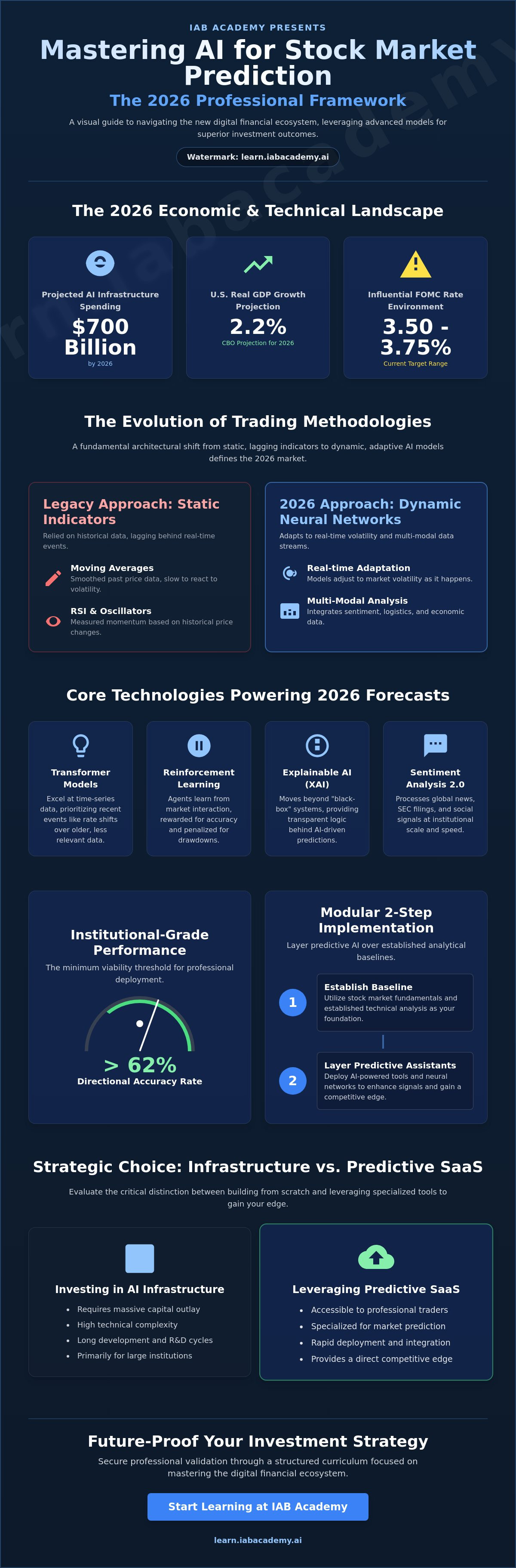
The era of passive AI exposure has ended. With major tech leaders projected to spend nearly $700 billion on AI infrastructure in 2026, the true market edge belongs to investors who can interpret the complex output of these systems. You've likely felt the mounting pressure of institutional algorithms and the exhaustion of filtering through conflicting market signals. It's increasingly difficult to distinguish functional predictive software from the persistent "AI hype" that still saturates financial media.
This article establishes a professional framework for mastering AI for stock market prediction 2026, ensuring you can leverage advanced models for superior investment outcomes. You'll learn to evaluate market signals with the precision of a global institutional trader. We will analyze the shift toward "Vertical AI," examine how current FOMC rates of 3.50% to 3.75% influence predictive modeling, and outline the exact steps to achieve professional certification in AI-powered investing. By the end of this guide, you'll possess the technical literacy required to maintain a competitive advantage in an increasingly automated digital ecosystem.
Key Takeaways
- Understand the architectural shift from static technical indicators to dynamic neural networks that adapt to real-time market volatility.
- Identify the strategic advantages of "Year of Implementation" software and how to effectively deploy AI for stock market prediction 2026 within a professional trading framework.
- Master a modular two-step implementation process that layers AI-powered predictive assistants over established technical analysis baselines.
- Evaluate the critical distinctions between investing in AI infrastructure and leveraging specialized predictive SaaS tools to gain a competitive edge.
- Secure professional validation and future-proof your investment strategy through a structured curriculum focused on mastery of the digital financial ecosystem.
The Evolution of AI for Stock Market Prediction in 2026
The transition from static technical indicators to dynamic neural networks represents a fundamental shift in the digital financial ecosystem. For decades, traders relied on lagging indicators like moving averages or the Relative Strength Index. In 2026, these are merely baseline inputs for sophisticated models that prioritize real-time adaptation. AI stock market prediction in 2026 is defined by the convergence of real-time sentiment analysis and multi-layered neural networks.
This period is recognized as the 'Year of Implementation' because the global hardware infrastructure has finally matured to support high-volume inference. Modern forecasting now integrates high-frequency data and alternative datasets, such as real-time supply chain logistics and granular consumer spending patterns. As the Congressional Budget Office projects a 2.2% U.S. real GDP growth for 2026, models must now account for moderate expansion alongside the Federal Reserve's current 3.50% to 3.75% rate environment. This requires a shift from simple AI for stock market prediction 2026 toward multi-modal analysis that can process diverse data streams simultaneously.
From Quantitative to Generative: The 2026 Shift
Large Language Models (LLMs) have evolved beyond simple text generation. They now synthesize thousands of pages of SEC filings and earnings call transcripts in milliseconds, identifying subtle shifts in executive sentiment that human analysts might miss. This evolution toward "explainable AI" (XAI) allows traders to see the logic behind a prediction, moving away from opaque "black-box" systems. While these tools are powerful, they aren't magic. Mastering stock market fundamentals remains the essential baseline for any serious investor attempting to train or verify an AI model.
The Institutional Edge vs. Retail Accessibility
The technological barrier that once separated institutional desks from individual investors has collapsed. Advanced algorithmic trading protocols and predictive assistants are now available to any professional committed to growth. This accessibility brings a new set of responsibilities. You must maintain strict data hygiene in your personal predictive models to avoid "hallucinations" or biased outputs. The IAB Academy empowers you to manage this complexity, providing the certification and technical training necessary to secure a competitive advantage in the 2026 market.
Core Technologies Powering 2026 Market Forecasts
The technical sophistication of AI for stock market prediction 2026 rests on the transition from simple linear regressions to multi-dimensional Transformer models. While earlier systems struggled with long-term sequence dependencies, modern Transformers excel at processing time-series stock data by assigning varying weights to historical price actions. This allows a model to prioritize a sudden 2026 interest rate shift over less relevant data from previous cycles, ensuring that the forecast remains grounded in current economic realities.
Reinforcement learning (RL) adds another layer of resilience to the digital ecosystem. Unlike static models that rely on fixed historical datasets, RL agents learn by interacting with market volatility in real-time. These systems receive rewards for accurate directional predictions and penalties for excessive drawdown. This technology is particularly effective in the current environment where the Federal Open Market Committee has maintained a target range of 3.50% to 3.75%. By simulating millions of market scenarios, these models develop strategies that anticipate institutional reactions to macroeconomic stability and the projected 2.2% U.S. real GDP growth.
Predictive Analytics and Neural Networks
Deep learning architectures in 2026 are specifically engineered to distinguish between mere pattern recognition and true predictive accuracy. While a chart pattern might repeat, its outcome depends on the underlying liquidity and sentiment context. Professional models now integrate sentiment analysis 2.0, which processes global news and social signals at a scale previously reserved for firms with a $31,980 Bloomberg subscription. In the current professional landscape, a predictive model is generally expected to maintain a directional accuracy rate exceeding 62% to be considered viable for institutional-grade deployment. Mastering these complex systems is a core component of our AI-powered trading tools training, which bridges the gap between raw data and actionable strategy.
Alternative Data: The New Gold Mine
The integration of alternative data has moved from the periphery to the core of the forecasting ecosystem. AI models now ingest satellite imagery of retail parking lots, real-time shipping manifests, and anonymized credit card transactions to build a micro-level view of corporate health. This data provides a lead time that traditional earnings reports cannot match. Success in 2026 requires more than just access to data; it demands the technical literacy to supervise the algorithms processing it.
Verification remains the primary challenge for retail and professional investors alike. High-density information is useless if the underlying data is noisy or biased. Modern AI systems use secondary auditor networks to filter market noise, ensuring that only high-integrity signals reach the final decision engine. Recent University of Chicago research on AI stock prediction highlights how these multi-layered approaches significantly outperform traditional quantitative methods by identifying non-linear relationships in complex, global datasets.
AI Infrastructure vs. Predictive Software: A Strategic Comparison
While major tech firms are projected to spend nearly $700 billion on AI infrastructure in 2026, the focus for astute investors has shifted from the "shovels" to the "intellect." The infrastructure phase, dominated by custom silicon and massive data centers, is now entering a high-volume production stage. However, owning the hardware is a separate challenge from mastering AI for stock market prediction 2026. A software-first mindset is now essential because the value of raw computational power is only realized through the effectiveness of the predictive models it runs. Success in this environment requires a clear how to invest in ai roadmap that prioritizes intelligence over mere capacity.
Investment Winners: Hardware vs. Intelligence
Chipmakers often face significant volatility as the market transitions from training to inference. In contrast, Software-as-a-Service (SaaS) and proprietary predictive platforms tend to stabilize as they demonstrate consistent revenue impact. This "Intelligence Premium" occurs because software captures the ultimate value generated by hardware infrastructure. When evaluating the ROI of infrastructure stocks versus AI-driven portfolio performance, the latter offers a more direct path to superior outcomes. Building a proprietary model requires significant capital and technical expertise, making high-quality, professional-grade SaaS tools the preferred choice for most retail and professional investors in 2026.
Risk Management in the Age of Algorithmic Volatility
The synchronization of AI models creates unique systemic risks, including the potential for "Flash Crashes" when multiple algorithms react to the same signal simultaneously. You can't delegate your compliance or risk responsibilities to an algorithm. SEC and FINRA regulations in 2026 remain technology-neutral, meaning firms and individuals must maintain rigorous human oversight. Managing these AI-driven risks requires more than just software; it demands a comprehensive financial literacy curriculum. Professional mastery involves understanding the limitations of your AI for stock market prediction 2026 tools and establishing governance frameworks to supervise their execution. This disciplined approach ensures that your strategy remains resilient even when market sentiment shifts toward "AI fatigue."
How to Implement AI in Your Investment Strategy
Implementation of AI for stock market prediction 2026 requires a modular, disciplined approach rather than a total replacement of established methodologies. You must first establish a baseline using traditional technical analysis. This provides a historical context for price action that the AI can then refine. Once your baseline is secure, select a professional-grade AI-powered stock screener or predictive assistant that aligns with your specific risk profile. This tool shouldn't act as a sole decision-maker but as a high-density data filter.
Validation is the next critical phase. You must backtest AI signals against historical data from 2024 and 2025 to ensure the model's logic remains sound across different interest rate cycles. In 2026, where the federal funds rate is held between 3.50% and 3.75%, understanding how an algorithm performed during the previous tightening or easing periods is essential. Following successful backtesting, move into iterative refinement. Rebalance your portfolio based on the AI's evolving sentiment scores while maintaining a commitment to continuous education through professional certification to ensure your skills don't atrophy as the technology advances.
Setting Up Your AI Trading Environment
Retail traders no longer require massive local server racks. Cloud-based alternatives provide the necessary computational power for complex inference without the overhead of physical hardware. You'll need to integrate robust API feeds to ensure your predictive assistant receives real-time market updates. Before committing capital, utilize paper trading to validate model accuracy. This step is vital for ensuring that your AI for stock market prediction 2026 tools are properly calibrated to the current 2.2% GDP growth environment.
Advanced Predictive Workflows
Sophisticated investors gain an edge by combining AI-generated sentiment scores with traditional fundamental ratios like P/E and debt-to-equity. This multi-layered approach is particularly effective for optimizing entry and exit points in options strategies, where timing and volatility are paramount. In the 2026 digital ecosystem, the "Human-in-the-loop" (HITL) requirement dictates that every AI-generated trade must be reviewed and verified by a human operator to ensure compliance and strategic alignment. To master these technical workflows, you should explore our AI-powered trading tools training to secure your professional standing.
Mastering the AI Ecosystem with IAB Academy
Professional education isn't just an elective; it's the primary differentiator in the current digital ecosystem. As major corporations move past the hardware build-out phase to focus on inference and monetization, the demand for individuals who can interpret AI for stock market prediction 2026 has reached a critical peak. Many investors currently suffer from "AI fatigue" because they lack the framework to distinguish between functional software and marketing hype. The IAB Academy curriculum is designed to resolve this by transforming technical complexity into a structured, instructional path for professional advancement.
The IAB Academy Advantage
Our Houston-based expertise provides a foundation for global market mastery, ensuring that learners receive instructions rooted in the highest industry standards. We provide lifetime access to evolving AI trading strategy tutorials. This is a vital resource in 2026, especially as the release cadence for core libraries like PyTorch 2.11.0 has shifted to every two months. Certification acts as a hallmark of professional quality and legitimacy. It validates your ability to manage risks such as data bias and hallucinations, ensuring you maintain the human oversight required by technology-neutral SEC and FINRA regulations.
Your Path to Professional Excellence
The journey from a novice investor to an AI-powered expert follows a disciplined, modular rhythm. You'll learn to leverage IAB tools for macro-economic analysis, integrating data points such as the CBO's projected 2.2% U.S. real GDP growth and the 4.1% interest rate on 10-year Treasury notes into your predictive models. While a single Bloomberg Terminal subscription now costs $31,980 per year, our curriculum provides the technical literacy to achieve similar professional outcomes through custom AI execution. Our Smart Instructor™ provides real-time AI tutoring, offering calculated encouragement as you master the technicalities of the 2026 market.
Joining this global community connects you with elite, forward-thinking investors who prioritize high-density information over market noise. You don't have to navigate the transition of Federal Reserve leadership or the complexities of a $1.9 trillion budget deficit alone. Secure your career survival and achieve excellence by committing to a standard of learning that commands respect in the financial industry. It's time to transition from an observer of the AI revolution to a master of its application. Enroll in the AI-Powered Investing Course today and define your future in the digital ecosystem.
Securing Your Competitive Edge in the 2026 Ecosystem
The transition from hardware infrastructure to software application is now complete. Success in this landscape requires a pivot from passive market exposure to the active mastery of predictive tools. You've explored how Transformer models and multi-layered neural networks have redefined AI for stock market prediction 2026. By implementing a modular, backtested strategy and maintaining human oversight, you move beyond the volatility of institutional algorithms to establish a sustainable professional advantage.
Achieving this level of excellence demands a commitment to validated, high-density education. The IAB Academy provides a Houston-based professional certification that serves as a definitive hallmark of industry expertise. Our curriculum offers lifetime access to all future updates, ensuring your skills remain current as technological standards evolve. With the Smart Instructor™ providing real-time support in over 130 languages, the path to technical mastery is accessible to any committed professional. Master the 2026 Market with IAB Academy's AI-Powered Curriculum and secure your position at the forefront of financial innovation. Your journey toward professional excellence begins today.
Frequently Asked Questions
Is AI for stock market prediction accurate in 2026?
AI accuracy in 2026 is high but not infallible. Professional-grade models often maintain directional accuracy rates exceeding 62%. These systems excel at identifying non-linear relationships in datasets that human analysts overlook. However, accuracy depends heavily on data hygiene and the current macroeconomic environment, such as the Federal Reserve holding interest rates between 3.50% and 3.75%.
Can retail investors access the same AI tools as hedge funds?
Retail investors now have access to professional-grade predictive analytics that were previously exclusive to institutional desks. The proliferation of Software-as-a-Service (SaaS) models allows individuals to leverage advanced Transformer architectures without the overhead of proprietary server infrastructure. This democratization of technology enables retail traders to compete effectively with algorithmic institutional traders within the digital ecosystem.
What is the best AI tool for stock market prediction for beginners?
The best AI tool for beginners is a combination of a reliable predictive assistant and a structured educational platform. IAB Academy provides specialized AI-powered trading tools training to help novices navigate the market. Rather than relying on a single "black box" software, beginners should prioritize tools that offer explainable AI (XAI) features to understand the logic behind each market signal.
How does generative AI help in stock market analysis?
Generative AI synthesizes vast quantities of unstructured data, including SEC filings, earnings call transcripts, and global sentiment signals. By processing this information in milliseconds, it identifies executive sentiment shifts and supply chain disruptions before they reflect in price action. This capability transforms qualitative information into quantitative inputs for AI for stock market prediction 2026, enhancing overall forecast precision.
Do I need coding skills to use AI for stock market prediction?
Coding skills aren't mandatory for utilizing AI in 2026. Most modern predictive platforms feature low-code or no-code interfaces that allow investors to build and backtest strategies through intuitive dashboards. While a fundamental understanding of Python or libraries like PyTorch 2.11.0 is beneficial for custom builds, professional-grade SaaS tools handle the underlying complexity for the user.
What are the risks of relying on AI for investment decisions?
Relying solely on AI introduces risks such as data hallucinations, algorithmic bias, and synchronized market volatility. If multiple models react to the same signal simultaneously, it can trigger rapid price corrections or "Flash Crashes." Maintaining a "Human-in-the-loop" (HITL) approach is essential for compliance and ensuring that automated decisions align with your broader risk management strategy and financial goals.
How much does it cost to implement an AI trading strategy in 2026?
Implementation costs vary significantly based on the level of sophistication required. While a single Bloomberg Terminal subscription costs $31,980 per year in 2026, many SaaS-based AI trading assistants offer tiered pricing models accessible to retail investors. Your primary investment should focus on professional certification and training to ensure you can effectively operate these tools within the digital ecosystem without incurring unnecessary losses.
Can AI predict a market crash before it happens?
AI identifies anomalies and heightened risk signals that often precede market crashes. By monitoring macro-economic variables like the 4.1% interest rate on 10-year Treasury notes and shifts in real-time liquidity, models can flag extreme volatility. However, no system can predict the exact timing of a crash with absolute certainty. AI for stock market prediction 2026 serves as an advanced early warning system rather than a crystal ball.
