
Stock Market Fundamentals: A Comprehensive Guide for 2026 Investors
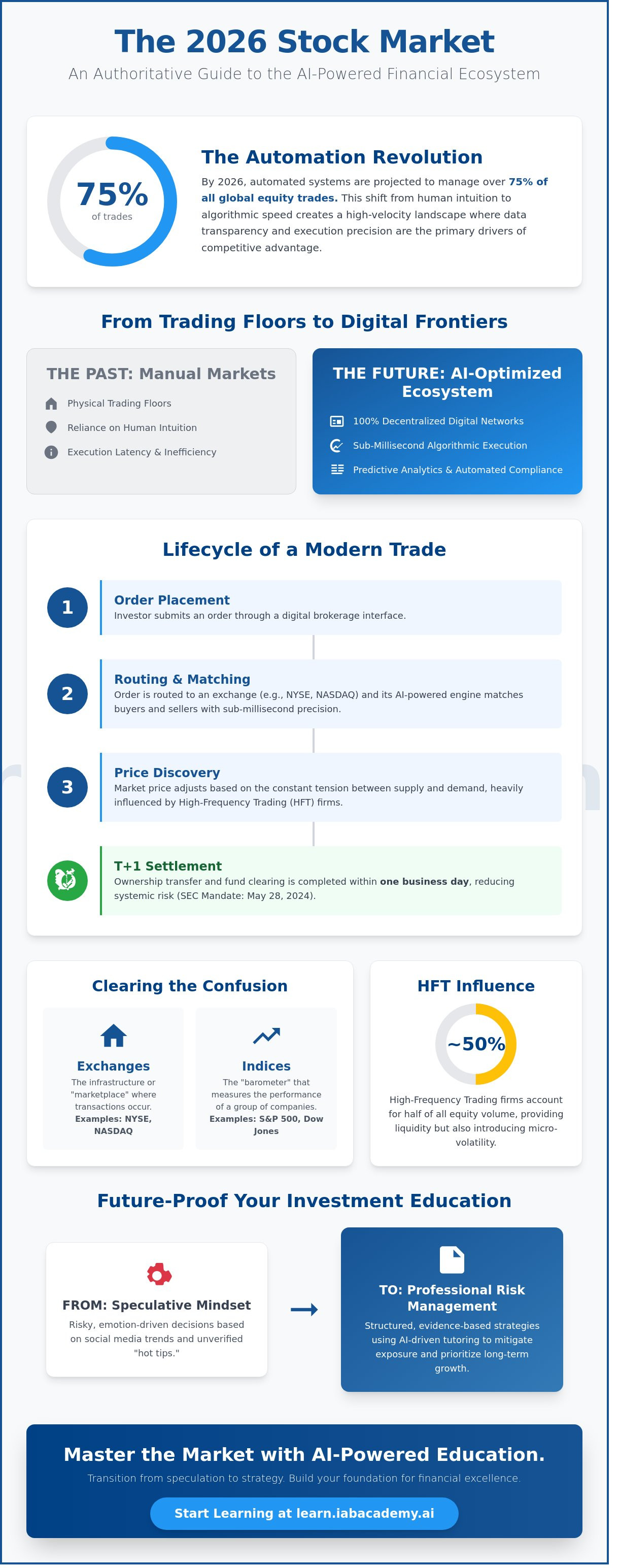
By 2026, automated systems are projected to manage over 75% of all global equity trades, creating a landscape where algorithmic speed often outpaces human intuition. It's understandable if you feel overwhelmed by the 24/7 news cycle or the sheer technical density of modern trading platforms. You likely recognize that the stock market has transitioned from a physical floor to a sophisticated digital ecosystem where volatility is the only constant. Mastery of this environment requires more than just luck; it demands a deep understanding of industry standards and technical infrastructure.
This guide serves as your authoritative resource to achieve that mastery. You'll learn to decode the mechanics of global indices and interpret ticker data with the precision of a professional analyst. We'll bridge the gap between traditional fundamentals and the AI-driven tools reshaping the industry today. By the end of this module, you'll have the confidence to execute risk-free practice trades using a structured, evidence-based approach that prioritizes professional growth and financial excellence.
Key Takeaways
- Define the 2026 stock market ecosystem as a decentralized digital network, establishing a professional foundation for fractional ownership and long-term growth.
- Decode the life cycle of a trade and the influence of AI-powered analysis on modern price discovery and order matching engines.
- Navigate the complexities of major indices like the S&P 500 and NASDAQ to accurately measure economic health and technological dominance.
- Transition from a speculative mindset to professional risk management, learning to mitigate exposure while maintaining strategic market positioning.
- Future-proof your investment education by utilizing AI-driven tutoring systems that transcend the limitations and risks of social media-based learning.
Understanding the Stock Market Ecosystem in 2026
The Understanding the Stock Market ecosystem has evolved into a high-velocity, decentralized digital network where participants exchange fractional ownership of global corporations. By January 2026, the S&P 500 index has successfully crossed the 7,000 threshold. This milestone signals a mature era of growth driven by deep technological integration and expanded retail participation. The ecosystem serves two primary functions. It allows corporations to raise essential capital for expansion and provides a mechanism for investors to build long-term wealth through equity appreciation.
The transition from physical trading floors to 100% digital environments is now complete. Execution is entirely AI-optimized. Algorithms process millions of data points per millisecond to ensure liquidity and price discovery. This shift has eliminated the latency once found in manual trading, making the 2026 stock market a model of efficiency and programmatic precision. It's a landscape where data transparency and execution speed are the primary drivers of competitive advantage.
Investors now operate within a framework where predictive analytics and automated compliance are standard features of every transaction. This 2026 environment prioritizes algorithmic integrity. Human intervention is now reserved for high-level strategic oversight, while the daily mechanics of the stock market rely on machine learning models that predict volatility and manage order flow. This evolution ensures that capital remains fluid and accessible to a global demographic of investors who demand instant execution and transparent fee structures.
The Role of Public Companies and Shareholders
Companies transition from private equity to the public sphere through an Initial Public Offering (IPO). This process allows a business to scale by selling shares to the public. As a shareholder, you hold specific rights. These include voting on corporate policies and receiving dividends when the company distributes profits. Ownership is no longer about holding a physical certificate; it's about holding a digital stake in a company's future performance. Market Capitalization is the total dollar value of a company’s outstanding shares.
Exchanges vs. Indices: Clearing the Confusion
The New York Stock Exchange (NYSE) and NASDAQ serve as the primary global liquidity hubs where transactions occur. While exchanges provide the infrastructure, indices like the Dow Jones and S&P 500 act as market health barometers. They aggregate the performance of specific groups of companies to provide a snapshot of economic trends. These benchmarks allow investors to compare their portfolio performance against broader industry standards. To navigate these complexities, you should consult our guide on Mastering Stock Market Terminology: The Essential Glossary for 2026 Investors.
How the Modern Stock Market Functions: From Tickers to AI Analysis
The stock market functions as a high-velocity digital ecosystem where billions of dollars in capital move based on algorithmic triggers and institutional mandates. Every transaction follows a rigorous lifecycle that begins with order placement through a brokerage interface. Once an order is submitted, it's routed to a centralized matching engine managed by exchanges such as the NYSE or NASDAQ. These engines pair buyers and sellers based on price and time priority with sub-millisecond precision. Since the SEC transitioned the industry to T+1 settlement on May 28, 2024, the ownership of shares and the clearing of funds now occur within a single business day. This accelerated cycle reduces systemic risk but requires investors to maintain higher levels of liquid collateral.
Price discovery is the primary output of this ecosystem, driven by the constant tension between supply and demand. When institutional demand outweighs available shares, prices adjust upward to find a new equilibrium. In the 2026 environment, this process is influenced heavily by high-frequency trading (HFT) firms, which now account for approximately 50 percent of all equity trading volume. These participants provide essential liquidity by narrowing spreads, yet they also introduce micro-volatility that retail investors must anticipate. Understanding the Basics of Investing in Stocks is essential for establishing a professional foundation before engaging with these complex mechanical drivers. Real-time data access has shifted from a premium luxury to a baseline requirement for survival in this landscape.
Decoding Market Data and Tickers
Professional market participation requires looking beyond the simple "last price" displayed on a screen. The bid-ask spread represents the hidden cost of every transaction; it's the difference between the highest price a buyer will pay and the lowest price a seller will accept. For traders, volume and liquidity are often more critical than price movement alone. High volume confirms the validity of a price trend, while low liquidity can lead to significant slippage during execution. To master these nuances, you should review our detailed guide on How to Read a Stock Market Ticker: A Professional Guide for New Investors.
The AI Revolution in Stock Analysis
By 2026, the stock market has been fundamentally reshaped by artificial intelligence. AI tools now process unstructured data, such as global news feeds and social sentiment, in under 10 milliseconds to predict short-term price fluctuations. The industry has moved away from manual charting toward AI-assisted pattern recognition that identifies institutional accumulation phases before they're visible to the naked eye. This technology allows for a sophisticated synthesis of macro-economic data and technical signals. IAB’s Smart Instructor™ provides real-time support for technical analysis, ensuring that learners can interpret these complex algorithmic outputs with professional accuracy. To ensure your skills remain relevant, you can access our advanced certification modules to future-proof your investment strategy.
Navigating Major Indices and Market Indicators
The S&P 500 remains the definitive benchmark for the US economy in 2026. This index tracks 500 large-cap companies and serves as the primary gauge for institutional health. Investors utilize the NASDAQ Composite to monitor the technological ecosystem, where AI integration has pushed valuations to record levels. While the Dow Jones Industrial Average provides a legacy view of 30 blue-chip stocks, modern portfolios increasingly rely on emerging market indices for diversification. Understanding these benchmarks is critical for Managing Market Risk effectively within a volatile global landscape. Mastery of these indices allows professionals to benchmark performance against industry standards and ensure their strategy aligns with broader market trends.
Sector Analysis: Where Growth Lives in 2026
Growth in 2026 is concentrated in specific industrial verticals. Technology and AI remain the dominant drivers. The sector saw a 22 percent increase in capital expenditure during the 2025 fiscal year as companies prioritized programmatic infrastructure and automated intelligence. The energy transition creates significant opportunities as the shift to renewables accelerates. Companies specializing in battery storage and grid modernization have seen 15 percent year-over-year revenue growth. Healthcare and biotechnology offer defensive stability. An aging global demographic, specifically the 20 percent of the population over age 65, ensures consistent demand for pharmaceutical innovation and medical services. These sectors represent the core of a future-proofed portfolio.
Economic Indicators That Move Markets
Market movements are often dictated by macroeconomic data points. The Federal Reserve's decisions on interest rates directly influence the stock market by altering the discount rate for future cash flows. When rates rise, equity valuations typically contract. Inflation monitoring through the Consumer Price Index (CPI) is equally vital. Investors must distinguish between nominal gains and real returns to preserve purchasing power. Employment data serves as a leading indicator of consumer resilience. In the first quarter of 2026, a 3.8 percent unemployment rate signaled continued corporate earnings potential. These metrics provide the technicalities needed for professional-grade market attribution.
- The Federal Reserve: Directly influences liquidity and borrowing costs for corporations.
- CPI and Inflation: Measures the erosion of purchasing power and dictates real yield.
- Employment Data: Tracks the health of the labor ecosystem and consumer spending power.
It's necessary to view these indicators as a cohesive system rather than isolated events. Professional investors don't just look at the numbers; they analyze the delta between expected and actual results. This analytical rigor is what separates speculative activity from disciplined investment mastery. By tracking these metrics, you gain a sense of stability and reliability in your financial decision-making process.
Managing Risk: Why Investing is Not Gambling
Equating the stock market with a casino is a fundamental misunderstanding of asset allocation. Gambling relies on negative expected value and pure chance; professional investing is built on the ownership of productive enterprises that generate cash flow. Historical data confirms this distinction. Over the last 30 years, the S&P 500 has delivered an average annual return of approximately 10.2%. While short-term volatility is certain, the long-term trajectory of the market reflects global economic growth and corporate innovation.
Professional investors don't practice risk avoidance; they practice risk management. Avoidance often leads to capital erosion. For instance, holding excessive cash during periods of 3.4% inflation, as seen in early 2024, guarantees a loss of purchasing power. Mastery involves identifying, quantifying, and pricing risk to ensure that the potential reward justifies the exposure. You aren't trying to eliminate uncertainty; you're trying to manage it through disciplined protocols.
Diversification remains the only free lunch in the financial ecosystem. By 2026, the correlation between traditional asset classes has tightened, making global diversification across sectors, geographies, and market caps essential. A concentrated portfolio might offer higher short-term gains, but it lacks the structural integrity to withstand systemic shocks. You must also guard against the psychological trap of FOMO. Chasing record highs, such as the AI-driven surges of 2023 and 2024, often leads to entering positions at the peak of a cycle. Discipline requires buying based on valuation, not social sentiment.
Essential Risk Mitigation Strategies
To protect your capital, you must implement automated safeguards. Stop-loss orders are vital; they execute a sell command when a security hits a predetermined price, preventing a standard correction from becoming a catastrophic loss. Position sizing is equally critical. You should rarely allocate more than 1% to 2% of your total capital to a single ticker. This ensures that a single failure doesn't compromise your entire portfolio. Finally, maintaining a long-term time horizon is your greatest advantage. History shows that the probability of a positive return on the S&P 500 rises to 94% when the holding period extends to ten years.
Paper Trading: The Professional Path to Mastery
The IAB Academy mandates that every student begins their journey in a simulated environment. This isn't a mere suggestion; it's a standard for professional validation. Before you expose real capital to the stock market, you must prove your strategy's efficacy through rigorous testing. This process allows you to refine your execution and emotional response to market movements without financial consequence. To begin your technical preparation, read our guide on What is Paper Trading? Practicing Stock Market Success Risk-Free in 2026.
Ready to move beyond speculation and secure your financial future? Enroll today to master professional risk management protocols with the IAB Academy.
Building Your Investment Foundation with AI-Powered Education
The evolution of financial education has transitioned from static 500-page textbooks to interactive, AI-driven environments. This shift is necessary for the 2026 investor who must process information at a velocity once reserved for high-frequency trading desks. Relying on social media for financial guidance introduces unnecessary risk. A 2024 report from the Financial Industry Regulatory Authority (FINRA) found that retail participants who prioritize social media "tips" are 30% more likely to experience catastrophic portfolio drawdowns during volatility. The IAB Academy eliminates this risk by providing a disciplined, institutional framework for the retail stock market participant.
The IAB Academy difference lies in its commitment to precision. While traditional courses offer generalized advice, our curriculum focuses on the technicalities of market infrastructure and regulatory compliance. This high-density information ensures that learners aren't just memorizing terms but are mastering the mechanics of wealth creation. Moving from theory to a certified curriculum represents the final step in professionalizing your investment strategy.
The IAB Learning Path: Novice to Pro
The Novice Investor Curriculum establishes a technical baseline by focusing on asset valuation, risk compliance, and market mechanics. This phase is critical for building the analytical skills needed to evaluate the stock market without bias. Our Smart Instructor™ technology facilitates this process by providing 24/7 clarification on complex instruments. This AI-powered tutor uses natural language processing to break down sophisticated concepts into actionable insights. Lifetime access to these modules ensures that your education evolves alongside the 2026 financial ecosystem. In a landscape where 44% of core skills are expected to change by 2027 according to World Economic Forum data, continuous learning is a requirement for capital preservation.
Certification and Professional Credibility
Earning a structured financial literacy certification provides a distinct advantage in a competitive global economy. A 2025 LinkedIn survey revealed that 62% of recruiters value specialized certifications as evidence of professional discipline and technical mastery. This credential signals to the market that you possess a verified level of competence. Beyond the curriculum, learners join a global community of AI-empowered investors who prioritize data over hype. This network reinforces the rigorous standards of excellence required to maintain long-term profitability. Secure your financial future by enrolling in a curriculum that transforms technical knowledge into a permanent professional asset.
Future-Proof Your Portfolio for the 2026 Financial Landscape
Success in the modern stock market demands a technical understanding of the ecosystem where AI analysis and human strategy converge. You've now explored how major indices function as benchmarks for global stability and why disciplined risk management remains the primary barrier against speculative gambling. Navigating these complexities requires a foundation built on verified industry standards rather than fleeting trends. As a Houston-based global authority in financial education, IAB Academy empowers you to transition from a novice to a calculated strategist with precision and confidence.
Mastery is within reach through our specialized curriculum. Our Smart Instructor™ AI provides real-time answers in 130+ languages, ensuring you're never left without clarity during your professional development. You'll also benefit from lifetime access to all course updates and AI tools, securing your knowledge base as technology evolves. Take the definitive step toward professional excellence today. Master the Markets with IAB Academy’s AI-Powered Novice Investor Curriculum and secure your place in the future of global finance. It's time to build a legacy of informed wealth.
Frequently Asked Questions
Is the stock market safe to enter when it's at an all-time high in 2026?
Historical data shows that the S&P 500 reached new highs on approximately 7% of all trading days since 1950. While volatility exists, 2026 investors should prioritize time in the market over timing the market. Long term returns average 10% annually before inflation adjustments. Entering at a peak doesn't prevent future gains if your investment horizon exceeds 10 years. You're building a portfolio for decades, not days.
How much money do I need to start investing in the stock market today?
You can begin investing with as little as $1 through fractional shares offered by 85% of major retail brokerages. Historically, minimums were $1,000 or more, but digital platforms have eliminated these barriers to entry. Starting with small, consistent contributions allows you to utilize dollar-cost averaging to build a robust portfolio over time. It's an effective way to achieve financial mastery without requiring a large initial capital outlay.
What is the difference between investing and day trading?
Investing focuses on long term wealth accumulation through asset ownership for years, while day trading involves buying and selling within a single session. Statistics from the SEC indicate that 90% of day traders lose money within their first year of activity. Investors typically target the 7% to 10% average annual return of the stock market rather than short term price fluctuations. This disciplined approach ensures professional growth and long term stability.
Can AI really help me pick better stocks than a human advisor?
AI algorithms process 1.5 million data points per second to identify patterns, but they lack the ethical judgment of a certified human advisor. A 2024 study by Vanguard found that human advisors add approximately 3% in net value through behavioral coaching and tax strategy. AI excels at portfolio rebalancing and algorithmic execution, while humans provide strategic compliance and emotional stability during market corrections. Both tools are essential for a modern, future-proofed strategy.
What happens to my money if a company I invested in goes bankrupt?
Common shareholders are last in line for repayment during a Chapter 7 liquidation according to the U.S. Bankruptcy Code. Bondholders and preferred stockholders receive priority for remaining assets. In most cases, the value of common stock drops to $0, resulting in a total loss for the individual investor. Diversification across 20 or more sectors mitigates the impact of a single corporate failure. It's a fundamental rule of risk management and professional asset protection.
How do I choose between the S&P 500 and the NASDAQ?
The S&P 500 tracks 500 large cap U.S. companies across all sectors, providing a broad benchmark for the stock market. The NASDAQ 100 is heavily weighted toward the technology sector, which comprises over 50% of its total value. Investors seeking stability often prefer the S&P 500, while those targeting high growth in the digital ecosystem prioritize the NASDAQ's tech heavy concentration. Your choice depends on your specific risk tolerance and certification goals.
What are the tax implications of stock market gains in 2026?
Long term capital gains are taxed at 0%, 15%, or 20% depending on your income bracket for assets held over 365 days. Short term gains are taxed as ordinary income, which can reach 37% for top earners. Under current IRS regulations, you can use up to $3,000 in annual capital losses to offset your taxable income. This process, known as tax loss harvesting, is vital for maintaining fiscal compliance and maximizing net returns.
How long does it take to learn the fundamentals of the stock market?
Mastery of core principles typically requires 40 to 50 hours of structured study to achieve professional competency. This timeframe covers technical analysis, fundamental valuation, and regulatory compliance. Most investors gain functional literacy within 3 months of consistent research. Continuous education is necessary to maintain an edge in a global financial ecosystem that evolves with every technological shift. High-density learning today ensures your career survival in the competitive markets of 2026.
