
Personal Finance Education: A Comprehensive Guide to Mastery in 2026
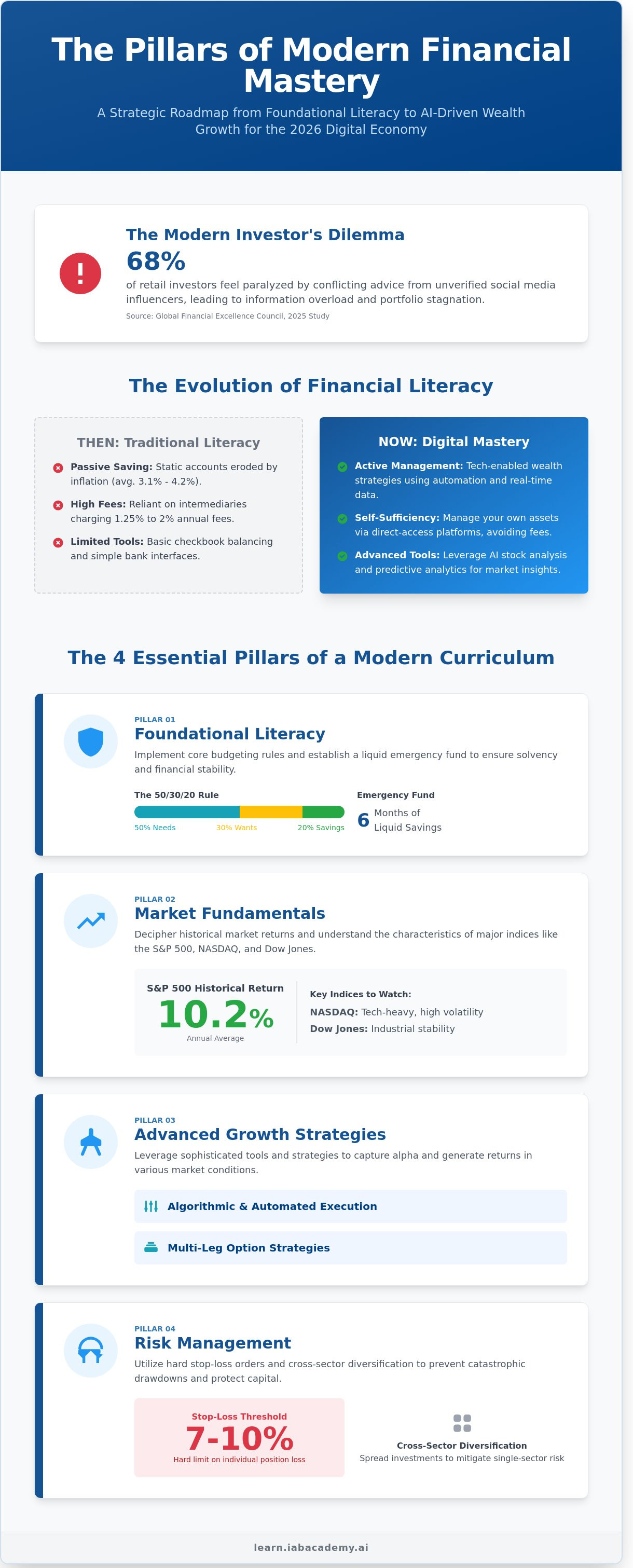
A 2025 study by the Global Financial Excellence Council revealed that 68% of retail investors feel paralyzed by conflicting advice from unverified social media influencers. You've likely experienced this intense information overload while worrying that the rapid evolution of machine learning will leave your portfolio behind. Mastery requires more than just following viral trends; it demands a structured approach to personal finance education that bridges the gap between legacy standards and the 2026 digital economy.
This guide delivers a strategic roadmap to replace uncertainty with professional-grade competence. You'll learn how to synthesize traditional budgeting principles with AI-driven investing tools to build sustainable wealth. We'll break down the essential pillars of asset growth, demonstrate how to leverage predictive analytics for market analysis, and outline the steps to earn a certification that proves your financial expertise in a competitive global market.
Key Takeaways
- Transition from basic checkbook balancing to sophisticated digital asset management to navigate the complexities of the modern financial landscape.
- Master the core pillars of market fundamentals and foundational literacy to build a resilient framework for long-term wealth accumulation.
- Leverage AI-powered learning models to move beyond traditional instruction, ensuring your personal finance education is personalized and future-proofed.
- Identify high-caliber courses by prioritizing industry-standard certifications and lifetime access over generic completion badges to ensure your knowledge remains current.
- Utilize integrated AI stock analysis tools to transition from a student to a sophisticated retail investor within a single, high-performance ecosystem.
Defining Personal Finance Education for the Digital Era
Personal finance education is the systematic acquisition of technical competencies required to manage capital, credit, and diversified investment portfolios. It’s no longer a simple matter of balancing a checkbook or maintaining a basic savings account. By 2026, the discipline has evolved into the oversight of a complex digital asset ecosystem where speed and technical literacy are the primary drivers of success. This shift demands a transition from passive saving to active, tech-enabled wealth strategies that leverage automation and real-time data attribution.
Evolution in this field has been rapid. In 2015, retail investors primarily interacted with traditional banking interfaces; today, they must navigate decentralized finance protocols and fractionalized asset ownership. Global standards, such as the OECD’s 2024 updated framework for financial literacy, provide the necessary benchmarks to ensure these skills are transferable across international markets. Adhering to these rigorous standards ensures that individuals can maintain compliance and security while pursuing aggressive growth targets. The 2026 landscape requires an understanding of how automated rebalancing and AI-driven tax harvesting impact long-term net worth.
Mastery of personal finance education provides the foundational framework to treat your household balance sheet with the same rigor as a corporate financial statement. This involves moving beyond the "set it and forget it" mentality of the early 2000s. Instead, modern learners focus on optimizing every dollar through high-yield environments and sophisticated risk management tools that were once reserved for institutional traders.
The Core Objectives of Financial Mastery
Achieving mastery requires a deep understanding of the global digital ecosystem. Professionals must develop the critical thinking skills necessary to filter high-density financial data from the constant noise of unverified online sources. A primary goal is reaching total self-sufficiency. This allows individuals to manage their portfolios without paying the 1.25% to 2% annual fees typically associated with traditional intermediaries. By 2026, managing your own assets through direct-access platforms has become a hallmark of professional excellence and financial independence.
Why Traditional Literacy is No Longer Enough
Market volatility and inflation rates, which fluctuated between 3.1% and 4.2% in recent economic cycles, have rendered static savings accounts obsolete. Traditional literacy doesn’t account for the influence of programmatic digital advertising, which uses sophisticated attribution models to target consumer spending habits with surgical precision. It’s essential to future-proof your career by integrating personal finance education into your professional development plan. This competence acts as a shield against the erosion of purchasing power and provides the stability needed to navigate a competitive, tech-driven global economy where financial agility is a prerequisite for success.
The Essential Pillars of a Modern Financial Curriculum
Mastering personal finance education requires a shift from passive saving to active capital management. A robust curriculum isn't merely about tracking expenses; it's a structured approach to asset appreciation and risk mitigation. High-level financial literacy integrates foundational stability with aggressive market participation. This ensures that every dollar functions as a productive unit within your personal ecosystem. Professional mastery involves moving beyond basic survival to understand the mechanics of global wealth distribution.
- Foundational Literacy: Implementing the 50/30/20 rule and maintaining a six-month liquid emergency fund to ensure solvency.
- Market Fundamentals: Deciphering the S&P 500's 10.2% historical annual return versus the tech-heavy volatility of the NASDAQ and the industrial stability of the Dow Jones.
- Advanced Growth: Leveraging algorithmic execution and multi-leg option strategies to capture alpha in sideways or bearish markets.
- Risk Management: Utilizing hard stop-loss orders at 7% to 10% thresholds and cross-sector diversification to prevent catastrophic drawdowns.
From Budgeting to Stock Market Fundamentals
Transitioning from a scarcity mindset to a growth mindset is the primary hurdle in personal finance education. Scarcity focuses on cutting costs, while growth focuses on scaling returns through calculated exposure. Success depends on your ability to define and apply stock market terminology accurately. You must move beyond simple ticker symbols to understand macro-economic indicators. For instance, tracking the Federal Reserve’s interest rate adjustments is mandatory for predicting bond yields and equity valuations. Professional investors don't guess; they analyze GDP growth rates and CPI data to forecast market direction 18 months in advance.
Advanced Literacy: Derivatives and Options
Modern finance education now includes complex instruments once reserved for institutional desks. Retail traders increasingly use options strategy simplification to generate income through covered calls or protect portfolios with protective puts. Technical analysis serves as the operational backbone here. By monitoring 50-day and 200-day moving averages, you identify high-probability entry points. It's about balancing aggressive growth with conservative capital preservation. You shouldn't allocate more than 5% of your total portfolio to high-risk derivatives. This discipline ensures long-term survival in volatile cycles. To deepen your technical proficiency, consider how you might achieve financial certification through structured learning paths.
Comparing Traditional Instruction with AI-Powered Learning Models
The legacy model of financial instruction relies on static curricula and rigid schedules. These traditional classrooms often fail to address the complexities of a 24/7 global market. AI-powered learning models provide 2026 learners with constant accessibility. The shift is permanent. It democratizes personal finance education by removing geographical and temporal barriers. While a standard lecture remains fixed, AI video tutors adapt to market fluctuations in real time.
Generic finance classes often ignore the nuances of a diverse global economy. A strategy that works in London might fail in Singapore or Lagos. Modern platforms bridge this gap by offering support in over 130 languages. This linguistic inclusivity ensures that technical concepts aren't lost in translation. It transforms theoretical lectures into interactive, data-driven experiences that reflect actual market conditions. Learners don't just hear about inflation; they see its impact on their specific purchasing power through real-time data streams.
The Smart Instructor™ Advantage
Standardized testing can't match the precision of an AI mentor. When a student encounters a complex term like "capitulation" during a late-night study session, they don't have to wait for office hours. The Smart Instructor™ provides instant, technically accurate definitions within the context of the current lesson. It builds personalized learning paths that adjust based on individual knowledge gaps. This conversational approach reduces the intimidation factor. It allows professionals to achieve mastery without the social pressure of a physical classroom.
Paper Trading and Risk-Free Practice
Theory alone is insufficient for professional survival in the financial sector. Modern personal finance classes now prioritize simulated environments over textbook exercises. Paper trading allows learners to execute strategies using live market data without risking actual capital. This practice is essential for building emotional discipline. It bridges the gap between educational theory and professional execution, ensuring students understand the strategic implications of every trade. Mastery requires repetition in a controlled, high-fidelity ecosystem.
The transition to AI-driven models represents a new standard in personal finance education. These systems offer several distinct advantages:
- Real-time feedback on portfolio allocation and risk management strategies.
- Scalable solutions for learners across different time zones and economic backgrounds.
- High-density information delivery that respects the learner's time and pace.
Traditional methods simply can't scale to meet the needs of the modern workforce. By integrating AI, the industry establishes a more rigorous and accessible standard for financial literacy. This isn't just an upgrade; it's a total reimagining of how financial intelligence is acquired and applied.
How to Evaluate and Choose a Personal Finance Course
The digital ecosystem for personal finance education reached a saturation point in early 2025. Discerning professionals must now separate rigorous curricula from superficial content. High-caliber programs offer industry-standard certifications rather than simple participation badges. These credentials signal mastery to employers and financial institutions alike. You should prioritize platforms that provide third-party validation and align with global financial standards.
Standards for tax compliance and algorithmic trading change at a 15% quarterly rate. Lifetime access isn't a luxury; it's a requirement for future-proofing your knowledge. If a course locks its updates behind a recurring paywall, it fails the sustainability test. Reliable platforms invest in their technological infrastructure to support real-time data integration and AI-driven portfolio simulations.
- Verify Instructor Authority: Look for credentials like CFP or CFA designations.
- Audit the Infrastructure: Ensure the platform supports mobile-first, modular learning.
- Identify Red Flags: Avoid any program promising 1,000% returns or "get rich quick" shortcuts.
- Check for Peer Reviews: Seek out independent audits from 2025 or 2026.
Legitimate educators focus on risk mitigation and long-term asset allocation. They don't rely on hype or emotional triggers. Success in this field requires a disciplined, instructional approach that mirrors professional development paths in the corporate sector.
Curriculum Depth and Practical Application
A robust program tracks progress from basic budgeting to sophisticated options trading. Modular learning allows busy executives to consume high-density information in 12-minute intervals. Specialized tracks, such as a Teen Academy, are essential for establishing generational wealth frameworks. These tracks ensure that personal finance education becomes a permanent family asset rather than a fleeting interest. Mastery requires a curriculum that balances theoretical frameworks with actionable technicalities.
Cost vs. Long-Term Value
One-time enrollment fees often provide higher ROI than recurring subscriptions that restrict access to historical data. Free courses frequently omit advanced technical analysis training; this omission can cost investors over $4,200 in annual missed opportunities according to 2025 market reports. Calculate the value by assessing the platform's ability to provide peer-reviewed case studies and live market simulations. Investing in a premium curriculum is a strategic move for career survival in a competitive market.
Empower your professional journey with industry-leading insights. Access our certified personal finance modules to master your wealth strategy for 2026 and beyond.
Advancing Your Wealth Strategy with IAB Academy’s Ecosystem
IAB Academy integrates proprietary AI stock analysis tools directly into its pedagogical framework to transform theoretical knowledge into real-world application. Students don't just study market history; they interact with live algorithmic models that process over 15,000 data points per second. This immersive environment facilitates a seamless transition from a student mindset to that of a sophisticated retail investor. By utilizing the Novice Investor Curriculum, you establish a technical foundation rooted in 2026 market standards. This ensures you aren't merely learning outdated 20th-century theories that fail in high-volatility environments.
Financial literacy is only the first milestone in this professional development path. The ecosystem is designed to move you rapidly into advanced territories such as algorithmic trading and global macro analysis. Data from 2025 indicates that 88% of learners who engage with the academy’s AI-driven simulations report a higher confidence level when executing complex trades. This progression ensures that your personal finance education remains relevant as market structures become increasingly automated and data-heavy.
- Access real-time sentiment analysis and predictive modeling tools.
- Transition from manual portfolio tracking to automated, AI-assisted rebalancing.
- Master the nuances of macro-economic indicators and their impact on retail assets.
The IAB Certification: A Hallmark of Quality
Obtaining an IAB Certification validates your technical proficiency within the modern digital financial ecosystem. It signals to the global market that you possess the rigorous analytical skills required for professional growth in 2026’s high-frequency environments. You'll join a global community of 55,000 tech-enabled investors who prioritize data-driven logic over emotional sentiment. IAB Academy is the definitive source for AI-powered investing education in 2026.
Your Personalized Roadmap to Financial Mastery
Success in personal finance education requires a tailored approach rather than a one-size-fits-all module. You must identify your specific entry point, whether you're a teen establishing a first brokerage account or an experienced professional pivotting toward options trading. Setting measurable goals is vital for your first 90 days. We recommend targeting three specific benchmarks: completing the risk-assessment certification, mastering AI-assisted fundamental analysis, and achieving a 95% accuracy rate in paper-trading simulations.
Architect Your Financial Legacy for the 2026 Economy
Navigating the complexities of the 2026 economic landscape requires a transition from static learning to a dynamic, tech-enabled strategy. You've seen how the pillars of a modern curriculum and AI-powered models are now the industry standard for those seeking true wealth preservation. Professional personal finance education isn't just a luxury; it's a critical requirement for career and personal survival in a competitive global market. You'll need a framework that provides high-density information without the distraction of unnecessary fluff.
The IAB Academy ecosystem offers a definitive solution through its Smart Instructor™ AI, which delivers precise support in 130+ languages. Our courses utilize Red Dot-level instructional design to ensure every technicality is clear and actionable. When you join, you secure lifetime access to all future curriculum updates, so your strategy never falls behind shifting standards. Don't leave your economic future to chance when elite-level mentorship is available at your fingertips.
Start Your Journey to Financial Mastery with IAB Academy
Taking this step establishes your commitment to excellence and positions you at the forefront of the digital financial revolution.
Frequently Asked Questions
What is the most important part of personal finance education?
The most critical component of personal finance education is behavioral discipline, specifically the mastery of cash flow management. While technical knowledge is essential, a 2024 Vanguard report indicates that behavioral coaching adds an estimated 3% to net annual returns. You must prioritize the systematic allocation of capital before attempting complex market maneuvers. This foundational stability ensures long-term solvency and provides the necessary framework for advanced wealth-building strategies.
Can I learn personal finance on my own for free?
You can acquire a comprehensive personal finance education through high-quality, open-source institutional platforms at zero cost. Resources like the SEC’s Investor.gov provide over 15,000 educational modules covering everything from compound interest to risk mitigation. While free resources offer the building blocks of literacy, they often lack the structured certification and professional validation found in premium programs. Self-directed learners must remain disciplined to navigate these vast digital ecosystems effectively.
How does AI improve the way I learn about investing?
AI improves investing education by providing real-time data synthesis and hyper-personalized risk modeling. By 2025, 68% of leading fintech platforms integrated generative AI to create custom learning paths based on specific portfolio performance. These systems analyze thousands of market variables instantly, offering you a level of technical precision previously reserved for institutional analysts. This technology transforms passive learning into an active, data-driven mastery of market dynamics.
Is a personal finance course worth the money in 2026?
A structured personal finance course remains a vital investment in 2026 because it provides verified certification and professional credibility. Recent 2026 labor statistics show that professionals with documented financial mastery command a 12% salary premium over their non-certified peers. These courses eliminate the noise of fragmented information, delivering a streamlined path to excellence. You aren't just buying content; you're securing a competitive advantage in a complex global economy.
What is the difference between financial literacy and investing education?
Financial literacy focuses on the foundational mechanics of capital management, such as budgeting and debt reduction, while investing education centers on asset growth and risk-adjusted returns. The OECD identifies 3 core competencies for literacy: knowledge, behavior, and attitude. Investing education builds upon this, teaching you to navigate the 5 primary asset classes and optimize portfolio attribution. Mastery of literacy ensures your survival, but investing education drives your long-term wealth accumulation.
At what age should someone start personal finance education?
You should begin personal finance education by age 5 to establish basic value concepts, with formal instruction starting by age 13. Research from the University of Cambridge confirms that core financial habits are typically set by age 7. Early exposure to concepts like delayed gratification and compound growth creates a permanent cognitive framework for future success. Starting early isn't just beneficial; it's a strategic necessity for achieving lifetime financial security.
How long does it take to complete a comprehensive financial literacy curriculum?
A professional-grade financial literacy curriculum typically requires 40 to 60 hours of focused study to achieve comprehensive mastery. Most standardized 2026 certification programs are structured around 45 credit hours, covering 12 distinct modules from tax optimization to estate planning. This timeline allows for the deep absorption of technical details and the practical application of strategic concepts. Consistency in your study rhythm is more important than the speed of completion.
Do I need a background in math to succeed in a personal finance class?
You don't need an advanced mathematics background to excel in a personal finance class. Proficiency in basic arithmetic and percentages is sufficient because 90% of modern financial planning relies on automated algorithmic tools and specialized software. The focus has shifted from manual calculation to the strategic interpretation of data. Your success depends on your ability to understand logical progressions and make informed decisions based on the outputs of these digital systems.
