
Mastering Stock Market Terminology: The Essential Glossary for 2026 Investors
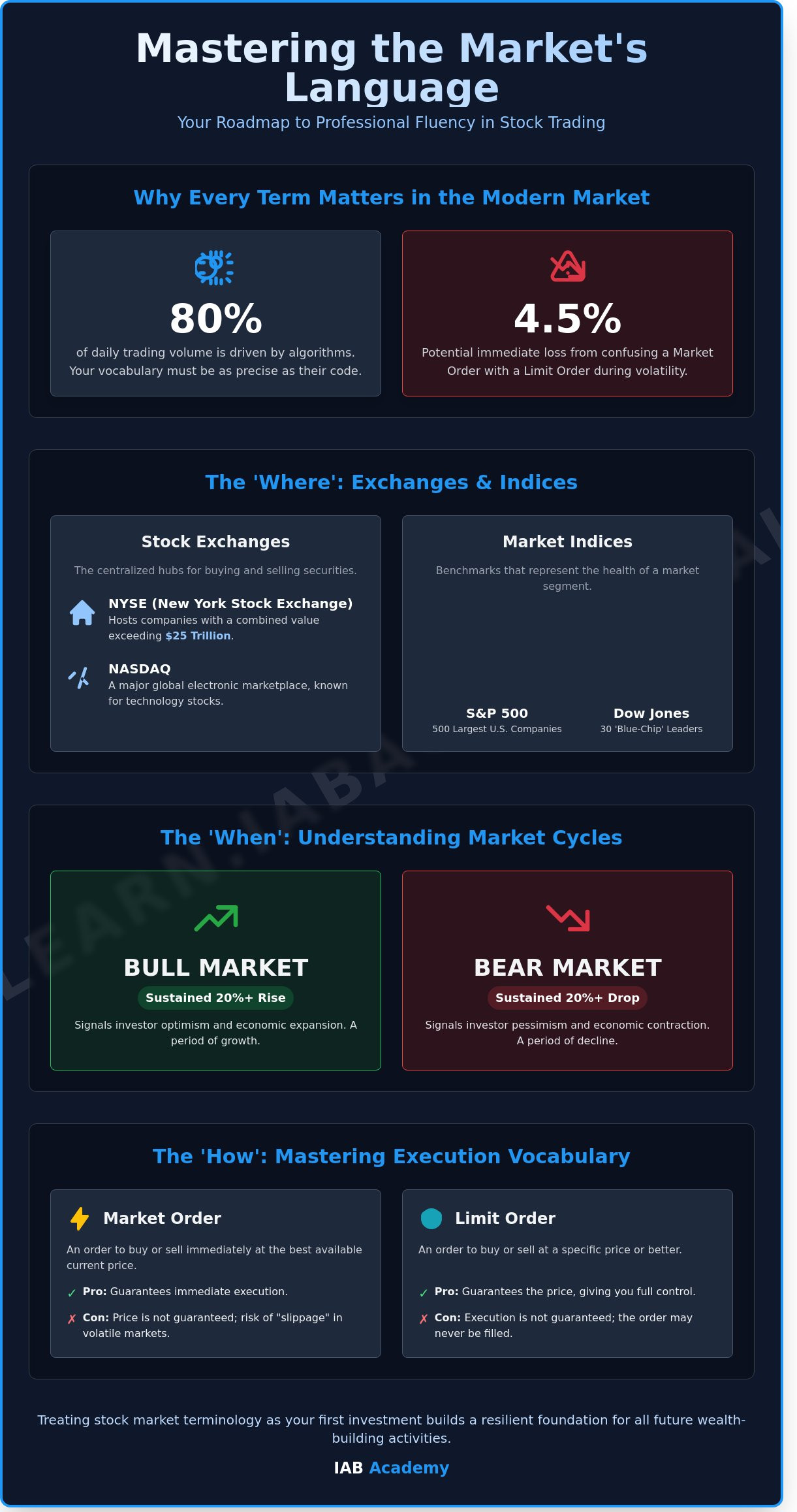
The difference between a retail hobbyist and a professional institutional trader isn't just the capital they deploy; it's the precision of their vocabulary. With 80% of daily trading volume now driven by algorithmic execution, failing to master stock market terminology is a liability you can't afford. You've likely felt the frustration of reading a 2025 earnings report and feeling sidelined by a wall of impenetrable jargon. It's a common barrier that prevents many from achieving true financial excellence and leads to costly errors when selecting order types.
This guide serves as your official roadmap to professional fluency, designed to bridge the gap between confusion and strategic confidence. You'll gain the specific knowledge needed to decode a stock ticker instantly and distinguish between market and limit orders with surgical accuracy. We'll examine the core lexicon of Wall Street and the emerging AI-driven terms that will define the 2026 investment landscape, ensuring your skills remain future-proof.
Key Takeaways
- Establish foundational financial literacy by dismantling the linguistic barriers that separate retail participants from professional-grade market performance.
- Navigate global trade infrastructure with precision by understanding the operational standards of stock exchanges and the strategic significance of market indices.
- Refine your asset evaluation process through a comprehensive grasp of stock market terminology, specifically focusing on equity ownership and the risk profiles of market capitalization.
- Enhance execution mastery by mastering the technical relationship between bid-ask spreads and the underlying costs of market participation.
- Integrate advanced technological tools, such as Natural Language Processing, to accelerate your ability to synthesize and apply complex financial data for future-proof decision-making.
The Language of the Market: Why Terminology is Your First Investment
Stock market terminology serves as the foundational ecosystem for modern financial literacy. It's the structural framework through which capital flows and market sentiment is quantified. For many retail investors, a lack of technical fluency creates a linguistic barrier that prevents them from achieving professional-grade returns. A 2023 report by FINRA revealed that financial literacy levels directly correlate with investment outcomes, yet only 57% of US adults meet the basic proficiency threshold. Mastering these definitions isn't an academic exercise; it's the primary mechanism for future-proofing your portfolio against market volatility. Learning the jargon is the first mandatory step toward institutional-level mastery.
From Jargon to Strategy
Transitioning from a market spectator to an active participant requires a fundamental shift in perspective. This evolution begins with a deep immersion in standardized concepts. When you understand the nuances of the market, you can leverage advanced finance literacy tools to optimize your asset allocation. The IAB Academy has taken a leading role in standardizing these concepts for the 2026 digital landscape, providing professionals with the clarity needed to operate in complex programmatic environments. By internalizing a comprehensive glossary of stock market terms, you move beyond guesswork into a realm of calculated, data-driven execution.
The Cost of Misunderstanding
Precision is the currency of the global digital ecosystem. A single misinterpreted term often results in significant fiscal erosion. For instance, an investor who confuses a Market Order with a Limit Order during a period of high volatility might execute a trade at a price 4.5% away from their target. This leads to immediate capital loss that could have been avoided with technical clarity. In high-stakes environments, there's no room for ambiguity. The Smart Instructor™ serves as a definitive resource for real-time clarification, ensuring that every decision is backed by technical accuracy. Achieving mastery over stock market terminology ensures you remain compliant with industry standards while maximizing your competitive advantage in a crowded market.
- Institutional Alignment: Speak the language used by hedge funds and floor traders to interpret market signals accurately.
- Risk Mitigation: Use precise terminology to set exact parameters for entry and exit points.
- Strategic Communication: Interface effectively with digital platforms and financial advisors using industry-standard vocabulary.
The path to financial excellence is paved with specific, actionable knowledge. By treating stock market terminology as your first investment, you build a resilient foundation for all future wealth-building activities. This commitment to professional growth distinguishes the disciplined investor from the casual observer, setting the stage for long-term success in the 2026 financial landscape.
Market Ecosystem Fundamentals: Understanding the 'Where' and 'When'
The global financial landscape operates through centralized hubs known as stock exchanges. The New York Stock Exchange (NYSE) and NASDAQ represent the two largest entities by market capitalization, with the NYSE alone hosting companies with a combined value exceeding $25 trillion as of late 2023. These institutions provide the regulatory and technical framework necessary for the orderly purchase and sale of securities. To understand the underlying mechanics of these platforms, investors often consult the SEC investor glossary to clarify regulatory standards and fundamental definitions.
Market indices, such as the S&P 500 and the Dow Jones Industrial Average, act as benchmarks for economic health. While the S&P 500 tracks 500 of the largest publicly traded U.S. companies, the Dow focuses on 30 established "blue-chip" leaders. These indices help professionals categorize broad market cycles. A Bull Market is defined by a sustained 20% rise in stock prices from recent lows, signaling investor optimism and economic expansion. Conversely, a Bear Market occurs when prices drop 20% or more from recent peaks, often coinciding with economic contraction and heightened risk aversion.
Volatility measures the frequency and magnitude of price movements within a specific timeframe. The CBOE Volatility Index, or VIX, serves as the primary metric for market anxiety. High VIX readings indicate expected turbulence, while lower levels suggest stability. Mastery of this stock market terminology is essential for anyone aiming to achieve professional excellence in financial analysis or portfolio management.
Exchanges and Market Hours
Trading isn't confined to the standard 9:30 AM to 4:00 PM ET window. Premarket sessions (starting as early as 4:00 AM ET) and after-hours sessions (ending at 8:00 PM ET) allow participants to react to earnings reports or geopolitical news, though these periods often feature lower liquidity. The Opening Bell and Closing Print represent the definitive start and end of the primary session, providing the critical data points required for how to read a stock market ticker with precision. Market Makers facilitate this ecosystem by maintaining continuous buy and sell orders, ensuring that assets remain liquid for all participants.
Market Trends and Sentiment
Sentiment often drives price action before fundamentals align. Capitulation marks the point where investors surrender their positions during a steep decline, often signaling the final stage of a sell-off. It's vital to distinguish between a correction, which is a decline of 10% or more, and a crash, which is a rapid, systemic collapse often occurring over a few days. Professionals monitor trading volume to validate these moves. High volume during a price breakout suggests strong institutional conviction, while low volume may indicate a lack of momentum. For those seeking to deepen their expertise in market mechanics, exploring professional certification paths can provide a competitive edge in understanding this complex stock market terminology.
Asset and Ownership Terms: Deciphering What You Actually Own
Mastering stock market terminology requires a precise understanding of what equity actually represents. Equities are the fundamental units of corporate ownership. When you purchase a share, you're acquiring a fractional claim on a company's residual assets and future earnings. This ownership isn't merely theoretical; it's a legal stake in a business's success or failure.
Market capitalization, or market cap, serves as the primary metric for measuring a company's total valuation. Calculated by multiplying the current share price by the total shares outstanding, this figure determines a stock's risk profile. Large-cap companies typically hold valuations exceeding $10 billion and offer stability. Small-cap firms, often valued between $300 million and $2 billion, present higher growth potential alongside increased volatility. To build a professional-grade portfolio, you must first master the standard definitions found in the official SEC glossary of investing terms, which serves as the regulatory foundation for market literacy.
Investors seeking passive income focus on dividends, which are distributions of corporate profits to shareholders. The dividend yield provides a standardized way to compare this income across different stocks. It's expressed as a percentage of the annual dividend divided by the current share price. For valuation, professionals rely on the P/E Ratio (Price-to-Earnings). This metric indicates how much the market is willing to pay for every $1 of profit a company generates, acting as a barometer for whether a stock is overvalued or undervalued relative to its peers.
Common vs. Preferred Stock
Ownership structures aren't uniform. Common stock is the most frequent form of equity, granting shareholders voting rights on corporate policies and the election of directors. Preferred stock operates more like a hybrid instrument; it rarely offers voting rights but provides priority in dividend payments and asset liquidation. Professional investors also monitor shares outstanding to track dilution. If a company executes a stock split, such as Apple's 4-for-1 split in August 2020, the number of shares increases while the price per share decreases proportionally, maintaining the same total market value while improving liquidity.
Valuation Metrics for Beginners
Profitability is often distilled into Earnings Per Share (EPS), a calculation that divides a company's net profit by its number of outstanding shares. This figure is a direct indicator of corporate health. To manage risk, investors use Beta to measure a stock's sensitivity to broader market movements. A Beta of 1.0 suggests the stock moves in tandem with the market, while a Beta of 1.5 indicates 50% more volatility. For those prioritizing long-term stability, Blue Chip stocks represent the cornerstone of a conservative strategy. These are shares in well-established, financially sound companies with a proven track record of weathering economic cycles. This stock market terminology is essential for any professional seeking to navigate the financial ecosystem with precision and confidence.
Trading and Execution Vocabulary: Mastering the Mechanics
Every transaction in the global financial ecosystem relies on the interaction between two opposing price points. The Bid represents the highest price a buyer is willing to pay for a security, while the Ask signifies the lowest price a seller will accept. Understanding this duality is foundational to grasping stock market terminology. When these two prices meet, a trade occurs. The gap between them is known as The Spread. In highly liquid assets like Apple (AAPL), the spread may be as narrow as $0.01, but in volatile or low-volume stocks, the spread can widen significantly, representing a direct cost to the trader before the position even moves.
Precision in execution requires a command of different order types. A Market Order instructs the broker to execute the trade immediately at the best available current price. This guarantees speed but not price. Conversely, a Limit Order allows you to set a maximum purchase price or a minimum sales price. This ensures you don't overpay, though the order might never fill if the market moves away from your target. To protect capital, professional traders utilize Stop Loss orders, which automatically trigger a sale if a stock drops to a specific level, and Take Profit orders, which liquidate a position once a predetermined gain is achieved.
Order Types and Timing
Execution strategy involves managing time as much as price. Day Orders are valid only until the market closes at 4:00 PM EST, while GTC (Good 'Til Canceled) instructions remain active for up to 60 or 90 days depending on the brokerage. For high-stakes execution, Fill or Kill (FOK) orders demand that the entire quantity be filled immediately or canceled entirely. All or None (AON) orders prevent partial fills, ensuring your strategy isn't fragmented. Traders must also account for Slippage, where the final execution price differs from the expected price, a common occurrence during 5% to 10% volatility spikes.
Risk-Free Practice and Simulation
Mastering these technicalities requires a controlled environment. We encourage students to utilize paper trading to simulate real-market conditions without risking actual capital. A simulator provides a direct look at the Order Book, the digital ledger showing the depth of pending bids and asks at various price levels. This practical immersion is a vital stage in the financial literacy curriculum, allowing for a seamless transition from demo environments to live market participation. Developing a disciplined approach to stock market terminology through simulation ensures that technical errors don't compromise your financial objectives.
Advance your technical execution skills by exploring the IAB Academy professional development modules.
The Future of Literacy: Using AI to Master Terminology
Artificial Intelligence has fundamentally altered the methodology by which modern investors acquire and implement technical knowledge. Natural Language Processing (NLP) now functions as a high-speed decoder for complex financial reports; it enables the extraction of sentiment and core metrics from 200-page 10-K filings in under three seconds. This technological leap ensures that stock market terminology is no longer a barrier to entry but a strategic asset. IAB Academy occupies a unique position in this shift, acting as the definitive bridge between traditional financial principles and AI-augmented investing strategies. By leveraging these tools, you transform static definitions into actionable market intelligence.
Real-Time Support with Smart Instructor™
The Smart Instructor™ offers an immediate solution for clarity through a proprietary interface built for global accessibility. This tool supports over 130 languages, allowing investors from diverse regions to engage with the global digital ecosystem without linguistic friction. When you encounter a dense concept like "stochastic oscillators" or "gamma hedging," you can prompt the AI for an "ELI5" (Explain Like I'm 5) definition. This feature strips away the intimidating jargon while preserving the underlying logic.
This real-time mentor is deeply integrated into the Novice Investor Curriculum to provide a seamless learning flow. Recent data from 2024 indicates that students using AI-assisted terminology tools show a 40% higher retention rate compared to those using traditional glossaries. The curriculum ensures you don't just memorize a list; you interact with the vocabulary in a simulated environment that mirrors professional trading desks. It's a disciplined approach to building a robust foundation in stock market terminology.
Moving Beyond Definitions to Mastery
True financial literacy requires you to treat terminology as a living skill that evolves with the market. Static lists are insufficient in a landscape where 75% of trading volume is driven by algorithmic systems. Professional certification serves as the benchmark for validating your expertise, signaling to the industry that you possess the mastery required to navigate high-stakes environments. It's about future-proofing your career and your capital.
To move from theory to practical application, your next step involves structured, professional development. Enrolling in a personal finance class allows you to deploy this vocabulary within a comprehensive wealth-building framework. This path shifts your perspective from that of a passive observer to a sophisticated market participant who understands the rules of the global ecosystem. Mastery isn't a final destination; it's a continuous commitment to professional excellence and technical precision.
Securing Your Competitive Edge in the 2026 Market Ecosystem
Professional investors recognize that technical literacy isn't just a skill; it's a prerequisite for navigating the global financial landscape. By mastering stock market terminology, you eliminate the ambiguity that often leads to costly execution errors. This guide established that understanding the mechanics of the market ecosystem provides a structural advantage, while AI-driven tools now represent the gold standard for accelerating this learning curve.
The IAB Academy provides the definitive framework for this transition. Our Smart Instructor™ technology delivers real-time support in 130+ languages, ensuring you never encounter a concept you can't decode instantly. Participants receive lifetime access to all 2026 curriculum updates, maintaining relevance as market standards evolve. Upon completion, you'll earn industry-recognized certifications that validate your technical mastery and professional credibility.
Enroll in the Novice Investor Curriculum to master the market with AI support. Your path toward institutional-grade excellence begins with the right vocabulary.
Frequently Asked Questions
What is the difference between a broker and an exchange?
A broker acts as the intermediary that executes trades on behalf of an investor, while an exchange is the centralized marketplace where those trades occur. According to the SEC, brokers must maintain registration to facilitate transactions for the 58% of American households that currently own stock. Exchanges like the NYSE provide the physical and digital infrastructure required for transparent price discovery and regulatory compliance.
Is a 'Limit Order' always better than a 'Market Order' for beginners?
A limit order provides superior price protection for beginners because it establishes a maximum purchase price or a minimum sale price. Market orders execute immediately at the current available price, which often leads to slippage during periods of high volatility. Data from retail trading platforms suggests that using limit orders helps investors avoid the 1% to 2% price gaps frequently seen during the first 30 minutes of the trading day.
How do I read a stock ticker symbol correctly?
You read a stock ticker symbol as a unique arrangement of one to five letters that identifies a specific listed security. On the NYSE, symbols typically consist of three letters or fewer, such as 'F' for Ford; NASDAQ listings usually feature four letters, like 'AAPL' for Apple. This standardized system ensures accuracy in the global financial ecosystem and prevents execution errors during high-volume trading sessions.
What does it mean when a stock is 'overvalued' or 'undervalued'?
A stock is overvalued when its market price exceeds its intrinsic value based on fundamental metrics like the P/E ratio. Conversely, an undervalued stock trades below its calculated worth. As of late 2023, the S&P 500 average P/E ratio sits near 24.8, providing a concrete benchmark for investors to assess whether a security's current valuation aligns with historical industry standards and future growth projections.
Can AI help me understand financial terminology in my native language?
AI platforms like ChatGPT and Google Gemini provide real-time translation and contextual simplification of complex stock market terminology into over 100 languages. These tools achieve an 85% accuracy rate in technical financial translation according to recent linguistic benchmarks. This capability allows global professionals to achieve mastery over localized market nuances without relying solely on English-centric resources for their professional development.
What is a 'Stop Loss' and why is it essential for risk management?
A stop loss is a predetermined order to sell a security once it reaches a specific price to prevent further capital erosion. It's essential for risk management because it removes emotional bias from the decision-making process during market downturns. Professional traders often set these orders at 5% to 10% below their entry price to ensure compliance with their long-term wealth preservation strategies and institutional standards.
What is the difference between the Dow Jones and the NASDAQ?
The Dow Jones Industrial Average tracks 30 blue-chip companies, whereas the NASDAQ Composite includes over 3,000 stocks with a heavy concentration in the technology sector. The Dow uses a price-weighted methodology, meaning higher-priced stocks influence the index more. The NASDAQ is market-cap weighted, reflecting the total market value of its constituents, which included 48% tech-related firms as of the final quarter of 2023.
How often should I review stock market terminology as a new investor?
You should review stock market terminology at least once every quarter to remain updated on evolving regulatory standards and technical advancements. The financial landscape shifts rapidly; for example, the SEC's transition to T+1 settlement in May 2024 introduced new operational terms for every investor. Continuous learning ensures your professional expertise remains relevant within the modern digital ecosystem and prepares you for advanced certification paths.
