
How to Stop Emotional Trading Decisions: A Professional Framework for 2026
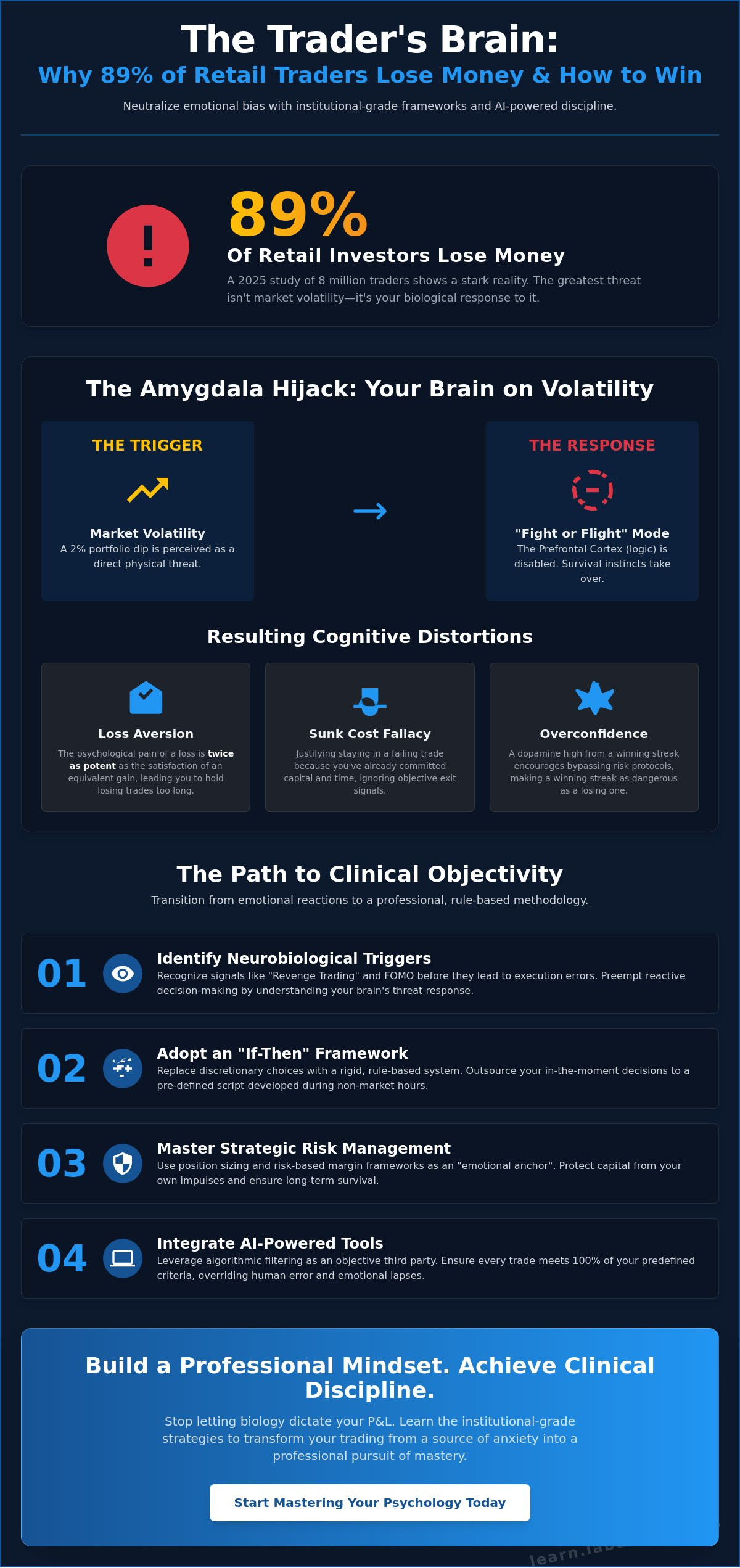
A 2025 study of eight million traders revealed that up to 89% of retail investors lose money, a statistic that remains stubbornly high even after the elimination of the Pattern Day Trader rule in June 2026. This reality highlights a fundamental truth: the greatest threat to your capital isn't the market's volatility, but your biological response to it. Learning how to stop emotional trading decisions requires a shift from manual intuition to a rigorous, framework-driven approach. You've likely experienced the exhaustion of watching a disciplined plan dissolve into panic or FOMO during a sudden price swing. It's frustrating to see your hard-earned capital vanish because of a split-second lapse in judgment.
We'll provide the institutional-grade strategies you need to neutralize these biases and achieve clinical objectivity. This guide masters the intersection of psychological discipline and AI-powered technological filters to ensure your execution remains consistent. We'll explore how to implement adaptive systems and risk-based margin frameworks that protect you from your own impulses, transforming your trading from a source of anxiety into a professional pursuit of mastery.
Key Takeaways
- Identify the neurobiological triggers that cause the brain to treat market volatility as a physical threat to preempt reactive decision-making.
- Transition from discretionary choices to a rule-based "If-Then" framework that removes the requirement for real-time creativity during high-stakes environments.
- Master the strategic risk management protocols and position-sizing techniques essential for learning how to stop emotional trading decisions before they impact your capital.
- Integrate AI-powered tools and algorithmic filtering to serve as an objective third party, ensuring every trade meets 100% of your predefined criteria.
- Build a professional mindset through structured education to replace market-induced anxiety with the clinical discipline required for institutional-grade execution.
The Neurobiology of the Trade: Why Your Brain is Wired to Lose
To master how to stop emotional trading decisions, you must first accept that your brain isn't naturally designed for 2026's high-frequency market environments. When a position moves against you, the amygdala, the brain's primitive survival center, perceives the financial drawdown as a direct physical threat. This "amygdala hijack" triggers a cascade of chemical responses that prioritize immediate survival over long-term strategic planning. In this state, the brain treats a 2% dip in a portfolio with the same urgency as a predator in the wild, effectively disabling the prefrontal cortex where analytical decision-making occurs. Emotional trading isn't a character flaw; it's a systemic failure where biological survival instincts override financial logic.
This biological reality is compounded by cognitive distortions that are deeply embedded in our evolutionary history. The Neurobiology of the Trade reveals that loss aversion often forces traders to hold onto losing positions far longer than their plan dictates. The psychological pain of a loss is statistically twice as potent as the satisfaction of an equivalent gain. This leads to the "sunk cost" fallacy, where you justify staying in a failing trade simply because you've already committed capital and time to it, ignoring the objective data that suggests an immediate exit.
Conversely, winning trades present their own unique risks through the dopamine loop. A successful trade releases dopamine, the brain's reward chemical, which can cloud judgment and lead to overconfidence. This chemical high often encourages traders to bypass their established risk protocols in search of the next "hit." This makes a winning streak just as dangerous to your long-term capital as a losing one if it leads to undisciplined execution.
The Physiology of Financial Stress
High-stakes trading environments naturally elevate cortisol levels, the body's primary stress hormone. Sustained cortisol exposure impairs your ability to process complex data and recognize subtle market patterns. As you transition from analytical thinking into a "fight or flight" mode, your field of vision narrows and your decision-making becomes binary. Relying on willpower alone to combat these physiological shifts is a losing strategy. Willpower is a finite cognitive resource that depletes rapidly under market pressure, making institutional-grade frameworks essential for survival.
Recognising Your Personal Emotional Triggers
Professional discipline requires identifying the specific scenarios that bypass your rational filters. The "Revenge Trade" is a common response to a significant drawdown, where the urge to recover losses immediately leads to oversized positions and ignored stop-losses. Similarly, Fear of Missing Out (FOMO) is a social survival mechanism that triggers urgent, impulsive action when you perceive others are profiting without you. Understanding how to stop emotional trading decisions starts with recognizing these internal signals before they manifest as manual execution errors.
Trading tilt is a state of temporary cognitive impairment where emotional volatility overrides rational execution.
Constructing a Systematic Trading Plan to Neutralise Bias
The transition from discretionary trading to rule-based execution represents the single most significant hurdle for the retail investor. Most traders fail because they rely on real-time creativity during market hours, a period when the biological pressures discussed in the previous section are at their peak. To understand how to stop emotional trading decisions, you must replace "gut feelings" with a rigid, institutional-grade framework. By utilizing an "If-Then" logic set, you effectively outsource your decision-making to a pre-defined script. This methodology aligns with the core tenets of behavioral economics, which suggests that human judgment is inherently prone to systematic errors when stakes are high.
Pre-market preparation serves as your primary tool for emotional grounding. By analyzing the market while the exchange is closed, you operate from a position of objective clarity rather than reactive panic. This discipline is reinforced by a meticulous trading journal. Professional journaling goes beyond recording profits and losses; it acts as a diagnostic tool to identify recurring psychological patterns and execution errors. Professional development through structured financial literacy courses provides the framework necessary to maintain this level of operational discipline consistently.
Defining Your Entry and Exit Parameters
Objective entry criteria are the first line of defense against impulsive action. Your plan should dictate exactly which technical indicators or price action signals must align before a trade is initiated. Equally critical is the necessity of hard-coded exit points. You must determine your stop-loss and take-profit levels before the trade is even placed. Integrating stock market fundamentals into these rules ensures that technical setups are supported by underlying asset strength, further reducing the urge to second-guess your strategy mid-trade.
The 5-Step Pre-Trade Checklist
A standardized checklist forces the brain to engage its analytical prefrontal cortex before execution. Every trade must pass through these five filters:
- Step 1: Technical Alignment. Verify that the setup exists across multiple timeframes to ensure high-probability confluence.
- Step 2: Macro-Economic Catalyst. Check the 2026 economic calendar for scheduled news events that could trigger artificial volatility.
- Step 3: Risk-to-Reward Ratio. Confirm a minimum 1:2 threshold. If the potential reward doesn't justify the risk, the trade is discarded.
- Step 4: Emotional Self-Assessment. Utilize the HALT method. Never trade if you're Hungry, Angry, Lonely, or Tired.
- Step 5: Liquidity Verification. Ensure the asset's current volume supports a clean entry and exit without excessive slippage.
This systematic approach is the only sustainable way to master how to stop emotional trading decisions. By treating each trade as a data point within a larger statistical model, you detach your self-worth from individual outcomes and focus entirely on the integrity of your process.
Strategic Risk Management as an Emotional Anchor
Risk management is frequently categorized as a capital preservation tool, yet its primary function in institutional environments is psychological stabilization. The "size of the bet" remains the fundamental driver of market-induced fear. When a position represents an outsized portion of your total equity, the physiological stress response becomes nearly impossible to suppress. Establishing rigid position-sizing protocols is the most effective way to understand how to stop emotional trading decisions at their source. By controlling the input, you dictate the intensity of the emotional output.
Adhering to the "1% Rule" ensures that no single trade can trigger a catastrophic emotional response. By risking only 1% of your account equity on any individual setup, you maintain the "emotional capital" required for long-term survival. Even a string of five consecutive losses results in only a 5% drawdown, a manageable figure that prevents the "revenge trading" impulse. This mathematical buffer keeps you within your cognitive "comfort zone," where analytical reasoning remains dominant over primitive survival instincts.
Math vs. Emotion: The Power of Probabilities
Professional traders view their career as a series of independent events rather than a single high-stakes gamble. This probabilistic shift in perspective transforms a loss from a personal failure into a standard cost of doing business. Robust risk management preserves your cognitive bandwidth, allowing you to focus on execution quality rather than dollar fluctuations. Leverage acts as the primary accelerant of emotional escalation. It compresses the time available to react, often forcing the brain into a state of "trading tilt" before you can process the incoming data. Reducing leverage is often the fastest path to restoring objectivity.
Protecting Gains and Limiting Losses
Automated stop-loss orders provide the psychological relief necessary to maintain discipline during high-volatility sessions. Mental stops almost always fail under pressure because they require the trader to negotiate with their own loss aversion mid-trade. Hard-coded stops remove this negotiation entirely. Trailing stops further neutralize the "greed" factor by locking in profits as the market moves in your favor, preventing the common mistake of turning a winner into a loser. Mastering these concepts through a structured financial literacy curriculum allows you to manage portfolio volatility with institutional-grade precision.
Finally, implement daily drawdown thresholds as a personal circuit breaker. If your losses exceed a pre-set percentage for the day, you must walk away from the terminal. This rule preserves your capital and your mental health for the next session. This is the practical reality of how to stop emotional trading decisions: you build a cage for your impulses before the market even opens.
Leveraging AI and Automation to Override Human Error
The technological landscape of 2026 provides retail investors with tools once reserved for elite institutional desks. While previous sections focused on internal discipline, the most effective strategy for how to stop emotional trading decisions involves removing the human element from the execution loop entirely. AI acts as an objective third party, unaffected by the cortisol spikes or dopamine loops that compromise human judgment. By delegating trade identification to algorithmic filters, you ensure that every position meets 100% of your predefined criteria before capital is committed. This shift from manual scanning to automated oversight eliminates the "ego" that often leads to disastrous mid-trade adjustments.
A 2026 survey of retail investors revealed that 62% now utilize AI tools to inform their market decisions, with 65% of those users reporting improved performance. This adoption is driven by the rise of real-time bias detection software. These modern tools monitor your execution patterns and can flag "impulse trading" behavior, such as revenge trading after a drawdown or chasing a vertical move. Transitioning to semi-automated execution allows you to bypass manual hesitation. You set the parameters in a cold, analytical state; the machine executes them in the heat of the market.
The Role of AI Trading Assistants
Modern AI trading assistants provide instant, data-driven answers during periods of extreme market volatility. Instead of reacting to a price spike with panic, you can query your assistant to verify if the movement aligns with historical backtested data. This reduces "analysis paralysis" by synthesizing vast amounts of sentiment and technical data into actionable insights. Building confidence through AI-led backtesting ensures that when the market tests your resolve, you rely on statistical evidence rather than emotional guesswork. To master these advanced systems, professionals are increasingly turning to AI-Powered Trading Tools Training to maintain their competitive edge.
Smart Instructor™: Real-Time Support for Traders
Educational infrastructure has evolved to include Smart Instructor™ technology, which offers real-time pedagogical support. These AI-powered video tutors provide immediate reinforcement of trading discipline, offering instant answers in over 130 languages to a global professional ecosystem. This technology is particularly effective for newer traders who need to stabilize their emotional state during live sessions. AI tutoring bridges the gap between theoretical knowledge and live execution by providing an objective voice of reason when biological impulses are most likely to override your plan. By integrating these automated filters, you transform your trading desk from a theater of emotion into a disciplined environment of institutional-grade execution.
Mastering the Professional Mindset with IAB Academy
Achieving institutional-grade discipline requires more than a set of rules; it demands a fundamental shift in your professional identity. The Novice Investors Course at IAB Academy is specifically engineered to provide this transformation, offering a foundation that resists market noise and speculative hype. By grounding your strategy in validated data and historical precedents, you discover how to stop emotional trading decisions through the lens of objective proficiency. Professional education serves as the ultimate antidote to trading anxiety, replacing the fear of the unknown with a comprehensive understanding of market mechanics. When you're backed by a structured framework, you don't react to the market; you execute within it.
The 2026 digital ecosystem moves with a velocity that renders static knowledge obsolete. Lifetime access to IAB Academy resources ensures that your skills remain aligned with the latest technological shifts and regulatory updates. Mastery is achieved through rigorous, structured assessments and certifications that validate your proficiency. This formal validation acts as a psychological anchor, reinforcing your confidence in your system during periods of high volatility. It's about moving from a state of constant doubt to one of clinical certainty.
A Curriculum Built for the Modern Investor
IAB Academy integrates sophisticated AI tools into every level of its financial literacy courses. This approach ensures that you aren't just learning legacy technical analysis, but rather how to synthesize macro-economic data and algorithmic strategy into a cohesive plan. Moving beyond basic charts is essential for survival in a market dominated by institutional bots. Mentorship within this professional ecosystem provides the emotional resilience needed to navigate drawdowns without breaking protocol. You'll learn to view risk not as a threat, but as a calculated component of a professional operation.
Your Roadmap to Trading Discipline
Enrolling in the AI-Powered Investing Education program provides the competitive edge necessary to thrive in 2026. This curriculum leverages the Smart Instructor™ for real-time decision support, ensuring that the gap between theory and live execution is permanently closed. By adopting these high-level standards, you protect your capital and your career longevity. The path to consistent profitability is paved with discipline, data, and the right educational infrastructure. Take the final step in your professional development and secure your position in the global market.
Join IAB Academy and master the art of objective trading
Securing Your Competitive Edge in the 2026 Market
The transition from a reactive retail participant to a disciplined professional requires a structural overhaul of your operational framework. You've seen how neurobiological triggers and cognitive distortions can sabotage even the most sophisticated strategies. By implementing rigid risk management and rule-based execution, you establish the clinical objectivity necessary for long-term survival. Understanding how to stop emotional trading decisions isn't about suppressing your humanity; it's about bypassing it through institutional-grade technology and systematic discipline. As the 2026 landscape grows more complex, the integration of AI-powered filters becomes the definitive standard for those seeking to protect their capital from impulsive execution errors.
IAB Academy stands as a global Houston-based authority in AI investing education, providing the infrastructure needed to bridge the gap between novice intuition and professional mastery. With our Smart Instructor™ offering real-time support in over 130 languages, you have the tools to maintain discipline regardless of market conditions. Our comprehensive curricula guide you from fundamental literacy to advanced algorithmic strategy. Master Your Trading Mindset with IAB Academy’s AI-Powered Curriculum and transform your approach into a source of consistent, objective execution. The future of your portfolio depends on the systems you build today.
Frequently Asked Questions
Can you actually trade without any emotion at all?
Total emotional elimination is biologically impossible because the human brain is hardwired for survival. Instead of attempting to delete feelings, professional traders focus on neutralizing their impact through institutional-grade frameworks. Mastery involves recognizing the physiological response to market movement and employing rule-based execution to ensure these impulses don't translate into manual errors. You don't eliminate the feeling; you simply remove its power over the trade.
What is the most common emotional mistake for new traders?
The most prevalent mistake is loss aversion, where traders hold losing positions in the hope of a break-even exit. This behavior is driven by the primitive brain's desire to avoid the pain of a realized loss. Fear of missing out, or FOMO, is a close second. It often leads to entering trades at suboptimal prices due to perceived social pressure or chasing vertical market momentum without technical confirmation.
How does a trading journal help stop emotional decisions?
A trading journal acts as a diagnostic tool that reveals recurring psychological patterns over time. By documenting your emotional state alongside technical data, you gain the objective evidence needed for how to stop emotional trading decisions. This process transforms subjective experiences into actionable data. It allows you to identify specific market conditions that trigger your personal biases, enabling you to build targeted defenses against them.
Is algorithmic trading better for emotional people?
Algorithmic trading is highly effective for individuals prone to emotional volatility because it removes the manual execution trigger. By automating the entry and exit process based on predefined logic, you eliminate the hesitation and second-guessing that occur during live sessions. This shift ensures that your strategy is executed with clinical precision. It maintains consistency regardless of your current stress levels or the market's immediate volatility.
What should I do immediately after a large emotional loss?
You must immediately cease all trading activity and disconnect from your platform to prevent further damage. Attempting to trade while in a state of tilt or extreme stress leads to compounding errors and rapid capital depletion. Professional discipline dictates that you wait for your cortisol levels to normalize before conducting a technical post-mortem. Only after you've regained analytical objectivity should you review the trade data.
How can AI help me stick to my trading plan?
AI provides an objective third-party layer that flags deviations from your established strategy in real time. Modern tools analyze your execution patterns and can proactively prevent you from placing trades that don't meet your 100% criteria. This technological oversight is a primary method for how to stop emotional trading decisions. It forces a cognitive pause between the emotional impulse and the physical act of execution.
What is the 1% rule in risk management?
The 1% rule is a foundational risk management protocol where you limit your risk on any single trade to 1% of your total account equity. This ensures that a single loss cannot cause a catastrophic drawdown or trigger a panic response. By keeping the stakes mathematically manageable, you reduce the intensity of the physiological stress response. This allows your analytical brain to remain in control during market fluctuations.
How do I know if I am revenge trading?
Revenge trading is characterized by an urgent desire to win back capital immediately after a loss. Indicators include increasing your position size to recover losses faster or entering trades that don't meet your technical criteria. If you find yourself ignoring your stop-loss or trading more frequently than your plan allows, you're likely operating under an emotional impulse. Recognizing this state is the first step toward restoring discipline.
