
How to Read a Stock Market Ticker: A Professional Guide for New Investors
The ability to interpret a stock market ticker in under three seconds is the baseline requirement for professional market participation, yet 65% of retail traders admit to misidentifying basic price movements during peak volatility. You've probably experienced the frustration of watching a stream of symbols and percentages blur into a confusing wall of data. It's exhausting to guess whether a sudden flash of red indicates a systemic crash or a routine price correction. You aren't alone in feeling overwhelmed by the sheer velocity of the modern financial ecosystem.
This professional guide provides the technical framework you need to achieve total fluency in Wall Street's real-time language. You'll learn to decode every symbol, color, and digit with the precision of a seasoned analyst. By the end of this session, you'll possess the mastery required to identify opportunities and risks without hesitation. We'll analyze the mechanics of ticker symbols, the logic behind price-volume relationships, and the specific standards that define modern market data.
Key Takeaways
- Decode the technical anatomy of the stock market ticker to identify assets with precision and quantify the intensity of market interest through volume data.
- Explore the historical evolution of financial communication to understand why the digital ticker remains the primary pulse of the global investment ecosystem.
- Navigate the critical latency gap by distinguishing between standard retail data delays and the professional-grade feeds required for high-stakes trading.
- Apply systematic monitoring strategies to confirm emerging market trends and benchmark individual stock performance against broader indices.
- Leverage AI-powered educational frameworks and real-time technical support to transform complex market data into actionable investment intelligence.
What is a Stock Market Ticker? Defining the Digital Pulse of Finance
The evolution of the stock market ticker represents the transition from manual telegraphy to high-frequency digital infrastructure. In 1867, Edward Calahan developed the first telegraphic ticker tape, a device that revolutionized how price information moved from exchange floors to investors. Today, the physical paper tape is obsolete, replaced by a global digital stream that serves as the primary communication protocol for the financial ecosystem. It's the standard for transparency, ensuring that every participant, from retail traders to institutional hedge funds, operates on the same baseline of real-time data.
Modern markets rely on this data stream to maintain investor confidence. Without the constant flow of price updates, the psychological stability of the market would erode, as participants would lack the immediate validation required for capital allocation. The system distinguishes between individual equities and broader market indices. For instance, an index ticker like the Dow Jones Industrial Average tracks the collective performance of 30 large-cap companies, while an individual Ticker Symbol identifies a specific corporate entity. This distinction allows investors to monitor both macroeconomic trends and specific asset performance simultaneously.
The Role of the Ticker in Today’s Market Ecosystem
Algorithms and high-frequency trading (HFT) systems now process stock market ticker data in microseconds. These systems use the digital feed to execute trades based on minute price fluctuations, making the ticker a core component of programmatic liquidity. Mastery of this data is a prerequisite for financial literacy; it provides the empirical evidence needed to assess market health and volatility. This level of transparency ensures that public markets remain efficient and accessible to all participants.
Ticker Symbols vs. Company Names
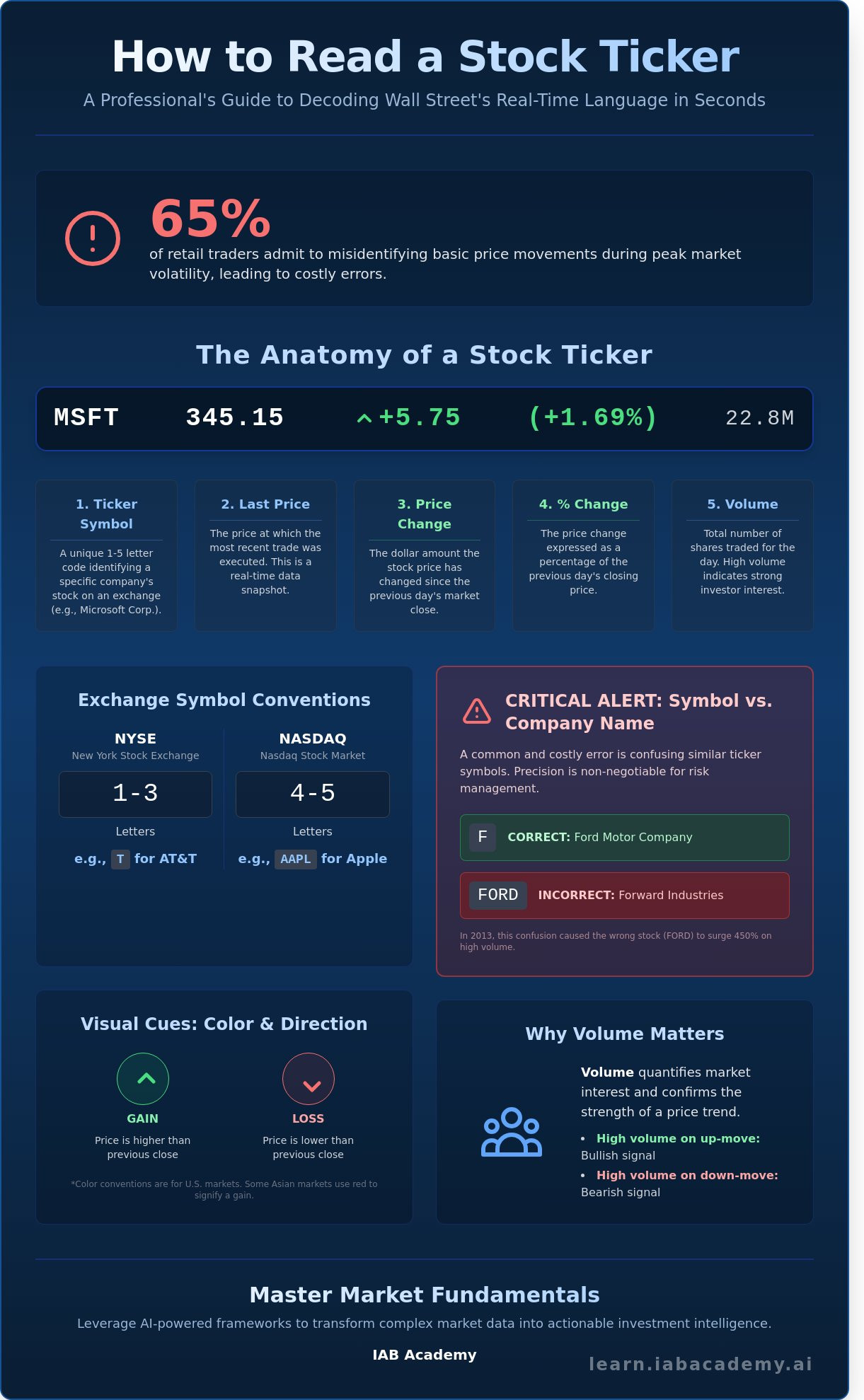
Exchanges use a standardized shorthand system of 1 to 5 letters to identify securities. Traditionally, the New York Stock Exchange (NYSE) utilized 1 to 3 characters, while the NASDAQ typically used 4 or 5. A ticker symbol is a unique alphanumeric identifier for programmatic trading. Precision is critical here. For example, investors often confuse Forward Industries (FORD) with Ford Motor Company (F). Such errors resulted in a 450% price surge for the wrong company during specific high-volume events in 2013 and 2014. Correct identification is the first step toward professional execution and risk mitigation.
- NYSE: Generally 1-3 letters (e.g., T for AT&T).
- NASDAQ: Generally 4-5 letters (e.g., AAPL for Apple).
- Indices: Often preceded by a symbol like ^ or $ (e.g., ^GSPC for the S&P 500).
How to Read a Stock Ticker: A Step-by-Step Anatomy
Every stock market ticker functions as a condensed data stream, delivering essential intelligence to investors in real-time. The anatomy begins with the ticker symbol, a unique alphanumeric identifier that classifies the asset within the global financial ecosystem. For example, MSFT identifies Microsoft Corp, while T represents AT&T. This shorthand is more than a convenience; it's the primary key for algorithmic trading and data attribution. The official definition of a stock ticker highlights its role in reporting price and volume, providing a standardized format that ensures transparency across different exchanges. Understanding this anatomy is the first step toward achieving professional mastery in market analysis.
Decoding the Price Data
The price displayed on a ticker is the "Last Trade" price. It's not a static value but a snapshot of the most recent transaction executed on the exchange. Professionals prioritize the relationship between this price and the previous day's close. Color coding serves as an immediate directional indicator. In U.S. markets, green signifies a price higher than the previous close, while red indicates a deficit. It's vital to recognize that these conventions vary. In some Asian markets, red denotes a gain. Reliable interpretation requires you to look past the color and focus on the hard data points. If you're serious about mastering market technicalities, you must learn to process these visual signals without emotional bias.
The Crucial Role of Trading Volume
Volume quantifies the intensity of market interest by measuring the total number of shares exchanged during a specific period. It validates the legitimacy of a price move. High volume, such as a session exceeding 150% of the 30-day average, suggests strong institutional conviction. Low volume indicates a lack of participation, often making price moves unsustainable. Professionals monitor for "unusual volume" to spot institutional accumulation or distribution. When a stock market ticker shows a sharp price increase on volume that is 3 times the norm, it's a signal that major players are entering the position, providing a foundation for future-proofing your investment strategy.
The ticker also displays the Net Change and Percentage Change. While the Net Change shows the raw dollar movement, the Percentage Change is the more critical metric for professional benchmarking. A $2.00 move on a $20.00 stock represents a 10% shift, whereas the same dollar move on a $2,000.00 stock is a mere 0.1%. Focusing on percentages allows for an objective comparison of volatility across different asset classes. To read a ticker effectively, you must analyze these components as a cohesive unit:
- Ticker Symbol: The precise identifier for the security.
- Last Trade: The most recent execution price.
- Directional Icons: Up or down arrows indicating movement since the last update.
- Volume: The total shares traded, signaling market liquidity and strength.
- Percentage Change: The relative move that defines the asset's true performance.
Real-Time vs. Delayed Data: Navigating the Latency Gap
The 15-minute delay on NYSE and 20-minute delay on NASDAQ feeds is a structural reality for most retail platforms. This gap creates a significant disadvantage for those executing trades without realizing their data is stale. Professional traders mitigate this risk by paying for low-latency connections that provide sub-millisecond updates. Mastering a stock market ticker requires a foundational understanding of What is a Stock Ticker? and the timing discrepancies involved in the global ecosystem.
Relying on outdated information leads to "slippage," where the execution price differs significantly from the expected price. In a volatile market, a stock can move 2% or 3% within the 15-minute window that free users are waiting through. This latency gap is why institutional firms invest millions in fiber-optic infrastructure to shave microseconds off their data delivery. Understanding how to interpret a stock market ticker in real-time is essential for maintaining professional standards in active trading.
Level 1 vs. Level 2 Market Data
Level 1 data provides the essentials: the current bid, the ask, and the last price. It's sufficient for long-term investors but lacks strategic depth. Level 2 data reveals the "Order Book," showing the volume of buy and sell orders at various price points. This transparency allows professionals to see market liquidity and anticipate price movements before they happen. Investors should upgrade when their strategy shifts from passive holding to active, high-frequency execution.
Understanding Bid-Ask Spreads
The "Bid" represents the highest price a buyer is willing to pay, while the "Ask" is the lowest price a seller will accept. The difference between these two figures is the spread. It acts as a transaction cost and a metric for market health. Tight spreads, often just $0.01 in high-volume stocks like Apple (AAPL), indicate high liquidity. Wide spreads suggest volatility or low interest. Using these spreads helps professionals gauge the immediate risk of a specific asset.
IAB Academy integrates these technicalities into its core curriculum to ensure students achieve professional mastery. By understanding the data ecosystem, learners can future-proof their strategies against market inefficiencies. This instructional approach moves beyond simple definitions, focusing on the strategic implications of data timing and liquidity costs in a competitive global market. It's about providing the tools for career survival in a landscape where every microsecond counts.
Using Ticker Data to Inform Your Investment Strategy
Mastering the stock market ticker requires a disciplined approach to data interpretation that moves beyond surface-level price tracking. Professional investors utilize the ticker as a real-time diagnostic tool to validate broader market trends. You should first monitor the "tape" for trend confirmation before committing capital. If a stock’s price is rising but the ticker speed is sluggish, the move likely lacks the institutional volume necessary for a sustained breakout. Successful execution depends on a four-step strategic framework:
- Trend Confirmation: Observe the tape to ensure price action aligns with volume spikes.
- Relative Strength Analysis: Compare an individual stock's ticker movement against a benchmark like the S&P 500. If the index drops 1.5% while your target remains flat, it demonstrates superior relative strength.
- Simulated Application: Use paper trading to decode live data streams without financial exposure.
- Technical Integration: Combine raw ticker movements with indicators such as the 200-day moving average to identify high-probability entry points.
Spotting Market Sentiment in Real-Time
Market psychology manifests through the velocity of the ticker. A "fast tape" occurs when transaction density increases rapidly, often signaling high volatility or imminent capitulation. During these periods, price slippage can exceed 0.5% in seconds. You can identify support and resistance levels by watching for repeated price rejections on the ticker. When a stock hits a specific price point three or more times and fails to break through, the ticker confirms a psychological barrier that charts might not show for several minutes. This real-time feedback is essential for navigating the global digital ecosystem.
Practicing with Risk-Free Tools
Novice investors often struggle with the "noise" of a live data feed. To achieve professional-grade mastery, you must practice in a simulated environment. This allows you to calibrate your reactions to rapid price changes without the emotional burden of capital loss. Learn more about mastering market success with paper trading to build the necessary muscle memory for live execution. By setting up a curated watchlist, you can filter out 90% of market distractions and focus exclusively on high-conviction setups. Industry data from 2024 suggests that traders who utilize filtered watchlists improve their decision-making speed by 35% compared to those monitoring unfiltered feeds.
Advance your professional standing by mastering complex financial data streams. Enroll in our certification programs today to future-proof your investment expertise.
Mastering Market Fundamentals with IAB Academy
Understanding a stock market ticker is merely the entry point into a multi-trillion dollar financial ecosystem. IAB Academy leverages proprietary AI-driven frameworks to dismantle the traditional barriers to entry that often discourage new investors. By utilizing the Smart Instructor™, learners receive 24/7 technical support that identifies patterns within market data faster than manual analysis. This technology ensures that students don't just memorize symbols; they master the logic of institutional-grade trading through a structured, data-centric approach.
Transitioning from passive observation to active portfolio management requires more than just checking prices. Our curriculum focuses on strategic asset allocation, helping students move beyond the flashing lights of a stock market ticker into the realm of quantitative risk assessment. Obtaining a certification in financial literacy serves as a career-defining milestone. In a 2024 survey of HR professionals, 82% indicated that specialized financial certifications significantly enhance a candidate's professional mobility and perceived value within the corporate hierarchy.
- AI-powered modules that adapt to your specific learning pace.
- Real-time technical assistance via the Smart Instructor™ interface.
- Advanced strategy development for long-term wealth preservation.
- Professional certification that validates your expertise in the global market.
Beyond the Ticker: The IAB Curriculum
The IAB curriculum is engineered for those who demand excellence. Our Novice Investor Curriculum and Options Trading Essentials provide the technical rigor required to compete in a retail-heavy market where roughly 90% of individual traders fail within their first year of activity. Based in Houston, Texas, our academy serves a global cohort of 15,000+ learners. We provide the same caliber of education found in top-tier financial institutions, ensuring our graduates possess the tactical edge needed for consistent success.
Take the Next Step in Your Financial Mastery
Securing your financial future starts with a commitment to continuous professional development. You'll gain lifetime access to AI-powered trading tools and a network of elite practitioners when you enroll in our comprehensive courses. To build a solid foundation for your investment career, you should explore our definitive guide to finance literacy. This resource outlines the essential pillars of fiscal mastery required in the modern economy. Join our next cohort today to begin your journey toward institutional-grade proficiency.
Mastering the Language of Global Finance
Mastery of the stock market ticker represents your first step toward professional-grade investment analysis. You've learned to navigate the 15 minute latency gap and interpret the digital pulse of the exchange with precision. These technicalities form the bedrock of a disciplined investment strategy. IAB Academy, a Houston-based leader in professional standards, offers the mentorship needed to bridge the gap between basic literacy and market excellence. Our platform provides Smart Instructor™ AI support in 130 languages; this ensures you have expert guidance regardless of your primary tongue. You'll also receive lifetime access to every course update, keeping your skills relevant in a shifting financial ecosystem. It's time to move beyond the basics and embrace a rigorous educational path. We've designed our curriculum to empower you with the technical density required for long-term success. Your commitment to learning today defines your professional standing in the competitive markets of tomorrow. Master the Markets with IAB Academy’s AI-Powered Courses. We're excited to see you achieve your financial goals.
Frequently Asked Questions
What does a flashing stock market ticker indicate?
A flashing stock market ticker signifies that a transaction has just been executed or that the price has updated in real-time. This visual cue indicates immediate market activity and high liquidity for a specific equity. On major platforms like the NYSE, these flashes occur the moment a trade is finalized, often updating every 100 milliseconds during peak trading hours to reflect the most current valuation.
Why do some stock symbols have four letters while others have three?
Ticker symbol length identifies the primary exchange where the security is listed. Companies on the New York Stock Exchange (NYSE) historically utilize 1 to 3 letters, such as "F" for Ford. In contrast, the NASDAQ exchange standardizes on 4 or 5 letters, such as "AAPL" for Apple. These protocols help institutional traders quickly categorize assets within the global financial ecosystem and ensure regulatory compliance across different trading floors.
How much of a delay is there on a standard stock market ticker?
Standard public feeds typically operate on a 15 or 20 minute delay compared to real-time market data. This latency is a standard regulatory requirement for free distribution platforms. Professional traders utilize proprietary data streams to achieve sub-10 millisecond latency. If you're analyzing a stock market ticker on a basic news site, the prices reflect market conditions from 900 seconds ago rather than the current second.
Can I trade stocks directly through a ticker app?
You can only execute trades through a ticker app if it includes a direct API connection to a registered brokerage. While 90% of ticker applications are designed solely for data visualization, integrated platforms allow for immediate order execution. Mastery of these tools requires understanding the security standards set by the SEC and FINRA. Always verify that your chosen application uses encrypted protocols for financial transactions before linking your capital.
What is the difference between price change and percentage change on a ticker?
Price change measures the absolute dollar movement, while percentage change quantifies the relative fluctuation compared to the previous closing price. For example, a $2.00 increase on a $20.00 stock represents a 10% gain. The same $2.00 increase on a $200.00 stock is only a 1% gain. Professional investors prioritize percentage change to assess volatility and performance across diverse asset classes within their portfolio to ensure accurate attribution.
Why is the stock ticker red when the price is higher than yesterday?
A ticker displays red when the current trade price is lower than the previous transaction or the opening price, regardless of yesterday's close. This happens when a stock gaps up at the open but then trends downward throughout the session. If a stock closed at $50.00, opened at $55.00, and is currently $54.00, it'll appear red on many professional monitors despite being up $4.00 from the previous day's final price.
Is a stock market ticker the same as a stock chart?
A stock market ticker is a linear stream of real-time trade data, whereas a stock chart is a graphical representation of price action over a specific period. Tickers provide the immediate "tape" of current transactions and volume. Charts allow for technical analysis using thousands of historical data points, such as 50-day moving averages. Professionals use the ticker for execution timing and charts for long-term strategic trend identification.
How does volume on a ticker affect my buying decisions?
Volume indicates the total number of shares traded, signaling the conviction behind a price movement. When a stock price rises on volume that's 150% higher than its 30-day average, it suggests strong institutional accumulation. Low volume moves often lack sustainability and can lead to false signals. Monitoring volume ensures you're entering positions with sufficient liquidity, which is essential for future-proofing your investment strategy in a competitive market.
