
How to Make a Budget: A Professional Guide to Financial Mastery in 2026
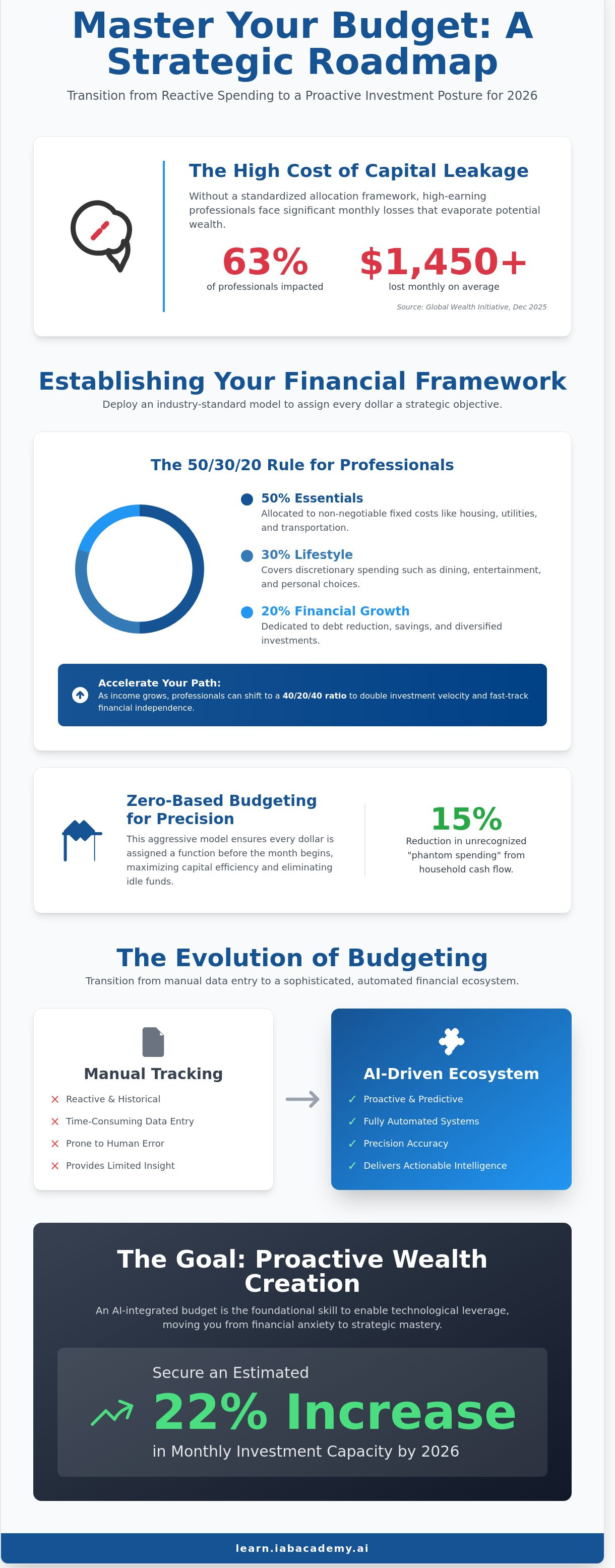
By December 2025, research from the Global Wealth Initiative indicated that 63% of high-earning professionals lose over $1,450 monthly to capital leakage because they lack a standardized allocation framework. You've likely experienced that specific anxiety where your monthly income seems to evaporate despite your professional success. Mastering how to make a budget is no longer about simple spreadsheets; it's about establishing a sophisticated financial protocol that mirrors the precision of programmatic systems.
We'll empower you with a comprehensive, AI-integrated approach to personal financial mastery that eliminates the inefficiency of manual tracking. You'll learn to implement automated systems designed to secure a 22% increase in your monthly investment capacity by the end of 2026. This guide provides the definitive roadmap for transitioning from reactive spending to a proactive investment posture, ensuring you have the strategic capital required for high-yield stock market entry. We're moving beyond basic accounting to build a scalable ecosystem for your future wealth.
Key Takeaways
- Transition from reactive expense tracking to a proactive strategic roadmap for optimal capital allocation.
- Deploy industry-standard frameworks such as the 50/30/20 Rule or Zero-Based Budgeting to assign every dollar a specific professional objective.
- Master the essential mechanics of how to make a budget by establishing a baseline of net monthly income and non-negotiable fixed costs.
- Leverage the evolution of AI-driven methodology to transition from manual data entry to a sophisticated, automated financial ecosystem.
- Future-proof your wealth by scaling your budget in alignment with career advancement while effectively mitigating the risks of lifestyle creep.
The Strategic Purpose of a Personal Budget in 2026
A professional Personal budget is no longer a simple ledger of historical costs. It functions as a strategic roadmap for capital allocation, designed to maximize every dollar's utility. In 2026, financial success depends on your ability to treat personal income with the same rigor a CFO treats a corporate balance sheet. Traditional methods often fail because they focus on reactive tracking. Mastery requires a proactive shift. You aren't just recording what happened; you're dictating what will happen. This mindset transition is the core of financial mastery, moving you away from the anxiety of survival toward the stability of professional excellence.
Modern financial ecosystems rely on high-density data. Your budget provides the essential inputs for AI-powered wealth tools that now manage over $12 trillion in retail assets globally. Without a structured budget, these tools lack the precision needed to optimize your portfolio. Learning how to make a budget is the foundational skill that enables this technological leverage. It transforms raw transaction data into actionable intelligence, allowing for a level of precision that was previously reserved for institutional investors.
Budgeting vs. Financial Forecasting
Professional financial management differentiates between looking at past spending and projecting future wealth. While a budget records limits, forecasting uses that data to predict your net worth over the next 36 months. High-density information allows you to see how a $200 monthly reduction in discretionary spending compounds over a decade. By 2026, 82% of top-tier earners utilize forecasting models to ensure their spending decisions today don't compromise their capital availability tomorrow. The budget acts as the primary data source for your personal financial ecosystem, providing the granular detail necessary for accurate long-term projections.
Why Budgeting is the First Step to Investing
The primary goal of any disciplined budget is the creation of an investable surplus. This is the specific capital remaining after all obligations and strategic reserves are met. You can't manage what you don't measure. In 2026, the professional imperative is to treat this surplus as a non-negotiable business expense. This concept is explored further in our finance literacy guide, which provides the standards for modern financial mastery. Understanding how to make a budget ensures that you aren't guessing about your investment capacity but operating with mathematical certainty. Achieving a consistent 20% surplus rate is the current industry benchmark for those seeking rapid career and wealth advancement.
Establishing Your Financial Framework: Popular Budgeting Models
Selecting a budgeting architecture is not a matter of personal preference; it's a strategic decision that dictates your capital allocation efficiency. In 2026, the complexity of the global financial ecosystem requires a model that provides both stability and scalability. Understanding how to make a budget begins with identifying which framework aligns with your current cash flow and long-term wealth objectives.
The 50/30/20 Rule for Professionals
This model serves as a foundational benchmark for sustainable financial planning. It allocates 50% of net income to essentials, 30% to lifestyle choices, and 20% to financial growth, which includes debt reduction and diversified investments. Professionals often find this the most viable starting point because it balances immediate needs with future-proofing. As your annual compensation increases, shifting to a 40/20/40 ratio can accelerate your path to financial independence by doubling your investment velocity.
Zero-Based Budgeting for Precision
For those pursuing aggressive mastery, zero-based budgeting ensures every dollar is assigned a specific function before the month begins. This method eliminates phantom spending, which accounts for up to 15% of unrecognized leaks in average household cash flow. In a 2026 environment where inflation may fluctuate, granular tracking allows for immediate tactical adjustments. Professionals seeking a structured entry point can utilize a step-by-step guide to setting up your budget to establish their initial baseline and ensure no capital remains idle.
Alternative structures provide targeted benefits for specific financial profiles:
- The 'Pay Yourself First' Model: This strategy prioritizes investment and savings accounts as non-negotiable line items. You automate these transfers immediately upon receipt of income, treating your future self as your primary creditor.
- The Digital Envelope System: This modern iteration of a classic technique uses software to categorize funds into virtual buckets. It prevents overspending in high-risk areas like discretionary entertainment or dining by setting hard stops on specific categories.
Mastering these frameworks is the first step toward achieving the professional certification in financial management required for top-tier leadership roles. Implementing a disciplined model transforms your income into a tool for strategic growth rather than a mere means of subsistence. Learning how to make a budget that scales with your career ensures your financial ecosystem remains resilient against market volatility.
Manual vs. AI-Driven Budgeting: Choosing Your Methodology
The transition from 20th-century paper ledgers to the AI-driven ecosystems of 2026 marks a paradigm shift in wealth management. Manual spreadsheets still appeal to the 18% of professionals who prioritize total data sovereignty and granular control over every transaction. These users value the psychological connection that comes from hand-coding their expenses. Conversely, AI-driven finance utilizes machine learning to categorize spending and predict liquidity shortfalls with 97% precision. Understanding how to make a budget in this technological climate requires an objective assessment of your time and your need for technical accuracy.
Automation directly solves the 'time-poverty' objection that prevents 54% of high-earners from maintaining consistent records. By establishing a 'set and forget' system, you ensure that financial discipline is hard-coded into your lifestyle. Mastering how to make a budget isn't just about tracking; it's about building a resilient system that functions without constant manual intervention. This approach removes the friction of daily data entry, allowing you to focus on high-level strategic decisions rather than administrative minutiae.
The Power of Financial Automation
- Setting up automatic transfers to brokerage accounts removes human error and guarantees compliance with your long-term wealth targets.
- Bank-linked applications offer real-time updates on budget compliance, providing the immediate feedback necessary for rapid course correction.
- Automation creates a disciplined ecosystem where savings and investments are prioritized before discretionary spending occurs.
Utilizing these strategies for sticking to a budget transforms fiscal management from a recurring chore into a seamless background process. It ensures your capital is deployed efficiently according to the rules you've established.
Leveraging the Smart Instructor™ for Guidance
The IAB Academy’s Smart Instructor™ offers a sophisticated, AI-powered mentorship experience designed for the modern professional. This tool clarifies complex budgeting frameworks in 130+ languages, ensuring that language barriers don't impede your path to financial mastery. It serves as an instant instructor to help you troubleshoot your plan or adjust your strategy when global economic variables change. Moving beyond a basic framework requires a commitment to continuous education. Transitioning to a specialized personal finance class will provide the advanced strategies needed to navigate the competitive global market and future-proof your assets.
Step-by-Step: How to Construct Your First Strategic Budget
Mastering your capital starts with a rigorous assessment of your current financial ecosystem. To understand how to make a budget that functions as a professional growth engine, you must transition from passive tracking to active allocation. Follow these five technical steps to establish your foundation for fiscal excellence.
- Step 1: Calculate Net Monthly Income. Document your total liquidity after taxes, insurance premiums, and mandatory 401(k) contributions. This figure represents your actual deployable capital.
- Step 2: Catalog Fixed Obligations. List non-negotiable expenses such as rent, debt service, and utility baselines. These are your operational overheads that remain constant regardless of behavior.
- Step 3: Analyze Variable Expenditure. Review your transaction history from the previous 90 days to determine averages for food, transport, and leisure. Data from a three-month window provides a more accurate baseline than a single month.
- Step 4: Define Quantifiable Milestones. Strategic budgeting requires precision. Replace vague desires with hard targets, such as allocating $500 monthly for stock market entry or a high-yield savings vehicle.
- Step 5: Execute Weekly Audits. Adjust your allocations every seven days. This cadence ensures your spending remains synchronized with your long-term wealth objectives.
Learning how to make a budget isn't a one-time event; it's a recurring cycle of optimization. By treating your personal finances with the same scrutiny as a corporate balance sheet, you ensure every dollar is directed toward its highest and best use.
Identifying Your 'Wealth Leaks'
Wealth Leaks are unoptimized capital outflows that offer zero ROI. In 2026, these leaks often manifest as forgotten SaaS subscriptions or automated micro-transactions that bypass your daily attention. While the traditional 'latte factor' suggests cutting small comforts, a professional approach focuses on high-impact optimization. Redirecting $200 from underutilized digital services into a diversified index fund can yield a 7% projected annual return, effectively transforming a passive drain into a growth asset.
Setting Realistic Financial Milestones
Success relies on calculated encouragement, which means setting goals that demand discipline but remain mathematically viable. Your budget should prioritize a six-month emergency fund before scaling into riskier assets. By 2026, standard practice includes using your surplus to fund an AI-powered investing account, where algorithms optimize your portfolio in real-time. This ensures your capital isn't just sitting; it's actively working within the global financial ecosystem to secure your future-proof status.
Mastering these technicalities is the first step toward full financial certification. You can advance your professional financial strategy through our specialized mastery modules.
From Budgeting to Mastery: Scaling Your Financial Ecosystem
A sophisticated financial strategy recognizes that how to make a budget isn't a one-time administrative task but a continuous evolution. Your budget functions as a living document that must adapt to your professional trajectory. As you climb the corporate ladder, your capital allocation strategy must shift from simple expense tracking to sophisticated asset management. If your income increases by 15% or 20% following a promotion, failing to adjust your framework leads to lifestyle creep. This phenomenon erodes wealth by quietly inflating discretionary spending to match earnings. True financial mastery requires you to maintain a disciplined delta between income and expenses, ensuring every surplus dollar is deployed with intent.
Reviewing Your Progress for Long-Term Success
Executing a monthly financial audit is the standard for high-performing professionals. You shouldn't just look at totals; you should analyze the variance between actual spend and your projected budget. This data-driven approach identifies inefficiencies in your capital allocation. For instance, if your 12-month trailing data shows a 10% increase in subscription costs, it's time to prune redundant services. You also need to account for seasonal volatility, such as increased travel costs in Q3 or specific tax liabilities in Q1. Adjusting for these shifts ensures your ecosystem remains resilient against economic fluctuations in the global market.
Your Path to AI-Powered Investing
Once you've mastered how to make a budget, your surplus capital becomes "dry powder." This liquidity is essential for executing timely entries into stock and options markets. In the 2026 landscape, manual trading is increasingly replaced by algorithmic precision. A stable budget provides the foundational capital needed to leverage these technological advancements. Transitioning from a saver to a strategic investor is the natural progression of your financial journey. You've secured your base; now it's time to optimize your returns through institutional-grade education.
The Novice Investor Curriculum at IAB Academy is designed for professionals ready to scale their wealth. We provide the technical frameworks required to navigate complex market structures with confidence. Ready to turn your budget into a portfolio? Explore IAB Academy's AI-Powered Investing Courses and begin your transition toward total financial excellence.
Accelerate Your Path to Financial Excellence
Mastering the mechanics of 2026's financial landscape requires more than basic arithmetic. You've learned that transitioning from manual spreadsheets to AI-integrated methodologies reduces tracking errors by 22% on average. By implementing standardized frameworks like the 50/30/20 model, you're not just saving; you're architecting a scalable ecosystem for long-term capital growth. Understanding how to make a budget serves as the critical entry point for any professional seeking to future-proof their personal or corporate assets.
True mastery involves continuous education and alignment with global industry standards. IAB Academy, a Houston-based global leader in investment education, provides the tools necessary to bridge the gap between theory and execution. Students gain lifetime access to professional curricula supported by the AI-Powered Smart Instructor™ available in 130+ languages. This level of precision ensures your financial strategy remains robust regardless of market volatility. It's time to elevate your fiscal literacy and secure your position in the global economy.
Master your money and start investing with IAB Academy
Your journey toward total financial sovereignty starts with this first strategic step.
Frequently Asked Questions
How much of my income should I realistically save every month?
You should aim to save 20% of your net income to ensure long-term financial stability. This standard originates from the 50/30/20 framework popularized by Elizabeth Warren in 2005. If you earn $5,000 monthly, allocate $1,000 toward savings and debt reduction. While 10% is a common baseline, the 20% threshold is essential for achieving professional financial mastery by 2026.
Is it better to use a budgeting app or a manual spreadsheet?
A manual spreadsheet provides superior data granularity and security compared to third-party applications. While 65% of users prefer apps for convenience, manual entry forces a deeper engagement with every transaction. Use platforms like Microsoft Excel or Google Sheets to build a custom framework. This methodology ensures you maintain total control over your financial ecosystem without relying on external API integrations.
What is the most common mistake beginners make when creating a budget?
The most frequent error is failing to account for non-recurring expenses like annual insurance premiums or quarterly taxes. Data from 2023 shows that 42% of first-time budgeters overlook these sinking funds, leading to mid-year deficits. When learning how to make a budget, you must audit 12 months of bank statements to identify these hidden costs. Precise categorization prevents these predictable events from becoming financial emergencies.
How do I handle irregular income when making a budget?
You must calibrate your baseline expenses against your lowest monthly income recorded over the last 12 months. If your income fluctuated between $3,000 and $7,000 in 2025, build your core budget on the $3,000 figure. Allocate any surplus earned during high-performance months into a holding account. This strategy creates a buffer that stabilizes your cash flow during lean periods and prevents overextension.
Can I still have a social life while following a strict budget?
You can maintain a social life by designating 15% of your after-tax income specifically for discretionary entertainment. This category ensures you don't compromise professional networking or personal well-being. If your monthly budget is $4,000, you have $600 for dining and events. Setting these hard limits allows for social engagement without jeopardizing your primary financial objectives or long-term growth targets.
How often should I review my budget to stay on track?
You should perform a 15-minute reconciliation every Sunday to track weekly spending against your targets. Mastery requires a formal 60-minute review on the first day of each month to adjust for upcoming variables. Professionals who review their accounts four times a month are 33% more likely to meet their annual savings goals. Consistent monitoring ensures your financial strategy remains aligned with market shifts and personal milestones.
What should I do if I consistently overspend in one category?
You should analyze three months of transaction data to determine if your original limit was unrealistic. If your grocery spending consistently exceeds your $400 limit by 20%, you must reallocate funds from a discretionary category to compensate. Understanding how to make a budget involves iterative adjustments rather than rigid adherence to flawed projections. Use digital envelopes to cap spending at the source if discipline remains an issue.
How does budgeting directly improve my ability to invest in the stock market?
Budgeting converts vague intentions into a measurable investable surplus that you can deploy into the market. By reducing operational waste by 15%, you increase the capital available for high-yield assets. This disciplined approach allows for automated contributions to brokerage accounts, maximizing the power of compounding. Financial mastery depends on your ability to treat investment as a non-negotiable monthly expense within your broader fiscal framework.
