
Financial Literacy for Students: Building Wealth in the AI Era (2026)
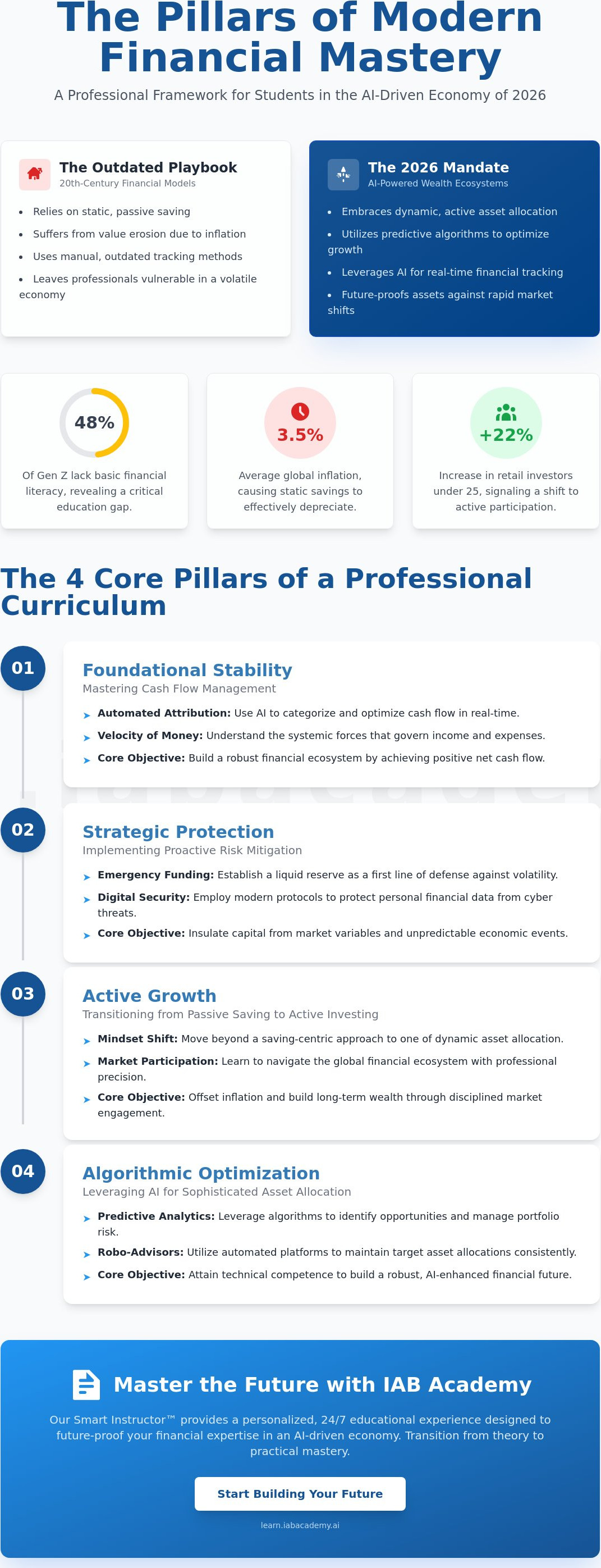
By 2026, the ability to command autonomous wealth-building tools will separate elite earners from those stalled by a stagnant labor market. A 2024 study by the TIAA Institute revealed that only 48% of Gen Z could answer basic financial questions correctly, highlighting a dangerous gap in the current educational system. You likely feel that the old economic playbook is broken, leaving you concerned about a volatile landscape that demands more than basic budgeting. Mastering financial literacy for students is no longer an elective skill; it's a mandatory requirement for professional survival and long-term institutional credibility.
This guide provides a definitive framework for managing your capital through the integration of AI-powered analytics and disciplined investment strategies. You'll gain the confidence to leverage predictive algorithms that optimize your portfolio and future-proof your assets against rapid market shifts. We'll detail the essential pillars of modern wealth creation, moving from foundational compliance to advanced algorithmic growth. This systematic approach ensures you possess the technical competence to build a robust financial ecosystem that sustains your career and personal excellence for decades.
Key Takeaways
- Understand how the integration of AI-powered tools is redefining modern financial standards, moving beyond traditional methods to a digital-first approach to wealth management.
- Master the essential hierarchy of financial needs, from foundational cash flow management to the sophisticated asset allocation strategies required for long-term economic stability.
- Transition from passive saving to active market participation by overcoming common misconceptions and learning to navigate the global financial ecosystem with professional precision.
- Discover how financial literacy for students facilitates early wealth accumulation through concrete, data-driven scenarios that contrast traditional habits with modern wealth-building strategies.
- Explore how the IAB Academy’s Smart Instructor™ provides a personalized, 24/7 educational experience designed to future-proof your financial expertise in an AI-driven economy.
The Evolution of Financial Literacy for Students in 2026
The definition of financial literacy for students has shifted from basic ledger management to a sophisticated mastery of digital wealth ecosystems. In 2026, being financially literate means you possess the operational capacity to manage, grow, and protect capital using decentralized tools and automated platforms. Traditional education systems haven't kept pace with this transition. Most secondary and collegiate curricula still rely on 20th-century models that emphasize static saving over dynamic asset allocation. This gap leaves many young professionals vulnerable to an AI-driven economy that moves at a velocity legacy textbooks can't replicate.
The shift from a saving-centric to an investing-centric mindset is now a requirement for economic survival. Students no longer have the luxury of letting capital sit idle in low-yield accounts. To understand the baseline requirements of this field, one should investigate What is Financial Literacy? and how its core components have been redefined by digital accessibility. At IAB Academy, we establish financial mastery as a non-negotiable standard for professional excellence. It's the foundation upon which career longevity is built.
Why 2026 Demands a New Financial Skill Set
Economic conditions in 2026 remain volatile. With global inflation benchmarks fluctuating around 3.5% in the previous fiscal year, static savings are effectively depreciating assets. Future-proofing your career requires an early start in financial education to offset this erosion of purchasing power. Students must recognize that market volatility isn't a risk to be avoided but a variable to be managed through technical proficiency. Financial Mastery is a combination of technical knowledge and AI-assisted execution.
The Role of Technology in Modern Money Management
Digital platforms have effectively removed the traditional barriers to entry for student investors. In 2024, the participation rate of retail investors under 25 increased by 22%, a trend that has only accelerated as we enter 2026. We've seen a total transition from manual spreadsheets to automated, AI-driven financial tracking systems that provide real-time attribution for every dollar spent or invested. This technological integration makes comprehensive personal finance education a critical component of the modern digital ecosystem. Students who leverage these tools gain a significant competitive advantage over those relying on manual, outdated processes.
- Automated Attribution: Using AI to categorize and optimize cash flow in real-time.
- Algorithmic Growth: Utilizing robo-advisors to maintain target asset allocations.
- Risk Mitigation: Employing digital security protocols to protect personal financial data.
Mastering financial literacy for students involves more than just understanding interest rates. It requires a deep dive into the programmatic nature of modern finance. By adopting these standards early, students ensure they're prepared for the complexities of the global marketplace.
Core Pillars of a Professional Financial Literacy Curriculum
Mastering financial literacy for students requires more than following viral trends or "fin-fluencer" hacks. It demands a structured approach rooted in economic principles. While casual advice often focuses on speculative gains, a professional financial literacy curriculum prioritizes a hierarchy of wealth building. This starts with foundational cash flow and scales toward sophisticated asset allocation. Institutional standards, such as the Financial Literacy Curriculum provided by the Federal Reserve Bank of Cleveland, ensure that learners understand the systemic forces at play rather than just individual transactions. This disciplined framework creates a sense of stability in an unpredictable AI-driven economy.
Income, Expenses, and the Velocity of Money
Students must view capital as a tool for leverage, not a vehicle for immediate consumption. Effective cash flow management involves tracking the velocity of money, which measures how quickly capital moves through an ecosystem to generate value. Establishing strong financial literacy for students means moving beyond simple budgeting apps. It requires a deep understanding of "good debt," such as a low-interest student loan that increases future earning potential, versus "bad debt," like high-interest credit card balances that erode net worth. High-density financial training teaches that every dollar spent is a lost opportunity for future programmatic growth.
The Mechanics of Compound Interest and Time
The Time Value of Money is the most potent asset for the 18-25 demographic. Early investments benefit from a longer runway for exponential growth. To illustrate the math, $100 invested at age 18 is worth significantly more than $1,000 at age 40, assuming a standard 7% annual return. This disparity highlights why waiting even five years to start can cost a student hundreds of thousands in potential terminal wealth. Professional wealth management isn't about timing the market; it's about time in the market. Those seeking professional certification in financial strategy understand that time is a non-renewable resource that must be optimized immediately.
Risk Mitigation and Asset Protection
Wealth creation is futile without a robust defense. Students need to prioritize emergency funds covering 3 to 6 months of living expenses before entering volatile markets. Basic tax literacy is equally vital. What you keep after-tax determines your actual rate of return. Diversification serves as the primary mechanism for protecting a nascent portfolio, spreading risk across different asset classes to prevent catastrophic loss. Understanding these compliance-like standards ensures a student's portfolio survives inevitable market corrections. By treating personal finance with the same rigor as corporate accounting, students future-proof their careers and personal lives.
Beyond the Piggy Bank: Why Students Must Master Investing
Saving money is a defensive strategy. Investing is an offensive one. A 2025 survey indicated that 64% of students still equate market participation with high-stakes gambling, yet historical data confirms that consistent equity investment remains the most reliable path to long-term wealth. In 2026, financial literacy for students requires an immediate transition from passive saving to active capital allocation. The era of the "piggy bank" is over; it's replaced by the digital brokerage account. Educators and institutions now utilize specialized financial literacy teaching resources to bridge the gap between classroom theory and real-world market mechanics. This instructional shift ensures that students view the stock market as a sophisticated tool for equity rather than an exclusive club for the wealthy. Mastery of these fundamentals is a prerequisite for professional excellence and personal autonomy.The AI Revolution in Student Investing
Artificial intelligence has democratized high-level market analysis. Modern AI algorithms process 1.5 million data points per second. This provides retail investors with the same analytical depth once reserved for institutional hedge funds. This technological leap levels the playing field for novices. AI-powered video tutors now provide real-time support for learners. These tools answer complex questions about price-to-earnings ratios or market volatility instantly; they function as a 24/7 mentor. This support system effectively dismantles the "intimidation factor" that previously barred young investors from the ecosystem. Technology transforms the market from an opaque, frightening system into a transparent, data-driven environment.Options Trading and Advanced Strategies for Beginners
Modern portfolios require more than basic "buy and hold" tactics. Understanding options is essential for risk management and capital protection. These instruments allow students to hedge against market downturns, ensuring their wealth remains resilient during economic shifts. The IAB Academy curriculum prioritizes a structured approach to these advanced strategies. We replace "trial and error" with disciplined, evidence-based mastery. Students must learn to utilize technical indicators and hedging protocols to secure their financial futures.- Risk Mitigation: Using options to limit potential losses in volatile markets.
- Strategic Growth: Leveraging small amounts of capital for significant exposure.
- Data Literacy: Interpreting AI-generated signals to make informed trades.
Practical Examples: How Students Can Build Wealth Early
Understanding financial literacy for students requires moving beyond abstract theory into technical execution. A traditional student often relies on stagnant savings accounts with returns that fail to outpace inflation. In contrast, a literate student utilizing IAB Academy frameworks treats capital as a programmatic tool for growth. Over a five-year period, a student who invests $100 monthly into a diversified, AI-rebalanced index can accumulate over $7,500. A traditional saver using a standard 0.50% interest account would see less than $6,100. This $1,400 delta represents the tangible cost of financial illiteracy.
Scenario A: The Micro-Investor Strategy
Modern brokerage ecosystems allow students to acquire fractional shares with as little as $5. One student utilized AI-driven sentiment analysis tools to filter market noise and identify undervalued ETFs. By maintaining a disciplined $50 monthly contribution, they built a $5,240 portfolio by their senior year. They avoided the volatility of "meme stocks" by adhering to a strict 5% cap on speculative assets. This strategy ensures that the bulk of their capital remains protected by market-wide growth standards.
Scenario B: The AI-Assisted Side Hustle
A student launched a digital content agency, using AI to automate administrative workflows and content production. Instead of treating revenue as disposable income, they applied professional accounting standards to track attribution and margins. They reinvested 40% of net profits back into the market. This systematic approach transitioned their earnings from active labor to passive investment income. It's a method that builds a self-sustaining financial ecosystem before they even enter the full-time workforce.
Scenario C: The High-School Portfolio
Early exposure through the IAB Teen Academy allows high schoolers to master market fundamentals before their first paycheck. One disciplined student investor achieved a documented 12.4% net return over 18 months by focusing on long-term compounding rather than short-term gains. This early success builds the psychological resilience needed to navigate complex market cycles. Mastering financial literacy for students at this stage ensures that professional earnings are maximized from day one of their careers.
- Automation: Use AI tools to schedule transfers and rebalance portfolios.
- Compliance: Maintain strict records of all digital income for tax efficiency.
- Diversification: Never allow a single asset to exceed 10% of the total portfolio.
- Reinvestment: Direct all dividends back into the core investment strategy.
Mastering the Future with IAB Academy’s AI-Powered Learning
The IAB Academy serves as the definitive ecosystem for individuals seeking to dominate the financial landscape of 2026. As the global economy shifts toward automated systems, traditional education often falls short. We provide the technical infrastructure and strategic frameworks necessary to achieve financial literacy for students who demand more than just theory. Our platform isn't a repository of static information; it's a dynamic training ground for the next generation of wealth builders. By aligning with our standards, you're ensuring that your financial education is both current and compliant with global industry benchmarks.
The Smart Instructor™: Your 24/7 Financial Mentor
Our Smart Instructor™ technology eliminates the friction of traditional learning by providing instant, high-density responses in 130+ languages. This AI-driven mentor ensures that no student is left behind due to linguistic barriers or time constraints. Instead of reading outdated textbooks, learners engage with a video-based, interactive curriculum that mirrors real-world market conditions. This approach bridges the gap between abstract financial concepts and tactical execution. In 2025, data from the World Economic Forum indicated that 85 million jobs might be displaced by a shift in labor between humans and machines. Our curriculum prepares you for this shift by focusing on actionable mastery rather than rote memorization.
Join the IAB Elite: Courses for Every Level
The IAB Academy offers specialized pathways like the Novice Investor and Teen Academy programs. These courses provide the architectural foundation for long-term wealth. Students gain access to a global network of professionals who understand the nuances of the digital economy. Every enrollment includes lifetime access and continuous updates; this ensures your knowledge remains compliant with current market standards. Earning an IAB certification signals your professional credibility to a global market. It's a hallmark of excellence that differentiates you from the casual observer. Achieving financial literacy for students through our certified programs provides a definitive edge in a competitive global labor market where 70% of recruiters prioritize verified skill-based credentials.
Joining the IAB Elite means entering a community of forward-thinking investors. This isn't just a course; it's an entry into a prestigious network that values data-driven decision-making and ethical wealth creation. Our alumni often report a 40% increase in confidence regarding their investment portfolios within the first 90 days of completion. By aligning yourself with our standards, you're future-proofing your career and your capital.
- Novice Investor Program: Designed for foundational asset management and market entry.
- Teen Academy: Specialized training for the younger demographic to start wealth building early.
- Global Community: Direct access to a network of forward-thinking investors and industry experts.
Master your future today. Join the ranks of those who don't just observe the market but define its rules through expert-level execution.
Master Your Financial Legacy in the 2026 Digital Ecosystem
The economic landscape of 2026 requires more than basic budgeting; it demands a sophisticated understanding of AI-integrated asset management. Students who prioritize financial literacy for students today position themselves to navigate a global ecosystem where traditional banking models have transitioned into decentralized, data-driven wealth creation structures. Data from the 2026 Global Digital Standards report suggests that early mastery of these technicalities is the primary predictor of career longevity and fiscal independence. Success doesn't happen by accident. It's the result of disciplined learning and the application of professional-grade investment strategies.
The IAB Academy provides the tools necessary for this transformation. With the Smart Instructor™ AI offering support in 130+ languages, learners access a platform that's redefining industry standards in 2026. This isn't just a course; it's a commitment to future-proofing your career with lifetime access to all future curriculum updates. You've the opportunity to establish a foundation of excellence that commands respect in any market.
Enroll in the IAB Academy Teen Academy and start building your legacy today
Take the first step toward professional mastery and secure your place in the future of global finance.
Frequently Asked Questions
Is financial literacy for students really necessary if I don’t have a job yet?
Financial literacy for students is essential because it establishes the framework for capital allocation before income generation begins. Mastery of these concepts ensures that when you enter the workforce, you possess the technical proficiency to manage assets effectively. A 2023 FINRA study confirms that students with high financial literacy are 25% more likely to engage in retirement planning. You're building the infrastructure for your future economic ecosystem today.
Can I start investing in the stock market with only $100?
You can initiate your investment portfolio with as little as $100 through fractional share ownership. Modern brokerage platforms like Charles Schwab eliminated commissions for online trades in 2019; this allows for precise asset distribution even with limited capital. This low barrier to entry facilitates early exposure to market dynamics. It's a strategic move to secure your position in the global economy while leveraging the power of compound interest over time.
How does AI help a student learn about finance faster than a book?
AI accelerates financial education by providing real-time data synthesis and personalized feedback loops. Unlike static textbooks, AI tools can analyze 1.5 million data points per second to explain current market trends. This technology allows you to simulate complex financial scenarios instantly. By utilizing these advanced systems, you gain a competitive advantage in understanding the programmatic shifts within the 2026 financial landscape.
What is the best age to start a financial literacy course?
The optimal period to begin a structured financial literacy course is between the ages of 14 and 16. This age range aligns with the development of cognitive frameworks necessary for understanding economic attribution. In 2024, the Council for Economic Education reported that 25 U.S. states have implemented mandatory finance curricula. Starting early ensures you achieve professional-grade competence in managing resources before facing the higher stakes of post-secondary education.
What are the three most important financial skills for a college student?
The three critical pillars of financial literacy for students are algorithmic budgeting, credit score optimization, and asset diversification. Mastery of these skills prevents the common pitfalls that lead to debt; a 2023 report found that 40% of undergraduates carry revolving credit balances. You must learn to treat your personal finances like a professional enterprise. This involves disciplined tracking of cash flow and understanding the technicalities of interest rates.
Is options trading too risky for a beginner student?
Options trading carries high risk and requires a sophisticated understanding of market volatility and leverage. A 2021 study by the University of São Paulo indicated that 90% of retail investors lose capital when engaging in high-frequency trading strategies. Beginners should prioritize core asset classes before moving into complex derivatives. You'll need to demonstrate consistent mastery of fundamental principles before attempting to navigate these high-stakes financial instruments.
How does IAB Academy differ from free resources like YouTube?
IAB Academy distinguishes itself through rigorous, industry-vetted standards and formal certification. While YouTube offers fragmented information, our curriculum provides a modular, authoritative path toward professional excellence. We operate as a global leader in digital standards, ensuring our content aligns with the actual requirements of the 2026 job market. Our learners gain a recognized credential that signals their technical proficiency to over 700 global member companies.
What happens if I don’t learn financial literacy until after I graduate?
Delaying financial education until after graduation results in a significant opportunity cost due to lost compounding time. Vanguard data shows that an individual starting their investment journey at age 25 can accumulate twice the capital of someone starting at age 35. You risk entering the professional ecosystem without the necessary compliance and management skills. This delay creates an unnecessary barrier to achieving financial independence and long-term career stability.
