
Choosing the Right Financial Literacy Course in 2026: A Guide to Financial Mastery
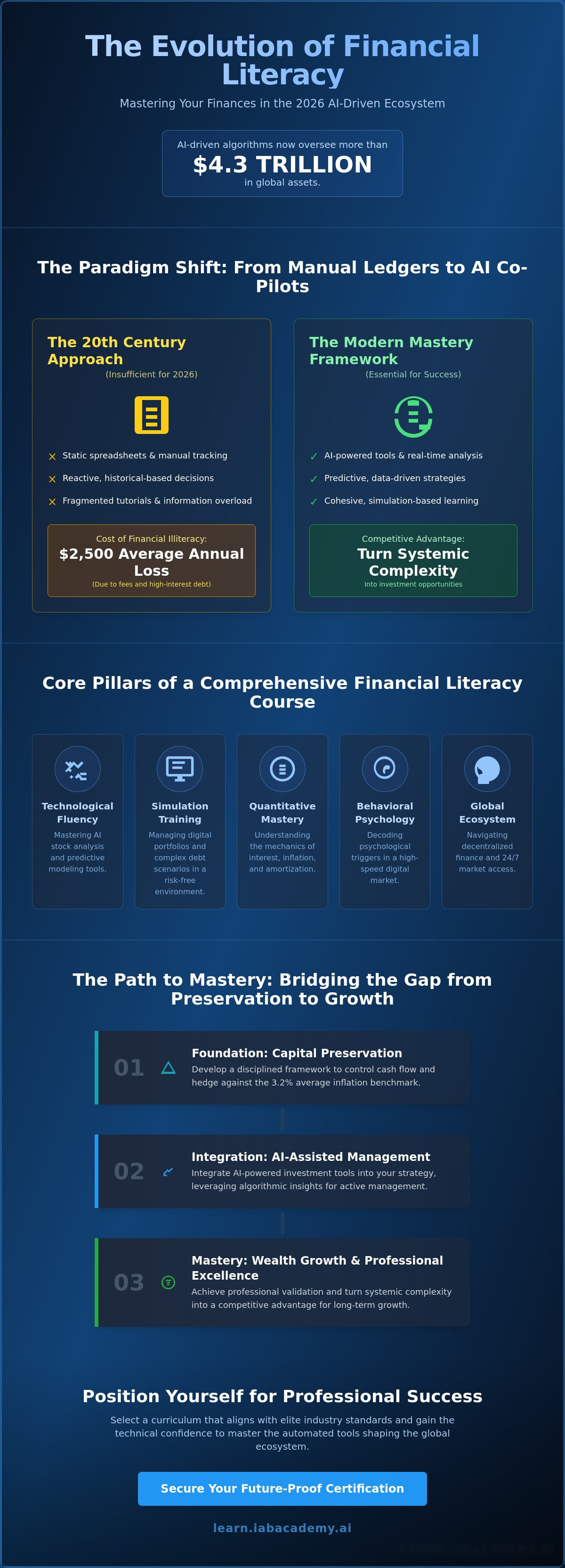
By 2026, relying on 20th-century money management strategies will be a calculated risk that few professionals can afford to take. As AI-driven algorithms now oversee more than $4.3 trillion in global assets, the definitive path to mastery requires a comprehensive financial literacy course that addresses both legacy systems and automated tools. You've likely experienced the paralysis of information overload from fragmented digital tutorials that lack a cohesive, authoritative structure. It's natural to feel concerned about making a technical error in a market that moves at the speed of code.
We'll show you how to identify a program that bridges the gap between traditional asset management and high-precision AI protocols. This article provides a rigorous framework to evaluate educational standards and ensure your skills remain future-proof. You'll gain a disciplined roadmap for building wealth and the technical confidence to master the automated tools shaping the global ecosystem. Secure a certification that offers more than just knowledge; it provides the professional validation required to excel in a competitive market.
Key Takeaways
- Understand why traditional budgeting is insufficient in the 2026 global ecosystem and how modern literacy requires a sophisticated blend of technological fluency and psychological insight.
- Identify the non-negotiable pillars of a high-quality financial literacy course, focusing on simulation-based training that moves beyond theoretical concepts.
- Evaluate the efficiency of AI-guided learning versus traditional formats to maximize retention and ensure the mastery of complex financial systems.
- Discover how to bridge the gap between basic capital preservation and active wealth growth by integrating AI-powered investment tools into your strategy.
- Position yourself for professional success by selecting a curriculum that aligns with elite industry standards and global digital excellence.
The Evolution of Financial Literacy in 2026
The global economic landscape has undergone a radical transformation, rendering traditional money management techniques obsolete. By 2026, financial competence is no longer defined by the ability to balance a checkbook or maintain a basic savings account. Instead, it's evolved into a sophisticated discipline that blends behavioral psychology, quantitative mathematics, and technological fluency. This shift is a direct response to a global ecosystem characterized by high-frequency trading, decentralized finance, and 24/7 market access.
Traditional "budget-only" education models fail because they ignore the psychological triggers of the modern consumer and the extreme speed of digital transactions. Static spreadsheets are insufficient in a world where market sentiment can shift in milliseconds. Choosing a modern financial literacy course provides the necessary framework to move from passive observation to active, AI-assisted management. This professional education serves as a critical hedge against the 3.2% inflation benchmarks and the market volatility that defines the current fiscal era.
Why Literacy is the Foundation of Wealth
Success in the modern workforce is inextricably linked to your command of fiscal principles. Establishing a high level of finance literacy is the most effective way to ensure long-term career stability and capital preservation. The cost of illiteracy is staggering; data from late 2025 indicates that individuals lacking formal financial training lose an average of $2,500 annually to unnecessary fees and high-interest debt. Financial literacy is the ability to decode and exploit economic systems. Mastery allows you to identify missed investment opportunities that others overlook, turning systemic complexity into a competitive advantage.
The Role of Technology in Modern Education
The transition from manual tracking to real-time AI stock analysis represents the most significant leap in personal finance history. The digital ecosystem has democratized access to professional-grade tools, allowing retail participants to utilize the same algorithmic insights as institutional firms. Integrating the Core Pillars of Financial Literacy into your daily routine is now facilitated by automated platforms that offer predictive modeling. Enrolling in a financial literacy course that emphasizes these technological shifts is essential for future-proofing your assets. You must learn to navigate rapid tech shifts to ensure your wealth strategy remains resilient against the automation of the broader financial sector.
Core Pillars of a Comprehensive Financial Literacy Course
A robust financial literacy course functions as a definitive blueprint for long-term economic stability. It must align with the National Strategy for Financial Literacy, ensuring that every learner meets the rigorous benchmarks required for 2026 market participation. High-quality programs move beyond theoretical lectures; they utilize real-world simulations where users manage digital portfolios or simulate complex debt repayment scenarios. This practical application ensures that knowledge translates into measurable behavioral change. Education must be granular, covering everything from basic interest calculations to the technical complexities of amortization.
The depth of content determines the ultimate value of the certification. A course that fails to provide specialized tracks, such as a teen academy for younger learners, misses the opportunity for multi-generational wealth building. In a professional context, mastery is not optional. It requires a disciplined approach to learning that treats financial management as a technical ecosystem rather than a series of isolated tasks. This creates a foundation for professional excellence and long-term future-proofing.
Mastering the Fundamentals: Budgeting and Debt
Budgeting isn't a static activity. It's a dynamic skill. Learning how to make a budget serves as the primary mechanism for controlling cash flow in an environment where inflation rates often fluctuate by 3% or more. Mastery requires understanding the precise mechanics of interest. Learners must grasp what is apr to avoid the pitfalls of high-interest consumer credit that can erode wealth over decades. A professional-grade financial literacy course provides technical tools like a detailed amortization schedule. This allows individuals to visualize the exact impact of principal payments, potentially saving $50,000 or more in interest over the life of a standard 30-year mortgage.
Investment Fundamentals and Market Mechanics
Transitioning from defensive saving to strategic wealth accumulation marks the difference between financial survival and total mastery. Effective training introduces the stock market through the lens of calculated risk management. High-density modules cover asset allocation, stop-loss orders, and the role of ETFs in a diversified portfolio. In 2026, these courses must also address the necessity of diversification to mitigate volatility in the global digital ecosystem. This multi-layered approach ensures that every learner understands the mechanics of equities and bonds. By implementing these strategies, professionals can move toward a state of financial compliance and readiness that secures their future in a competitive market.
Evaluating Course Formats: Self-Paced vs. AI-Guided Learning
The efficiency of a financial literacy course hinges on its delivery architecture. In the current ed-tech ecosystem, the shift from passive consumption to active engagement defines the standard for professional development. Traditional video-only courses frequently fail to sustain momentum; industry benchmarks from 2024 show that completion rates for non-interactive digital learning often hover below 15%. This high drop-out rate occurs because learners encounter cognitive bottlenecks without a mechanism for immediate resolution. When a novice investor struggles with the mechanics of compound interest or asset allocation, the absence of a feedback loop leads to frustration and disengagement.
Real-time AI tutoring addresses this "stuck" problem by providing a bridge between theory and application. Unlike static repositories of information, AI-guided platforms offer a responsive environment where questions are resolved at the moment of inquiry. This ensures that the learning process remains fluid and disciplined. Choosing between a one-time enrollment and a lifetime access membership also requires strategic consideration. Lifetime access acts as a hedge against information obsolescence, providing a continuous reference point as global market conditions shift and new financial instruments emerge.
The Smart Instructor™ Advantage
The Smart Instructor™ technology utilizes AI-powered video tutors to provide instant, precise answers in over 130 languages. This capability removes linguistic barriers and ensures that technical terminology is understood within a localized context. A 24/7 mentor offers the psychological stability required when tackling intimidating topics like algorithmic trading or portfolio risk management. AI tutoring reduces the learning curve by 40% by tailoring the instructional pace to the individual's specific mastery level. This personalized approach transforms the educational experience from a generic lecture into a high-density professional briefing. It's a system designed for those who don't have time for inefficient study methods.
Certification and Professional Validation
A verified certificate is an essential component of professional validation. It provides a tangible record of mastery that enhances a resume and demonstrates a commitment to industry excellence. Assessing the credibility of the issuing institution is vital; a certificate from a recognized global leader carries significant weight in a competitive job market. Lifetime access adds further value by allowing learners to revisit core modules and access updates on financial regulations. This ensures that the knowledge gained from a financial literacy course remains relevant and actionable throughout a professional's career. This long-term access is critical for maintaining compliance with evolving fiscal standards.
Beyond Budgeting: Integrating AI and Investment Strategy
Modern wealth creation requires more than just tracking expenses. A robust financial literacy curriculum in 2026 integrates artificial intelligence as a core component. You can't rely on 20th-century savings models when algorithmic high-frequency trading accounts for over 70% of US equity market volume. Mastery involves shifting from passive saving to strategic growth. This transition requires understanding macro-economic indicators, such as the Federal Reserve's 2025 interest rate adjustments, to inform long-term portfolio rebalancing.
Some learners fear technology will replace human judgment. This is a misconception. AI acts as a sophisticated co-pilot that processes datasets too large for manual review. It identifies patterns, not certainties. Professionals use these tools to filter out noise and focus on high-probability setups. By removing emotional bias, technology ensures you stick to a disciplined strategy during periods of extreme market fear. Every modern financial literacy course must bridge the gap between basic numeracy and the ability to interpret machine-generated insights.
Novice Investor Curriculum: A Strategic Path
Graduating from a personal finance class to a dedicated investing program is a critical milestone. You'll move from basic liquidity management to understanding options trading essentials. This transition doesn't require a computer science degree. Instead, you'll learn to interpret algorithmic signals to identify momentum. A comprehensive financial literacy course teaches you to leverage these automated insights while maintaining full oversight of your risk parameters.
Risk Management in the Age of AI
Effective strategy requires identifying market capitulation points. During the August 2024 market correction, AI stock analysis tools flagged oversold conditions hours before traditional news outlets reported the recovery. You'll learn to use these tools to find entry points that minimize drawdown. Compliance is equally vital. Staying within regulatory frameworks ensures your use of automated tools meets institutional standards. Ethical AI usage prevents market manipulation and protects your long-term professional reputation.
Ready to master the tools of the modern economy? Explore our advanced modules to future-proof your investment skills.
Mastering Your Future with IAB Academy’s Curriculum
Selecting a financial literacy course in 2026 requires more than a cursory glance at basic budgeting. IAB Academy positions itself as the definitive authority for serious learners, bridging the gap between traditional Houston-based financial expertise and a sophisticated global digital delivery system. This isn't a passive learning experience; it's a rigorous professional development path designed for those who demand mastery over their economic destiny. You'll join a community of tech-literate investors who prioritize data-driven decisions over market speculation.
Your first 30 days in the Novice Investor Curriculum are structured to deliver immediate technical proficiency. The first week focuses on the mechanics of capital markets and asset classes. By day 15, students analyze risk-adjusted returns using IAB’s proprietary evaluation frameworks. By the end of the first month, you'll have developed a documented investment thesis. This disciplined progression ensures that every participant moves from foundational knowledge to actionable strategy without the typical friction found in generic ed-tech programs.
Enrollment Options and Lifetime Mastery
Choosing between a one-time course fee and full platform access depends on your commitment to future-proofing your wealth. A single financial literacy course provides immediate skills, but full platform access offers a continuous roadmap toward becoming an AI-powered trader. This membership provides ongoing updates as market regulations and technologies shift. Secure your seat in the next cohort to gain the certification necessary for professional-grade financial management. The July 2026 enrollment window is currently open for those ready to transition from observation to execution.
Success Stories: From Literacy to Legacy
The impact of IAB Academy extends beyond individual portfolios. Our Teen Academy has empowered the next generation, with 85% of graduates establishing diversified investment accounts before their 19th birthday. These aren't just success stories; they're blueprints for legacy building. One recent case study tracked a 22% improvement in household net worth within 18 months of curriculum completion. This focus on professional excellence and industry-standard compliance makes IAB Academy the definitive source for those who view financial education as a lifelong pursuit rather than a one-time event.
Mastering Your Financial Trajectory in 2026
Success in the 2026 economy requires a transition from basic money management to sophisticated digital asset mastery. We've explored how the integration of AI-driven tools and advanced investment strategies creates a new standard for professional competence. Choosing a comprehensive financial literacy course isn't just an educational step; it's a commitment to future-proofing your career within a complex global ecosystem. The IAB Academy provides this foundation by combining Houston-based professional expertise with cutting-edge technological support.
Our platform ensures you aren't learning in isolation. The Smart Instructor™ AI offers immediate guidance in 130+ languages, breaking down barriers to entry for professionals worldwide. You'll benefit from lifetime access to course materials that we update regularly to reflect the latest market shifts and regulatory changes. This approach guarantees your knowledge remains relevant as the industry evolves. You're ready to command your financial future with precision and authority.
Enroll in the IAB Academy Financial Literacy Curriculum Today
Your path to financial excellence starts with the right mentorship.
Frequently Asked Questions
What is included in a standard financial literacy course?
A standard curriculum includes modules on cash flow management, debt reduction, and risk assessment protocols. The Global Financial Literacy Excellence Center reported in 2024 that effective programs must integrate behavioral economics to influence long-term habits. You'll engage with technical frameworks for asset allocation and tax optimization. These elements provide the necessary structure to navigate a complex and evolving global economic landscape.
How long does it take to complete a financial literacy certification?
Completion times vary between 20 and 40 hours of focused instructional content. Most learners finish the certification within a 6-week window by committing 5 hours of study per week. This disciplined pace ensures you absorb technical details before moving to strategic applications. For professionals seeking rapid advancement, accelerated paths can be completed in approximately 14 days without sacrificing the depth of information.
Is an AI-powered financial course better than a traditional one?
AI-powered platforms deliver 35% higher engagement levels than static traditional formats. These systems offer immediate feedback and personalized learning paths that adjust to your performance data. An AI-driven financial literacy course identifies your specific weaknesses in real-time. It eliminates redundant study time by focusing on the complex technicalities you haven't yet mastered, ensuring a more efficient path to professional excellence.
Can teens enroll in the IAB Academy financial literacy curriculum?
Students who are at least 13 years old can access the IAB Academy curriculum. According to the 2023 Program for International Student Assessment, early financial education correlates with a 22% increase in future net worth. We've designed our modules to be rigorous enough for professionals yet clear enough for younger learners. It's an essential step for future-proofing the next generation against market volatility.
Do I need prior investing experience to take these classes?
You don't need any previous background in markets to enroll in our foundational financial literacy course. We begin with primary concepts like interest rate mechanics and the impact of inflation on purchasing power. The curriculum uses a modular approach to build your technical proficiency from the ground up. This ensures every student can achieve industry-standard mastery regardless of their starting point or professional history.
How does the Smart Instructor™ AI tutor work?
The Smart Instructor™ AI tutor uses advanced natural language processing to provide technical support at any hour. It monitors your progress and generates targeted exercises when it detects a lack of comprehension. If you find a topic like net present value difficult, the tutor delivers a specific breakdown based on your learning style. This tool maintains the high-minded standards required for elite professional development.
Is the financial literacy course available in multiple languages?
Our instructional materials are currently offered in 12 different languages to support a global professional network. We implemented a major translation update in January 2025 to ensure all technical terminology remains precise across different cultures. This allows you to master financial standards in your primary language while staying aligned with international benchmarks. You can easily switch your language settings within the academy dashboard.
What is the difference between a personal finance class and an investing course?
Personal finance focuses on individual liquidity and debt management, whereas investing courses target capital appreciation and risk mitigation. Personal finance modules often address credit score health, which influences 90% of consumer loan approvals. Investing curricula dive into the specifics of asset classes and market analysis. Both disciplines are required to build a comprehensive understanding of the modern financial ecosystem and ensure long-term stability.
