
Amortization Schedule: The Strategic Blueprint for Debt Repayment in 2026
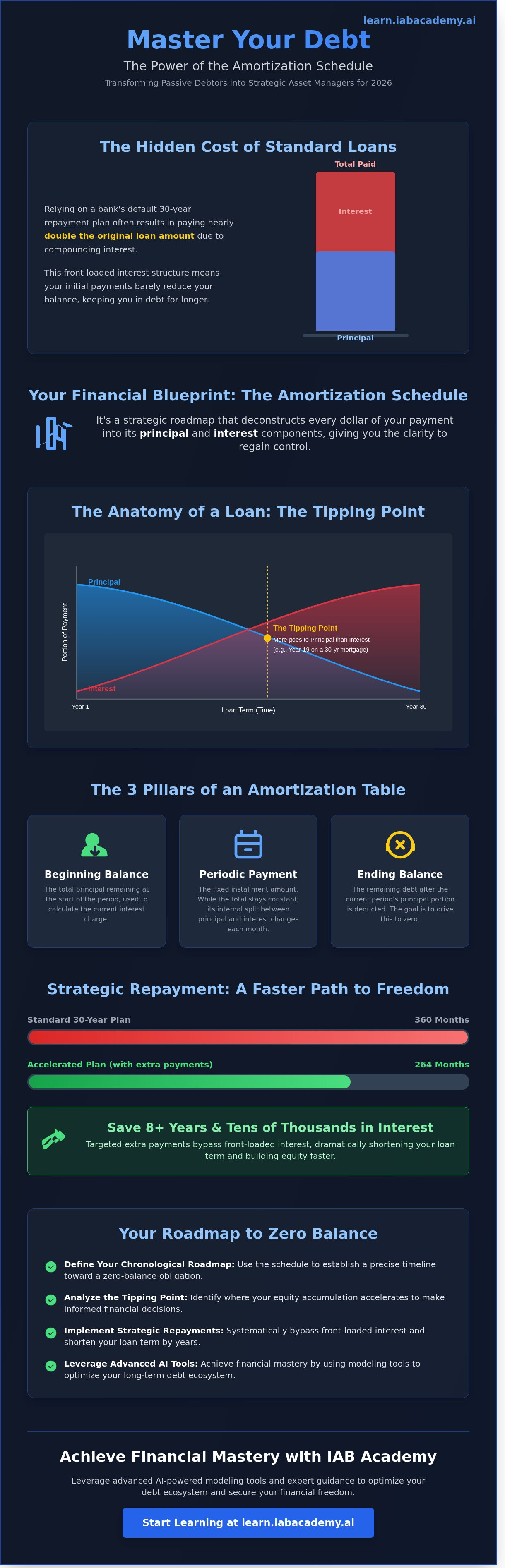
The standard monthly payment is not a fixed destiny; it's a strategic variable that most borrowers fail to optimize. Relying on a bank's default repayment plan often results in paying double the original loan amount over a 30-year term due to compound interest. To regain control, you must master the amortization schedule, a technical blueprint that deconstructs every dollar into principal and interest components. This document is the definitive tool for anyone seeking to transition from a passive debtor to a strategic asset manager in the 2026 financial ecosystem.
You likely recognize the frustration of seeing a balance barely move despite consistent monthly contributions. This curriculum provides the instructional framework needed to interpret any loan table and identify the exact date you'll achieve zero balance. This guide outlines how to utilize your data to execute targeted extra payments, effectively future-proofing your wealth by minimizing total interest costs and securing your financial freedom. You'll gain mastery over debt mechanics through a disciplined, modular approach to repayment strategy.
Key Takeaways
- Define the mechanics of systematic debt liquidation to establish a precise chronological roadmap toward a zero-balance obligation.
- Analyze the distribution between principal and interest to identify the critical tipping point where your equity accumulation accelerates.
- Implement strategic repayment techniques using an amortization schedule to bypass front-loaded interest and shorten your loan term by years.
- Leverage advanced AI-powered modeling tools and expert guidance to achieve financial mastery and optimize your long-term debt ecosystem.
What Is an Amortization Schedule? The Blueprint of Debt Repayment
Amortization represents the systematic liquidation of a debt over a predetermined period through regular installments. It isn't merely a repayment plan; it's a mathematical certainty that ensures a loan balance reaches zero by the final maturity date. An amortization schedule functions as a comprehensive chronological table, detailing every individual payment throughout the life of the loan. This document serves as a strategic roadmap for both lenders and borrowers, providing total transparency regarding how much of each dollar goes toward interest versus principal reduction.
The structure of the schedule is dictated by the time-value of money. In the 2026 financial environment, where interest rate volatility requires precise cash flow forecasting, this table allows professionals to visualize the shifting ratio of their payments. During the initial stages of a 360-month mortgage or a 60-month equipment loan, interest costs are at their peak because the outstanding principal is at its highest. As the principal decreases, the interest portion of the fixed payment shrinks, accelerating the pace of equity build-up in the later stages of the term.
Mastering this document is the primary foundation of finance literacy. It empowers decision-makers to evaluate the true cost of borrowing and determine the impact of making additional principal payments. Without a clear amortization schedule, debt management becomes a reactive process rather than a disciplined strategy for wealth preservation and capital allocation.
Amortization vs. Depreciation: Clearing the Confusion
Amortization and depreciation both involve spreading costs over time, but they apply to different asset classes. Amortization focuses on intangible assets, such as patents and trademarks, or the repayment of financial liabilities like bank loans. Depreciation applies specifically to physical, tangible assets like machinery, fleet vehicles, or office buildings. For business owners, the accounting distinction is that amortization recovers the cost of an intangible asset or loan, while depreciation accounts for the physical wear and tear of a tangible asset.
The Three Pillars of an Amortization Table
- The Beginning Balance: This is the total amount of principal remaining at the start of the period. It's the figure used to calculate the interest charge for that specific month or quarter.
- The Periodic Payment: This is the fixed amount due every period. While the total payment remains constant, the internal distribution between interest and principal shifts with every installment.
- The Ending Balance: This represents the remaining debt after the current period’s principal portion has been deducted. It's the target that eventually hits zero, signaling the total discharge of the debt.
The Anatomy of Amortization: Principal, Interest, and the Tipping Point
Every installment in an amortization schedule functions as a dual-purpose allocation. It satisfies the cost of borrowing while simultaneously building equity. In the 2026 financial ecosystem, understanding this split is essential for long-term fiscal health. The what is apr guide explains how the annual percentage rate dictates the steepness of your interest curve. A higher APR means interest consumes a larger portion of the payment for a longer duration. This creates a "front-loaded" effect where the lender's profit is prioritized in the early stages of the loan lifecycle.
The "Tipping Point" represents the specific month where the principal portion finally exceeds the interest portion. For a standard 30-year fixed mortgage at a 6.5% interest rate, this milestone often doesn't occur until year 19. Visualizing this crossover helps professionals master their debt strategy rather than merely reacting to monthly bills. It transforms a passive payment into a calculated step toward asset ownership.
Why Interest Dominates the Early Years
Interest charges aren't arbitrary. They're the direct result of a transparent mathematical formula: (Remaining Balance x Interest Rate) / 12 months. Because your initial balance is at its peak during month one, the interest charge is naturally at its highest. It's a matter of simple arithmetic, not a hidden fee or a "scam" by the institution. High initial balances generate high interest expenses, which is why early payments feel like they're barely moving the needle on the total debt. As the balance decreases, the interest obligation drops in tandem.
Calculating the Principal Reduction
The formula for equity growth is straightforward: Total Monthly Payment - Monthly Interest = Principal Paid. Every dollar directed toward the principal reduces the base upon which next month's interest is calculated. This creates a powerful compounding effect. As the balance drops, the interest charge shrinks, allowing a larger slice of the fixed payment to attack the remaining debt. Professionals who understand this mechanism often use strategic overpayments to accelerate the amortization schedule and bypass years of interest. This discipline ensures that more of your capital works for your net worth rather than the lender's bottom line.
To refine your financial modeling skills and achieve industry-recognized mastery, consider exploring our curriculum at learn.iabacademy.ai.
Types of Amortized Loans: From Mortgages to Personal Credit
The structure of a debt obligation is defined by its repayment logic. Fixed-rate loans utilize a static amortization schedule where the interest and principal portions are calculated at the outset. Conversely, adjustable-rate mortgages (ARMs) feature schedules that shift periodically based on index fluctuations such as the Secured Overnight Financing Rate (SOFR). While most installment loans follow these patterns, revolving credit like credit cards does not. These accounts require a minimum payment that often barely covers interest, preventing the systematic principal reduction found in structured loans. Balloon payment loans present another variation; they follow a traditional schedule for a set period before requiring the remaining balance in one final, substantial sum.
Mortgage Amortization: The 30-Year Journey
A 30-year mortgage is heavily front-loaded with interest. During the first 120 months, a borrower's equity grows at a marginal rate because the bulk of each payment services the debt cost. In contrast, a 15-year term accelerates equity build-up and reduces total interest expense by approximately 60 percent over the life of the loan. Real estate obligations also involve escrow accounts for property taxes and homeowner insurance. These variables fluctuate annually, which can alter the total monthly outflow. Consequently, a comprehensive strategy for how to make a budget must account for these potential payment shifts to maintain long-term solvency.
Auto and Personal Loans: Shorter Cycles, Faster Equity
Auto loans typically span 60 to 72 months, representing a much faster cycle than residential debt. The primary risk here is negative equity. Because vehicles are depreciating assets, they often lose value faster than the amortization schedule reduces the principal. This "underwater" status is particularly common in the first 24 months of a high-interest loan. Borrowers must distinguish between two interest calculation methods to manage this risk effectively:
- Simple Interest: Interest is calculated based on the daily balance. This structure benefits those who make payments before the due date.
- Pre-computed Interest: The total interest is calculated at the start and integrated into the loan. This makes early repayment less financially advantageous for the borrower.
Personal loans usually mirror the simple interest structure. They offer a predictable path to debt elimination within three to five years, provided the borrower adheres to the original timeline without taking on additional high-interest debt.
Strategic Debt Management: Using Your Schedule to Save Thousands
Mastery of debt requires more than passive observation. An amortization schedule serves as a tactical map to identify where interest costs are heaviest. By directing principal-only payments during the early stages of a loan, you effectively dismantle the interest curve before it compounds. This intervention is critical because interest is front-loaded. In a standard 30-year fixed mortgage, nearly 70% of your initial payments may be allocated to interest rather than equity. Disrupting this ratio early on delivers the highest return on investment.
- Principal-Only Payments: These bypass the scheduled interest calculation, immediately reducing the balance that future interest is based upon.
- The 13th Payment Rule: Making one extra full payment each year can reduce a 30-year mortgage term by approximately 4.5 to 5 years, depending on the interest rate.
- Loan Recasting: Unlike refinancing, recasting involves paying a lump sum (typically $5,000 or more) toward the principal. The lender then re-amortizes the remaining balance, lowering your monthly obligation without changing the original interest rate or term.
The Accelerated Repayment Strategy
Early intervention is the most effective way to save. Consider a $400,000 loan at a 6.5% interest rate. A single extra payment of $100 in month 1 of your amortization schedule saves approximately $685 in total interest over the life of the loan. However, making that same $100 payment in month 120 saves only about $320. The math is clear: Time is either your greatest expense or your greatest asset. Prioritizing early principal reduction maximizes your long-term capital efficiency.
Analyzing Refinance Opportunities
Determining the optimal time to refinance requires a granular comparison of your current schedule against a proposed one. You must identify the break-even point by dividing the total closing costs, which typically range from 2% to 5% of the loan amount, by the monthly savings. If closing costs are $6,000 and you save $200 monthly, your break-even point is 30 months. If you plan to exit the property before month 30, the refinance is a net loss. Always audit the new amortization schedule for "resetting the clock" risks, where a lower rate on a new 30-year term might actually increase total interest paid compared to finishing a 20-year remaining balance.
Professional financial management requires precision and data-driven decision-making. Master strategic financial modeling with IAB Academy to future-proof your career and capital.
Mastering Financial Literacy with IAB Academy’s AI-Powered Tools
Artificial intelligence has transformed static financial data into actionable strategic intelligence. At IAB Academy, we utilize advanced neural networks to decode complex financial models that once required hours of manual calculation. Our Smart Instructor™ provides real-time analysis of your amortization schedule, ensuring you understand the precise destination of every dollar. This tool doesn't merely display numbers; it explains the underlying mechanics of interest accrual and principal reduction as they happen. Technical mastery over your liabilities is the non-negotiable foundation for building a robust investment portfolio. Our financial literacy curriculum bridges the gap between debt management and wealth creation by treating interest as a controllable variable rather than an inevitable cost of living.
AI-Enhanced Financial Education
IAB Academy leverages proprietary algorithms to tailor learning modules to your specific proficiency level. New investors don't follow a generic path. They follow a data-driven roadmap that adapts to their pace and performance. Our platform offers support in 130 languages to ensure global financial standards remain accessible to every demographic. This inclusivity eliminates the linguistic barriers that often gatekeep high-level financial concepts. By utilizing AI, we provide instant clarity on global compliance and tax implications across different jurisdictions.
- Personalized risk assessment based on behavioral data.
- Real-time feedback loops during complex financial modeling.
- Global compliance training for diverse international markets.
Mastery of these concepts is essential for long-term stability. Join the Teen Academy or our Novice Investor Curriculum to secure your financial future through verified expertise.
From Debt Mastery to AI Investing
Understanding cash flow requires total control over existing liabilities. It's impossible to maximize market returns while losing significant capital to unmanaged interest. Once you master the mechanics of your amortization schedule, you can pivot that capital toward high-yield assets. We guide learners through the critical transition from saving interest to earning dividends. This shift represents the move from a defensive financial posture to an offensive, growth-oriented strategy. Our curriculum treats debt as a tool to be optimized, not a burden to be feared. By applying AI-driven insights to your personal balance sheet, you establish the liquidity needed for programmatic investing and stock market participation. This disciplined approach ensures your capital works for you, rather than for your creditors.
Enroll in our AI-Powered Investing Education today to transform your economic trajectory and achieve professional-grade financial excellence.
Mastering Your Financial Architecture in 2026
Navigating the complex debt landscape of 2026 requires more than just making monthly payments; it demands a technical mastery of your financial obligations. By dissecting the anatomy of your amortization schedule, you gain the ability to pinpoint the exact tipping point where principal reduction accelerates. This strategic insight allows you to deploy capital effectively, potentially saving significant interest expenses over the life of a 30 year mortgage or a 60 month personal loan. Financial literacy isn't a static skill. It's a continuous evolution in a market driven by algorithmic precision.
IAB Academy provides the definitive framework for this professional advancement. Our platform offers a comprehensive curriculum that bridges the gap between basic literacy and advanced AI-powered trading strategies. You'll benefit from our Smart Instructor™, an AI-powered tool providing guidance in over 130 languages. With lifetime access to all educational modules, you can ensure your expertise remains current as global standards shift. Secure your professional future by integrating these sophisticated tools into your daily financial practice.
Start Your Journey to Financial Mastery with IAB Academy
Your path to fiscal excellence begins with the right technical foundation.
Frequently Asked Questions
Is an amortization schedule the same as a payment plan?
No. While a payment plan is a general agreement to settle a debt, an amortization schedule is a precise mathematical document detailing the exact allocation of every dollar toward principal and interest. According to the Consumer Financial Protection Bureau (CFPB), these schedules provide a transparent roadmap for the entire loan term. They ensure that the debt reaches a zero balance by a specific maturity date through structured installments.
How do extra payments affect my amortization schedule?
Extra payments accelerate principal reduction, which immediately recalculates the interest charges for all subsequent periods in the cycle. By applying an additional $500 to a standard mortgage principal, a borrower can effectively shorten the loan term by several years. A 2023 study by the Federal Reserve indicates that consistent principal-only payments significantly reduce total interest expense over the lifecycle of a 30-year fixed-rate loan.
Can I create my own amortization schedule in Excel or Google Sheets?
Yes, you can build a custom amortization schedule using the PMT and IPMT functions within standard spreadsheet software. These technical tools allow for granular tracking of debt trajectories and strategic scenario modeling for financial planning. Microsoft Excel provides pre-built templates that utilize standardized financial formulas to ensure 100% accuracy in interest calculations and principal tracking for diverse loan types across the global ecosystem.
Does a 15-year mortgage have the same amortization structure as a 30-year?
No, the mathematical progression differs because a 15-year mortgage requires a higher percentage of the monthly payment to be applied to the principal from the first installment. On a $300,000 loan at 6% interest, the 15-year schedule allocates approximately 45% to principal in month one. In contrast, a 30-year term allocates only 18% to principal initially, resulting in much slower equity accumulation for the borrower.
What happens to the schedule if I have an adjustable-rate mortgage (ARM)?
The schedule resets whenever the interest rate adjusts based on its underlying index, such as the Secured Overnight Financing Rate (SOFR). This causes the remaining balance to be re-amortized over the remaining months of the loan's life. Most ARM contracts include a 2/2/5 cap structure that limits how much the payment can shift during these adjustment periods to maintain a level of financial stability and compliance.
Why does the interest amount change every month even if my payment stays the same?
Interest is calculated based on the current outstanding balance, which decreases every time you make a successful principal payment. As the balance drops, the interest portion of the fixed payment shrinks while the principal portion grows proportionally. This inverse relationship is the core mechanic of a standard fixed-rate amortization schedule, ensuring the loan reaches a zero balance by the designated maturity date without requiring payment increases.
Are credit cards considered amortized loans?
No, credit cards are revolving credit lines and don't follow a fixed amortization schedule unless they're converted into a formal structured repayment plan. They use daily balance methods to calculate interest, which can fluctuate based on new purchases and payment timing. The Federal Reserve's G.19 report shows that revolving debt lacks the terminal date and predictable principal reduction found in standard installment loans.
What is negative amortization and is it dangerous?
Negative amortization occurs when the monthly payment is less than the interest due, causing the total loan balance to increase rather than decrease over time. It's a high-risk financial state that often leads to upside-down loans where the borrower owes more than the asset's value. The 2008 financial crisis highlighted the dangers of these products, leading to the Dodd-Frank Act's 2010 restrictions on specific negative-amortizing loan types.
